Behaviour · Cat · 06 Jul 2026
Cats Are Experts at Hiding Illness. Here's How to Read Them
By Burrow · 06 Jul 2026
TL;DR
- Cats instinctively hide pain and illness, a survival trait, so problems are often noticed late.
- The most reliable signal isn't any one symptom but a change from your cat's normal: in hiding, grooming, appetite, movement or mood.
- Some conditions are especially quiet. Cats with heart trouble rarely cough; they simply move less.
- Resting respiratory rate (breaths per minute while asleep) is one sign a cat can't hide. Consistently over ~30 warrants a vet call.
- New 2026 research offers a validated way to assess feline quality of life, reinforcing how much of a cat's wellbeing is easy to miss.
- Annual checks (twice-yearly for seniors) catch what home observation can't.
If you've ever felt your cat was fine right up until, suddenly, they very much weren't, you're not a careless owner. You're up against one of the most effective survival instincts in any pet. Cats are built to hide illness, and they're extremely good at it, which is precisely why feline problems are so often caught late.
New research is starting to change that. In July 2026, scientists at the Waltham Petcare Science Institute, working with Mars Veterinary Health, Royal Canin and the University of Bristol, published a scientifically validated tool for assessing a cat's quality of life, built from the responses of more than 1,300 cat owners. Its whole purpose is to give a clearer read on a cat's physical and emotional wellbeing, precisely because, as the researchers put it, cats so often mask their discomfort. This piece is about that masking: why cats do it, what to look for anyway, and what the new science adds.
Why cats hide it
The instinct traces back to how cats live in the wild. They're what biologists call mid-ranking predators: hunters themselves, but also prey to larger animals. A wild cat that limped, breathed heavily or otherwise looked weak advertised itself as an easy target, and risked losing its territory too. So natural selection favoured cats that could carry on as normal while quietly unwell.
Domestic cats have kept the instinct wholesale. It's why, as vets often note, a cat can purr in the consulting room while running a fever: purring is partly a self-soothing behaviour, not only a sign of contentment. And it's a real contrast with dogs, which evolved as pack animals that signal distress to the group. A cat has no pack coming to help, so its strategy is to power through and reveal nothing. Understanding that changes how you watch them: you're not waiting for an obvious symptom, you're watching for a break in the performance.
The signal that matters most: change
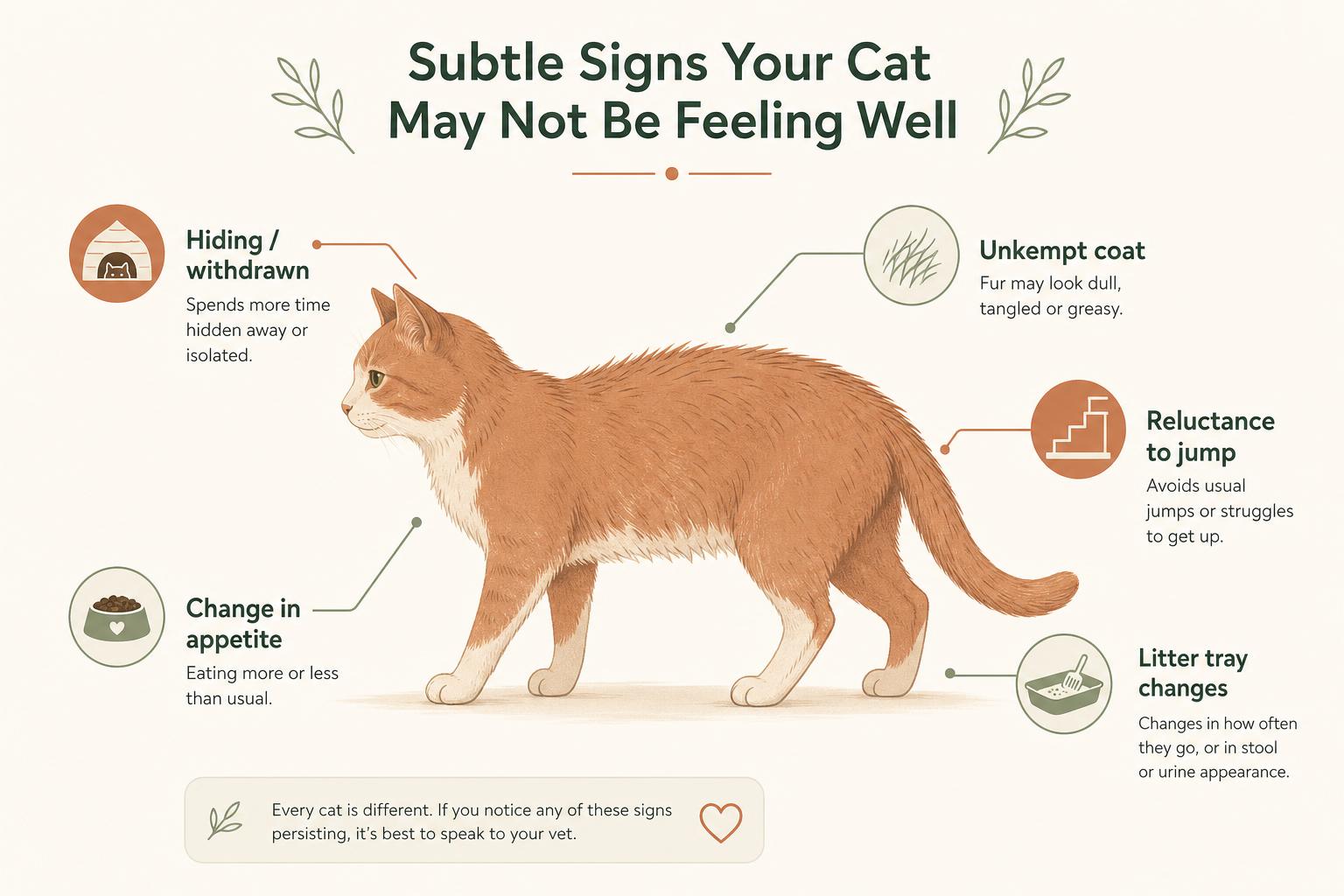
Because cats mask specific symptoms so well, the single most useful thing to track isn't any individual sign. It's change from your particular cat's normal. A cat that suddenly hides more, or sleeps in odd new places, or stops greeting you, is telling you something even if nothing looks acutely wrong.
The changes worth noticing tend to cluster in a few areas:
- Behaviour and mood: hiding more than usual, becoming withdrawn or unusually clingy, less interested in play or company. In early illness, "quiet and withdrawn" is often the only sign there is.
- Grooming: a normally sleek cat looking unkempt or greasy can mean they feel too unwell to groom. Conversely, over-grooming one spot until it thins can flag pain or irritation there.
- Movement: hesitating before jumping, no longer taking a favourite high perch, stiffness after rest, or a hunched, tucked posture.
- Appetite and thirst: eating noticeably more or less, or drinking much more than usual, all of which are worth a vet's attention.
- Litter tray: changes in how often, straining, or going outside the tray.
None of these is a diagnosis. Any of them, especially if it persists past a day or two or arrives with something else, is a reason to pick up the phone.
The conditions that hide best
Some problems are especially good at staying hidden, which makes them worth knowing about specifically. In older cats in particular, screening can find disease long before it looks like illness.
Joint disease is far more common than most owners realise. Studies estimate that around 60% of cats aged six and over have some degree of degenerative joint disease, yet cats rarely limp or cry out. Instead they simply do less: fewer jumps, more time settled, a favourite windowsill quietly abandoned. It's easy to write off as "getting older" when it may be treatable discomfort.
Heart disease is perhaps the most deceptive of all. Unlike dogs, cats with failing hearts rarely cough. They just move less and slow down, so the problem can go unnoticed until a sudden crisis. This is where one particular home measurement earns its keep.
The one sign a cat can't hide
For all a cat's skill at masking, there's a physiological signal they can't consciously control: how fast they breathe at rest. A cat's resting respiratory rate, counted while they're genuinely relaxed or asleep, should be slow and steady. Count the breaths (each rise and fall of the chest is one) over a minute. For most healthy cats this sits comfortably below 30.
A resting rate that consistently climbs above about 30 breaths per minute can be an early warning that the heart or lungs are struggling, sometimes days or weeks before an obvious emergency. It's especially worth tracking for cats with a known heart murmur or thyroid condition, and it's simple to do at home. If your cat's resting rate is persistently elevated, that's a same-day vet conversation. (Dog owners: the equivalent quick home check is gum colour.)
Where the new research fits
The 2026 quality-of-life tool matters because it formalises exactly this problem. By drawing on structured owner observations across physical and emotional wellbeing, a validated questionnaire gives vets a more reliable read on how a cat is actually doing, rather than relying on a stoic animal to reveal it in a ten-minute consultation. For owners, the underlying message is the useful part: your everyday observations are genuinely valuable data. You see your cat across a whole week, in ways the vet never can, and learning to notice and describe subtle change is one of the most useful things you can do for a naturally secretive animal.
The Bottom Line
Cats hide illness because their ancestors had to, and they're remarkably good at it, so the job of the owner is to watch for the break in the act rather than the obvious symptom. Learn your cat's normal, and treat changes in hiding, grooming, movement, appetite or mood as information worth acting on. Track resting breathing for at-risk cats, keep up annual checks (twice-yearly once they're seniors), and trust your sense that something's off even when you can't name it. With cats, quiet is not the same as fine.
This is a general guide and isn't a substitute for veterinary care. If you think your cat may be unwell or in pain, however subtle the signs, contact your vet.
Related reading: The Cat Behaviour Guide
Common questions
Frequently asked.
Keep reading
Further reading.
Want practical notes like this in your inbox? Join The Once-Over, our weekly note from Hazel.