Cat · All · Routine
The Cat Behaviour Guide
Published 11 Sept 2026 · ✓ Researched
TL;DR
- Three explanations cover most problem behaviour: normal behaviour with nowhere appropriate to happen, a response to the cat's environment or social situation, or an underlying medical problem.
- Rule out medical causes first. Pain, urinary disease, hyperthyroidism, dental disease and cognitive decline can all present as behaviour change.
- The Five Pillars — safe places, separated resources, play and predatory outlets, positive human interaction, and respect for scent — cover almost everything a cat needs environmentally.
- Read the whole cat, not individual signals. Posture, ears, eyes and tail together, in context.
- Litter tray provision is an area many owners receive surprisingly little guidance on, and one of the most common causes of house soiling.
- Punishment doesn't address the underlying motivation and can increase fear, anxiety and conflict.
- Inter-cat tension can be remarkably subtle — staring, blocking, one cat quietly avoiding areas — rather than open fighting.
Most of what gets called a cat behaviour problem is normal cat behaviour happening somewhere inconvenient, a response to something in the environment, or a medical problem presenting as behaviour. Very little of it is the cat being difficult.
Cats are routinely misread, largely because we interpret them through the wrong lens. Dog behaviour thinking doesn't transfer well, and human emotional reasoning transfers less well still. The result is a set of beliefs — that a cat urinating on the bed is making a point, that a cat who hides is sulking, that a cat scratching the sofa knows it shouldn't — which lead owners towards responses that tend to make things worse.
Research has linked these misconceptions directly to welfare problems: too few resources, little enrichment, forced interactions, and the use of punishment. None of that comes from a lack of care. It comes from misreading the animal.
This guide is built around one organising idea. When a cat does something you'd rather it didn't, there are three likely explanations — and working out which one you're looking at determines everything that follows.
The three explanations
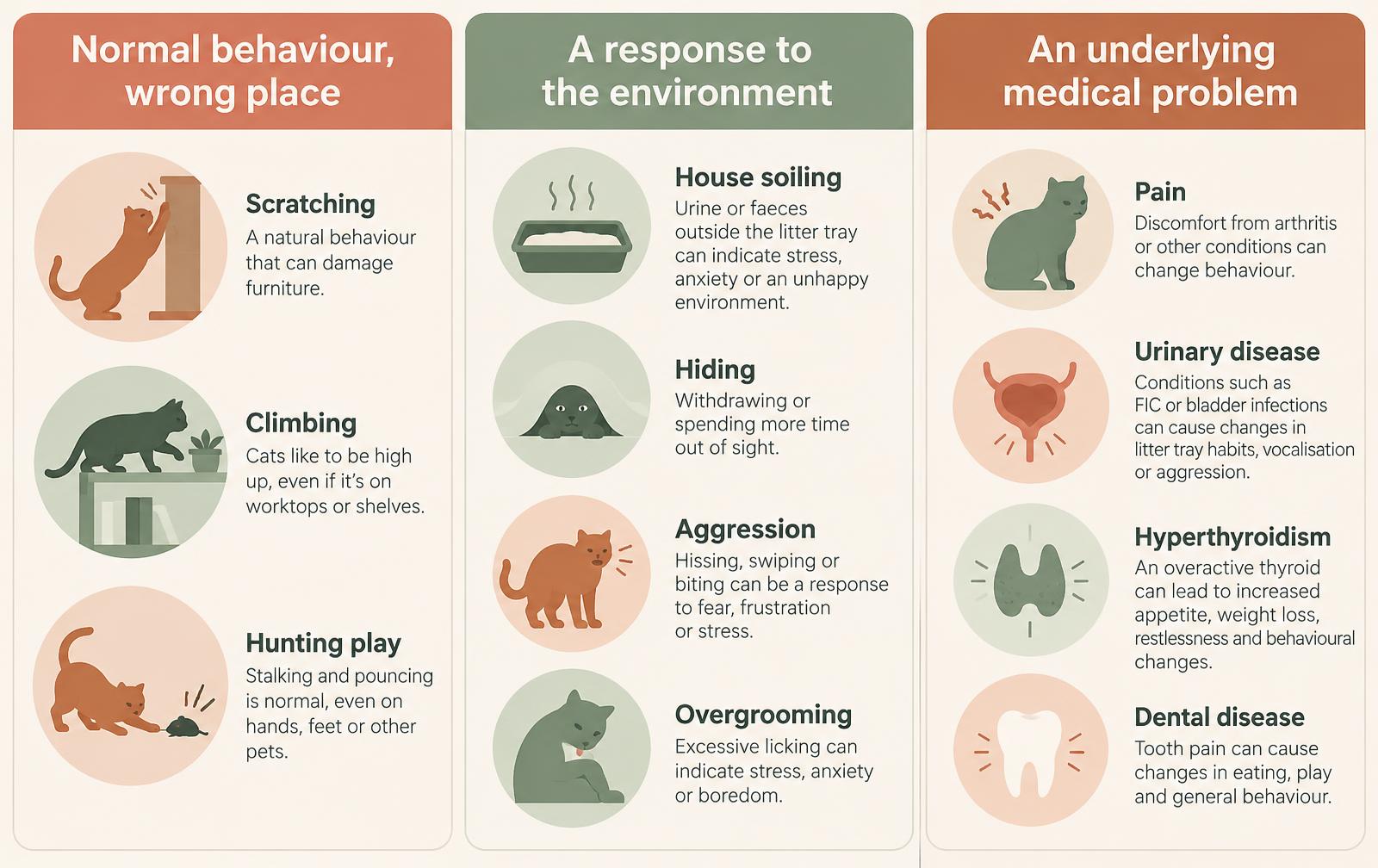
Almost every behaviour an owner finds problematic falls into one of three categories.
Normal behaviour with nowhere appropriate to happen. Scratching is the clearest example, and one of the most commonly reported problem behaviours in UK households. Cats scratch to maintain claws, stretch, and leave visual and scent marks. It isn't optional and it can't be trained away. A cat scratching the sofa is doing something entirely normal in the only place available to it.
A response to something in the environment or social situation. House soiling, spraying, hiding, overgrooming, aggression and increased vocalisation often sit here. These tend to signal that something isn't working — too few resources, resources in the wrong places, tension with another cat, a disrupted routine, or a change the cat hasn't adjusted to.
An underlying medical problem. This is the category most often missed, and the reason behaviour change warrants a veterinary conversation before it's treated as purely behavioural.
Rule out medical causes first
Cats conceal illness and discomfort effectively, and the early signs are frequently behavioural rather than physical.
Cats with joint pain often don't show the obvious limping owners expect — they stop jumping onto the worktop, choose lower surfaces, or groom certain areas less thoroughly. Cats can continue eating despite significant dental disease, though some do reduce their food intake; what's more telling is chewing on one side or a new preference for softer food. Feline idiopathic cystitis and other urinary tract disease cause litter tray avoidance, because the cat associates the tray with discomfort. Hyperthyroidism can produce restlessness and increased vocalisation. Cognitive dysfunction in older cats causes disorientation, altered sleep and night-time vocalising.
The practical rule: a new or persistent behavioural change — particularly in an older cat, or when accompanied by changes in eating, drinking, toileting or mobility — deserves veterinary attention before it's approached as a behaviour problem.
The Five Pillars
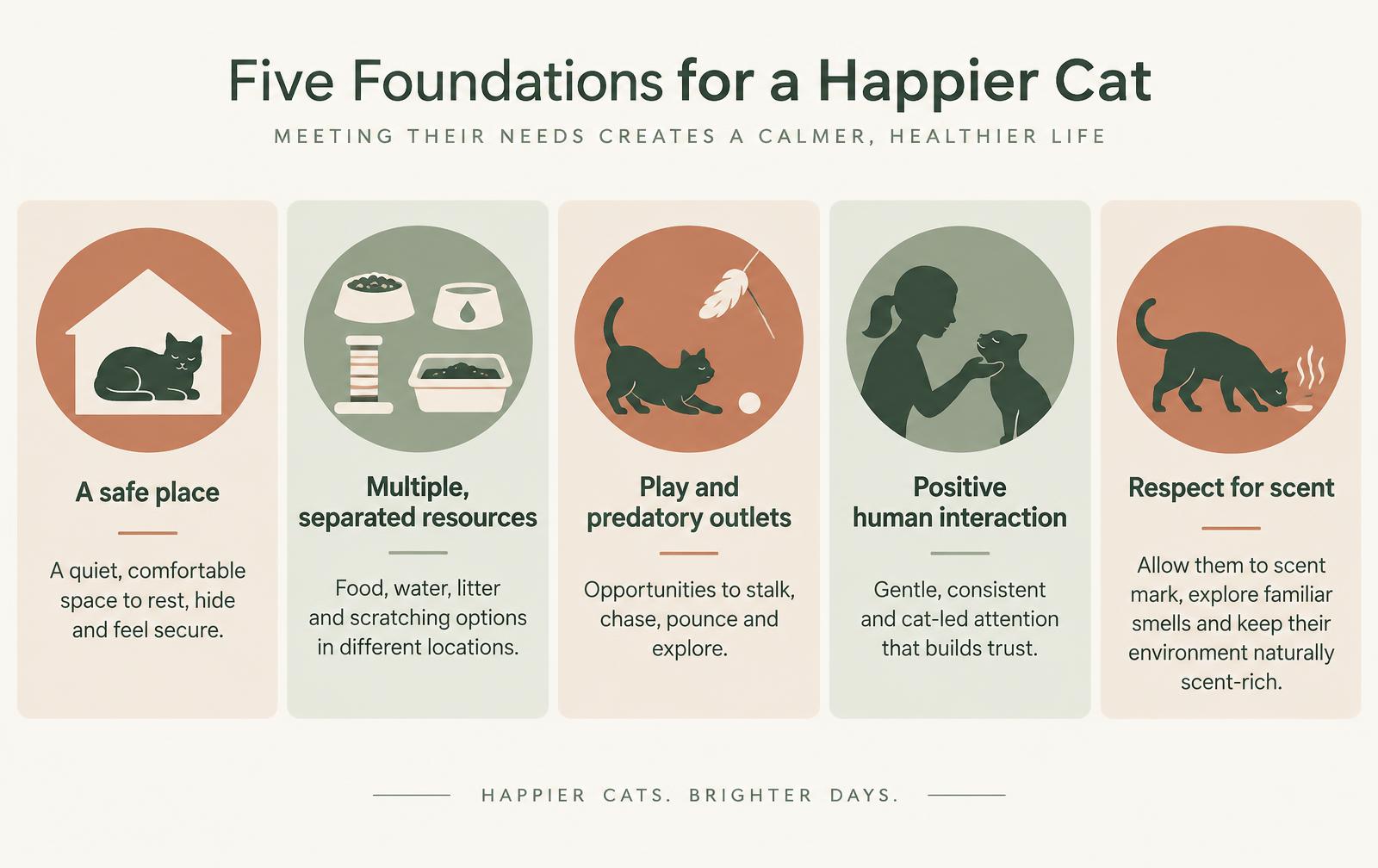
The framework used in feline medicine to describe what cats need environmentally comes from the AAFP and International Cat Care. Most environmental behaviour problems trace back to one of these five being inadequately met.
A safe place. Somewhere each cat can retreat to and feel secure, typically elevated, enclosed, or both. In multi-cat homes, each cat needs its own, reachable without passing another cat it might want to avoid.
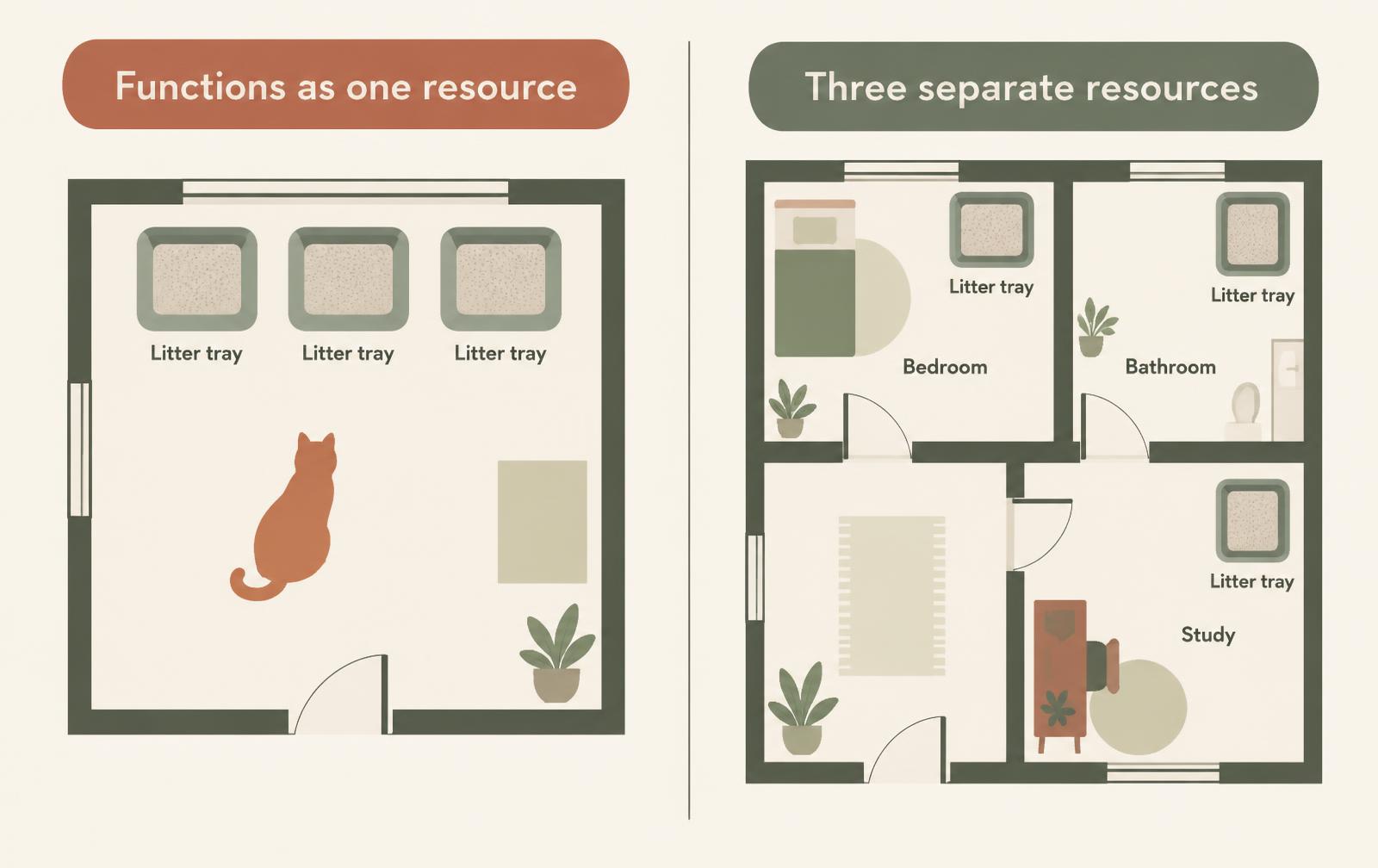
Multiple and separated key resources. Food, water, litter trays, scratching posts, resting places, toys. The important words are multiple and separated — two food bowls side by side function as one resource, because a cat controlling that spot controls both.
Opportunity for play and predatory behaviour. Hunting-type activity is a behavioural need rather than entertainment. A cat with no outlet becomes frustrated, and frustration shows up as overactivity, attention-seeking, night disturbance or aggression.
Positive, consistent and predictable human interaction. Cats are selectively social. Most prefer to initiate contact, prefer short frequent interactions to long ones, and have strong preferences about where they're touched. Consistency matters as much as quantity.
An environment that respects the cat's sense of smell. Cats orient and feel secure through scent. Strong cleaning products, scented litter, air fresheners and washing away a cat's own scent marks all disrupt that.
Read the whole cat
Cat body language is often presented as a set of translations — this tail position means that, this ear position means the other. It's more useful to read posture, ears, eyes and tail together, and always in context. The same tail position means different things in a cat who has just seen a visitor and a cat who has just seen next door's tom through the window.
Broadly: a relaxed cat is loose-bodied and unhurried. A cat that becomes still, crouched and compact may be anxious, fearful or trying to avoid attention. Ears rotating back or flattening, pupils widening in normal light, and a tail that has started thrashing or thumping all suggest rising arousal — and in cats a swishing tail signals the opposite of what it does in dogs, which is a common route to being scratched.
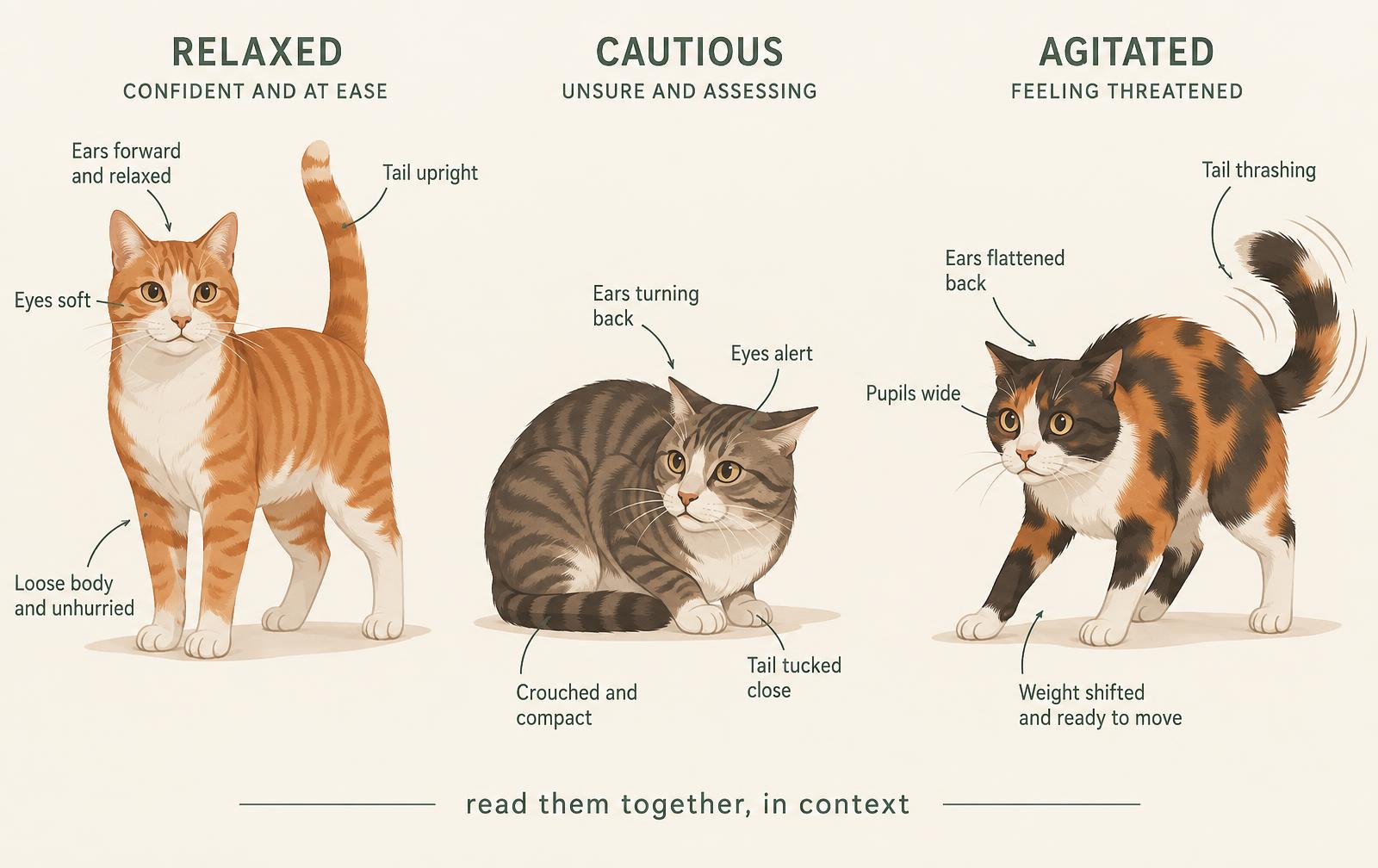
The most useful thing to learn is your own cat's petting threshold. Many cats enjoy being stroked up to a point and then abruptly don't. The signals usually arrive before the swipe: tail twitching, skin rippling along the back, ears turning, a pause in purring, the head turning towards your hand. Owners who learn to stop at the first of these avoid almost all petting-related aggression.
Common problems and what they usually mean
Scratching furniture
The solution is redirection, not prevention. Scratching posts need to be tall enough for a full stretch, sturdy enough not to wobble, and — the part most attempts get wrong — located where the cat actually wants to scratch. A post in the spare room doesn't compete with the arm of the sofa by the door. Cats scratch at entry points, near where they sleep, and in socially significant places. Put the post there rather than where it looks tidiest.
Individual cats also have preferences for orientation and material. Some prefer vertical, some horizontal; sisal, cardboard and carpet suit different cats. If a cat ignores a post, the post is usually the problem.
Urinating or defecating outside the litter tray
See a vet first, every time. Urinary tract disease causes tray avoidance, and a cat straining to urinate, vocalising while urinating, passing blood, or making frequent unproductive attempts needs urgent attention — urethral obstruction in male cats is life-threatening.
Once medical causes are excluded, litter provision is the next place to look, and it's an area many owners receive surprisingly little guidance on. Survey research has found large proportions of owners whose cats had urinary problems or were soiling indoors had never received any advice on litter tray management.
What helps:
- More trays than cats. One per cat plus a spare is the standard rule of thumb, particularly in multi-cat homes.
- Separate locations. Three trays in a row function as one resource.
- Unscented litter, in a substrate the individual cat accepts. Cats have genuine substrate preferences, and a cat that stops using a tray after a litter change is telling you something.
- Enough depth to dig and cover properly.
- Large, accessible trays. An older or arthritic cat may struggle with high sides.
- Waste removed at least once daily. Cats avoid soiled trays, and infrequent cleaning is consistently associated with soiling elsewhere.
- Quiet locations away from food and water, away from noisy appliances, with more than one escape route.
Aggression
Aggression towards people or other pets is among the problem behaviours UK owners report most often. It nearly always has an identifiable cause.
Play aggression occurs in cats — often young, often single — with no appropriate outlet for predatory behaviour. Provide proper wand-toy play daily, and never use hands as toys.
Petting-induced aggression is the threshold problem above.
Redirected aggression confuses owners most. A cat becomes highly aroused by something it can't reach, typically a cat outside, then attacks whoever is nearest. The attack seems to come from nowhere; the trigger was minutes earlier and in another room. Reducing or blocking access to the trigger can help.
Fear aggression is defensive and happens when a cat feels cornered. Give more space and more escape routes, never press on.
Pain-related aggression is common and under-recognised. A cat that has become less tolerant of handling may be uncomfortable rather than grumpy.
Overgrooming
Fleas, allergies, skin disease and pain in the area being groomed all cause overgrooming, so a vet check comes first — and your vet may recommend appropriate flea control even when no fleas are visible.
Where it's behavioural, overgrooming is usually self-soothing in response to stress. The aim isn't to stop the grooming but to identify and address what's driving it, which the Five Pillars usually help locate.
Increased vocalisation
Frequently reported by UK owners. The first question is whether it has changed. A cat that has always been vocal is being itself. A previously quiet cat that has started yowling, particularly at night, particularly if older, needs a vet appointment — hyperthyroidism, hypertension, cognitive dysfunction and pain all increase vocalisation.
The 4am problem
Night-time activity is one of the most common complaints and one of the most misunderstood. Cats are often particularly active around dawn and dusk, so a cat becoming lively before sunrise is doing something quite natural.
It becomes a problem when the cat has nothing else to do with that energy, or when waking you has been inadvertently reinforced. Feeding a cat that wakes you teaches it that waking you produces food. Getting up to shout at it also teaches it that waking you produces attention.
What tends to help: a proper predatory play session in the evening, followed by a meal, so the cat's natural hunt-eat-groom-sleep pattern lands at a useful time. A timed feeder can break the link between you and breakfast entirely. Enrichment that works without you — puzzle feeders, a window perch, safe things to investigate — gives a cat something to do at 4am that isn't your face.
If night activity is new, particularly in an older cat, see a vet before treating it as a routine problem.
Hiding
Some hiding is normal and healthy. It becomes a concern when it's new, when it's most of the time, or when a cat has stopped emerging for things it previously enjoyed. New or increased hiding is a common early sign of both illness and stress — vet check first, then an honest look at what's changed.
Multi-cat households
Problem behaviours are reported more often in multi-cat homes. Cats can live together contentedly, but the requirements are higher and often unmet.
The most important thing to understand is that inter-cat tension can be remarkably subtle. Open fighting is obvious; chronic low-grade conflict isn't. It looks like one cat staring at another, blocking a doorway or the top of the stairs, or controlling access to a room — and the other cat quietly avoiding areas, eating less, or using a tray less often. That kind of resource avoidance has real health consequences, including reduced water intake and reduced litter tray use.
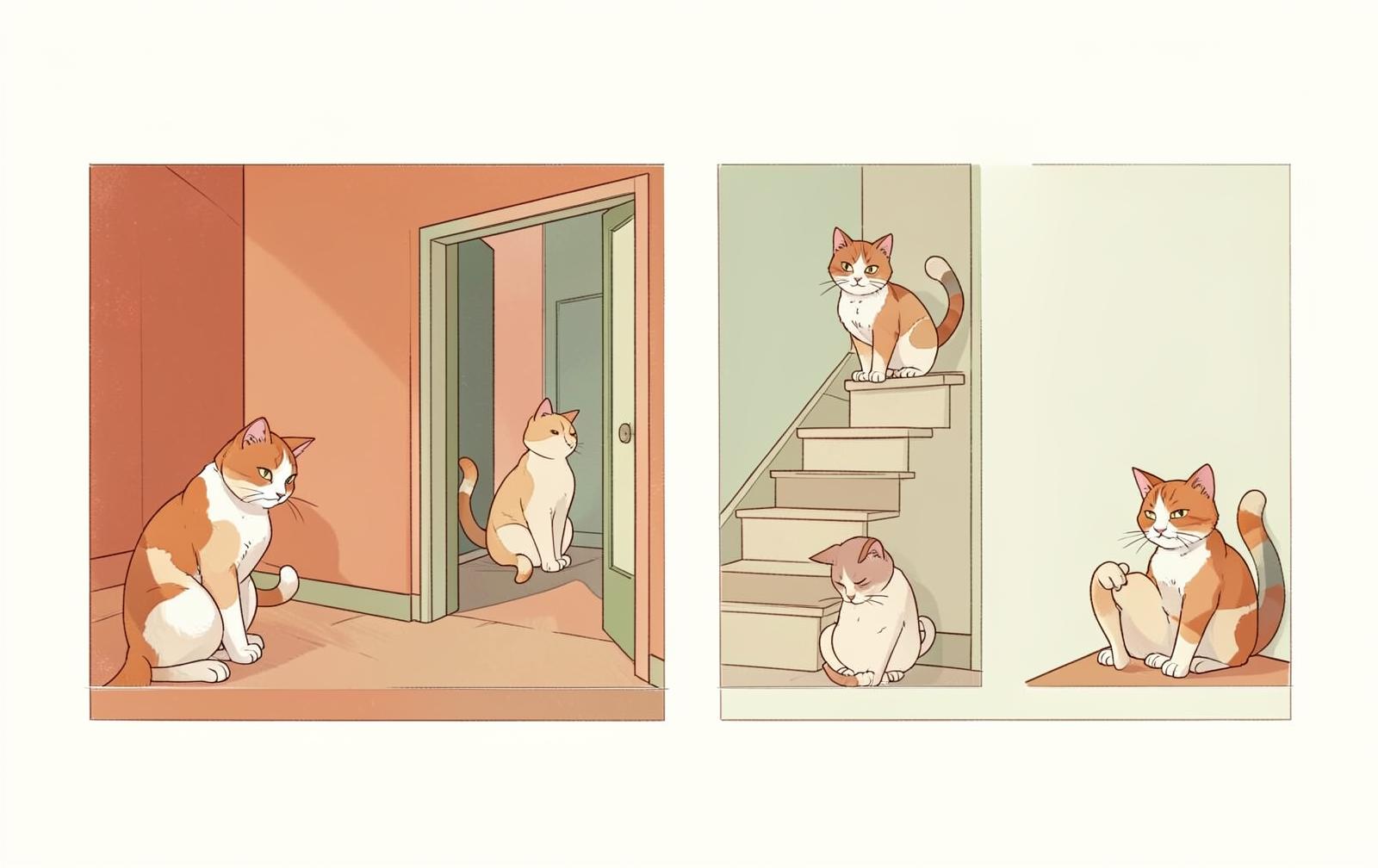
What helps: resources scaled and separated across the home, so no cat has to choose between a resource and avoiding another cat. Vertical space, since cats use height to manage social distance. And slow introductions for new cats — separate room, scent swapping, visual contact through a barrier, then supervised contact — because rushing this creates problems that take far longer to undo.
What not to do
Don't punish. Shouting, smacking, water sprays, scruffing and nose-rubbing don't address the underlying motivation, and can increase the fear, anxiety and conflict that drive most problem behaviour in the first place.
Don't assume spite. A cat urinating on your bed is more likely responding to your scent as a source of security while stressed, or to a medical problem, than expressing displeasure.
Don't remove resources as a solution. Taking away an avoided litter tray, or blocking a hiding place, removes options rather than addressing causes.
Don't force interaction. Picking up a cat that doesn't want to be held teaches it that human contact is unpredictable.
When to get professional help
See your vet for any behaviour change that is new, persistent, or accompanied by physical signs — and urgently for any cat with urinary difficulty.
Ask about referral to a qualified clinical animal behaviourist if the problem persists once medical causes are excluded and environmental changes have been made, if there is aggression causing injury, if a multi-cat household has entrenched conflict, or if you're beginning to consider rehoming. Behaviour referral is more effective than most owners expect and is sought less often than it should be.
Try this today
Walk through your home at cat height. Sit down on the floor in each room your cat uses and look around from there. Can it get somewhere elevated? Can it reach a safe refuge without crossing another cat's path, or passing the washing machine, or going through the busiest part of the house? Where are the food, water and litter trays in relation to each other?
Then count your litter trays and where they are. If you have two cats and two trays, or three trays in the same room, you've found something worth changing before you change anything else.
Those two checks address the environmental failures most commonly behind feline behaviour problems, and both are fixable this week.
The Bottom Line
The most useful shift is to stop asking why a cat is behaving badly and start asking what the behaviour is a reasonable response to. Scratching is normal. House soiling is a signal. Aggression has a cause. Hiding means something.
Rule out medical causes first. Then work through the Five Pillars — safe places, separated resources, predatory outlets, consistent interaction on the cat's terms, and an environment that respects its sense of smell. Most behaviour problems improve when the environment stops asking the cat to be something it isn't.
And if it doesn't improve, ask about referral. These problems are more solvable than most owners realise.
Guides on Burrow are researched carefully and written to be genuinely useful, but they aren't a substitute for veterinary advice. A new or persistent behaviour change in a cat warrants a veterinary assessment. If your cat is straining to urinate or unable to pass urine, seek veterinary help immediately — this is an emergency.
Related reading: Can Cats Get Depressed? · Cats Are Experts at Hiding Illness · When Does a Cat Actually Start Getting Old? · The Fireworks Guide
Common questions