Dog & Cat & Small Pet · All · Seasonal
The Fireworks Guide
Published 27 Sept 2026 · ✓ Researched
TL;DR
- Don't try to cram months of desensitisation into six weeks. Recorded sounds need to remain below the level that causes fear and progress at the animal's pace.
- Build the safe place before it's needed, and let the animal choose where that is.
- The vet conversation should happen before the night, particularly if your pet was badly frightened last year.
- Two medicines are authorised for noise-related fear and anxiety in dogs in Great Britain, and imepitoin needs to be started two days before the expected event.
- Evidence for pheromones, calming supplements and pressure vests is considerably weaker than their marketing can suggest. None should be relied upon as the sole plan for severe fear.
- You don't need to ignore an animal that seeks reassurance. Let it hide if it wants to; stay available if it wants you.
- For an animal with established fear, manage this year's season and make the longer-term behaviour work the project for afterwards.
If your pet is frightened of fireworks, the weeks before Bonfire Night are primarily for preparation, not a race to cure an established fear. Here's what to do now, what can help on the night, when medication is worth discussing, and how to work on the underlying problem for next year.
There are two separate jobs here, and most firework advice muddles them together.
The first is protecting the animal you have through this year's firework season. The second is changing the underlying fear, which is slower behaviour work measured in weeks and months rather than a countdown to 5 November.
Confusing the two is how owners end up rushing through progressively louder firework recordings because November is approaching. Proper desensitisation works in almost the opposite way: the animal sets the pace.
Start here: don't race the calendar
One of the most common pieces of autumn pet advice is to start playing recordings of fireworks at low volume and gradually make them louder. The underlying idea is sound. The problem is what owners can understandably do with it when Bonfire Night is approaching.
Desensitisation involves exposing an animal to a version of a frightening stimulus at an intensity low enough that it doesn't trigger a fear response, then increasing the exposure gradually. Counterconditioning can run alongside it, pairing the sound with something the animal values. The crucial word is gradually.
There is published evidence that structured recorded-sound programmes can improve firework fear, including a study by Levine, Ramos and Mills which recruited 54 dogs for an eight-week training programme running from August to October. So it would be too strong to say that beginning sound work now is inherently harmful, or that no behaviour work should happen before November.
But six weeks isn't a deadline by which a fearful dog must learn to tolerate loud firework recordings. If the dog becomes worried, you've progressed too quickly. And real fireworks add something recordings can't control: unpredictable timing, intensity, direction, flashes and vibration.
So if your animal already has significant firework fear, don't turn the next few weeks into a race through progressively louder recordings. The immediate priorities are preparation, management and, where necessary, veterinary treatment. The underlying fear can be worked on properly over the longer term.
Work out how frightened your animal actually is
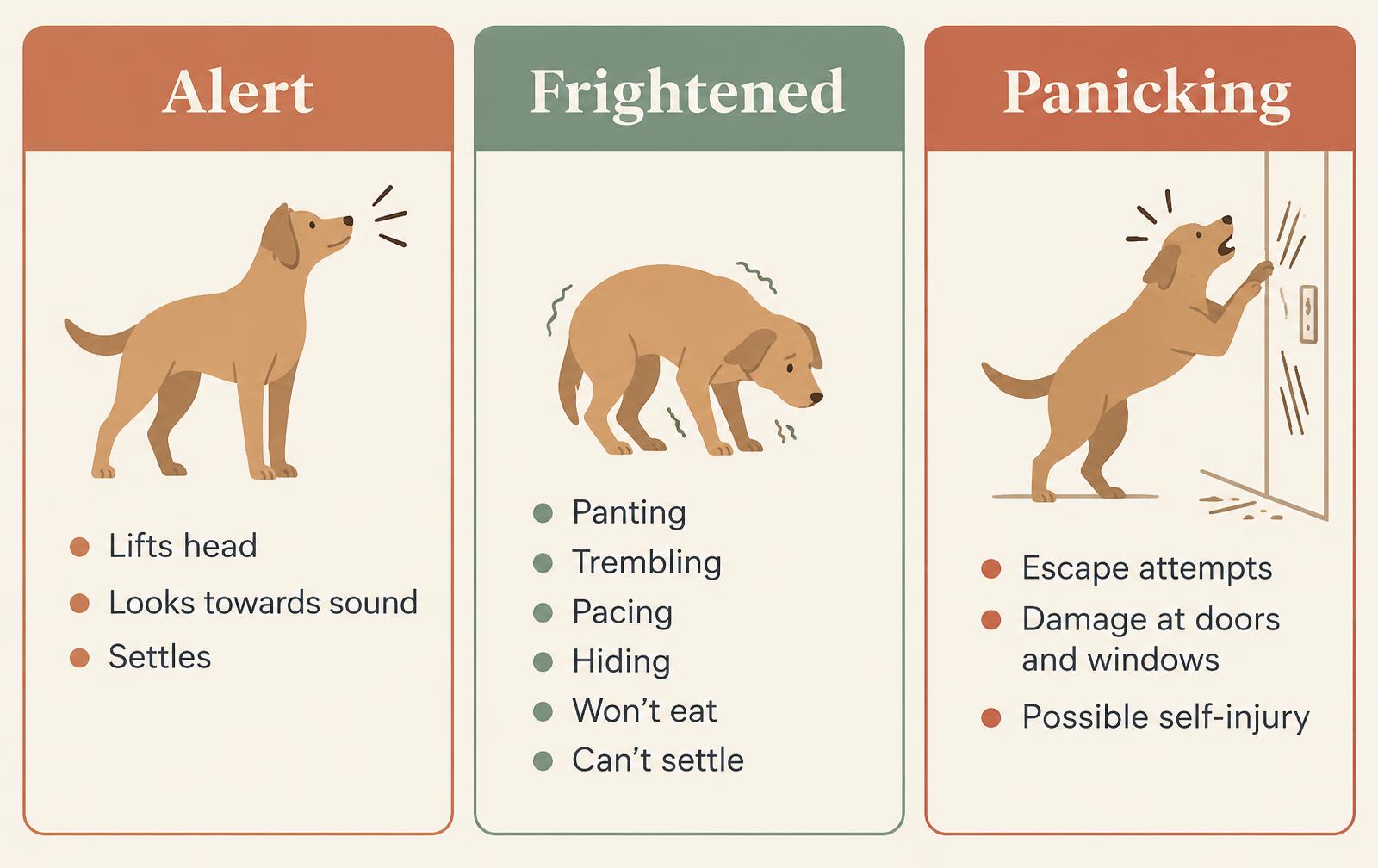
Not every animal that notices fireworks has a noise phobia. A dog might lift its head at a distant bang, look towards the window and settle again. That's very different from a dog that spends hours trembling behind a sofa.
Alert or startled might mean looking towards the noise, pausing briefly or becoming watchful before settling again.
Significant fear can include panting, trembling, pacing, drooling, refusing food, hiding, clinginess or being unable to settle.
Panic may involve desperate escape attempts, destructive behaviour around doors or windows, self-injury or an animal becoming extremely difficult to engage with.
The most useful planning information you have is often what happened last year. If your dog spent previous firework nights shaking, attempting to escape or remaining distressed for hours, don't wait until the first major display to decide whether help is needed. That's the trigger for a vet conversation now.
Build the safe place now, not on the night
Animals need somewhere they can retreat when they're frightened, and that place is more useful if it's familiar before the fireworks begin.
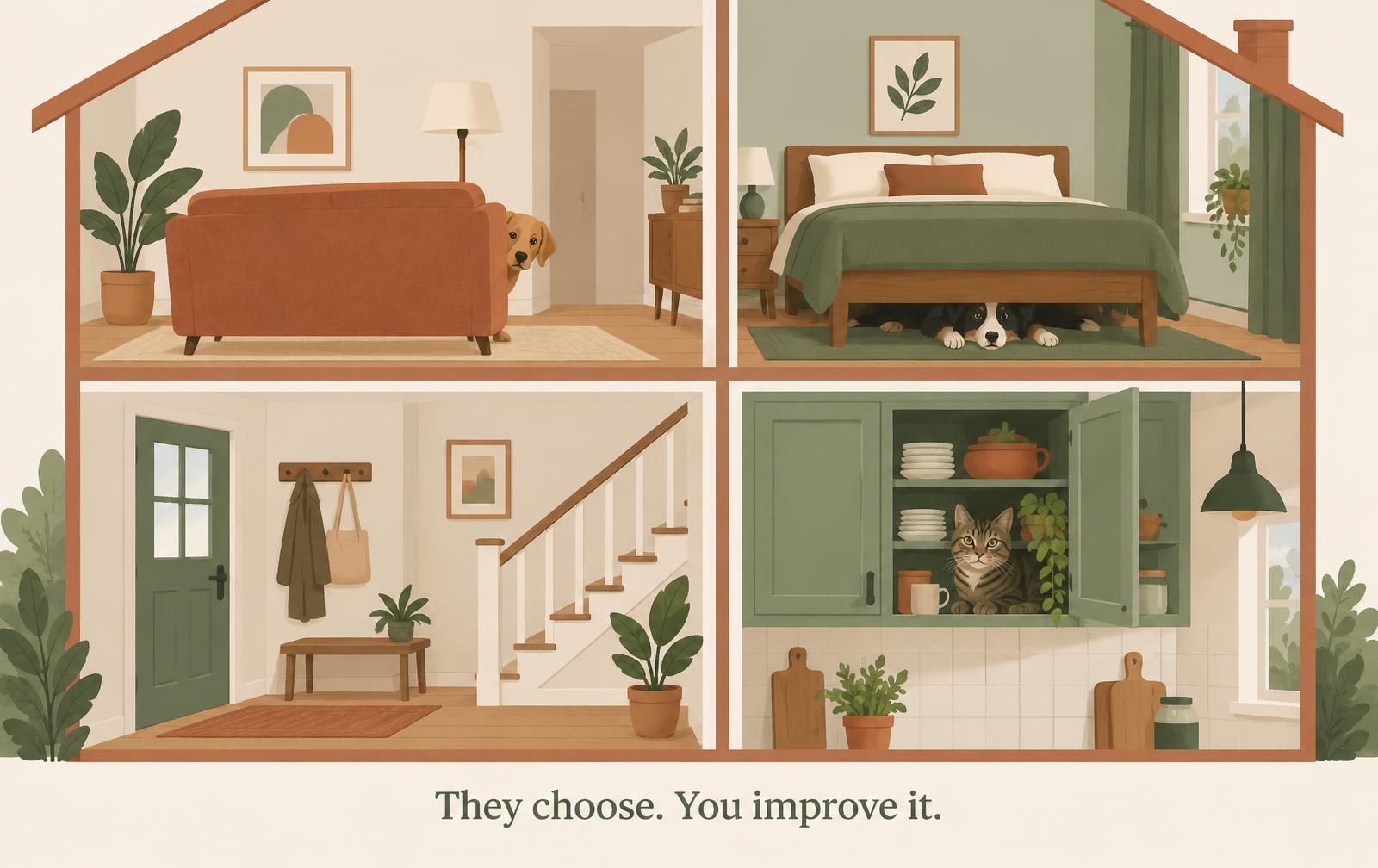
The important point is that the animal gets a say in where it is. Watch where your dog or cat already goes when something startles it. Behind the sofa, under a bed, into a bathroom, inside an open crate or on top of a wardrobe may tell you more than an elaborate firework den you've chosen for them.
If the location is safe, make it more comfortable and keep access open. Familiar bedding can help. Curtains and soft furnishings can reduce some external light and sound. Allow the animal to enter and leave rather than repeatedly putting it there.
Don't shut a frightened dog into a crate unless it already regards the crate as a safe resting place. Confinement can add another source of distress if the animal is trying to escape. Cats may prefer enclosed or elevated places, so provide choices rather than one designated refuge.
The aim isn't to teach the animal to hide. It's to make sure that if hiding is how it copes, it can do so safely.
Book the vet conversation before you need it
For a dog with substantial firework fear, environmental management may not be enough. Medication isn't a failure of training — severe fear is a welfare problem, and making an animal endure hours of distress isn't a behavioural treatment.
There are prescription veterinary medicines authorised for noise-related fear and anxiety in dogs in Great Britain.
Dexmedetomidine oromucosal gel (Sileo) is administered between the cheek and gum and is authorised in Great Britain for alleviating acute anxiety and fear associated with noise in dogs. A randomised, placebo-controlled field study found better owner-rated outcomes during New Year's Eve fireworks among dogs receiving dexmedetomidine than those receiving placebo.
Imepitoin (Pexion) is authorised in Great Britain for reducing anxiety and fear associated with noise phobia in dogs. Its summary of product characteristics recommends beginning treatment two days before the expected noise event to achieve optimal anxiolytic efficacy. That timing alone is a good reason not to leave the veterinary conversation until 5 November.
Both are prescription medicines. Which treatment, if any, is appropriate depends on the individual dog, its health, other medication and the nature of its fear.
Tell your vet what actually happened previously. "She's nervous around fireworks" is less useful than "she trembled, wouldn't eat and tried to get through the back door for four hours."
For cats, there isn't an equivalent GB-authorised medicine specifically for noise fear. If your cat experiences severe firework distress, that still warrants a veterinary discussion; a vet can advise on the individual animal and whether any treatment is appropriate.
Pheromones, supplements and pressure vests
This is where owners can spend a great deal of money for much less certain benefit.
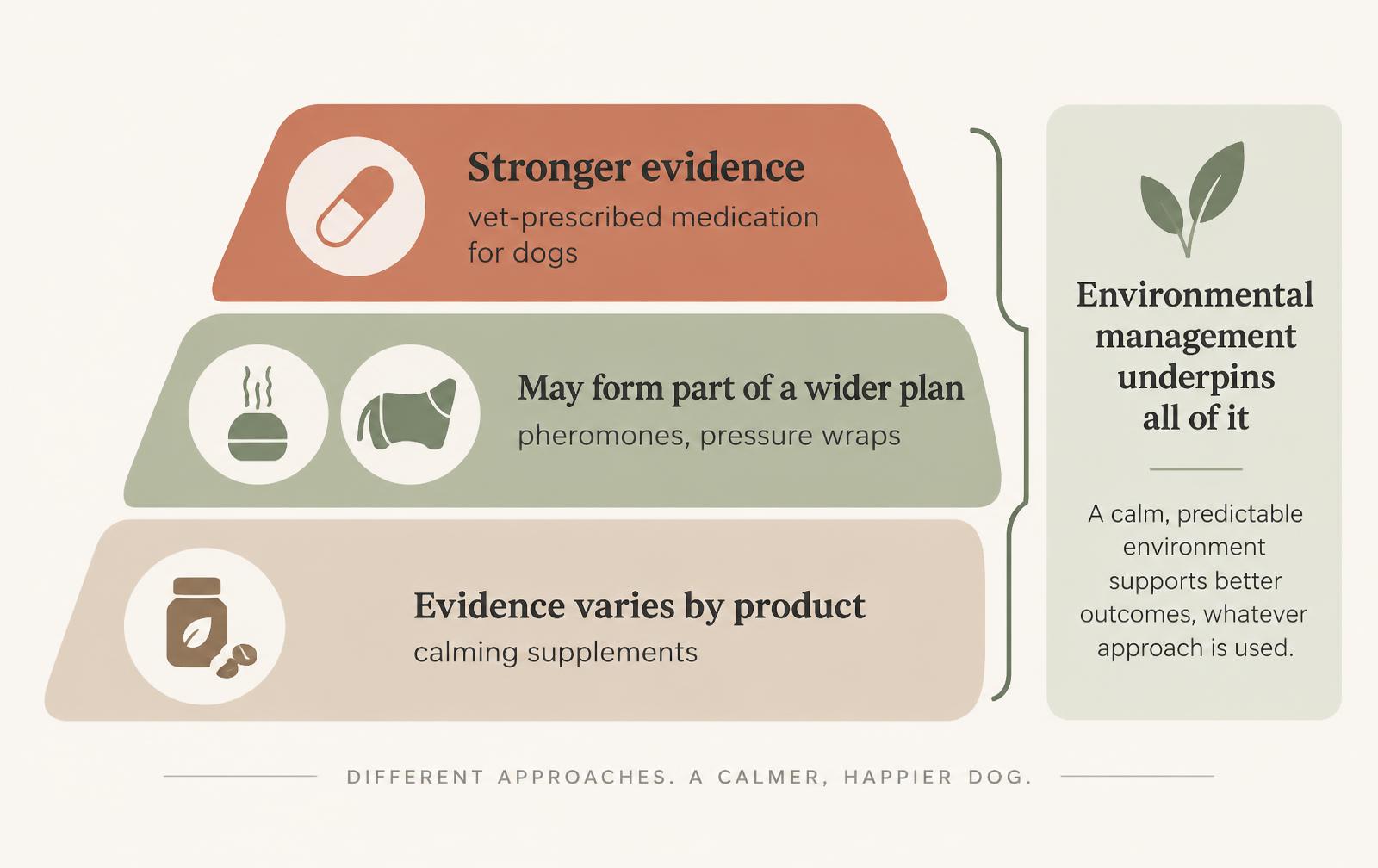
Pheromones. Dog-appeasing and feline pheromone products have been studied for stress and fear, including in relation to fireworks, and the picture is more specific than "mixed evidence" suggests. A systematic review by Frank, Beauchamp and Palestrini examined seven dog studies. Only one provided sufficient evidence of reduced fear or anxiety, and that was during training. Six provided insufficient evidence, including two reports specifically concerning noise phobia. Across cats and dogs together, eleven of fourteen reports provided insufficient evidence and one lacked support for effectiveness altogether.
That doesn't prove pheromones cannot help an individual animal. It means they shouldn't be presented as a reliably effective treatment for severe firework fear. If you choose to use one, regard it as an adjunct to the wider plan rather than the plan itself.
Calming supplements. The evidence varies enormously by ingredient and product, and for the most commonly recommended one it is weaker than most owners would assume. A 2017 review in Veterinary Evidence concluded that there is currently no evidence that alpha-casozepine — the active ingredient in Zylkene and several other products — is effective when given shortly before an anxiety-provoking stressor, meaning anything from minutes to a few days beforehand. The limited evidence suggesting a possible effect comes from daily use over weeks, and that evidence is itself low-quality or at high risk of bias. It also doesn't establish efficacy specifically for firework fear.
So the common recommendation to start a supplement a day or two before Bonfire Night isn't supported by the evidence for this ingredient. More broadly, "calming supplement" is a marketing category rather than a single treatment — different products contain different compounds at different doses with very different levels of evidence. For a dog that panicked last year, a supplement shouldn't replace a veterinary conversation.
Pressure vests. Pressure garments are relatively low-intervention, but evidence for their anxiolytic effect is limited. A 2024 systematic review by Mathis and colleagues screened 229 studies and found only four that met the inclusion criteria. Its conclusion was appropriately blunt: evidence of benefit is weak and limited, with confidence low because of moderate-to-high risks of bias and inconsistent findings. The review did, however, find no association with adverse effects.
If your dog already wears one comfortably and you think it helps, it may be reasonable to include it in the plan. Don't introduce a tight unfamiliar garment for the first time while the dog is already panicking.
Prepare the house before dark
The practical work is simple, but it matters.
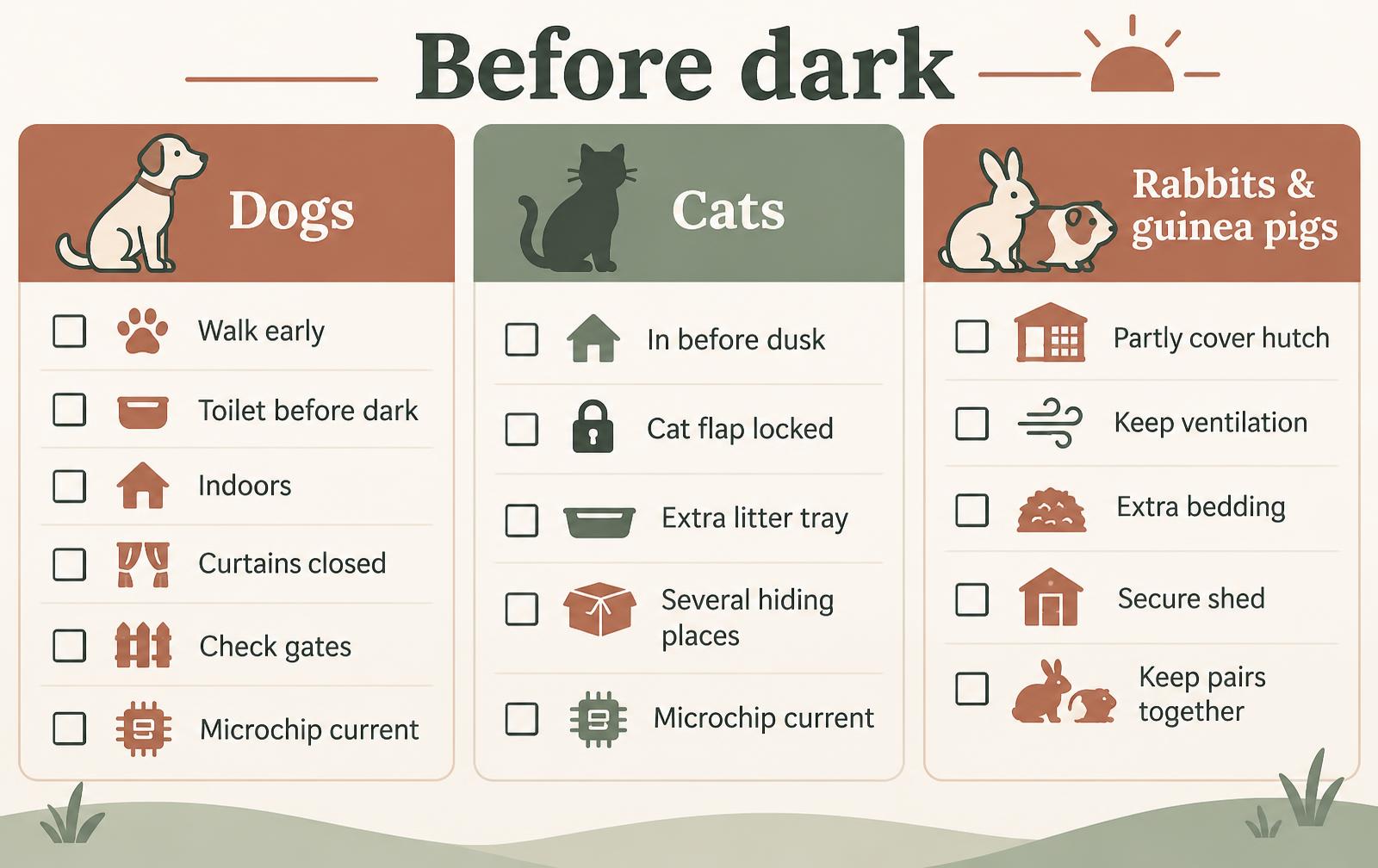
Dogs. Exercise earlier, while it is still light and before fireworks are likely, and keep your dog on a lead if unexpected bangs are plausible. Give it an opportunity to toilet before the busiest period. Once fireworks begin, keep the dog indoors, close windows and doors, and draw curtains or blinds to reduce flashes. Familiar television, radio or music can provide background sound, although it won't completely mask nearby explosions. Check doors, gates and fences particularly carefully, because a panicking animal can behave in ways it never normally would. Make sure microchip registration details are current.
Cats. Bring cats indoors before fireworks are likely to start if that can be done without creating additional distress, and keep doors, windows and cat flaps secure. Make sure indoor toileting facilities are available, particularly for cats accustomed to going outside. Provide several hiding choices rather than continually checking one hiding cat. And check the microchip details.
Rabbits and guinea pigs. Outdoor animals need somewhere secure to retreat. Provide abundant appropriate bedding and sheltered areas. External accommodation can be partly covered to reduce flashes and some noise, but ventilation must remain adequate. A secure shed or suitable outbuilding may offer additional protection if conditions inside are appropriate and there are no vehicle fumes or other hazards. Keep bonded companions together — don't create another stressor by separating an established pair on a frightening night.
What to do when the fireworks start
Let the animal decide how it wants to cope. If it hides, leave it there unless the location itself is dangerous. If it wants to remain close to you, let it.
You don't need to ignore a frightened animal because you're worried that reassurance will reward fear. Fear is an emotional state rather than a simple voluntary behaviour being performed for attention. That doesn't mean repeatedly fussing over an animal that wants to be left alone. The useful rule is simpler: let them hide if they want to hide, and stay available if they want you.
Don't punish barking, indoor toileting or destructive behaviour occurring in panic. Don't drag an animal from its hiding place to demonstrate that there is nothing to fear. And don't take a frightened dog outside to watch the fireworks.
What if they won't eat?
Food and play can be useful when an animal is still capable of engaging. If your dog hears a distant bang, remains relaxed and happily takes something it loves, that can provide an opportunity for positive associations.
But a dog hiding, trembling and refusing a favourite food is telling you something important: it is too distressed for that particular exercise. Don't repeatedly push treats towards it or try to coax it into playing. At that point, the priority is reducing exposure, maintaining safety and following whatever management or medication plan has been agreed with your vet.
When does it become an emergency?
Most firework fear is distressing rather than medically emergent. But panic can cause injury.
Contact an emergency vet if an animal injures itself trying to escape, suffers a significant wound, collapses, develops obvious breathing difficulty or is injured after bolting.
Severe recurrent fear that doesn't require emergency treatment still deserves attention. If every November involves hours of panic, that's not something an animal simply has to live with.
After the season: work on the underlying fear
Once the main firework period has passed, the pressure of the calendar disappears. That's the time to make the longer-term behaviour plan the priority.
With sound desensitisation, recordings begin at a level low enough that the animal shows no fear response. Counterconditioning can pair those sounds with something positive. Sessions should be short and progression gradual. If the animal becomes vigilant, moves away, starts panting, stops eating or otherwise shows concern, you've progressed beyond the level at which useful desensitisation is happening — reduce the intensity. Progress isn't measured by how quickly you can turn up the volume.
Recordings also have limitations. They can't reproduce all the vibration, flashes, smells, unpredictability and directionality of real fireworks, so a dog comfortable with recordings isn't automatically prepared for every real display.
Dogs with severe fear may benefit from a properly qualified clinical animal behaviourist working alongside the vet.
Six weeks to fireworks
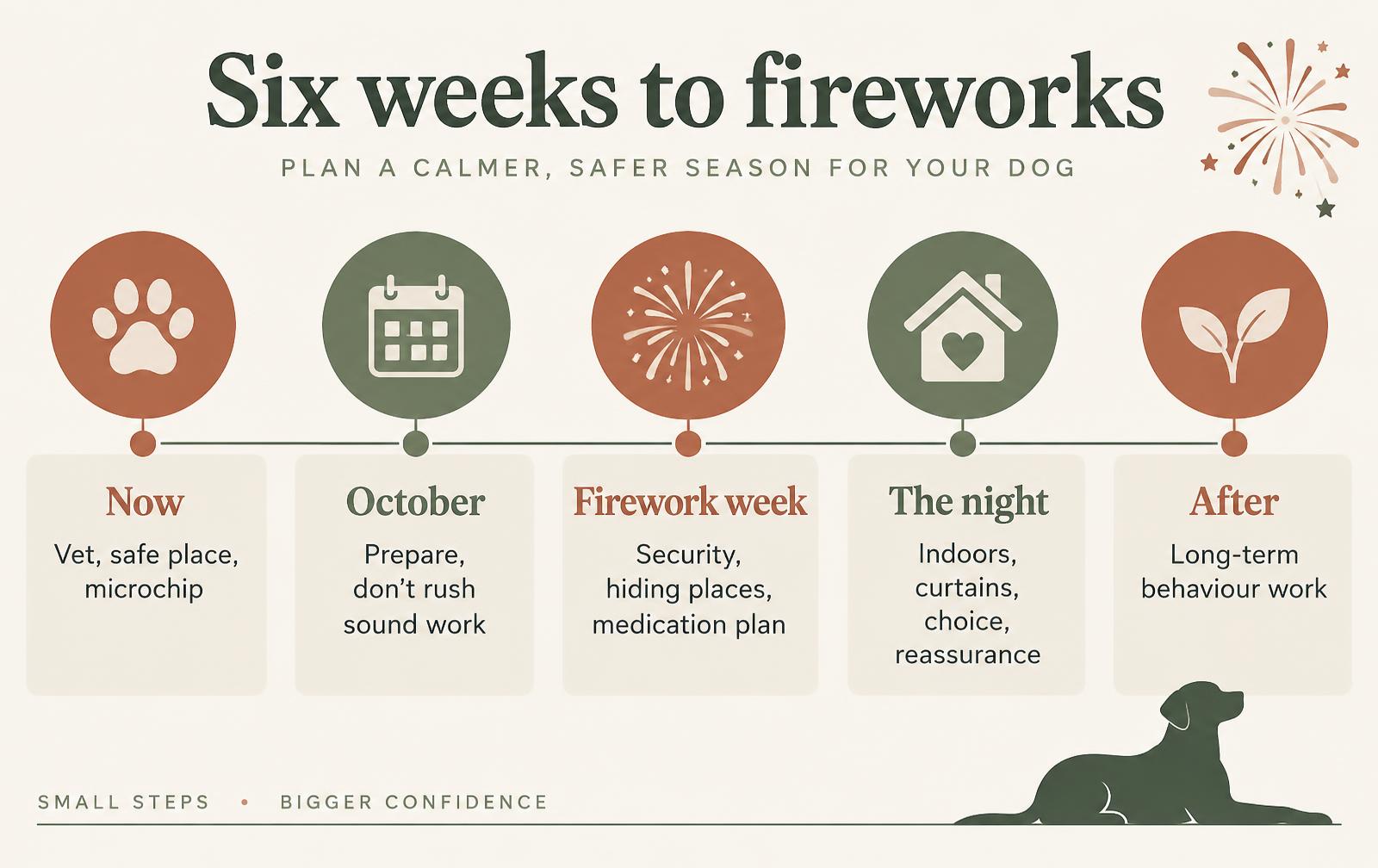
Now. Think back to last year's response. If fear was significant, contact your vet. Establish the safe place and check microchip and contact details.
Through October. Keep the safe area available so it becomes ordinary. Introduce any vet-recommended environmental measures. Plan walks and toilet trips around darkness. If you're doing careful sound work, don't chase louder volumes because November is approaching.
Firework week. Check doors, gates and fencing. Prepare hiding places and familiar background sound. Make sure prescribed medication is available and that you understand exactly when and how it should be given.
On the night. Get animals safely inside where appropriate before fireworks begin. Close curtains. Let them choose where to settle. Stay calm and available. Comfort them if they seek it.
After the season. Don't forget the problem until next October. If your animal struggled, this is when the longer-term behaviour work should become the priority.
Try this today
Don't see how loudly your dog can tolerate a firework recording.
Instead, think about where your animal went the last time something frightened it. If that place is safe, start making it available and comfortable now.
Then think honestly about last year's response. If it was more than mild unease, book the vet conversation.
Those two things are more useful at the end of September than trying to compress months of behaviour work into a few weekends.
The Bottom Line
The weeks before Bonfire Night are primarily for preparation, not a race to cure an established firework fear. Don't set yourself a deadline by which your dog has to tolerate increasingly loud recordings — proper desensitisation progresses at the animal's pace.
What you can do now is substantial. Establish the safe place. Have the veterinary conversation before the busiest nights if previous fear has been significant. Secure the house and garden. Know how and when prescribed medication should be used. Be sceptical of products whose marketing is stronger than their evidence.
On the night, let your animal choose where it feels safest. Stay available. You don't need to ignore it if it seeks reassurance.
And when firework season ends, don't put the problem away for another ten months. That's when you have the time to work on changing what happens next year.
This year, manage the fear. Afterwards, work on changing it.
Guides on Burrow are researched carefully and written to be genuinely useful, but they aren't a substitute for veterinary advice. Prescription medication for noise fear requires assessment by your vet. If an animal injures itself, collapses or develops breathing difficulty, contact an emergency vet immediately.
Related reading: The Cat Behaviour Guide · How to Read Your Dog's Body Language · Rabbit Care: What Rabbits Actually Need · Is Your Cat Scared of Fireworks?
Common questions
Frequently asked.
References
Sources.
- Levine ED, Ramos D, Mills DS. A prospective study of two self-help CD based desensitization and counter-conditioning programmes with the use of Dog Appeasing Pheromone for the treatment of firework fears in dogs. Applied Animal Behaviour Science, 2007;105(4):311–329.
https://www.sciencedirect.com/science/article/pii/S0168159106003777
https://doi.org/10.1016/j.applanim.2006.11.006 - Veterinary Medicines Directorate. Sileo 0.1 mg/ml Oromucosal Gel for Dogs — product record.
https://www.vmd.defra.gov.uk/productinformationdatabase/product/A008937
https://www.vmd.defra.gov.uk/productinformationdatabase/files/QRD_Documents/QRD-Auth_3219396.PDF - Veterinary Medicines Directorate. Pexion 100 mg and 400 mg Tablets for Dogs — product record and summary of product characteristics.
https://www.vmd.defra.gov.uk/productinformationdatabase/product/A008340
https://www.vmd.defra.gov.uk/ProductInformationDatabase/files/SPC_Documents/SPC_3030205.PDF - Mathis A, et al. A Systematic Review of the Efficacy of Compression Wraps as an Anxiolytic in Domesticated Dogs. Animals, 2024;14(23):3445.
https://pmc.ncbi.nlm.nih.gov/articles/PMC11639916/
https://doi.org/10.3390/ani14233445 - Is alpha-casozepine efficacious at reducing anxiety in dogs? Veterinary Evidence, 2017.
https://live.veterinaryevidence.org/index.php/ve/article/view/67
https://doi.org/10.18849/ve.v2i3.67 - Frank D, Beauchamp G, Palestrini C. Systematic review of the use of pheromones for treatment of undesirable behavior in cats and dogs. Journal of the American Veterinary Medical Association, 2010;236(12):1308–1316.
https://pubmed.ncbi.nlm.nih.gov/20550445/
https://doi.org/10.2460/javma.236.12.1308