Cat · All · Routine
The Outdoor Cat Guide
Published 16 Oct 2026 · ✓ Researched
TL;DR
- **Most UK cats go outside.** In Cats Protection's 2026 survey of more than 10,000 people, 59% of cats went both indoors and out and 38% stayed indoors.
- **There is no single right answer.** Outdoor access brings real risks, especially from roads, while keeping a cat indoors raises the bar for meeting its needs at home.
- **Some things come first.** A registered microchip is a legal requirement in England, and neutering, vaccination and parasite control should all be in place before a cat goes out.
- **Timing matters.** Kittens should not go out until they are vaccinated, neutered and healed, and adult cats in a new home need two to three weeks to settle first.
- **The first trip is simple.** Choose a quiet, dry day, go out shortly before a meal, stay with your cat and leave the door open.
- **Young cats face the highest road risk.** UK emergency data link cats aged six months to two years, male cats and autumn with higher odds of road accidents.
- **Hunting can be reduced without confinement.** In a controlled UK trial, food with meat-based protein and short daily play sessions cut the number of animals cats brought home.
Most UK cats go outside, and many owners worry about it. The risks are real but specific, most of the preparation is straightforward, and the first trips go better when they are planned around the cat, not the calendar.
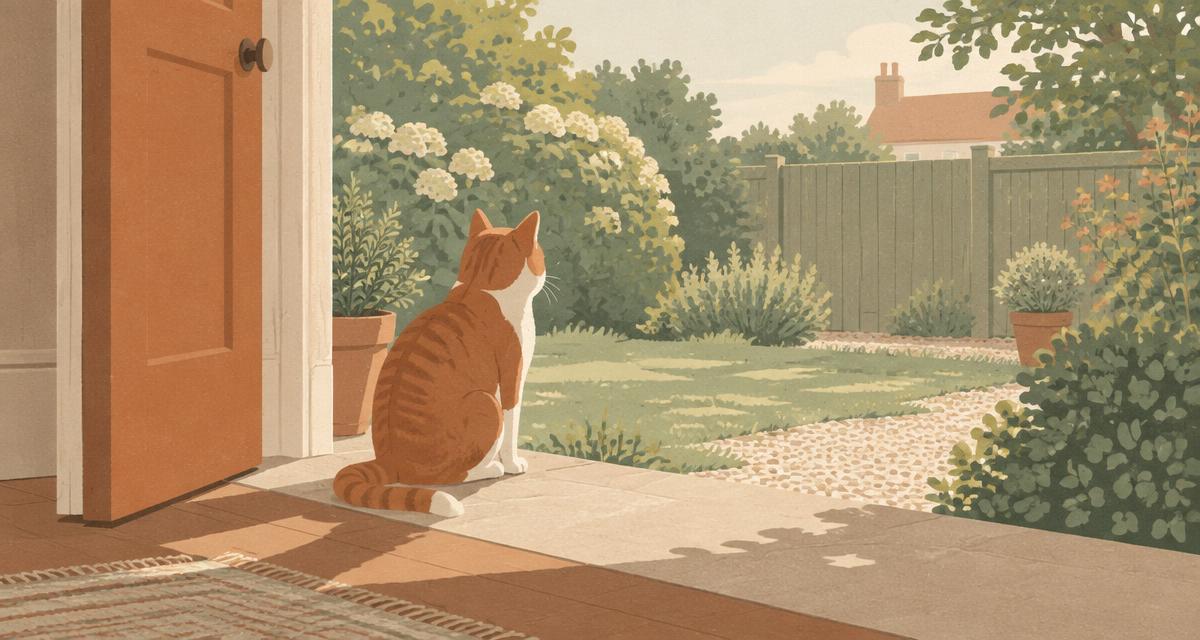
Few decisions about a cat cause as much worry as letting it out. Some owners take outdoor access for granted, while others keep their cats in because they fear traffic, theft or the cat simply not coming back. In Cats Protection's 2026 survey, 59% of UK cats went both indoors and outdoors, 38% always stayed indoors and 3% lived entirely outdoors. The most common concerns owners gave for keeping cats indoors were being hit by a vehicle (44%) and going missing (43%).
This guide works through the decision, the preparation, the first trips and the risks that follow. It assumes your cat is new to the outdoors, whether it is a kitten, an adult cat that has lived indoors, or a cat that has just moved home.
Should your cat go outside at all?
There is no universal answer, and the decision belongs to you and your circumstances. The outdoors offers space, exploration and the chance to express natural behaviours such as hunting, climbing and patrolling territory. International Cat Care describes cats as remarkably adaptable, and notes that many cats that have lived indoors take readily to going out.
The main risk is traffic. A UK study of cats seen at emergency clinics found that road accidents made up 4.2% of all cats treated. Cats aged six months to two years had higher odds of a road accident, as did male cats and crossbred cats, and the odds were highest in autumn. A separate study of cats under primary veterinary care in England found the median age at death from road accidents was 2.7 years, against 14 years for deaths from all causes. That study found no link between road deaths and living in urban areas, and no support for the belief that black cats are more at risk.
Other outdoor risks include fights with other cats, which owners in the Cats Protection survey named as the most common cause of injury, as well as infectious disease, parasites and, less commonly, poisoning or theft.
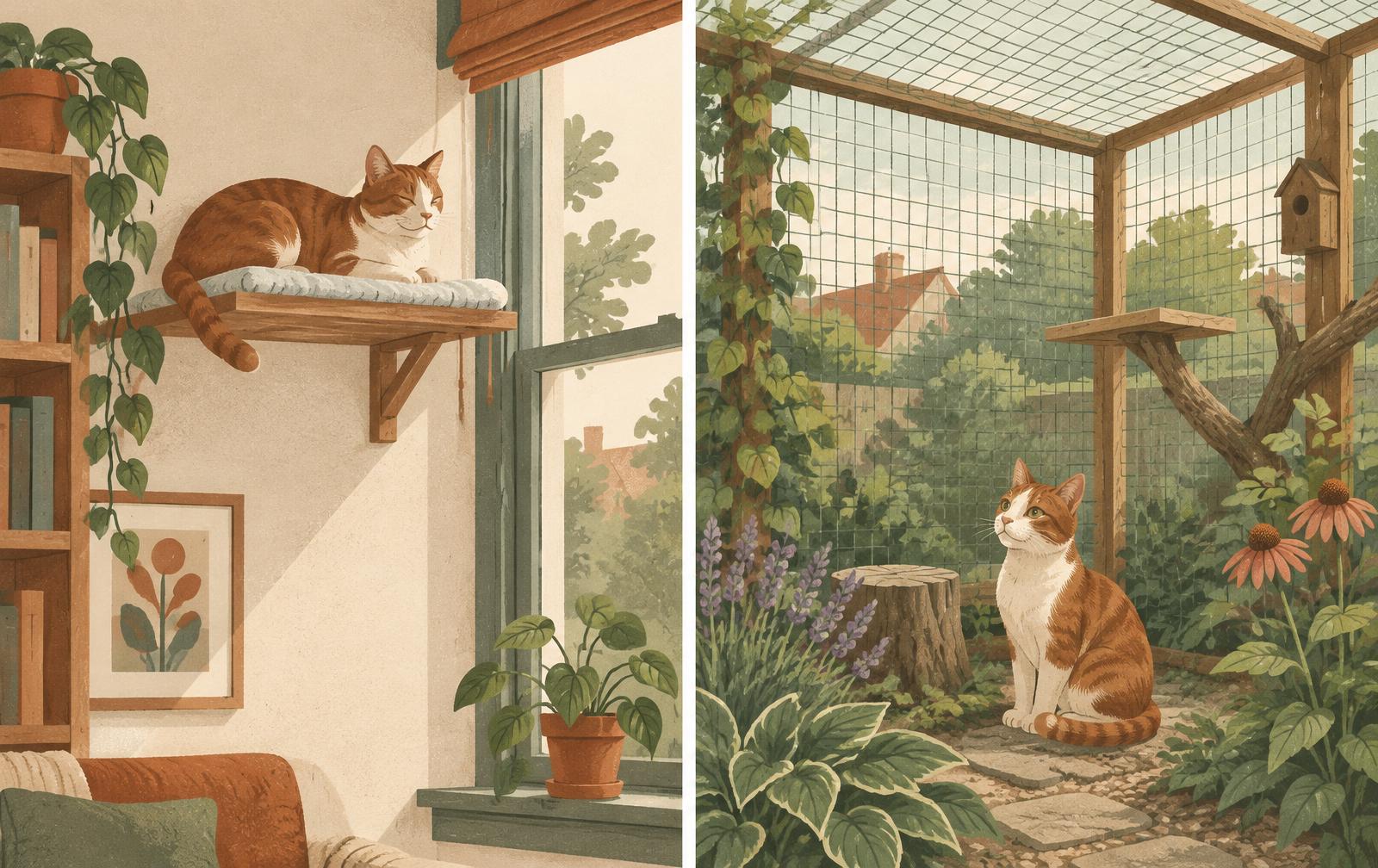
Keeping a cat indoors avoids most of these, but Cats Protection's chair of trustees, the vet Kit Sturgess, makes the trade-off clear: it increases the need to provide a stimulating physical and psychological environment at home. An indoor cat needs places to climb and hide, opportunities to play and hunt, and enough resources to avoid conflict with other cats. Our Cat Behaviour Guide covers those needs in detail.
Your local environment matters most. A cat in a quiet cul-de-sac backing onto fields faces different risks from one living beside a busy main road. Some cats also show little interest in going out, and there is no need to push them.
Before the first trip
Most of the preparation can be done while your cat is settling in. The table sets out what to have in place and why.
| What | Why it matters | When |
|---|---|---|
| Microchip, registered with your current details | A legal requirement for pet cats in England, and the most reliable way to be reunited with a lost cat | By 20 weeks of age in England, and before any outdoor access |
| Neutering | Prevents unplanned litters, and International Cat Care advises it before any outdoor access | Around four months of age, fully healed before going out |
| Vaccination | Protects against infectious diseases that outdoor cats are more likely to meet | Primary course completed at least a week before going out |
| Parasite control | Outdoor cats, and especially hunters, face higher parasite exposure | Agree a plan with your vet based on lifestyle |
| Safe identification | A snap-open collar with your number is a useful extra, but not a replacement for a microchip | Fitted and comfortable before the first trip |
| A recall routine | Makes it easier to call your cat in | Practise indoors in the weeks before |
| A safe garden | Ponds, gaps in fencing and toxic plants are avoidable hazards | Checked before the first trip |
Microchipping
Since 10 June 2024, pet cats in England must be microchipped before they reach 20 weeks of age, with the owner's contact details stored and kept up to date on an approved database. Owners found without a chipped cat have 21 days to have one implanted or may face a fine of up to £500. The law does not cover feral, farm or community cats that live with little human contact.
Compliance has not caught up. Cats Protection's 2026 survey found 73% of UK cats were microchipped, down from 75% when the law changed. The most common reasons owners gave for not chipping were that their cat did not go outside, did not stray far, or wore a collar. For a cat about to go out for the first time, none of those apply. Check that the details on the database are current too: the same survey estimated that more than 820,000 microchipped cats had out-of-date registration details. If you have moved house, update your address and phone number as soon as possible.
Neutering
International Cat Care recommends neutering at around four months of age, and says kittens should be neutered and fully healed before they have any kind of outdoor access. Cats Protection also recommends neutering at or by four months, because cats can become reproductively active from that age. Neutering rates have been falling: the 2026 survey put them at 79% of cats, down from 88% in 2020.
Vaccination
Your cat's core vaccinations should be complete before it goes out. Ask your vet about feline leukaemia virus (FeLV) too, because the risk depends on contact with other cats. The 2024 vaccination guidelines from the World Small Animal Veterinary Association recommend that, in areas where FeLV is present, the vaccine is treated as core for young cats and for adult cats with outdoor access or that live with cats that go out. European guidance from the ABCD describes FeLV vaccination as circumstantial for cats with outdoor access.
Parasite control
Outdoor cats are more exposed to fleas, ticks and worms, and cats that hunt can pick up worms from their prey. The European parasite guidance body ESCCAP recommends that adult cats are wormed at least four times a year, and monthly for cats that hunt or roam freely. Cats Protection now advocates a more tailored approach that reflects each cat's risk and limits unnecessary environmental exposure to parasite treatments, so agree a plan with your vet based on how your cat will live.
Collars and identification
If you use a collar, International Cat Care advises a securely fitted, snap-open type. Cats Protection's survey found that only 41% of collars worn by cats were safety collars. A collar and tag can help a neighbour return your cat quickly, but collars are lost, and Cats Protection is clear that no device, including GPS trackers, replaces a microchip.
When to start
Kittens
Two conditions decide when a kitten can first go out. On disease grounds, International Cat Care recommends waiting until at least a week after the primary vaccinations are complete, which is usually at around 13 to 14 weeks of age, depending on the vaccines used and your vet's advice. The charity also says kittens should be neutered, ideally at around four months, and fully healed before any outdoor access at all. In practice, that means most kittens' first trips come after neutering.
Those first trips should be supervised. International Cat Care advises staying with kittens outside and not leaving them alone outdoors until they are six months old. That time is useful for play and for teaching recall.
Adult cats in a new home
For an adult cat you have just adopted, International Cat Care recommends waiting two to three weeks before letting it out, so it has time to settle and learn where home is. Some cats need longer. A nervous cat that is still hiding or reluctant to explore indoors is not ready to explore outdoors.
After moving house
The same principles apply when you move. International Cat Care advises keeping a cat indoors for at least two to three weeks after a move. If you have moved only a short distance, the charity recommends keeping your cat in for as long as possible, because it may find familiar routes back to your old home. It also suggests warning the new occupants of your old home, and asking them to contact you and not to feed your cat if it turns up.
The first trip, step by step
International Cat Care's advice for a first outing is straightforward, and the same approach works for supervised kitten trips.
Choose the day. Pick a quiet, dry day when you are at home and have time. Avoid days with building work next door, visiting dogs or children playing loudly in neighbouring gardens.
Go out before a meal. Let your cat out shortly before a routine mealtime, because a hungry cat is more likely to come back in when called.
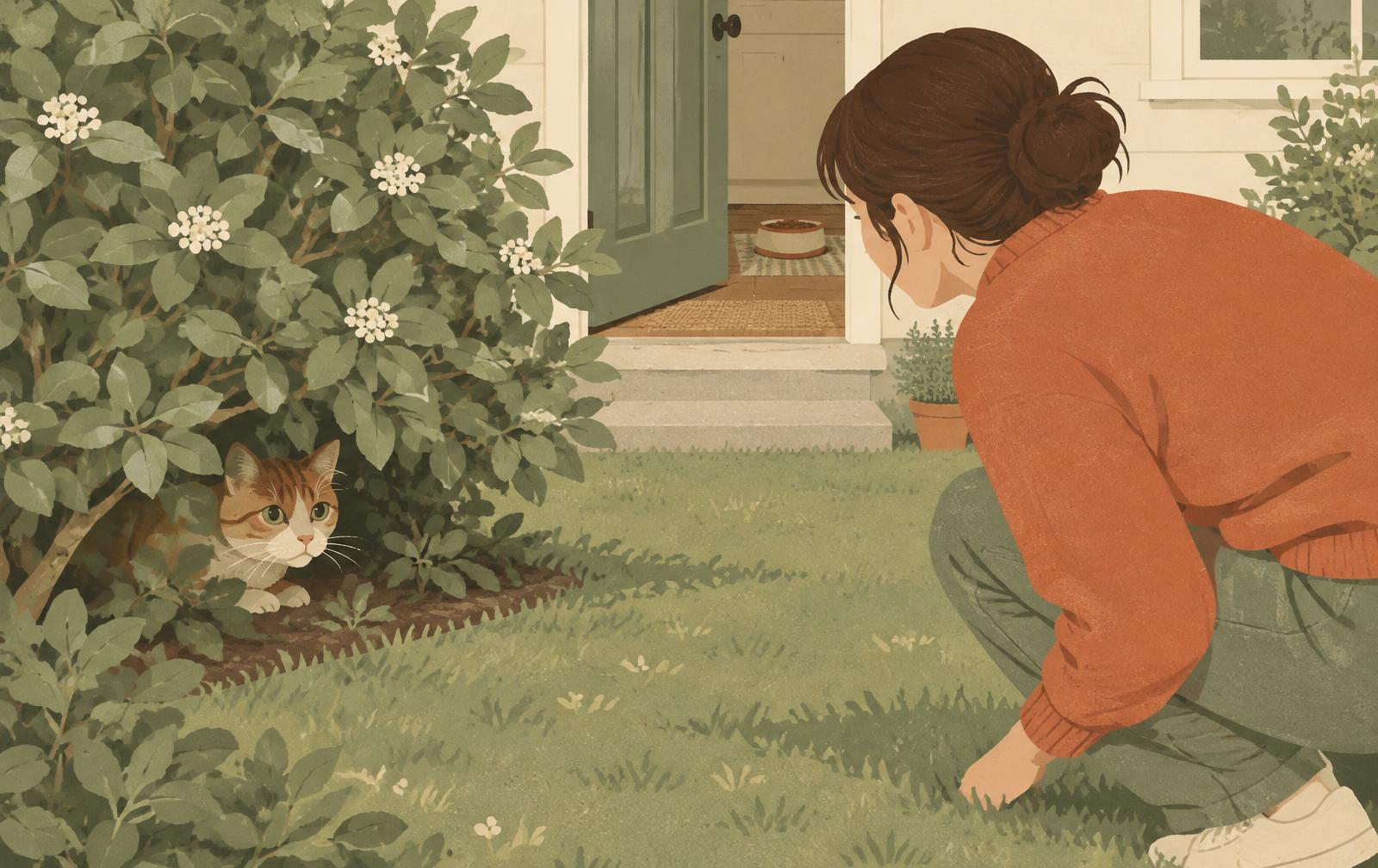
Go together, without carrying. Open the door and step into the garden with your cat. International Cat Care advises against carrying your cat outside: let it decide whether to explore, in its own time. Don't panic if it disappears into a shrub, which the charity notes is normal, because it lets a cat watch its new surroundings without being seen.
Leave the door open. An open door gives your cat an easy escape route back inside if something startles it.
Let your cat set the length. International Cat Care suggests calling your cat in for its meal after 30 to 60 minutes and repeating the next day. Treat that as an upper guide, not a target. A confident cat may happily explore for that long, while a nervous one may come back after a few minutes, and that is fine. You can also call your cat to you for a treat during a trip and then let it carry on, so that checking in with you becomes a routine.
Build up gradually. Most cats adapt quickly. Timid cats benefit from gradually longer trips over the first few weeks, and some cats new to the outdoors prefer to go out only when you are there.
Building a safe routine
Once your cat is going out confidently, think about how access will work long term. A cat flap gives your cat the freedom to come and go and an escape route from neighbouring cats. International Cat Care recommends microchip-operated or magnetic exclusive-entry flaps, which stop unfamiliar cats coming in, and some can be programmed to keep your cat in at set times.
Many owners keep their cats in overnight or at busy traffic times, and International Cat Care suggests considering both. Autumn deserves particular care, because the UK emergency study found the odds of road accidents were highest at this time of year, and dark evenings arrive once the clocks go back. Bonfire Night is another time to keep cats in, and our Fireworks Guide sets out how to prepare.
If your cat is young or male, be especially watchful in the first couple of years, when road accident risk is highest.
Trackers, harnesses and devices to avoid
GPS trackers can be reassuring, but batteries fail and devices are lost, so treat one as an extra, not a safeguard.
Walking a cat on a harness and lead has become more popular, and some cats cope well with it, particularly when introduced gradually and taken somewhere quiet and familiar. Cats Protection raises concerns that owners should weigh: harnesses can be uncomfortable, they stop a cat from fleeing when it feels threatened, and cats have escaped while wearing them. The welfare question is whether your individual cat is relaxed in one and has a way to retreat if frightened. Introduce a harness slowly indoors, and stop if your cat shows signs of stress.
Avoid electronic shock collars, including invisible boundary systems. They work by delivering an unpleasant shock, and Cats Protection, which is calling for a ban, describes them as causing pain, fear and distress. In its survey, 7% of owners reported using electronic devices that act as an invisible boundary, such as shock collars.
Cats and wildlife
Many owners worry about what their cat catches. A controlled trial in UK households led by the University of Exeter tested several ways of reducing hunting without keeping cats in. Households that switched to a food in which the protein came from meat, not plant sources, recorded 36% fewer animals brought home, and five to ten minutes of daily play with a wand toy, finished with a toy to "catch", cut the number by 25%. Bells on collars had no discernible effect. Brightly coloured collar covers reduced the number of birds brought home by 42% but made no difference to mammals, and puzzle feeders increased the number of animals brought home by 33%.
The study counted prey brought home, which is only part of what cats catch, so the real effect on wildlife may differ.
Alternatives to free roaming
Outdoor access does not have to mean the whole neighbourhood. International Cat Care describes several options for owners who want to reduce the risks while keeping the benefits of being outside:
- Cat fence barriers fitted to the top of an existing fence, angled to stop cats climbing out.
- Garden enclosures that section off part of a garden, useful where a hedge or gap would let a cat through.
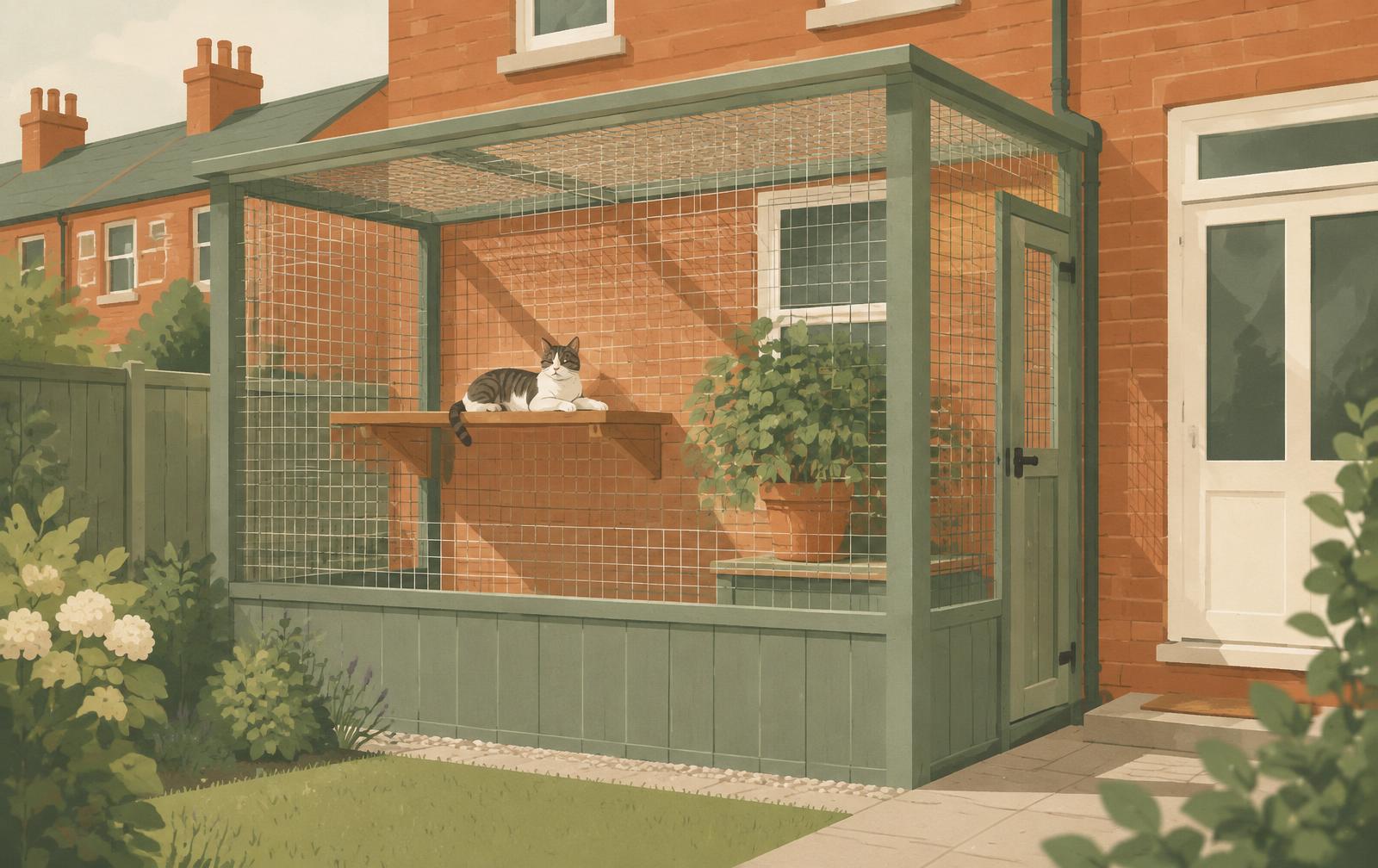
- Catios, enclosed mesh-roofed spaces that suit smaller gardens and patios, or homes where higher security is needed.
If your cat does not want to go out
Not every cat will take to the outdoors, and some will happily stay on the sofa. A cat that has had a fright outside may also become reluctant for a while. Leave the door open and let your cat choose. If a confident outdoor cat suddenly stops wanting to go out, consider whether something has changed outside, such as a new cat in the area, or whether your cat may be unwell, and speak to your vet if you are unsure.
Try this today
Check your cat's microchip details on the database it is registered with and make sure your phone number and address are current. If your cat is not yet chipped, book it in, along with neutering if needed. Then walk round your garden at cat height and look for gaps in fences, uncovered ponds or water butts, and any plants that may be toxic to cats. If you are planning a first trip, start the recall routine indoors now: a call word, a shake of the treat bag, and a reward every time your cat comes.
The Bottom Line
Letting a cat outside is a balance, not a test of good ownership. The outdoors gives cats space and stimulation, and the main risk, traffic, falls most heavily on young cats and peaks in autumn. Whichever way you decide, get the basics in place first: a registered microchip, neutering, vaccination and a parasite plan agreed with your vet. Then let your cat settle, start with short, accompanied trips before mealtimes, and let its confidence set the pace. If free roaming is not right for your home, enclosures and catios offer much of the benefit with far less risk.
This guide is for general information and does not replace veterinary advice. Speak to your vet about vaccination, neutering and parasite control before your cat goes outside. If your cat is injured, has been hit by a car or seems unwell after being outdoors, contact your vet straight away.
Related reading: The Cat Behaviour Guide · The Fireworks Guide · When Should You Worm a Kitten? · Is Your Cat Scared of Fireworks?
Common questions
Frequently asked.
References
Sources.
- Cats Protection. CATS Report UK 2026 (Cats and Their Stats). Published September 2026.
https://www.cats.org.uk/media/grnfe5wr/cats-report-uk-2026.pdf - GOV.UK. Cat microchipping now mandatory. 10 June 2024.
https://www.gov.uk/government/news/cat-microchipping-now-mandatory - International Cat Care. Letting your cat or kitten outside for the first time. Updated September 2025.
https://icatcare.org/articles/letting-your-cat-or-kitten-outside-for-the-first-time - International Cat Care. Moving house with your cat. Updated September 2025.
https://icatcare.org/articles/moving-house-with-your-cat - Conroy MC, O'Neill DG, Boag A, Church DB, Brodbelt DC. Epidemiology of road traffic accidents in cats attending emergency-care practices in the UK. Journal of Small Animal Practice. 2019;60(3):146–152.
https://doi.org/10.1111/jsap.12941 - McDonald JL, Cleasby IR, Brodbelt DC, Church DB, O'Neill DG. Mortality due to trauma in cats attending veterinary practices in central and south-east England. Journal of Small Animal Practice. 2017.
https://doi.org/10.1111/jsap.12716 - World Small Animal Veterinary Association Vaccination Guidelines Group. 2024 guidelines for the vaccination of dogs and cats.
https://wsava.org/wp-content/uploads/2024/05/2024-Guidelines-for-the-Vaccination-of-Dogs-and-Cats.pdf - European Advisory Board on Cat Diseases (ABCD). Matrix vaccination guidelines: 2015 ABCD recommendations for indoor/outdoor cats, rescue shelter cats and breeding catteries. Journal of Feline Medicine and Surgery.
https://pmc.ncbi.nlm.nih.gov/articles/PMC11148924 - European Scientific Counsel Companion Animal Parasites (ESCCAP). Toxocara infection in dogs and cats. Fact Sheet 7.
https://www.esccap.org/uploads/docs/eekw6v76_1295_ESCCAP_FS7_Toxocara_Fact_Sheet_English_v4.pdf - Cecchetti M, Crowley SL, Goodwin CED, McDonald RA. Provision of high meat content food and object play reduce predation of wild animals by domestic cats Felis catus. Current Biology. 2021.
https://doi.org/10.1016/j.cub.2020.12.044