Seasonal Health · Cat · 27 Sept 2026
Is Your Cat Scared of Fireworks?
By Burrow · 27 Sept 2026
TL;DR
- Cats often withdraw when frightened, making firework fear easier to miss than it is in dogs.
- PDSA reports that 30% of UK cat owners say their cat is afraid of fireworks, estimated at around 3.3 million cats.
- In a 2024 Dutch owner survey, 75.9% of cats hid and 64.6% fled during or immediately after fireworks.
- Hiding is a normal coping response. Don't drag a cat out simply because it has disappeared.
- Look at the whole picture. Whether your cat can eat, settle and return to normal afterwards matters more than one body-language sign.
- Bring outdoor cats in before fireworks are likely, but don't automatically confine them to one room. Choice matters.
- There isn't a medicine authorised specifically for feline noise fear in Great Britain, but severe or worsening fear still warrants a veterinary conversation.
A dog that's frightened of fireworks can make it obvious. A cat goes quiet and disappears — which is roughly what a cat does anyway.
Firework advice is overwhelmingly written about dogs. But that doesn't mean cats simply cope better.
A frightened dog may pant, pace, tremble, whine or follow its owner around the house, and the distress becomes difficult to miss. Cats often do something rather less conspicuous. They withdraw, find somewhere enclosed and stay there.
The difficulty with firework fear in cats isn't that they don't show it. It's that some of the ways they show it — hiding, withdrawing, becoming still — are very easy for us to mistake for coping well.
What the numbers actually tell us
PDSA's Animal Wellbeing Report found that 30% of cat owners said their cat was afraid of fireworks, which it estimated represented around 3.3 million UK cats. Other surveys have produced higher figures when asking somewhat different questions about whether cats are adversely affected or display signs of stress.
Those figures aren't necessarily contradictory. "Is your cat afraid of fireworks?" and "have you observed your cat being affected by fireworks?" aren't the same question. The studies also use different samples and methodologies, so we shouldn't use the gap between their results to calculate how much feline fear owners are supposedly missing.
But there is good reason to think some of it is missed. A particularly useful study published in 2024 surveyed owners of 3,009 dogs and 622 cats in the Netherlands about their animals' responses to fireworks. Among the cats, 75.9% were reported to hide during or immediately after hearing fireworks, and almost two-thirds — 64.6% — fled.
Those are behaviours that can disappear from an owner's view remarkably quickly. The cat hasn't necessarily stopped being frightened. It's simply stopped being visible.
Hiding isn't the problem
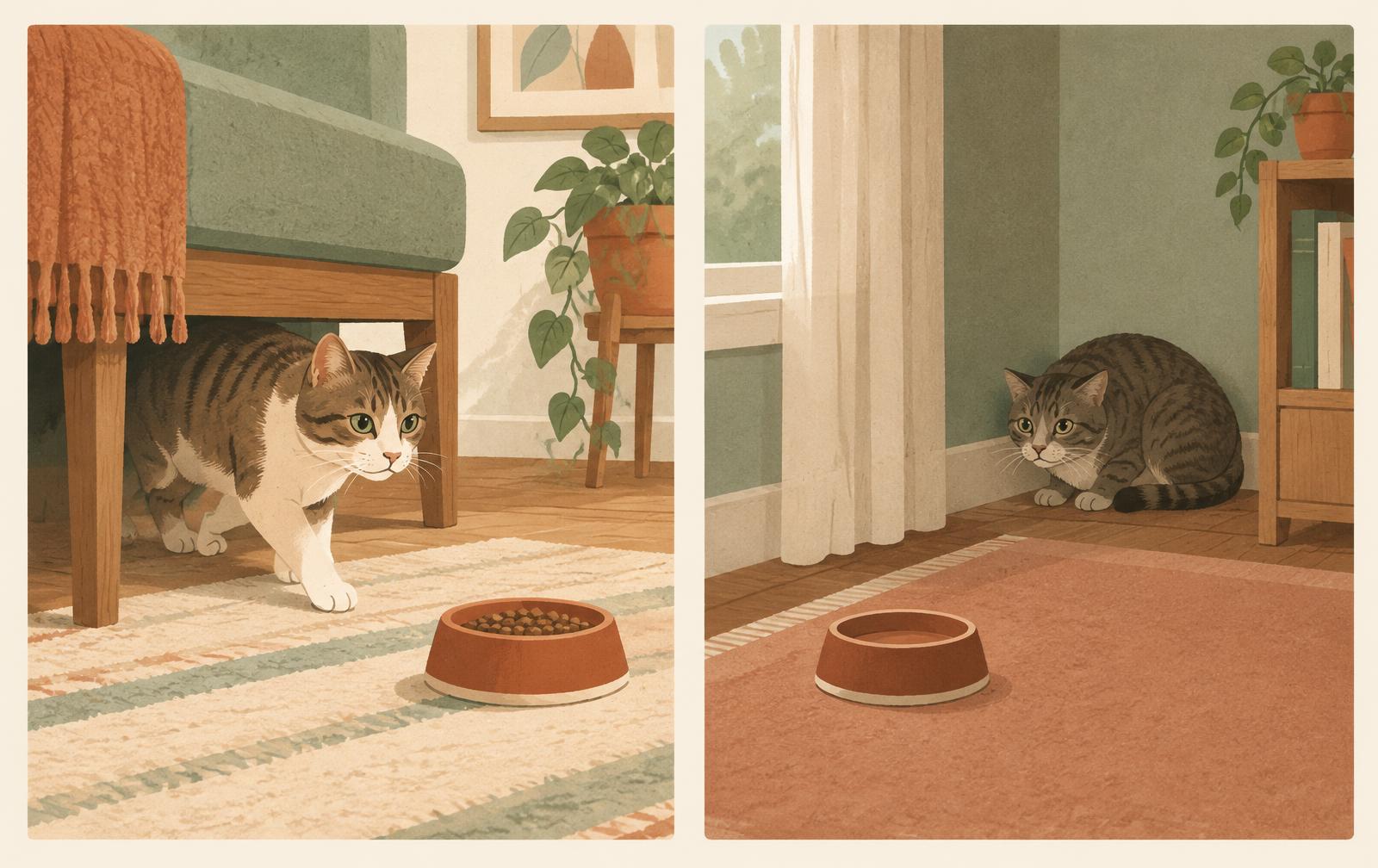
This distinction matters. A cat that hears a bang and retreats underneath a bed hasn't necessarily developed a behavioural problem — hiding is a normal feline coping response. Cats use concealed and elevated places to withdraw from things they perceive as threatening, and during fireworks that might mean under furniture, behind a sofa, inside a cupboard or cardboard box, or on top of a wardrobe.
If the location is safe, you generally don't need to get the cat out. Repeatedly reaching beneath the bed, picking the cat up or carrying it back into the living room can remove the control it has over the situation.
Instead, look at what happens around the hiding. Can the cat settle? Does it eventually emerge voluntarily? Will it eat? Does it use its litter tray? Does it return to something resembling its normal behaviour when the noise stops?
In the Dutch study, 34.2% of cats were reported to remain fearful for more than half an hour after hearing fireworks. That doesn't give us a clinical cut-off at 30 minutes — this was an owner-reported survey rather than a diagnostic study. It does demonstrate why "the cat hid" isn't enough information on its own. Hiding can be coping. What matters is the animal's wider response and how long that response persists.
Look at the whole cat
It's tempting to turn feline body language into a checklist. Dilated pupils mean this. Sideways ears mean that. A particular tail position means something else. Real cats are more complicated.
A frightened cat may crouch and become tense, keep its body low, change the position of its ears, become unusually vigilant, freeze or develop dilated pupils. But no single ear, eye or tail position diagnoses fear. Context is what makes those observations useful. A cat with large pupils while racing around the house during evening play isn't telling you the same thing as a cat with large pupils crouched behind furniture immediately after an explosion outside.
Look for changes from your cat's normal behaviour occurring alongside the fireworks. Refusing food it would normally want, remaining unable to settle, persistent withdrawal and suddenly becoming much more reactive to other noises can tell you considerably more than one physical sign.
That last one is particularly interesting. In the Dutch study, 52.6% of cats were reported to become more sensitive to other, non-firework noises during the firework period. So a cat that suddenly starts reacting to the letterbox, traffic or ordinary household sounds around firework season may be showing a broader period of heightened sensitivity rather than developing an entirely separate problem.
The bigger danger may be fleeing
Hiding inside a safe home is one thing. Bolting outside is another.
A frightened cat isn't necessarily running towards somewhere safer. It is simply attempting to get away from a stimulus it cannot control.
The Dutch study contains a striking finding here: 8.4% of the 622 cats were reported by their owners to have been lost at some point after hearing fireworks. That number needs context — this was a Dutch convenience sample recruited for a survey about firework aversion, it isn't a representative UK population study, and it does not mean 8.4% of British cats will go missing during fireworks. But it illustrates why preventing escape matters.
Bring outdoor cats inside before fireworks are likely to begin rather than attempting to find them once the noise has started. Secure windows and external doors. Lock the cat flap where appropriate.
And check your cat's microchip registration details. A microchip cannot prevent a frightened cat from escaping. It can make an enormous difference to what happens if someone else subsequently finds it.
Bring them in. Don't necessarily shut them in.
These are two different pieces of advice.
Keeping an outdoor cat safely inside during fireworks reduces the risk of it bolting into traffic or disappearing. Taking that cat and shutting it into one unfamiliar room can create another source of stress. Cats Protection advises allowing cats access to the areas of the home they normally use rather than unnecessarily confining them to one room.
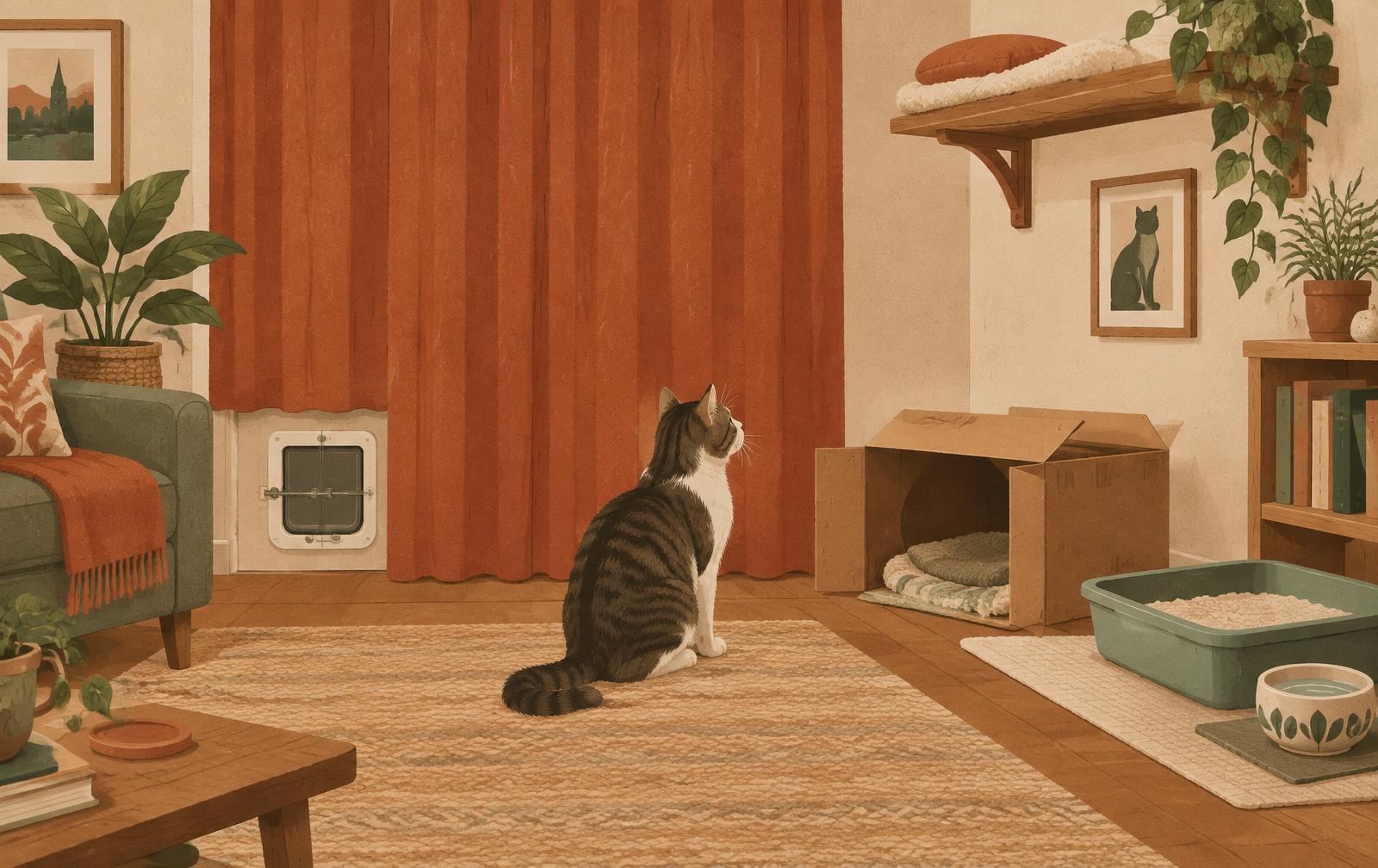
Choice matters. Provide several safe places where practical. Some cats prefer to be underneath things; others prefer height. An open cardboard box, space beneath a bed or access to a familiar high shelf may be more attractive than the expensive calming den you've bought specifically for November.
Make sure frightened cats can't squeeze into genuinely dangerous gaps behind appliances or become trapped. And remember the less glamorous resources — a cat normally accustomed to toileting outdoors needs an indoor litter tray if it is suddenly going to spend the evening inside, and food and fresh water should remain accessible.
The principle is straightforward: increase safety without unnecessarily removing choice.
Should you comfort your cat?
If your cat wants you, yes.
The old idea that an owner must ignore a frightened animal or risk rewarding its fear is too simplistic. But with cats, it's equally easy to make the opposite mistake. A cat beneath the bed that moves farther away every time your hand appears isn't asking you to comfort it — leave it alone. A cat that comes towards you, sits beside you or actively seeks physical contact can be allowed that contact.
Interestingly, the Dutch survey found that 55.6% of cats sought eye contact with their owner during or immediately after fireworks, while 43.4% moved closer to their owner. Cats don't all respond to fear by wanting complete isolation.
So don't impose comfort. But don't deliberately withhold it either. Let your cat decide.
Pheromones aren't the same thing as a treatment plan
Pheromone diffusers are among the products most commonly recommended for feline stress. The evidence is much less impressive than their ubiquity might suggest.
A systematic review by Frank and colleagues examined pheromone studies in cats and dogs and found insufficient evidence of effectiveness across most of the included studies.
The 2024 Dutch firework survey provides another useful, although very different, piece of evidence. Among owners who reported using pheromone-based products for their cats, 9 of 147 — 6.1% — reported a lasting mitigating effect. That does not mean pheromones have a 6.1% efficacy rate. This was an observational owner survey rather than a randomised controlled trial, and "lasting mitigating effect" is a particular outcome rather than a direct measurement of whether a diffuser had any effect at all.
But taken alongside the systematic-review evidence, it certainly doesn't justify presenting a pheromone diffuser as the main intervention for a severely frightened cat. If you use one, think of it as one possible component of the environment. Not the plan.
The medication gap
This is one important respect in which cat and dog firework advice shouldn't simply be copied and pasted between species.
There are veterinary medicines authorised specifically for noise-related fear or anxiety in dogs in Great Britain. There isn't an equivalent medicine authorised specifically for feline noise fear.
That doesn't mean a vet has nothing to offer. A vet can assess how severe the problem actually is, consider whether pain or another health problem could be contributing to a change in behaviour, and discuss whether any treatment is appropriate for that particular cat.
If last year's fireworks meant your cat disappeared for a prolonged period, wouldn't eat, injured itself, escaped or remained substantially affected afterwards, have that conversation before the main firework nights.
Don't give your cat human anxiety medication or medicine prescribed for another animal. And don't interpret the absence of a licensed feline firework drug as meaning there is nothing worth discussing. The absence of a licensed medication isn't the same as the absence of anything worth doing.
What about firework recordings?
Recorded firework sounds can be used in carefully controlled desensitisation work. But the objective isn't to discover how much noise your cat can tolerate.
The recording begins at an intensity low enough that it doesn't produce fear. Progress is gradual and governed by the animal's response. If the cat runs away when you turn up the recording, you've gone too far.
Recordings also can't reproduce everything about a real display — the unpredictable direction, vibration, flashes and timing all make real fireworks a more complicated stimulus.
With Bonfire Night only weeks away, don't turn desensitisation into a race against the calendar. For a cat with established firework fear, the immediate priorities are making the environment safer and reducing avoidable exposure. The longer-term behaviour work doesn't need to end on 5 November.
Try this today
Think about where your cat went the last time something frightened it. Not where you'd like it to go — where it actually went. Check that the location is safe and that the route remains accessible.
If your cat normally toilets outdoors, make sure you have an appropriate indoor litter tray ready. Then check the microchip registration details and the phone number attached to them.
None of those things will cure firework fear. All of them could matter when the fireworks begin.
The Bottom Line
The reason firework fear in cats can be difficult to recognise isn't that cats don't show it. It's that some of the ways they show it look remarkably like ordinary cat behaviour. They hide. They become quiet. They withdraw.
Hiding itself doesn't need fixing. What matters is the cat that cannot settle, won't eat, remains frightened after the noise has stopped, becomes increasingly sensitive to other sounds or tries to escape.
Before the busiest nights, bring outdoor cats in before the fireworks start. Secure the cat flap and windows. Provide an indoor litter tray. Give them several safe places rather than one place you've chosen for them. Check the microchip details.
Then let the cat decide whether it wants to disappear under the bed or sit beside you. And if last year involved severe or prolonged distress, speak to your vet before this year's fireworks begin.
A frightened cat isn't necessarily the one making the most noise. Sometimes it's the one you can't see.
Burrow provides evidence-led pet health information and isn't a substitute for veterinary diagnosis or treatment. If your cat is injured, stops eating, escapes or remains significantly distressed, contact your vet.
Common questions
Frequently asked.
References
Sources.
- PDSA. Cats and fireworks — guidance and PAW Report estimate that 30% of owners report their cat is afraid of fireworks.
https://www.pdsa.org.uk/pet-help-and-advice/pet-health-hub/other-veterinary-advice/cats-and-fireworks - Cats Protection. Cats and fireworks — advice on keeping cats indoors, providing hiding places, avoiding unnecessary confinement and allowing cats to choose interaction.
https://www.cats.org.uk/help-and-advice/home-and-environment/fireworks - van Herwijnen IR, Vinke CM, Arndt SS, Roulaux PEM. Firework (noise) aversion in cats and dogs as reported by Dutch animal owners. Veterinary and Animal Science, 2024;26:100402.
https://doi.org/10.1016/j.vas.2024.100402 - Frank D, Beauchamp G, Palestrini C. Systematic review of the use of pheromones for treatment of undesirable behavior in cats and dogs. Journal of the American Veterinary Medical Association, 2010;236(12):1308–1316.
https://doi.org/10.2460/javma.236.12.1308
Keep reading
Further reading.
Want calm, seasonal notes on keeping your pets safe? Join The Once-Over, our weekly note from Hazel.