Dog · All · Routine
How to Read Your Dog's Body Language
Published 16 Jul 2026 · ✓ Researched
TL;DR
- Dogs communicate constantly through posture, face and movement. Most miscommunication is us misreading them, not them being unclear.
- Read the whole dog, in context. No single signal means anything on its own — a wagging tail with soft eyes and a loose body is the opposite of a wagging tail with a stiff frame and hard stare.
- A wagging tail means arousal, not happiness. It can signal excitement, frustration or threat depending on height, speed and stiffness.
- A growl is communication, not aggression. It says 'I need space.' Punishing it teaches a dog to skip the warning and go straight to a bite — the single most important thing on this page.
- The 'guilty look' isn't guilt. It's an appeasement response to your body language, not awareness of wrongdoing.
- Learn the quiet stress signals — yawning, lip-licking, looking away, whale eye — and act on them early, before a dog has to escalate.
- A sudden change in how your dog communicates can mean pain or illness. It's worth a vet's attention, not just a trainer's.
Your dog has been talking to you all day. The question is whether you've been reading it right — because most of us, with the best will in the world, aren't.
Watch your dog for the next ten minutes and you'll see it: an ear flick, a slow blink, a yawn, a lick of the lips, a turn of the head, a sniff at the ground. Almost all of it looks like nothing. Almost none of it is. Dogs communicate more or less constantly, through a fluent language of posture, expression and movement, and they are remarkably good at it. We are the ones who struggle. We read our own meanings into their signals, trust folk wisdom that turns out to be wrong, and miss the quiet cues until they become loud ones.
This matters for more than curiosity. Misreading a dog has real consequences: for the dog, whose discomfort goes unheard until it escalates, and sometimes for the people around it. Learning to read a dog properly is one of the most useful and humane things an owner can do. This guide sets out what the evidence actually says.
The two rules that govern everything
Before any individual signal, two principles underpin the whole business of reading a dog. Get these, and the rest becomes far easier.
The first: never read a single signal in isolation. A wag, an ear position, a lick — none of them means anything reliable on its own. What matters is the whole dog: the overall posture, the combination of signals, and how they fit together. A tail wagging on a loose, wiggly, soft-eyed dog is friendly. The very same wag on a dog that is stiff, still and hard-eyed is a warning. The signals only make sense together.
The second: context is everything. The same behaviour can mean opposite things depending on the situation. A yawn from a dog dozing in the sun is tiredness. The identical yawn from a dog at the vet, or being hugged by a child, is very likely stress. Panting on a hot walk is thermoregulation; panting in a quiet, cool room may be anxiety or pain. Before you interpret any signal, ask what else is going on: where is the dog, who is present, what just happened, and is the dog otherwise loose or tense?
Hold those two rules in mind and you're already reading your dog better than most.
Reading the dog, head to tail
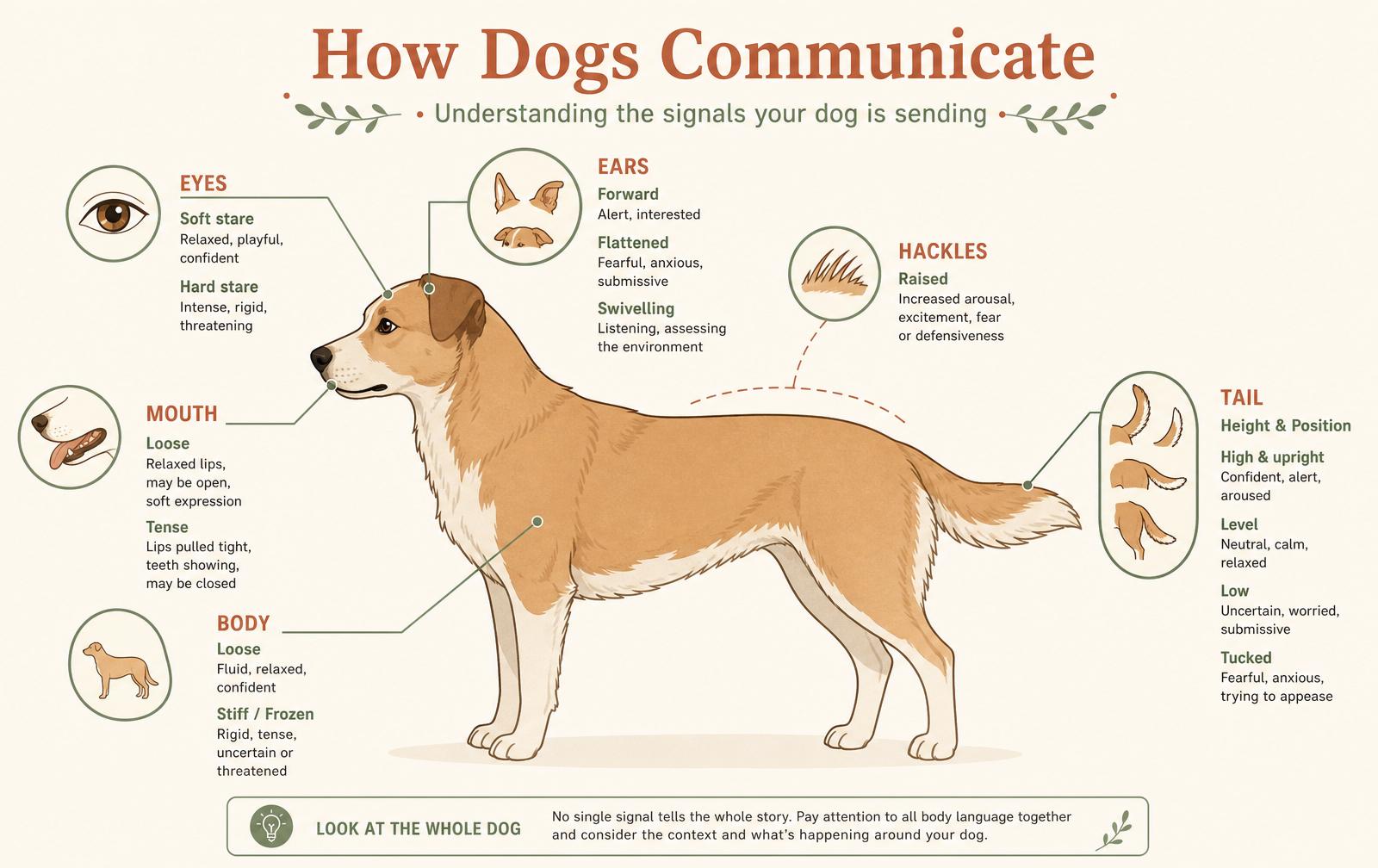
With those rules in place, here is what each part of the dog is telling you. Remember to combine them rather than reading any one alone.
The eyes. Soft, slightly squinted eyes on a relaxed dog signal comfort. Hard, wide eyes with a fixed stare signal tension or threat. One particular sign is worth learning by name: "whale eye," where the dog turns its head slightly away but keeps looking at something, showing the whites at the corner. Whale eye is a clear signal of discomfort and a request to be left alone, and it's frequently missed.
The ears. Ear position varies enormously by breed, which is why baseline matters, but broadly: ears forward and up mean interest, alertness or assertiveness; ears flattened back against the head mean fear, anxiety or appeasement; ears swivelling are simply a dog processing sounds. On a floppy-eared breed you're watching the base of the ear rather than the tip.
The mouth. A relaxed dog often has a loose, slightly open mouth, sometimes with a "long lip." A tightly closed mouth with the corners drawn forward or back, a tense jaw, is a sign of stress or arousal. A dog that suddenly closes its mouth and goes still has just noticed something. Note that a "submissive grin," where a dog shows its front teeth with a wiggly, loose body, is not a snarl; context and body tell them apart.
The body. This is where much of the truth lives. A relaxed dog is loose, its movements fluid, its weight balanced. A tense dog is stiff, and the most important single posture to recognise is the freeze: a dog that goes completely still, holding its breath, weight set. Freezing is a serious warning. It very often comes immediately before a snap or a bite, and it means "stop now." A dog leaning forward is confident or assertive; a dog with its weight back, crouched or trying to make itself small, is fearful.
The hackles. Raised hackles, the hair standing along the spine, technically piloerection, indicate arousal, but not necessarily aggression. A dog can raise its hackles from excitement or uncertainty as well as threat. It tells you the dog is highly stimulated; the rest of the body tells you by what.
The tail. The most misread part of the dog, and worth its own section.
The tail: the most misunderstood signal there is
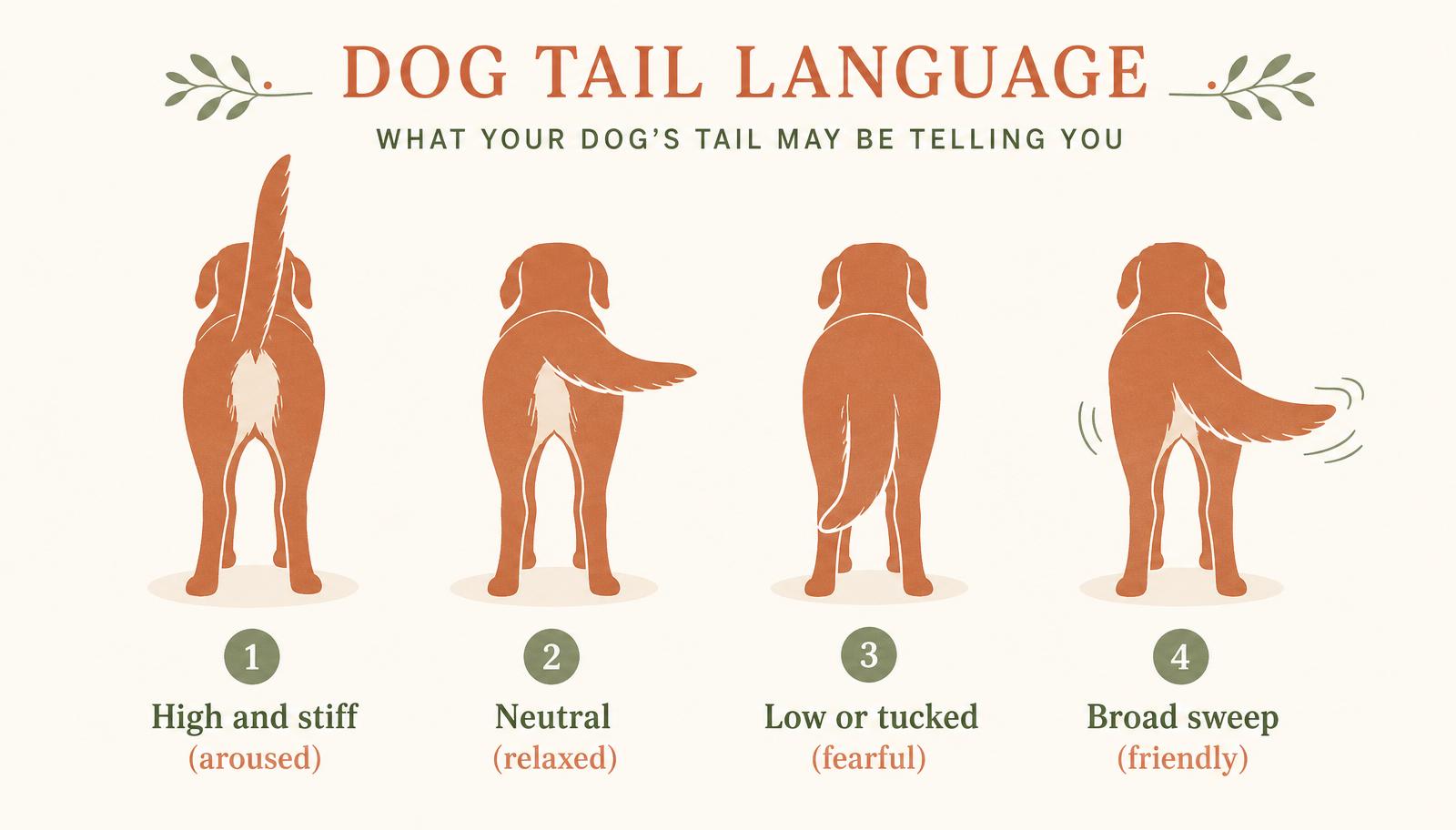
If one myth needs retiring, it's that a wagging tail means a happy dog. It does not. A wag signals emotional arousal, and arousal comes in many flavours, including frustration and threat.
The detail is where the meaning lives. Height matters: broadly, the higher the tail, the more assertive the dog, while a tail tucked low or between the legs signals fear and stress, and a neutral mid-height tail (neutral depends on breed) signals a relaxed dog. Speed and stiffness matter: a slow wag on a stiff, high tail is very different from a loose, broad sweep. A high, stiff, fast twitch of a wag can precede aggression; a low, fast wag is often appeasement; a broad, sweeping wag, or the full "helicopter" spin where the tail goes in circles, is a genuinely happy, friendly greeting.
There's even a subtler finding from the research: dogs tend to wag more to the right when feeling something positive, and more to the left when feeling something negative. You won't always catch that in real time, but it underlines the point: the tail is a rich, nuanced signal, not a simple happiness gauge.
The four myths that get dogs into trouble
Some misreadings are harmless. These four are not, because acting on them can genuinely damage the relationship or make a dog more dangerous, not less.
Myth one: a wagging tail means a happy dog. Covered above, but it belongs here too, because it's the myth most likely to get someone bitten. People approach a wagging dog assuming friendliness and miss the stiff body and hard eyes that told the real story.
Myth two: a growl is bad behaviour to be punished. This is the most important correction in this guide. A growl is not aggression; it is communication. Your dog is telling you, as politely as it can, that it is uncomfortable and needs more space. It is a warning, and a warning is a gift. If you punish a dog for growling, you don't remove the discomfort, you only remove the warning, and you teach the dog that growling brings trouble. The result is a dog that learns to skip the growl and go straight to snapping or biting, with no signal in between. Never punish a growl. Instead, note what caused it, remove your dog from the situation, and address the underlying discomfort, ideally with a qualified behaviourist if it's persistent.
Myth three: the "guilty look" is guilt. You come home, find the mess, and there's the dog: ears back, head low, eyes averted, slinking away. It looks exactly like a guilty child. It isn't. Studies have shown the "guilty look" has nothing to do with a dog's awareness of past wrongdoing. It's an appeasement response to your body language and tone, a dog reacting to your anger, or to the memory of past consequences, and trying to defuse the threat. Punishing the "guilty" dog punishes fear and confusion, not wrongdoing, and does nothing to change the original behaviour.
Myth four: a dog that licks is giving kisses. Sometimes, yes, licking is affection or a learned attention-seeking habit. But it's also a common appeasement and anxiety signal. A dog licking insistently in a tense moment isn't necessarily expressing love; it may be asking for the tension to stop.
The quiet signals most people miss
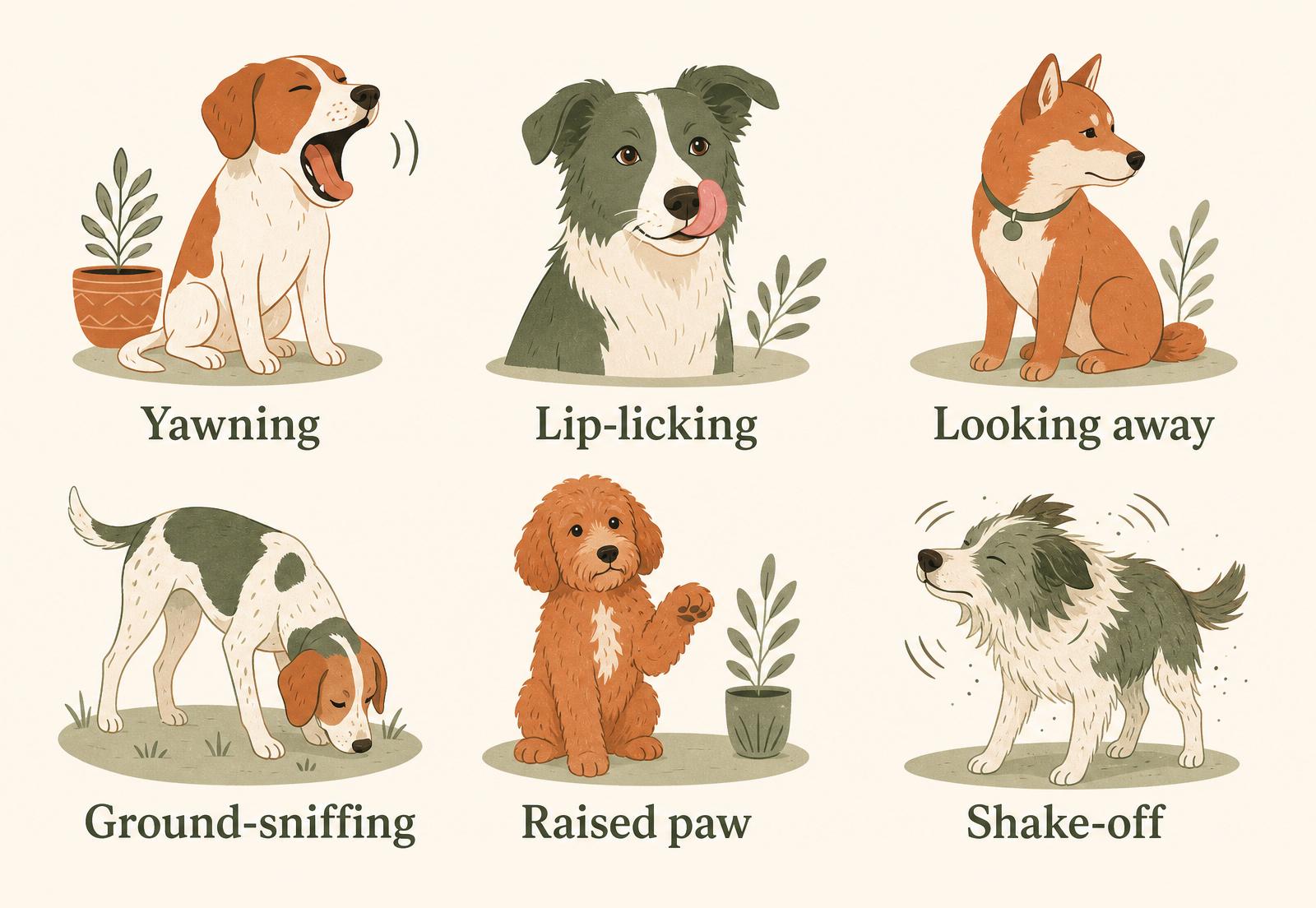
Between "relaxed" and "growling" lies a whole vocabulary of subtle stress signals, often called calming signals or displacement behaviours. Dogs use them both to soothe themselves and to signal peaceful intent, to say "I mean no harm" or "please, less." They are easy to miss precisely because they're understated, and learning to spot them is perhaps the single most useful skill in this guide.
Watch for:
- Yawning when the dog isn't tired
- Lip-licking or a quick tongue-flick when there's no food around
- Turning the head away, or averting the eyes
- Sniffing the ground suddenly in a socially tense moment
- Slow, deliberate blinking
- A raised front paw, held still
- Shaking off as if wet, when dry, often to reset after a tense moment
- Whale eye, the whites showing at the corner
- Moving slowly, or freezing
The "shake off" and the sudden ground-sniff are particularly telling once you learn them: a dog that shakes off after a stressful encounter is quite literally resetting. A dog that breaks off to sniff the grass mid-greeting is defusing tension.
The ladder: why catching it early matters
Dog stress signals exist on a continuum, sometimes called the ladder of aggression, though it's really a ladder of communication. At the bottom are the quiet signals above: yawning, lip-licking, looking away. If those are noticed and the dog is given space, everything resolves. If they're consistently ignored or overridden, the dog has little choice but to climb the ladder to louder signals: a stiffening body, a freeze, a growl, a snap that deliberately misses, and finally a bite.
Understanding this changes how you respond to a dog. Almost every "sudden" bite was in fact the top of a ladder the dog had been climbing for a while, sending signal after signal that went unread. The whole point of learning the quiet signals is to catch discomfort at the bottom of the ladder, where a little space solves everything, rather than at the top, where it's hard to recover from. A dog that trusts its early signals will be heard rarely needs the later ones.
This is also why forcing a dog to "tolerate" something it's signalling discomfort about — a nervous dog made to accept a stranger's hug, a dog pushed to share space with something it fears — is such a bad idea. It teaches the dog that its quiet signals don't work, which pushes it up the ladder.
A quick word on the "dominance" myth
You'll still hear a great deal about dogs being "dominant," trying to be "pack leader," or needing to be shown "who's boss." It's worth knowing that modern behavioural science has largely moved away from this framing. Most problem behaviour in pet dogs is not a bid for status; it is fear, anxiety, insufficient training, or unmet needs. The old dominance model, and the confrontational, punishment-based methods that come with it, tends to increase fear and damage trust, which makes behaviour worse rather than better.
The practical takeaway: when a dog behaves in a way you don't want, the useful question is almost never "how do I assert dominance" and almost always "what is this dog feeling, and what does it need?" That shift, from control to communication, is the whole spirit of reading body language well.
What to do with what you've read
Reading your dog is only useful if it changes what you do. A few principles:
When your dog signals discomfort, respect it. Give space, remove the trigger, let the dog retreat. This is how trust is built: the dog learns that its signals work and it doesn't need to escalate.
Approach nervous dogs slowly and sideways. Don't loom, stare, or reach over the head. Turn slightly side-on, move slowly, and let the dog come to you. You're speaking their language back to them.
Never punish the warning. Growls, and the quieter signals beneath them, are information. Punish them and you go blind to your dog's state.
Learn your own dog's baseline. Every dog is an individual, and breed affects everything from ear carriage to tail position. The better you know your dog's normal, the faster you'll spot when something's off.
When body language is a health signal
One crucial point that's easy to overlook: a sudden change in how your dog communicates can be a sign of pain or illness, not just emotion. A normally sociable dog that becomes withdrawn or reactive, a relaxed dog that starts showing persistent stress signals, a dog that suddenly resents being touched in a particular spot — all of these can indicate that something hurts. Dogs, like cats, tend to mask pain, and a shift in body language is sometimes the first outward sign.
So if your dog's communication changes noticeably and there's no obvious situational reason, treat it as a possible medical matter as much as a behavioural one, and speak to your vet. And for persistent fear, anxiety or aggression, seek a qualified, reward-based behaviourist, ideally one accredited by a recognised body, rather than a trainer who talks in terms of dominance and correction.
The bottom line
Your dog is communicating all the time, in a language that's learnable once you know what to look for. The two rules that matter most are to read the whole dog rather than any single signal, and to always consider the context. From there, retire the myths that get dogs into trouble: the wagging tail that supposedly means happiness, the growl that supposedly deserves punishment, the "guilty look" that isn't guilt. Learn the quiet signals — yawns, lip-licks, looking away — and act on them early, because a dog whose small signals are heard rarely needs the big ones.
Above all, treat your dog's communication as information to respect rather than behaviour to control. Do that, and you'll not only avoid a great deal of trouble, you'll have a dog that trusts you to listen, which is the foundation everything else is built on.
Guides on Burrow are researched carefully and written to be genuinely useful, but they aren't a substitute for professional behavioural or veterinary advice. If your dog is showing persistent fear or aggression, or its behaviour changes suddenly, speak to your vet and consider a qualified, reward-based behaviourist.
Related reading: How to Tell if Your Cat Is Unwell · How Much to Feed Your Dog · Recognising Heatstroke in Dogs · Does Playing With Your Dog Keep Its Brain Younger? · The Fireworks Guide
Common questions