Behaviour · Dog · 20 Aug 2026
Does Playing With Your Dog Keep Its Brain Younger?
By Burrow · 20 Aug 2026
TL;DR
- Dogs can develop canine cognitive dysfunction syndrome (CCDS), a progressive age-related condition affecting behaviour, memory, sleep and awareness.
- A new study of 858 dogs over seven found that lifetime sporting activity and regular shared activities with owners were associated with lower cognitive-decline scores.
- The research does not prove that play prevents dementia. The study was observational, so cause and effect remain uncertain.
- Earlier Dog Aging Project research also found a strong association between greater physical activity and lower odds of cognitive dysfunction.
- New veterinary guidelines now formally classify CCDS into mild, moderate and severe stages and recommend behavioural screening as dogs age.
- Early signs can include disorientation, changes in interaction, disrupted sleep, house soiling, altered activity, anxiety and changes in learning or memory.
- Play, sniffing, training and exploration are sensible ways to keep a dog engaged, even if we cannot yet say they prevent cognitive decline.
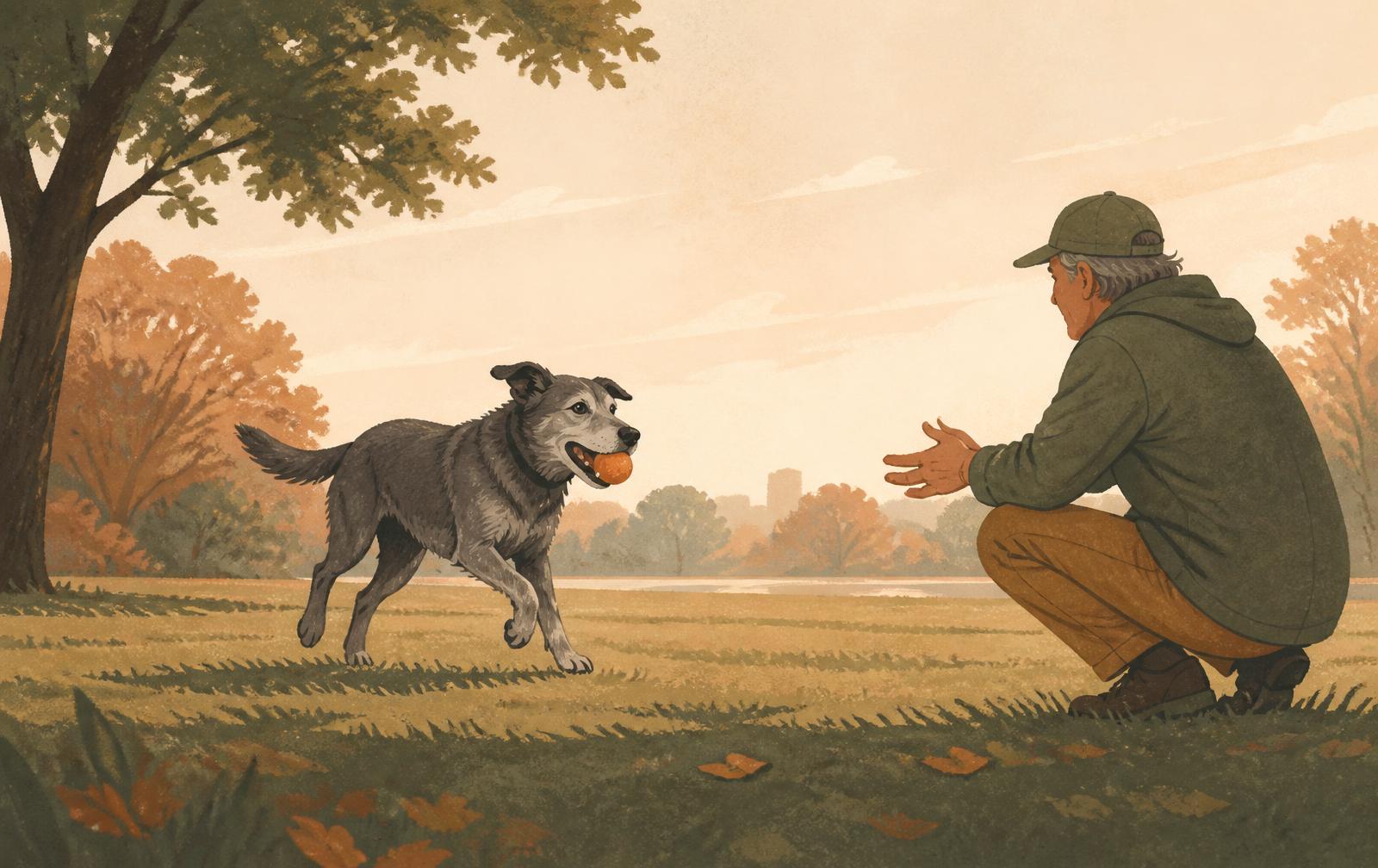
Could a lifetime of fetch, tug and shared activity help protect your dog's brain? A new study of 858 dogs says there may be something in it — but the honest answer is more interesting than the headline.
A new study of 858 dogs aged over seven found that dogs with a history of regular activity with their owners had lower cognitive-decline scores in later life. Dogs with a lifetime history of sporting activity also tended to score better.
It is an intriguing result. It is not proof that playing prevents dementia. The study was observational, which means researchers found a relationship between activity and cognitive health but cannot tell us with certainty which caused which. Dogs with healthier brains may simply remain more active for longer. Owners who play and train more may differ in other ways that matter. But the study adds to a growing body of evidence suggesting that how dogs move, explore, learn and interact throughout life may matter to the ageing brain — and that makes a game of fetch considerably more interesting than it looks.
Dogs' brains age too
The ageing dog is easy to recognise physically. Grey around the muzzle. A slower climb into the car. Longer naps. Less enthusiasm for a cold morning walk. Changes in the brain can be much harder to spot.
Canine cognitive dysfunction syndrome, or CCDS, is a chronic, progressive neurodegenerative condition affecting older dogs. It can alter orientation, memory, sleep, social behaviour, activity and previously learned habits. It is sometimes described as dog dementia, and there are meaningful biological similarities with human neurodegenerative disease, including changes involving amyloid-beta in the ageing canine brain. But the comparison should not be taken too literally — CCDS is its own veterinary condition, and one that has historically lacked consistent diagnostic standards.
That is beginning to change. New consensus guidelines published online in late 2025 and in the 2026 Journal of the American Veterinary Medical Association introduced a standardised definition of CCDS, two diagnostic levels and three severity stages: mild, moderate and severe. That matters because subtle cognitive change is easy to dismiss as simply getting old. Increasingly, vets are being encouraged to look for it much earlier.
The new study: 858 older dogs
The latest research looked at 858 dogs aged seven years and older. Owners provided information about their dogs' activity histories and completed a validated questionnaire assessing signs associated with cognitive decline. Researchers then looked for relationships between lifestyle factors and cognitive scores.
Two findings stood out. Dogs with a history of lifetime sporting activity tended to have lower cognitive-decline scores. So did dogs that regularly participated in shared activities with their owners, including ordinary interactive activities rather than formal sport alone. That second finding is arguably the more interesting one for most owners. You do not need an agility dog. You do not need to compete in obedience. Something as ordinary as playing together may be part of the same picture.
Does that mean fetch prevents dementia?
No — and this distinction is important. The study found an association. It did not randomly assign puppies to play and no-play groups, follow them for fifteen years and compare rates of dementia.
There are several possible explanations for the finding. Perhaps regular physical and mental activity helps preserve cognitive function. Perhaps dogs developing cognitive decline gradually stop playing and become less active before their owners or vets notice any change. Perhaps healthier dogs are able to remain active for longer. Perhaps owners who provide more play and training also provide other forms of care that influence long-term health. Or several of those things may be happening together. The researchers themselves frame the findings cautiously.
The correct conclusion is not: play with your dog and it won't get dementia. It is: dogs with more active and interactive lives appear to have better cognitive outcomes, and researchers are increasingly interested in whether that relationship may be protective. That is still a significant finding.
Earlier research points in the same direction
This is not the first time activity and canine cognition have been linked. Research from the Dog Aging Project, involving more than 15,000 companion dogs, found that the odds of CCDS increased by around 52% for every additional year of age. Among dogs of the same age, those reported as less active had substantially greater odds of cognitive dysfunction. But the researchers highlighted the same problem: which comes first? An active dog may have a healthier brain, or a dog with a healthier brain may simply remain active. The new 858-dog study adds weight to the relationship, particularly because it looks at activity history rather than only what dogs are doing at the moment of assessment. But the causal question remains open.
What does play actually ask a dog's brain to do?
Watch a dog chasing a ball and the behaviour can look almost comically simple. Ball goes away. Dog retrieves ball. Repeat until one participant loses interest. Usually the human. But even simple play can involve a surprising amount of cognitive processing. A game of fetch may involve tracking movement, locating an object, remembering where it landed, interpreting a human cue, navigating the environment and anticipating what happens next. Tug adds social interaction and behavioural control. Hide-and-seek adds memory, searching and scent. Training introduces learning, attention and reward prediction. None of this means play is a medical treatment. It does mean that activity is often much richer neurologically than simply burning calories.
Physical activity and mental activity are not the same thing
A dog can walk five kilometres and experience relatively little novelty. Another dog may walk half that distance while stopping to sniff, exploring a new route and interacting with its environment. Both have exercised. The cognitive experience is different.
Dogs understand much of their world through smell. A lamp post that seems entirely uninteresting to you may contain information about multiple animals that passed several hours earlier. This is why letting dogs sniff is not wasted walking time — it is sensory activity. For older dogs in particular, this can matter because high-impact exercise may become less suitable while exploration remains perfectly accessible. Allowing a dog to explore scent gives it information to process and decisions to make. That can mean taking a slightly different route, slowing down, allowing longer sniffing stops, or hiding suitable food for the dog to find.
Older dogs can keep learning
The cliché about old dogs and new tricks has never been particularly accurate. Older dogs remain capable of learning. What changes is the way we may need to teach them. A dog with arthritis may struggle with repeated sits. A dog losing its hearing may respond better to visual signals. A dog with deteriorating eyesight may particularly enjoy scent-based tasks. The principle is not to force an elderly dog through a cognitive workout — it is to keep giving it opportunities to engage. That might mean teaching one simple new cue, finding a hidden treat, learning the name of a toy, or solving a very easy food puzzle. The activity should be interesting enough to engage the dog, not difficult enough to frustrate it.
The signs of cognitive decline owners should know
The recognised framework for assessing behavioural change in older dogs is commonly summarised as DISHAA.
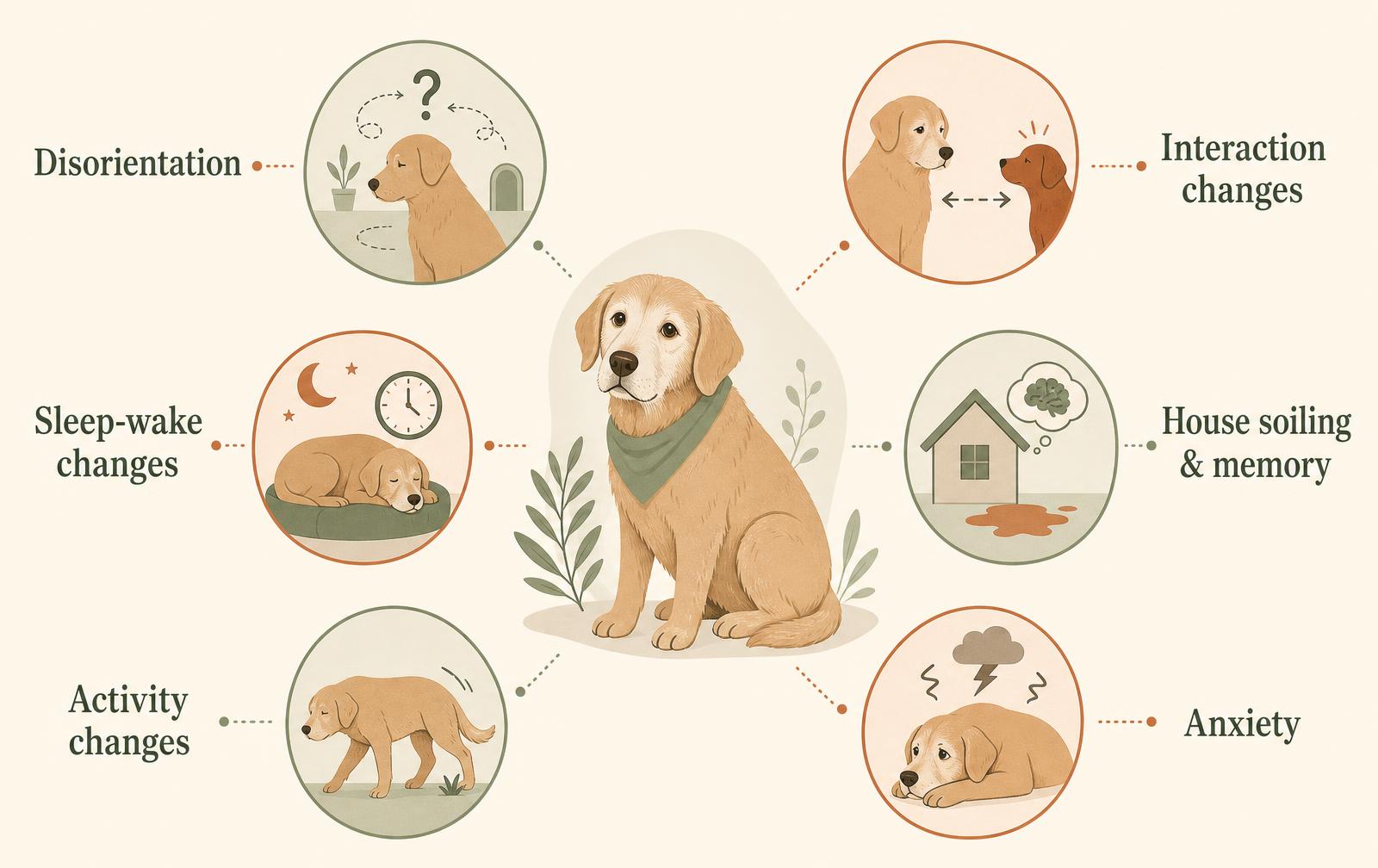
Disorientation. Getting stuck behind furniture, walking to the wrong side of a door, staring at walls, appearing lost in a familiar room, or struggling with routes previously known.
Interaction changes. Some dogs become withdrawn; others become unusually clingy. They may greet familiar people differently or lose interest in interactions they previously enjoyed.
Sleep-wake changes. Sleeping more during the day but becoming restless at night is common. Dogs may pace, wander or vocalise during hours when they previously slept soundly.
House soiling and memory. A previously house-trained dog may begin having accidents indoors. Familiar cues, routines or learned behaviours may also seem less reliable.
Activity changes. Less interest in play or exploration, but also repetitive activity including wandering or pacing without obvious purpose.
Anxiety. New or worsening anxiety, increased separation distress, noise sensitivity or general restlessness that wasn't there before.
These signs do not automatically mean a dog has CCDS. Pain, arthritis, urinary disease, neurological problems, reduced hearing and eyesight, and endocrine disease can all produce similar changes. Diagnosis involves ruling out other explanations — which is why a vet assessment matters rather than assuming. Learning to read subtle shifts in your dog's body language makes those changes easier to notice early.
Why "he's just getting old" can be unhelpful
Normal ageing exists. But it should not become an explanation for every change in an older animal. A dog that becomes reluctant to walk may have arthritis. A dog suddenly toileting indoors may have urinary disease. A dog that stops responding to its name may be losing its hearing. A dog wandering at night may be experiencing cognitive change. The useful question is not "is this normal for an old dog?" It is "what has changed, and is there a reason for it?" That is a much better starting point, and the new CCDS guidelines make the same point — recommending behavioural screening annually from around seven years of age, so that subtle changes can be identified earlier against a known baseline rather than noticed only once they become obvious.
Try this today
Think about your dog six months ago. Not yesterday, not last week — six months. Then ask: does it greet you in the same way? Does it still initiate play? Is it sleeping differently? Has it started wandering at night? Does it ever seem confused in familiar places? Has toilet behaviour changed? Is it more anxious? Does it still respond reliably to familiar cues? Gradual behavioural changes are particularly difficult to detect when you live with an animal every day. Looking backwards over months makes them much easier to see. If something has changed, write it down and mention it at your dog's next vet appointment rather than assuming it is simply age. A short video can also be useful if the behaviour is visual.
Should you deliberately play more with your dog?
There is very little downside to providing an otherwise healthy dog with appropriate opportunities for play, activity and engagement. But the word appropriate matters — the objective is not to maximise minutes.
Play together. If your dog still enjoys fetch, tug or another interactive game, keep doing it.
Let walks involve exploration. Distance is not the only useful measure of a walk.
Keep teaching. Simple new behaviours provide cognitive engagement.
Use scent. Searching for food or objects can be particularly accessible for older animals.
Adapt with age. Make activities easier as mobility, hearing or vision changes. The Joint Health Guide covers how to keep an older dog moving comfortably.
Keep it enjoyable. If the dog is frustrated, frightened or exhausted, it is no longer enrichment.
What if a dog already has cognitive dysfunction?
Activity and enrichment may still form part of management, but they are not a cure. A 2026 intervention study examining structured senior-dog training found no significant overall reduction in CCDS severity, although researchers observed changes in some sleep and activity measures and reported reduced caregiver burden. That is a useful reminder of the difference between something being good for an ageing dog and something reversing neurodegenerative disease.
Dogs with suspected CCDS need veterinary assessment. Management may involve environmental changes, routine, diet, treatment of concurrent disease and in some cases medication. The earlier owners recognise the changes, the more opportunity there is to support the animal.
The Bottom Line
The idea that playing with your dog could help keep its brain younger is no longer just a nice theory. A new study of 858 older dogs found that dogs with histories of sport and regular shared activity with their owners tended to have better cognitive scores. Earlier large-scale research has found similar associations.
What we still cannot say is that play causes that protection. The relationship may run in both directions, and the science has not yet shown that another game of fetch today means a lower dementia risk ten years from now.
Fortunately, it does not need to. Playing, exploring, sniffing and learning already make a dog's life richer. If keeping that life interesting also turns out to help the ageing brain, all the better.
This is general information and not veterinary advice. If an older dog's behaviour, sleep, house training, activity or awareness changes, discuss it with your vet. Several medical conditions can produce signs similar to canine cognitive dysfunction.
Related reading: Arthritis in Dogs: The Early Signs Most Owners Miss · The Joint Health Guide · How to Read Your Dog's Body Language
Common questions
Frequently asked.
Keep reading
Further reading.
Want plain-English notes on pet health and the things that affect it? Join The Once-Over, our weekly note from Hazel.