Preventive Vet Care · Dog · 30 Jul 2026
Arthritis in Dogs: The Early Signs Most Owners Miss
By Burrow · 30 Jul 2026
TL;DR
- A 2024 study found nearly 40% of dogs under four already showed joint changes on X-ray, making arthritis far from just an old dog's disease.
- Dogs hide joint pain well. Owners of dogs with confirmed arthritis and joint pain noticed signs in fewer than a third of cases.
- The early signs are all behavioural, not obviously medical: slowing down, hesitating at stairs, not jumping up, stiffness after rest, licking a joint, grumpiness.
- "Slowing down is just getting older" is the myth that costs dogs the most time. It's worth investigating rather than accepting.
- Maintaining a healthy weight is one of the most effective things you can do to reduce joint stress, at any age.
- Early diagnosis and management make a real difference. There's no cure, but catching it early changes what's possible.
Nearly 40% of young dogs already show radiographic signs of arthritis. Most of their owners have no idea.
Arthritis is almost universally thought of as an old dog's disease, something to start worrying about somewhere around the eighth birthday. A 2024 study published in Scientific Reports challenges that assumption directly. Researchers examined 123 dogs aged eight months to four years at a single veterinary practice, and found that 39.8% already showed radiographic signs of osteoarthritis in at least one joint. Around a quarter had both visible joint changes and joint pain. The owners of those dogs noticed signs of a problem in fewer than a third of cases.
It's worth being clear about what this study was and wasn't: 123 dogs at one practice is a small sample, not a definitive population figure. But it has since been cited in multiple subsequent reviews, and the finding — that significant joint changes in young dogs are far more common than assumed, and almost entirely unrecognised — is broadly consistent with what veterinary professionals working in this area have been saying for some time.
If it holds even partially, it means arthritis starts earlier than we think, dogs are remarkably good at hiding it, and by the time most owners notice something is wrong, the disease has often been progressing for a while. Catching it earlier changes what you can do about it. That's what this piece is for.
Why we miss it, and why that matters
The reason most arthritis goes unnoticed for so long comes down to two things: our expectations, and dogs.
We expect arthritis to look like obvious pain. A yelp, a pronounced limp, a dog that won't get up. That's the advanced presentation. The early stages look nothing like that. They look like a dog that's a bit slower than it used to be, a bit less enthusiastic, a bit stiffer on cold mornings. All things that are easy to attribute to ageing, and very human to accept without question.
And then there are the dogs themselves. Like many animals, dogs often mask pain remarkably well. Changes tend to appear first in behaviour rather than obvious limping or crying out, which is one reason arthritis is frequently recognised later than it could be. A dog with genuinely sore joints will compensate, adjust its gait, avoid certain movements, carry weight differently, and behave subtly differently, all without showing what most of us would recognise as distress. If you want to get better at reading those quieter signals in general, our guide to reading your dog's body language is a good place to start.
The result is a condition that typically goes undiagnosed for years. Research from the Canine Arthritis Management resource confirms that dogs may live with arthritis for a very long time before showing signs obvious enough to prompt a vet visit. The owners who catch it early are nearly always the ones who knew the subtle signs and noticed a change from their own dog's normal.
The early signs: what to actually watch for
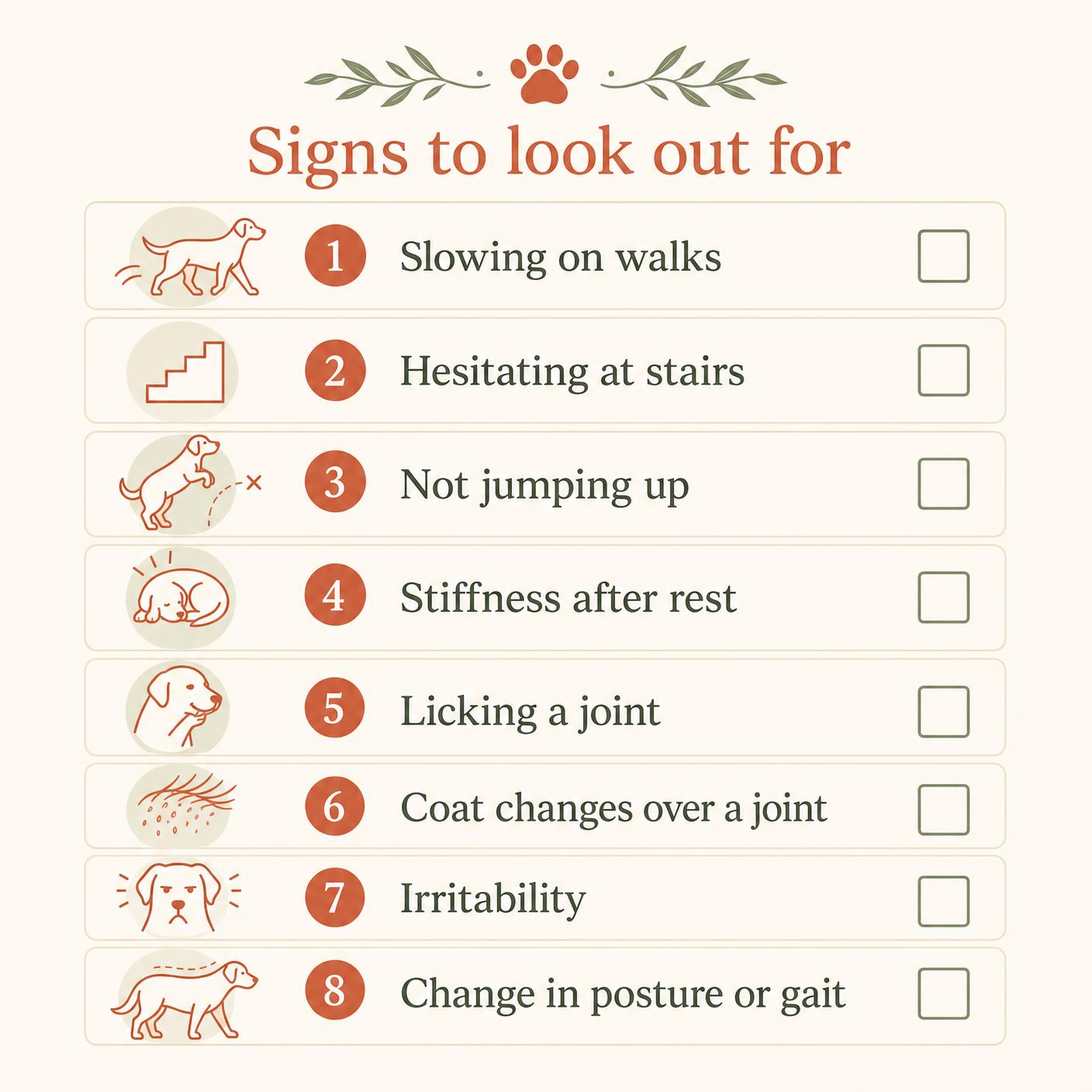
None of these individually is a diagnosis. But a dog showing several of them, particularly after rest or in cold weather, is a dog worth taking to the vet.
Slowing down on walks. Not a dramatic change, more that the dog is hanging back a little, stopping more often, or seeming satisfied with less. This is frequently the first sign, and the one most often explained away.
Hesitating before stairs. A moment of consideration before going up or down, or using the stairs differently than before, going more slowly, placing the feet more carefully.
Not jumping up any more. A dog that used to leap onto the sofa or greet you by jumping up but has quietly stopped. Often attributed to "growing out of it" rather than a possible reason.
Stiffness after rest. A dog that gets up from sleep or a long lie-down moving stiffly, taking a minute to warm up and move more easily. This tends to be most noticeable on cold mornings or after a long rest.
Licking or chewing a joint. Persistent attention to a specific area of the leg, wrist, elbow, shoulder, hip or knee. Not dramatic, but specific: always the same spot.
Coat changes over a joint. Related to the above — prolonged licking changes the coat texture and colour, creating a damp, rust-stained or roughened patch over the affected area.
Grumpiness or irritability. A dog that has become snappier than usual, particularly when touched in certain places or when people approach suddenly.
Changes in how it carries itself. A slightly altered posture, a subtle head tilt, a change in gait that's hard to name. Owners often describe this as "something just looks different," and that instinct is usually right.
Try this today
One of the most effective things you can do right now costs nothing and takes thirty seconds. Film your dog walking towards you and away from you on a flat surface. Do it once a month and save the clips. Small changes in gait, posture, and ease of movement are genuinely difficult to spot day-to-day but become obvious when you compare footage from three or six months apart. It's the kind of low-effort habit that has caught real problems early, and it gives your vet something concrete to look at rather than relying on your memory of how your dog moved six months ago.
The myth that costs the most time
Of all the reasons early arthritis gets missed, one is responsible for more delay than any other: the assumption that slowing down is simply getting older.
It's a natural assumption, and it isn't always wrong. But it's wrong often enough, and early enough, that it's worth treating any significant change in your dog's movement, energy or enthusiasm as something to check rather than accept. Blue Cross, Guide Dogs UK and the Canine Arthritis Management resource all make the same point explicitly: don't assume changes in a dog are simply a result of ageing without ruling out arthritis first.
The difference matters because the earlier arthritis is identified and managed, the more that management can slow its progression and protect what joint health remains. By the time a dog is obviously lame, a good deal of that window has closed.
Weight: the single most important thing you can do
Before we reach risk factors as a list, this one deserves its own paragraph, because the evidence behind it is stronger than almost anything else in this area.
Excess body weight is one of the most significant and modifiable risk factors for arthritis in dogs, and maintaining a healthy weight is one of the most effective things an owner can do to protect their dog's joints, at any age. Every extra kilogram of body weight puts meaningfully more load through joints that may already be compromised. For a dog already showing early signs, losing even a modest amount of weight can measurably reduce discomfort and slow progression. For a young dog with no signs yet, staying at a healthy weight is genuinely preventive.
If you're not sure whether your dog is carrying too much, the body condition check in our feeding guide takes under a minute and tells you more than a scale does. The ribs should be easy to feel under a thin layer of fat, and there should be a visible waist from above.
Who's most at risk
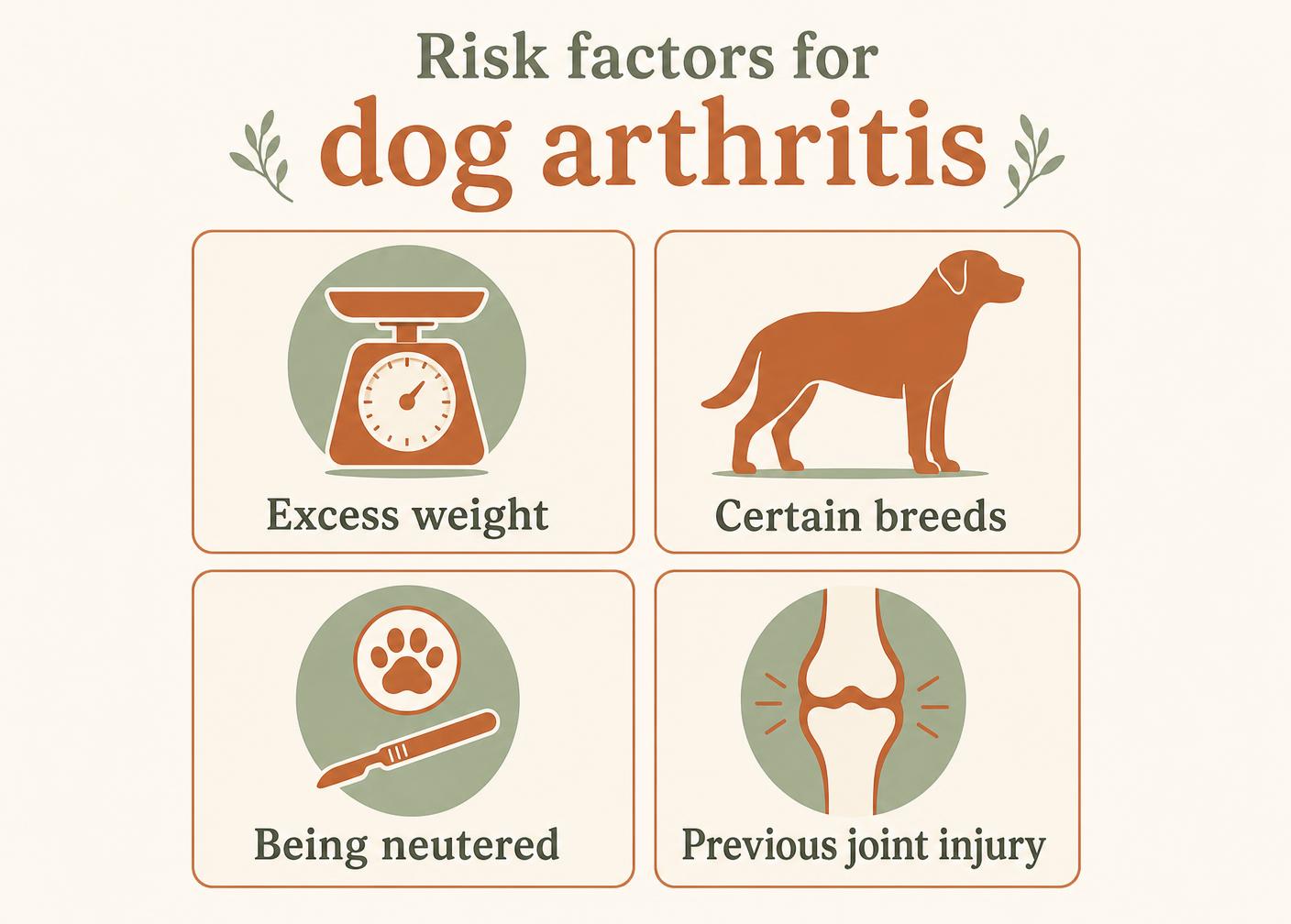
Beyond weight, UK veterinary data from the VetCompass programme at the Royal Veterinary College identifies several clear risk factors:
Breed. Labradors, Golden Retrievers, German Shepherds and other large breeds are at higher risk, though the young-dog study found changes across a range of breeds.
Being neutered. UK data links neutering to increased OA risk, possibly through hormonal effects on joint development.
Previous joint injury. A prior cruciate ligament rupture, hip dysplasia or other joint condition substantially raises the risk of OA in that joint later.
Age. Risk rises significantly after eight years, but as the young-dog data makes clear, joint changes can begin much earlier.
What to do if you're concerned
Make a vet appointment and describe what you've noticed. A good description of the behavioural changes matters far more than you might expect, because it gives the vet something specific to look for during examination. The thirty-second monthly video habit mentioned above pays off here: footage of a gait change or a hesitation at the stairs is genuinely useful to a vet in a way that "he seems a bit stiffer" isn't.
A vet assessing for arthritis will examine the joints for pain response, swelling and range of motion. X-rays may be taken to assess the extent of joint changes. From there, a management plan can be discussed, and management has improved meaningfully in recent years: prescription pain relief options have expanded, and there is growing evidence behind weight management, controlled exercise, hydrotherapy and certain supplements. What the evidence says about each of those options is covered in our Joint Health Guide: Managing Arthritis in Dogs.
The bottom line
Arthritis in dogs starts earlier than most people think, shows up as behavioural changes rather than obvious pain, and gets missed for years because dogs are built to mask discomfort and we are built to explain it away. If your dog is slower than it was, hesitating at stairs, not jumping up, or stiff after a rest, those things are worth investigating rather than accepting.
The goal isn't simply treating arthritis. It's recognising it early enough to help your dog stay comfortable, active and mobile for as long as possible. That's where prevention makes the biggest difference, and where the habits built now — healthy weight, monthly movement checks, prompt attention to subtle changes — pay off in years of better quality of life.
This is general information and not a substitute for veterinary advice. If you're concerned your dog may have arthritis or joint pain, speak to your vet.
Related reading: Does Playing With Your Dog Keep Its Brain Younger? · The Joint Health Guide
Common questions
Frequently asked.
Keep reading
Further reading.
Want plain-English notes on pet health and the things that affect it? Join The Once-Over, our weekly note from Hazel.