Research · Dog · 16 Oct 2026
Why Do Large Dogs Age Faster Than Small Dogs?
By Burrow · 16 Oct 2026
TL;DR
- **Large dogs tend to live shorter lives.** In a UK study of more than half a million dogs, large purebreds had a median lifespan of 11.9 years against 12.7 for small breeds.
- **Earlier work suggested they age faster, not sooner.** A 2013 analysis of death records from 74 breeds found no clear link between size and when ageing begins, but a strong link between size and how quickly the risk of death rises with age.
- **The new study looks inside the cells.** Researchers analysed 1,640 blood samples from 894 dogs and found larger dogs showed accelerated ageing in their DNA methylation patterns.
- **The differences cluster in "jumping genes".** Size-linked changes were most marked in transposable elements, stretches of DNA that methylation normally helps keep quiet.
- **It does not show cause.** The study measured chemical marks, not whether those jumping genes became more active or caused disease.
- **No individual dog is a statistic.** These are population patterns, and breed, face shape and many other factors also shape how long a dog lives.
It has long been known that big dogs tend to die younger. A new study in Science suggests something more specific: their bodies may move through ageing faster, measured in the chemistry of their DNA.
Anyone who has shared their life with a Great Dane and a Jack Russell knows the pattern. The big dog greys early and slows down while the small one carries on into its teens. Across mammal species the rule usually runs the other way, since elephants outlive mice, but within a single species larger individuals tend to be shorter-lived, and dogs show this more starkly than almost any other animal. The question researchers have been chasing is why. A large dog could simply have a higher risk of dying at every age, it could start ageing earlier, or it could age at a faster rate once the process begins. The study published in Science on 8 October addresses the third possibility at the level of the cell.
How much shorter do large dogs live?
One of the largest UK studies is a 2024 Dogs Trust analysis in Scientific Reports, which pooled records on 584,734 dogs from 18 sources including breed registries, vet groups, insurers and rehoming charities. Among purebreds, median lifespan was 12.7 years for small breeds, 12.5 for medium and 11.9 for large. Those medians hide much bigger gaps at the extremes. The breeds with the shortest median lifespans included the Cane Corso at 8.1 years and the Mastiff at 9.0, while the Lancashire Heeler reached 15.4.
Size is not the whole story, and the same study shows why. Flat-faced breeds had a median lifespan of 11.2 years, and medium-sized flat-faced breeds fared worst of all, below the large dogs. The authors also note that cause of death was not recorded, so the data show who dies younger but not why, and that the figures apply to UK dogs only.
Dying younger is not the same as ageing faster
A shorter lifespan could arise in several ways, and they matter differently for a dog owner. In 2013, researchers fitted mortality models to death records from 74 breeds to separate them. They found no clear relationship between body size and the age at which ageing begins, and only a slightly higher baseline risk of death in large dogs. The strongest relationship was between body size and the rate at which the risk of death increased with age. Their conclusion was that large dogs die young mainly because they age quickly.
That finding was inferred from the pattern of deaths across whole breeds, not from measuring physical decline in individual dogs. It could not say what was happening inside the dogs themselves, which is where the new work comes in.
What the new study measured
The research comes from the Dog Aging Project, a long-running study of companion dogs in the United States. The team, led by Blaise Mariner, Brianah McCoy and Noah Snyder-Mackler at Arizona State University, analysed 1,640 blood samples from 894 dogs of many breeds and mixes, with some dogs sampled more than once over several years.
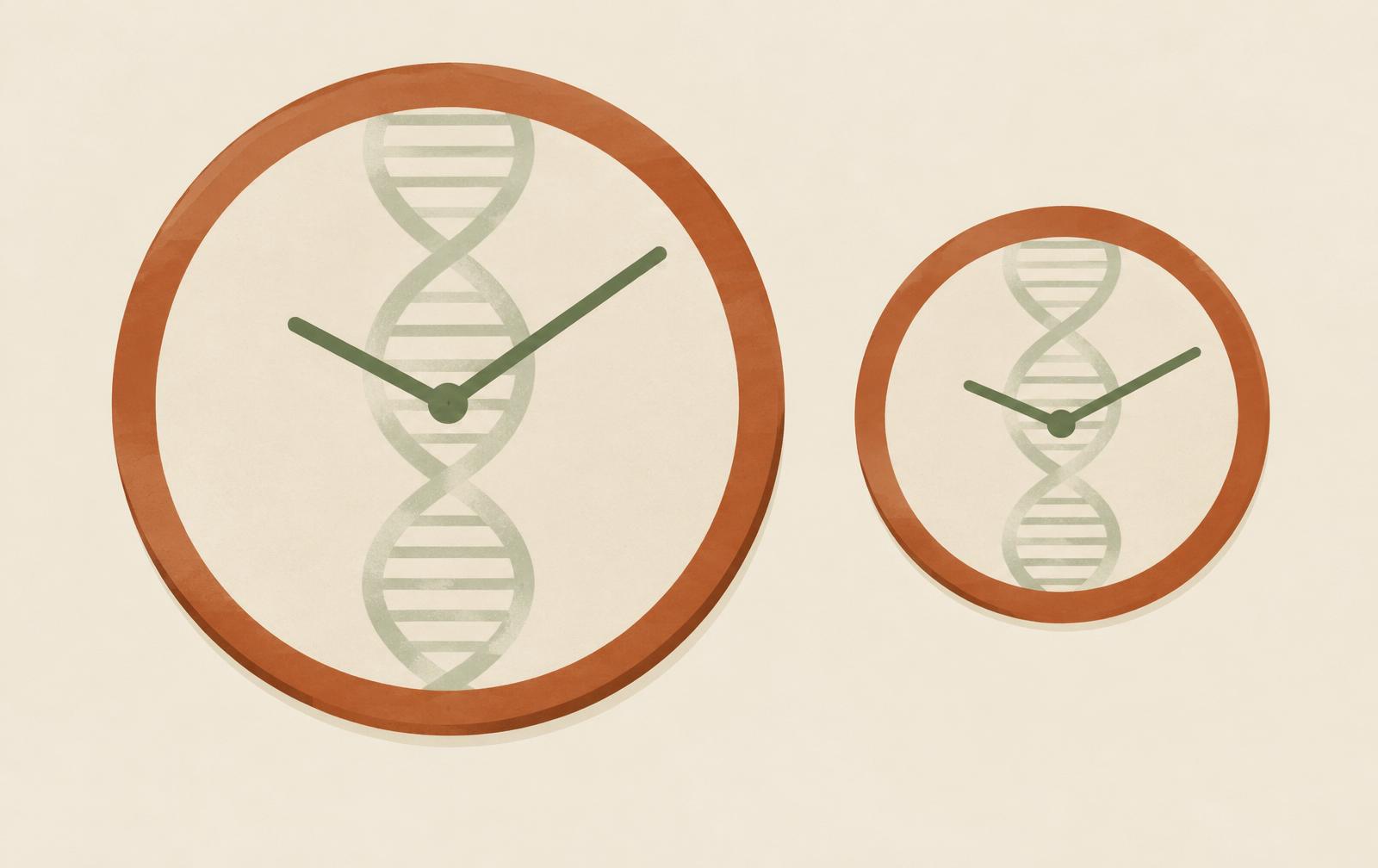
They looked at DNA methylation, small chemical tags attached to DNA that help control which genes are switched on. These tags shift in predictable ways as an animal gets older, which allows scientists to build an "epigenetic clock", an estimate of biological age from a blood sample. Dogs whose clocks ran older than their actual age had a higher risk of death during follow-up, which is what makes the measure meaningful.
Larger dogs and male dogs, both shorter-lived groups, showed patterns consistent with faster molecular ageing. The study also found that this molecular ageing runs fastest early in life, which fits with how quickly dogs mature in their first years.
The jumping genes
The most striking result concerns transposable elements, often called jumping genes. These are repetitive stretches of DNA, some of which can copy themselves and insert into new places in the genome, potentially disrupting genes along the way. Cells normally keep them quiet, partly by coating them in methylation.
As the dogs aged, they lost methylation across many of these regions, and a family called LINE1 was among the most affected. Crucially, the loss was faster in larger dogs. The sex difference followed a different path, concentrated on the X chromosome, which suggests size and sex shape ageing through partly separate routes.
What the study does not show
It would be easy to read this as proof that jumping genes make big dogs die young, and the researchers do not claim that. The study measured methylation marks. It did not measure whether the jumping genes became more active, damaged DNA or caused disease, so the loss of control could be a driver of faster ageing or simply something that happens alongside it.
Snyder-Mackler has described big dogs as ageing only a little faster per year on this measure. He has also said that the data so far explain only part of how biological age varies between dogs, and that the idea of a trade-off between rapid growth and bodily maintenance remains a hypothesis. This is also an American cohort measured in blood, so it captures ageing in immune cells, not every tissue.
The findings add another dimension to the explanation for shorter lifespans in large dogs. They suggest that certain molecular changes associated with ageing proceed more quickly in bigger dogs, alongside the breed-specific disease risks already known to influence survival. Whether those changes contribute directly to disease remains unresolved.
What this means for your dog
None of this changes how an individual large dog should be cared for today, and there is no test or treatment that follows from it. Population figures describe groups of dogs, not any one dog. A particular Labrador or Bernese may age slowly or quickly for reasons that have nothing to do with size, and the UK data show that face shape and breed matter as much as size for some dogs.
What it does reinforce is that a big dog's timeline is compressed. The changes of later life, from stiff joints to slower recovery, can arrive at an age when owners of smaller dogs are still thinking of their dog as young. That makes middle age a sensible time to start paying closer attention, before obvious decline.
Try this today
Ask your vet when your dog should begin receiving more age-focused health assessments. That point may arrive earlier for a giant breed than for a small one, but it depends on your dog's breed, medical history and overall condition. In the meantime, start noting small changes, such as how long it takes your dog to get up after rest, how far it is happy to walk and whether it is slower to recover after exercise, so you have something concrete to discuss at the next appointment.
The Bottom Line
Large dogs do not simply die younger than small ones. Mortality data suggest their risk of death climbs faster with age, and the new Science study adds a molecular picture to that, with faster changes in parts of the genome that normally keep jumping genes in check. Whether that loss of control causes faster ageing is not yet known, and nothing in the study changes care for an individual dog. What it does underline is that a big dog's middle age comes early, and that is the time to start watching and talking to your vet.
This article is for general information and does not replace veterinary advice. If you are concerned about changes in your dog's health or mobility at any age, speak to your vet.
Common questions
Frequently asked.
References
Sources.
- Mariner BL, McCoy BM, Greenier A, et al., Snyder-Mackler N. Epigenetic aging and transposon dysregulation reflect size-related lifespan compression in dogs. Science. 2026;394(6820):eaeb2986.
https://doi.org/10.1126/science.aeb2986 - American Association for the Advancement of Science. Epigenetic clocks reveal why larger dogs age faster. Press release, 8 October 2026.
https://www.eurekalert.org/news-releases/1146434 - Arizona State University. Why big dogs age faster. Press release, October 2026.
https://www.eurekalert.org/news-releases/1146795 - Kraus C, Pavard S, Promislow DEL. The size–life span trade-off decomposed: why large dogs die young. The American Naturalist. 2013;181(4):492–505.
https://doi.org/10.1086/669665 - McMillan KM, Bielby J, Williams CL, Upjohn MM, Casey RA, Christley RM. Longevity of companion dog breeds: those at risk from early death. Scientific Reports. 2024;14:531.
https://doi.org/10.1038/s41598-023-50458-w - Live Science. Big dogs age faster at an epigenetic level, new study finds. 8 October 2026.
https://www.livescience.com/animals/dogs/big-dogs-age-faster-at-an-epigenetic-level-new-study-finds
Keep reading
Further reading.
Want plain-English notes on pet health and the research behind it? Join The Once-Over, our weekly note from Hazel.