Preventive Vet Care · Dog · 30 Jul 2026
Is My Dog Overweight? How to Tell Before It Becomes a Health Problem
By Burrow · 30 Jul 2026
TL;DR
- Vets estimate nearly half of UK dogs are overweight, yet most owners think their dog is fine. The gap is a calibration problem, not a caring problem.
- The scales alone don't tell you enough. A healthy weight for one dog can be obesity for another of the same breed. What matters is body condition.
- The body condition score (BCS) is a nine-point system used by vets. Four or five out of nine is ideal. You can assess it at home in under two minutes.
- The three checks: feel the ribs, look for a waist from above, look for a belly tuck from the side.
- Treats are where the maths quietly breaks down. Four treats a day is the UK average, and for a small dog even that can be a significant share of daily calories.
- The health consequences are real and well-evidenced: shorter lifespan, joint disease, diabetes, heart and respiratory problems.
Vets estimate that nearly half of UK dogs are overweight. Most of their owners are confident they aren't.
The gap between those two facts is the whole problem. According to the PDSA's annual PAW Report, veterinary professionals estimate that 46% of dogs in the UK are overweight or obese — while surveys of owners consistently find that around 80% believe their dog is an ideal weight. Both groups are looking at the same dogs and reaching very different conclusions.
It isn't that owners are careless. It's that most of us genuinely can't tell. Overweight has become common enough that it's starting to look normal, which is exactly how a slow, quiet problem compounds into a serious one. This piece gives you the tools to check your own dog properly and to catch it before the health consequences begin.
Why the scales aren't enough
The first thing most people reach for is the scales, which is understandable and only half the answer. The problem is that "healthy weight" means something different for every individual dog, even within the same breed.
Two Labradors can both weigh 30kg. One is lean, muscular, and healthy. The other is carrying significant excess fat. The scale tells you nothing about which is which. What actually matters is body condition: the ratio of fat to lean mass, and the distribution of that fat on the dog's frame. A number that's overweight for a small female is fine for a large male. Breed, sex, age, and build all shift what the right number looks like.
This is why vets use the body condition score, and why it's a more useful tool than a number on the scales alone.
The body condition score: what it is and how to use it
The body condition score, or BCS, is a nine-point scale developed by the World Small Animal Veterinary Association (WSAVA) and widely used in UK veterinary practice. A score of four or five out of nine is ideal for most dogs. Below that is too lean. Above it is heading towards overweight, and a score of eight or nine indicates obesity.
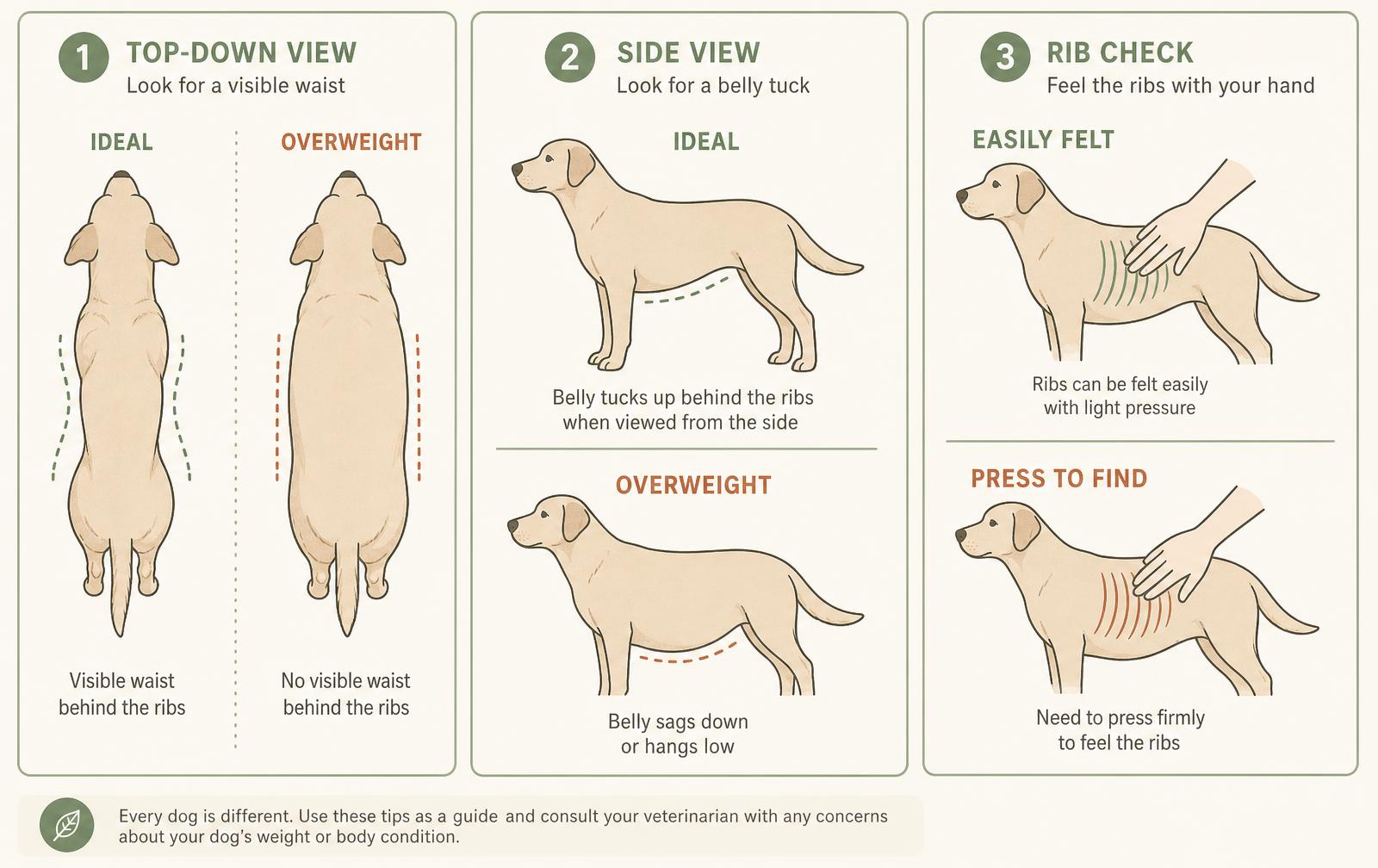
You don't need to memorise the scale to use the idea. The assessment comes down to three checks, which take under two minutes and are best done while your dog is standing or relaxed on a flat surface.
Feel the ribs. Run both hands gently along your dog's sides. On a dog at an ideal weight, you should be able to feel the ribs easily under a thin layer of fat — something like the feeling of running a finger across the back of your knuckles. If you have to press firmly to find them, there is too much covering. If they feel sharp and prominent with nothing over them at all, the dog may be too lean.
Look from above. Stand over your dog and look straight down. You should see a distinct waist — a clear narrowing behind the ribcage, before the hips. A dog with no visible waist, whose outline runs straight or bulges from ribs to hips, is likely carrying excess weight.
Look from the side. From side on, the belly should rise up from the base of the ribcage towards the back legs — the line vets call the abdominal tuck. A belly that hangs level or sags, rather than tucking upward, suggests too much weight. A pronounced tuck with a very narrow waist and visible hip bones suggests the opposite.
There is one important caveat worth knowing. Some breeds naturally look quite different from the typical dog. Greyhounds, whippets, lurchers and other sighthounds carry far less body fat as a matter of normal anatomy — visible ribs and a dramatic tuck are correct for them. What looks alarmingly thin on a Labrador is simply right on a lurcher. If you're not sure what's right for your breed, that's exactly the kind of thing to ask your vet to show you with their hands rather than just explain.
What the numbers tend to look like
If you want to put a rough number to it, here's how the BCS scale maps to what you see and feel:
| BCS | What it looks like |
|---|---|
| 1–3 | Ribs, spine and hip bones visible without touching. Very little muscle. |
| 4–5 (ideal) | Ribs easily felt under thin fat. Clear waist and belly tuck. |
| 6–7 (overweight) | Ribs felt only with pressure. Waist difficult to see. Tuck reduced or absent. |
| 8–9 (obese) | Ribs very difficult or impossible to feel. No waist. Fat deposits on spine, tailhead and neck. |
A score of six or seven means the dog is overweight but not yet at the level that requires the most intensive intervention. A score of eight or nine warrants prompt veterinary attention alongside a weight management plan.
The treat problem
One of the most consistent findings in UK dog obesity research is that excess weight builds quietly through treats rather than dramatic overfeeding at mealtimes. A 2026 Bella+Duke study found that UK dog owners give their dog an average of four treats a day, with 85% sharing leftovers regularly.
For a medium dog, four treats a day can represent a meaningful percentage of daily calories, depending on the treat. For a small dog, it can represent a genuinely significant one. Most owners measure meals reasonably carefully and then add treats without counting, which undoes a fair amount of the discipline applied at the bowl.
The fix isn't to stop treating, which is part of training and part of the relationship. It's to count them as part of the daily total. Trim the main meals slightly on days when treats feature heavily. Consider lower-calorie options: a piece of carrot, a bit of cucumber, the dog's own kibble counted out from the daily ration rather than added to it. The target for treats and scraps combined is no more than 10% of total daily calories.
The full guide to portion management, including how to calculate and adjust for your specific dog's food, is in our feeding guide.
The normalisation problem
It's worth understanding why the perception gap is so large. When most dogs around you are carrying excess weight, a genuinely healthy lean dog starts to look thin. Studies consistently find that owners underestimate their dog's body condition not because they're not looking, but because their reference point for "normal" has shifted.
The PDSA's research found that the majority of owners believe their dog is an ideal weight. If nearly half of UK dogs are overweight, and most of those owners believe them to be fine, then overweight has become the new unremarkable. Learning to calibrate against the BCS rather than against other dogs around you is precisely the point of the three-check assessment above.
Why it matters: the health consequences
This isn't a cosmetic question. The health evidence behind excess weight in dogs is unambiguous and sobering.
Joint disease and arthritis are among the most direct consequences. Extra body weight means extra load through every joint, every day, and adipose tissue also produces inflammatory chemicals that actively worsen joint disease. Our Joint Health Guide covers this in detail, but the short version is that weight management is the most evidence-backed thing an owner can do to protect a dog's joints — more than any supplement, and at least as important as pain relief in an already arthritic dog.
Beyond joints: diabetes, heart and respiratory problems, reduced immune function, and certain cancers are all more prevalent in overweight dogs. Anaesthetic and surgical risk also rises with excess weight, which matters if your dog ever needs to be put under for any reason.
And lifespan. Multiple studies show that dogs maintained at a lean ideal weight live measurably longer than overweight dogs — in some breed-specific studies, by a year or more. For a Labrador, that's significant.
What to do if you think your dog is overweight
First, a vet appointment to confirm and to rule out any underlying medical reason for the weight. Thyroid problems and other conditions can drive weight gain, and it's worth checking before assuming it's purely dietary.
Once it's confirmed as a weight management matter, the approach is always gradual. Crash calorie restriction causes muscle loss alongside fat loss, which is counterproductive — muscle supports joints and helps with metabolism. A loss of around 1–2% of body weight per week is safe and sustainable for most dogs. Your vet may recommend a prescription weight-loss diet, particularly for significant obesity, as these are formulated to provide full nutrition at a lower calorie density.
Exercise helps, both for calorie use and for maintaining muscle, but for an already arthritic or heavy dog, it needs to be low-impact and gradual rather than a sudden increase. Short and frequent is better than long and infrequent.
Try this: weigh your dog now and note it down. Then do the three-check BCS assessment. Book a vet appointment if the result suggests a score above five, or if you're uncertain. And start the monthly habit of checking both weight and BCS, because a slow trend is much easier to catch in numbers than by eye.
The bottom line
Nearly half of UK dogs are overweight, and most of their owners don't know it — not because they don't care, but because the tools most people use (the scales, the eye) aren't calibrated well enough to catch the problem early. The body condition score gives you a better tool, and the three checks take two minutes. Feel the ribs, look for a waist, look for a belly tuck.
If the result suggests your dog is above a five out of nine, take it seriously. The health consequences of sustained excess weight in dogs are well-evidenced and significant, and the earlier the problem is caught, the more there is to be done about it before joints, heart and lifespan are affected. If your dog is already showing stiffness or slowing down, our piece on the early signs of arthritis is worth reading alongside this.
This is general guidance and not veterinary advice. If you're concerned about your dog's weight or health, speak to your vet.
Common questions
Frequently asked.
Keep reading
Further reading.
Want plain-English notes on pet health and the things that affect it? Join The Once-Over, our weekly note from Hazel.