Dog · All · Routine
The Joint Health Guide: Managing Arthritis in Dogs
Published 30 Jul 2026 · ✓ Researched
TL;DR
- Weight management is the single most evidence-supported thing an owner can do. Every extra kilogram increases joint load, and even modest weight loss measurably reduces pain.
- Controlled, regular exercise helps. Short and frequent beats long and infrequent. Keep it low-impact, lead-based, and consistent.
- NSAIDs are the most effective pharmaceutical pain relief and are first-line treatment in most cases. They require blood monitoring. Never use human NSAIDs — they can be fatal to dogs.
- Omega-3 fatty acids are the best-evidenced supplement. Marine-sourced EPA and DHA have genuine analgesic support from systematic review.
- Glucosamine and chondroitin have a very weak evidence base. A 2022 systematic review found they had no meaningful effect on pain in dogs and cats. Worth knowing before spending money on them.
- Librela (bedinvetmab), the monthly injection, can provide meaningful pain relief but has a live safety debate. UK warnings were strengthened in 2026 while the regulator maintained a positive overall benefit-risk balance.
- Home adaptations help more than most people expect — orthopaedic bedding, ramps, and non-slip surfaces are cheap, practical, and genuinely reduce daily pain load.
- Arthritis management is multimodal. The best outcomes combine several approaches rather than relying on any one.
There is no cure for arthritis. But there is a great deal that slows it, manages it, and keeps a dog comfortable and mobile for far longer than most owners expect.
Osteoarthritis is a progressive disease, which means it moves in one direction. The job of management isn't to reverse it — that isn't yet possible — but to slow its progression, protect what remains of joint health, reduce pain, and maintain quality of life. Done well, that can mean years of comfortable, active living rather than a slow decline into immobility. Done poorly, or not at all, the trajectory is considerably steeper.
This guide covers the full management toolkit available to UK dog owners, in honest order of evidence: what works, what doesn't, what's genuinely contested, and where your vet's input is essential. There are things here that will surprise you — particularly on supplements — and one current debate in veterinary medicine that every owner of an arthritic dog should be aware of.
If you're not yet sure whether your dog has arthritis, or suspect it but haven't had it confirmed, the place to start is our blog on early signs of arthritis in dogs, which covers what to look for and when to see a vet.
First, the principle: multimodal management
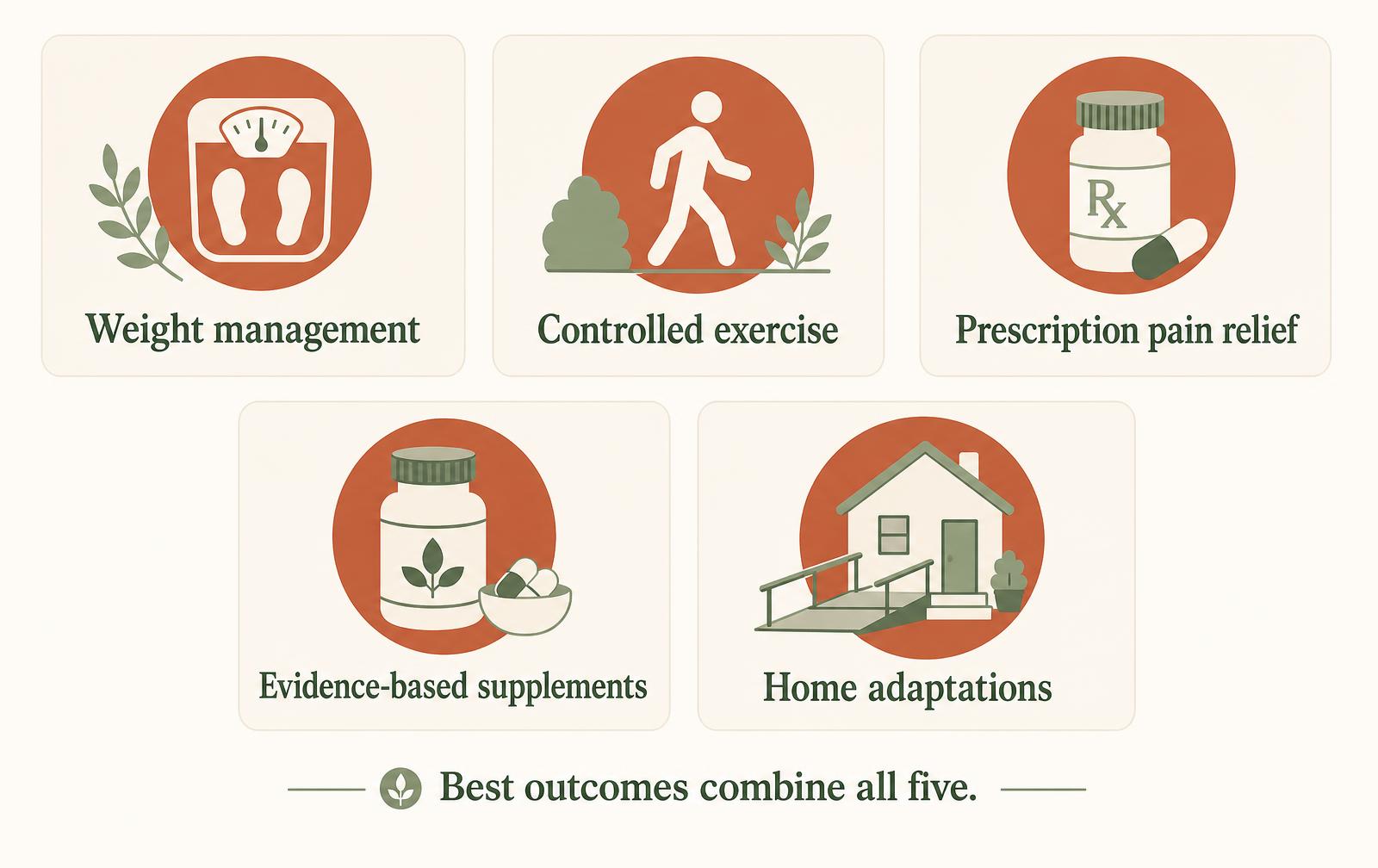
No single intervention does the whole job. The most effective approach to arthritis in dogs combines several things at once — addressing pain, managing weight, maintaining muscle through appropriate exercise, and reducing daily joint stress through home adaptations — and adjusts the combination as the disease progresses.
A dog that loses excess weight, gets daily controlled exercise, takes omega-3 fatty acids, sleeps on an orthopaedic bed, and has its pain appropriately managed with prescription medication will fare considerably better than one that is only on pain relief. That's the evidence-based consensus from UK and international veterinary organisations. This guide works through each layer.
1. Weight management: the most effective thing you can do
Let's be direct about this, because it's the intervention with the strongest evidence and the one owners most consistently underestimate.
Every extra kilogram of body weight your dog carries puts meaningfully more load through already-compromised joints. This is mechanical as much as anything: heavier dogs hurt more, move less, and decline faster. And adipose tissue — body fat — is not inert. It produces inflammatory cytokines that actively worsen the inflammatory component of OA.
The obverse is equally true. Studies consistently show that weight loss in overweight arthritic dogs produces measurable improvements in mobility and pain scores, sometimes dramatically so, and can reduce dependence on pharmaceutical pain relief. For an overweight dog with arthritis, weight management is not optional — it is first-line treatment.
The practical check is a body condition assessment, which you can do at home in under a minute. You should be able to feel your dog's ribs easily under a thin layer of fat; there should be a visible waist when looking down from above; and the belly should tuck up from the ribcage rather than hanging level or sagging. Our feeding guide covers this in detail with a full body condition guide.
If your dog needs to lose weight, do it gradually under veterinary guidance. Crash diets cause muscle loss as well as fat loss, which is counterproductive in a dog whose joints depend on strong surrounding muscle for support.
2. Exercise: less is not more
The instinct when a dog is in pain is to rest them. That instinct is understandable and largely wrong.
Controlled exercise is essential for dogs with arthritis, because muscle is what supports the joint. A dog that stops moving loses muscle, the joint becomes less stable, and pain and progression both worsen. The goal is exercise that maintains and builds muscle without putting excessive load through the affected joints.
What that looks like in practice:
Short and frequent beats long and infrequent. Twenty minutes three times a day is far preferable to one hour-long walk. Long walks are tiring, increase inflammatory load, and tend to produce pronounced post-exercise stiffness.
Lead walks on even surfaces. Predictable, controlled movement where you set the pace. Grass is gentler than tarmac; hills add load to joints so should be introduced carefully.
Swimming and hydrotherapy. The best exercise for an arthritic dog, if accessible. Water supports body weight while allowing a full range of motion and significant muscle building. Hydrotherapy pools with warm water and underwater treadmills are particularly effective, and there is a genuine evidence base behind them. A referral from your vet can sometimes be supported by pet insurance.
Avoid explosive or high-impact activities. Jumping, leaping off furniture, ball-chasing with sudden direction changes — all of these put sudden high loads through joints and should be managed or stopped. A dog with arthritis that lives for fetch may need its play adapted rather than simply ended.
Warm up and cool down. A few minutes of slow walking at the start and end of each walk genuinely helps, just as it does for people.
On cold and damp days, stiffness tends to be worse. Many owners find that warming a dog's joints gently before going out — a few minutes of gentle massage or a warm (not hot) pad over the joint — helps them move more comfortably at the start of a walk.
3. Prescription pain relief: what your vet can offer
Pain management is your vet's domain, not this guide's, and the right medication for your dog depends on its age, overall health, kidney and liver function, and the severity of its arthritis. What follows is a map of what exists and what the evidence says, not a recommendation.
NSAIDs (non-steroidal anti-inflammatory drugs) are first-line treatment and have the strongest evidence base. They reduce both pain and inflammation. They require a prescription, regular monitoring (liver and kidney function via blood tests), and careful selection by your vet — different NSAIDs suit different dogs. Never use human NSAIDs such as ibuprofen or aspirin on a dog. They are processed differently by the canine system and can cause severe, life-threatening gastric haemorrhage and kidney failure.
Librela (bedinvetmab) is a monthly injection that works differently from NSAIDs — it's a monoclonal antibody targeting nerve growth factor (NGF), a mediator of chronic pain — and has been increasingly used since its launch as a well-tolerated alternative or adjunct. Evidence for efficacy is solid. However, there is a live safety debate that owners should know about.
A 2025 study by Farrell and colleagues, published in Frontiers in Veterinary Science, found that several musculoskeletal adverse-event categories were reported roughly nine times more frequently with Librela than with six comparator drugs combined in a European pharmacovigilance database. That is a reporting difference, not proof that an individual dog's risk is nine times higher. A published independent critique argues that the analysis lacks reliable treatment denominators and does not use a valid disproportionality method.
The UK position became clearer in 2026. The Veterinary Medicines Directorate concluded that Librela's overall benefit-risk balance remained positive based on the data available at that time. It also strengthened the product information, adding several very rare neurological, immune-mediated and musculoskeletal events. In an August 2026 information response, the VMD said its May additions — joint swelling, joint pain, bone and joint disorder, and soft-tissue ossification — followed increasing multi-source evidence of a causal association with those specific events. The size and mechanism of the risk remain uncertain. Our full evidence review, Is Librela Safe?, explains the research and regulatory position in detail.
What this means practically: Librela can have real benefits, particularly for dogs that do not tolerate NSAIDs well or where other measures are insufficient. The safety question is neither imaginary nor a reason to stop treatment without veterinary advice. It is a conversation worth having openly with your vet — specifically about the benefit your dog is receiving, any new clinical changes, and the alternatives available.
Other adjunct medications including gabapentin and other drugs may be added in more severe or complex cases. These are your vet's call.
4. Supplements: what the evidence actually says
This is the section where Burrow has to depart from the conventional wisdom, because the evidence on supplements doesn't support what most owners have been told and most pet shops sell.
A 2022 systematic review and meta-analysis covering 1,578 publications on nutraceuticals and enriched diets in dogs and cats with OA reached conclusions that are worth knowing.
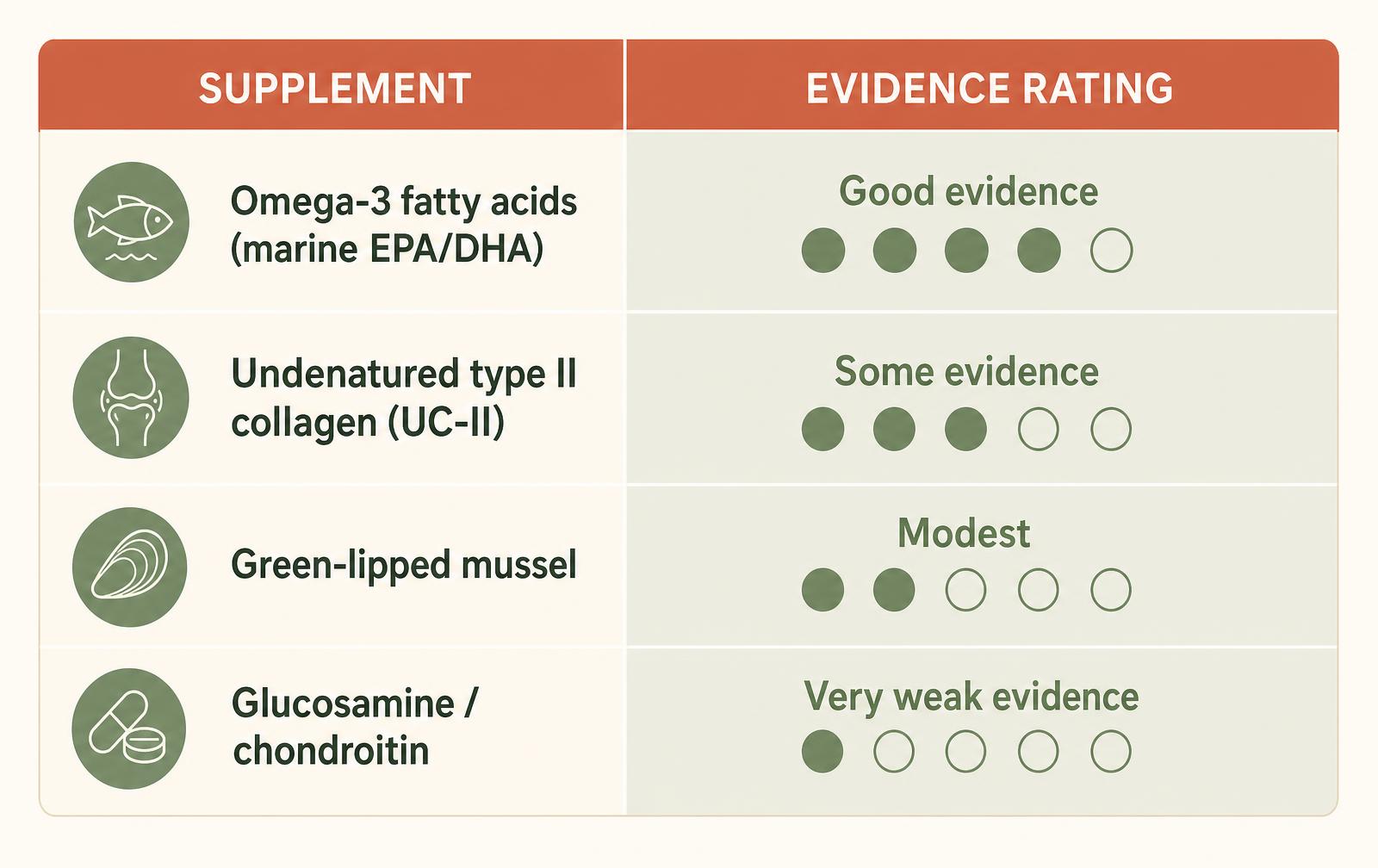
Omega-3 fatty acids (marine-sourced EPA and DHA) are the standout: the review found "evident clinical analgesic efficacy" for omega-3-enriched diets and omega-3 supplements. This is the most evidence-backed supplement you can give an arthritic dog. Marine-sourced matters — the EPA and DHA from fish oil, for example — rather than plant-sourced omega-3 which converts poorly.
Glucosamine and chondroitin are the hardest part of this section. These are the most widely sold joint supplements for dogs, and most owners with an arthritic dog have been told to give them. The same 2022 systematic review found a "very marked non-effect" for chondroitin-glucosamine nutraceuticals in canine and feline OA, and concluded that "these products should no longer be recommended for pain management." The University of Illinois veterinary medicine service concurs that "no strong evidence has been documented to prove the reliable benefit of glucosamine/chondroitin." This doesn't mean they cause harm, but it does mean the money spent on them may be better spent on something with a real evidence base.
Undenatured type II collagen (UC-II) showed "weak efficacy" in the same review — better than glucosamine but not as strong as omega-3. Some individual trials have been positive. It's a more promising option than glucosamine if you want to supplement beyond omega-3.
Green-lipped mussel is widely sold in the UK and contains some omega-3, which is likely where its modest benefit comes from. Not well-evidenced as a standalone but reasonable as an omega-3 source.
CBD/cannabidiol shows some early promise in small studies, but is not licensed as a veterinary medicine in the UK, making it both difficult to source reliably and practically limited. The evidence is not yet sufficient to recommend it.
The practical takeaway: add a quality marine omega-3 supplement or switch to a veterinary joint-health diet that includes EPA/DHA at appropriate levels. Save the money on glucosamine and chondroitin unless your vet has a specific reason to recommend them.
5. Home adaptations: the underrated layer
This is the part of management that costs least and gets the least attention. Small changes to your home can meaningfully reduce the daily pain load a dog with arthritis carries.
Orthopaedic bedding. Memory foam or orthopaedic dog beds support joints during sleep, which is where a dog with arthritis spends a significant portion of its life. A dog sleeping on a hard floor is putting unnecessary pressure on already painful joints for hours at a time. This is a genuinely impactful change.
Ramps and steps. If your dog has access to the sofa, the car, or the bed, a ramp replaces the jump — and the jump is one of the highest-load movements an arthritic dog makes regularly. Ramps are inexpensive, widely available, and make a real difference to dogs that love to be on furniture.
Non-slip surfaces. Dogs with joint pain often struggle on smooth floors. A paw that slips during a turn puts sudden high load through the stabilising muscles and joints. Rugs, yoga mats, or non-slip socks for dogs (yes, they exist) on slippery floors help considerably.
Raised food and water bowls. For dogs with shoulder, elbow or neck arthritis, bending to the floor for every meal and drink is repeatedly painful. A raised bowl at the right height is a minor change with a notable quality-of-life benefit.
Warmth. Cold and damp environments worsen stiffness. A warm sleeping spot, away from draughts, helps — as does warming the joints gently before exercise on cold days.
6. Monitoring: keeping track over time
Arthritis progresses, and its management needs to keep pace. A few habits make a meaningful difference.
Monthly video. Film your dog walking towards and away from you on a flat surface, once a month. Small changes in gait, posture, and ease of movement are nearly impossible to detect day-to-day but become obvious when you compare clips over time. It also gives your vet something concrete to assess.
Regular vet check-ups. For a dog with confirmed arthritis, six-monthly vet appointments are a sensible minimum, rising to more frequent if the disease is progressing or medication is being adjusted. Blood monitoring for dogs on long-term NSAIDs is not optional — it's how liver and kidney effects are caught early.
Body condition checks. Monthly, alongside the gait video. Arthritis tends to reduce activity, and reduced activity tends to add weight, which worsens arthritis — a cycle worth breaking early.
Watch for pain signals. A dog on medication that starts showing signs of breakthrough pain — the hesitating, the stiffness, the grumpiness — is telling you the current management plan needs revisiting. That's a vet conversation, not a reason to simply increase a dose. Our guide to reading your dog's body language covers the quieter signals worth catching.
The bottom line
Arthritis in dogs is a progressive disease with no cure, but it is manageable, and good management makes an enormous difference over the course of a dog's life. The combination that works best is weight at a healthy level, controlled regular exercise, appropriate prescription pain relief, marine omega-3 as the supplement with the real evidence behind it, and a home that reduces unnecessary daily joint stress.
Skip the glucosamine. Ask your vet about NSAIDs and, if they suggest Librela, have the honest safety conversation. Film your dog once a month. Check the body condition regularly. Book the six-monthly appointment.
None of that is complicated. It's just worth doing consistently, and early, because the window when management makes the most difference is earlier than most people think.
Guides on Burrow are researched carefully and written to be genuinely useful, but they are not a substitute for veterinary advice. Arthritis management should be tailored to your individual dog by a vet who can examine it. If you have concerns about your dog's joints or pain, please make an appointment.
Related reading: Arthritis in Dogs: The Early Signs Most Owners Miss · How Much to Feed Your Dog · How to Read Your Dog's Body Language · Does Playing With Your Dog Keep Its Brain Younger?
Common questions