Behaviour · Cat · 16 Oct 2026
Is Your Cat Grooming Too Much?
By Burrow · 16 Oct 2026
TL;DR
- **There is no fixed normal amount of grooming.** What matters is a change in pattern, repeated attention to one area, and whether the cat is damaging or removing its coat.
- **New research shows what changes.** In a 2026 study, cats with stress-related hair loss groomed fewer areas of the body and chewed their skin about ten times longer than healthy cats.
- **Broken, spiky hair is a clue.** Fur removed by grooming tends to feel sharp at the edges of a patch, where other hair loss usually leaves soft fur.
- **Itch is often behind it.** In a study of 21 cats referred with suspected stress-related hair loss, 16 turned out to have a medical cause of itching.
- **Pain can look like a grooming problem.** Bladder pain may show as a bald lower belly and inner thighs, and a cat straining to pass urine needs emergency care.
- **Stress can contribute.** It often sits alongside a skin or pain problem, and should not be assumed without looking for those first.
A bald belly or thinning flanks are often blamed on stress. But itching, allergy and pain can look much the same, and those are the causes a vet needs to investigate first.
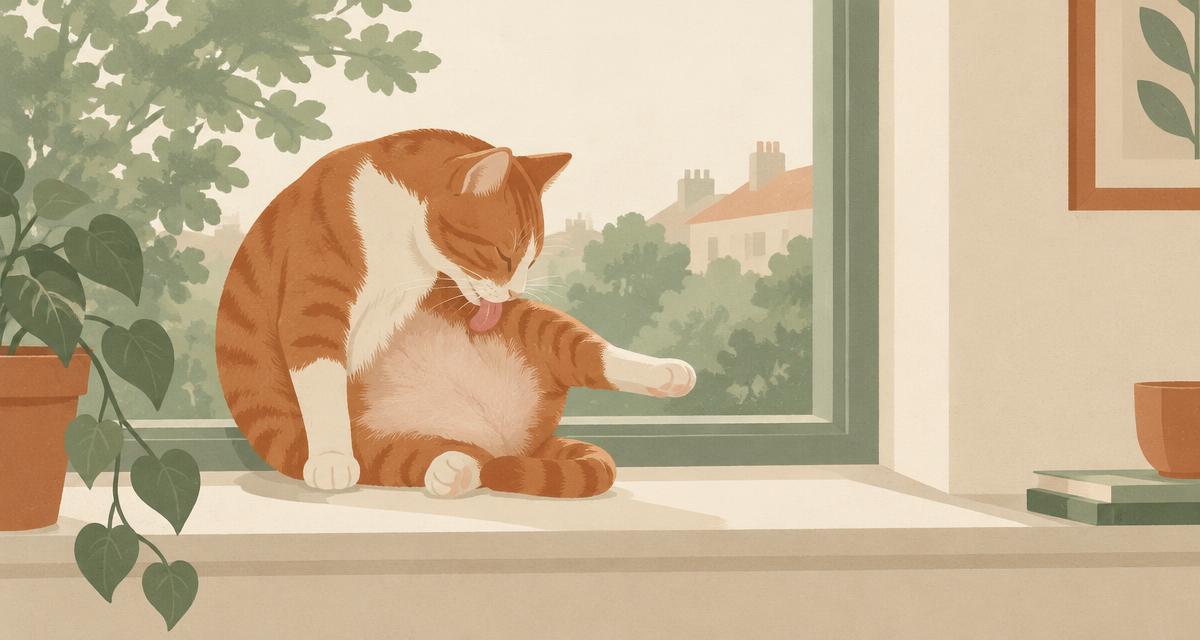
Cats are famous for keeping themselves clean, so it can take a while to notice when grooming has gone past what is useful. Usually the first sign is not the licking itself but its result: a belly that has gone thin, a stripe of short fur down the inside of a back leg, or a patch on the flank that feels rough when you stroke it. The natural assumption is that the cat is anxious about something. Sometimes that is part of the picture, but the research consistently points to looking for something itchy or painful first.
What changes when grooming becomes a problem
Grooming matters to cats. It keeps the coat in order, removes parasites and spreads scent, and the amount varies a great deal from cat to cat. A study published in Veterinary Dermatology this year analysed 118 videos of 29 healthy cats and seven cats with stress-related hair loss. It found major individual variation and no difference in the average length of grooming bouts between healthy and affected cats, so time spent grooming on its own was not a useful signal.
What did differ was the pattern. The affected cats groomed fewer areas of the body in each session, spent longer on the insides of their hind legs, and chewed their skin about ten times longer than healthy shorthaired cats. The authors concluded that the findings support classifying the condition as an abnormal repetitive behaviour. For owners, the practical point is that focused, repetitive attention to one area, and chewing or pulling instead of smooth licking, matter more than how often a cat grooms.
Clues that the hair is being groomed away
International Cat Care, the feline welfare charity, describes a useful check you can do with your fingertips. When hair is removed by grooming, the remaining hair shafts are broken off and feel spiky and sharp. When hair is lost for other reasons, the hair left at the edges usually feels soft and normal. This is a clue, not a diagnosis, and your vet can confirm it by looking at hairs under a microscope.
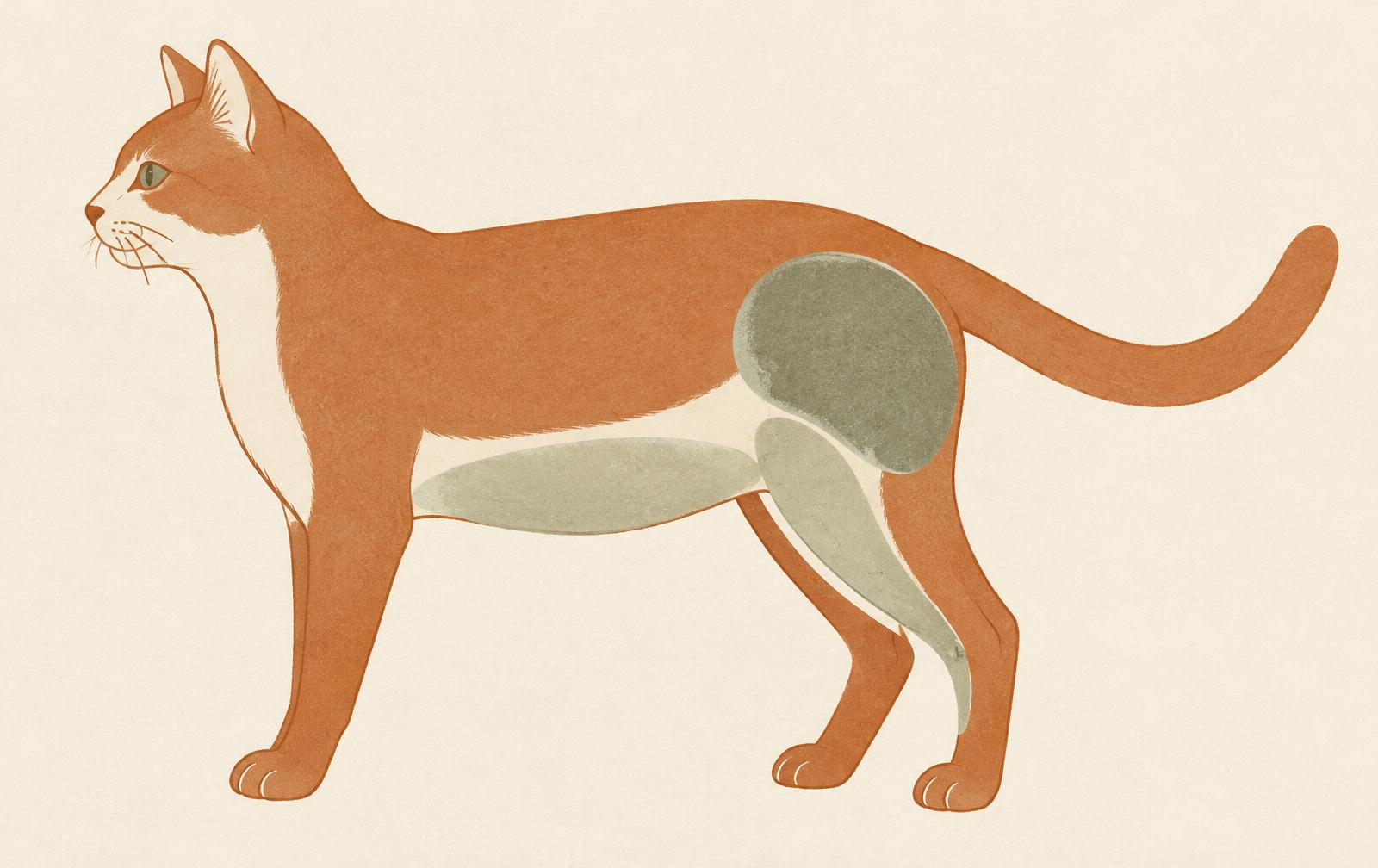
Location helps too. Overgrooming can affect anywhere a cat can reach with its tongue, but the most common areas are the belly, the insides of the back legs and the flanks, often in a matching pattern on both sides.
Why stress is not the first answer
The term vets use for hair loss caused purely by stress-related grooming is psychogenic alopecia. A 2006 study tested how often that label holds up. Researchers took 21 cats referred to specialists with a presumptive diagnosis of psychogenic alopecia and investigated each one thoroughly, including skin biopsies and food trials.
They found a medical cause of itching in 16 of the 21. Only two had stress-related hair loss alone, and another three had both a medical and a behavioural cause. A food reaction was diagnosed in 12 cats, and several cats whose skin looked normal under the microscope still turned out to have an allergy. The authors concluded that psychogenic alopecia is overdiagnosed in cats. This was a small group of selected referral cases, so the proportions should not be read as rates for all cats that overgroom, but the finding has shaped how vets approach these cases since.
The itchy causes
Itch does not always look like scratching, and many itchy cats lick instead. A large multicentre study of 502 itchy cats seen by dermatologists in Europe and the United States sorted them into separate diagnostic groups: flea allergy in 29%, food allergy in 12%, allergy to neither fleas nor food (often environmental) in 20%, and other itchy diseases in 24%. The remaining 15% could not be classified because they did not complete a food trial.
Two findings matter for owners. First, flea allergy was the largest single group, and a cat can react strongly to very few fleas, so not seeing any does not rule it out. Second, the pattern of skin changes did not reliably point to any one cause. Symmetrical licked patches can come from fleas, food or environmental allergy, which is why finding the cause usually means a structured process with your vet, often thorough flea control first and then a strict food trial.
The painful causes
Pain is the cause owners are least likely to suspect, but cats may lick over the area that hurts. International Cat Care highlights lower urinary tract disease as a common example: a cat with bladder pain may develop a bald or sparse patch on the lower belly, the insides of the thighs and around the genitals. If that is the pattern you see, tell your vet about any change in litter tray habits.
One situation is an emergency. If a cat is repeatedly visiting the litter tray, straining to urinate or passing little or no urine, contact a vet straight away. Urinary obstruction, which is far more common in male cats, can be life-threatening and should not be treated as a grooming or behaviour problem.
Joint pain can work in a similar way, and iCatCare notes that arthritic cats may overgroom because of pain that needs managing. A less common and poorly understood condition, feline hyperaesthesia syndrome, can cause skin twitching and sudden bouts of intense grooming, often along the back and tail.
Where stress fits in
Stress is still part of the picture. Cats use grooming to settle themselves when anxious, and iCatCare's view is that although most overgrooming starts with a skin or pain problem, there is reason to believe a stress component is common, and for a small number of cats the problem is entirely stress-related. Cornell's Feline Health Center notes that the repetitive act of licking may itself be soothing, which can reinforce the habit. Changes to routine, competition with other cats in the house and unwelcome cats outside are common sources of stress, and reducing them can help even when a medical cause is also being treated.
The evidence on medication is limited. A small placebo-controlled trial of clomipramine, a drug used for compulsive behaviour, gave 22 cats either the drug or a placebo for 56 days and found no statistically significant difference in grooming, hair regrowth or the area affected. The authors could not say whether this reflected the drug itself, too short a course or too few cats, and an RCVS Knowledge evidence review found it was the only controlled study available. That does not rule out a benefit in individual cats, but it shows how little evidence there is, and why medication is best seen as one possible part of a plan your vet puts together.
Try this today
If you can see thinning or bald patches, book a vet appointment now; don't wait to see whether it settles. Before you go, run your fingers over the patches to feel whether the remaining fur is spiky or soft, take a clear photo, and if you can, record a short video of your cat grooming. Check for fleas and flea dirt, and note when your cat last had a flea treatment your vet recommends. Jot down anything else you have noticed, such as changes in eating, toileting or mood, and take it all with you.
The Bottom Line
A cat that licks itself bald is showing you a problem worth investigating, and stress is not a diagnosis to reach for casually. Research on cats first thought to have stress-related hair loss found that most were itchy, and pain from the bladder or joints can produce a similar picture. Start with your vet, expect them to work through fleas, allergies and pain, and treat stress as something to address alongside those, not instead of them.
This article is for general information and does not replace veterinary advice. If your cat has hair loss or sore skin, contact your vet. If your cat is straining to urinate or passing little or no urine, seek emergency veterinary care.
Common questions
Frequently asked.
References
Sources.
- Guillon M, Naudin L, Cochet-Faivre N, Titeux E, Gilbert C. Exploring normal to abnormal variations of grooming behaviours in cats. Veterinary Dermatology. 2026;37(5):865–875.
https://doi.org/10.1111/vde.70109 - Waisglass SE, Landsberg GM, Yager JA, Hall JA. Underlying medical conditions in cats with presumptive psychogenic alopecia. Journal of the American Veterinary Medical Association. 2006;228(11):1705–1709.
https://doi.org/10.2460/javma.228.11.1705 - Hobi S, Linek M, Marignac G, et al. Clinical characteristics and causes of pruritus in cats: a multicentre study on feline hypersensitivity-associated dermatoses. Veterinary Dermatology. 2011;22(5):406–413.
https://doi.org/10.1111/j.1365-3164.2011.00962.x - Mertens PA, et al. The effects of clomipramine hydrochloride in cats with psychogenic alopecia: a prospective study. Journal of the American Animal Hospital Association. 2006;42(5):336–343.
https://doi.org/10.5326/0420336 - Veterinary Evidence (RCVS Knowledge). Does treatment with clomipramine reduce cat psychogenic alopecia?
https://production.veterinaryevidence.org/index.php/ve/article/view/573 - International Cat Care. Over-grooming in cats. Updated September 2025.
https://icatcare.org/articles/over-grooming-in-cats - American College of Veterinary Surgeons. Urinary obstruction in male cats.
https://www.acvs.org/small-animal/pu/ - Cornell Feline Health Center. Cats that lick too much.
https://www.vet.cornell.edu/departments-centers-and-institutes/cornell-feline-health-center/health-information/feline-health-topics/cats-lick-too-much
Keep reading
Further reading.
Want plain-English notes on pet health and the research behind it? Join The Once-Over, our weekly note from Hazel.