Dog & Cat · All · Routine
The Dog and Cat Allergy Guide
Published 21 Aug 2026 · ✓ Researched
TL;DR
- Three distinct allergy types affect dogs and cats: flea allergy dermatitis, environmental allergy (atopic dermatitis), and food allergy. Each needs a different investigation.
- Flea allergy is the most common and should always be excluded first, before anything else. A pet with flea allergy may show no visible fleas.
- Food allergy is diagnosed by an 8–12 week elimination diet trial, not by blood or saliva tests. Those tests are not validated for diagnosing food allergy and are not recommended by current veterinary dermatology guidelines.
- Environmental allergy cannot be cured, but it can be managed well. Allergen-specific immunotherapy is the only treatment that changes the immune response rather than suppressing symptoms.
- Secondary bacterial and yeast infections are almost always present in allergic skin disease and worsen itching independently of the underlying allergy. Treating them is usually the first clinical step.
- Cats present differently from dogs. The same allergy in a cat may show as overgrooming, neck scratching or skin lesions rather than the paw licking and ear problems more typical in dogs.
- The order of investigation matters. Working through the causes systematically — fleas first, food second, environment last — prevents years of misdiagnosis.
Allergies are one of the most common reasons dogs and cats see a vet — and one of the most consistently mismanaged. Here's how to tell the three types apart, why the order of investigation matters enormously, and what the evidence actually says about treatment.
Itching, scratching, licking, chewing, recurring ear infections, patchy fur, red skin, persistent rashes — these are some of the most frustrating presentations in companion animal medicine, for vets, owners and pets alike. Allergic skin disease in dogs and cats is common, chronic, and frequently complicated by secondary infections that obscure the underlying cause. It is also an area where owners regularly spend considerable money on tests and products that the current evidence does not support.
The most useful thing to understand before anything else is this: there are three distinct types of allergy that cause these signs in dogs and cats, and they require different investigations, different diets, and different treatments. Treating them as interchangeable — which many products and some advice implicitly does — is the reason so many allergic pets remain unmanaged for months or years.

The three types of allergy
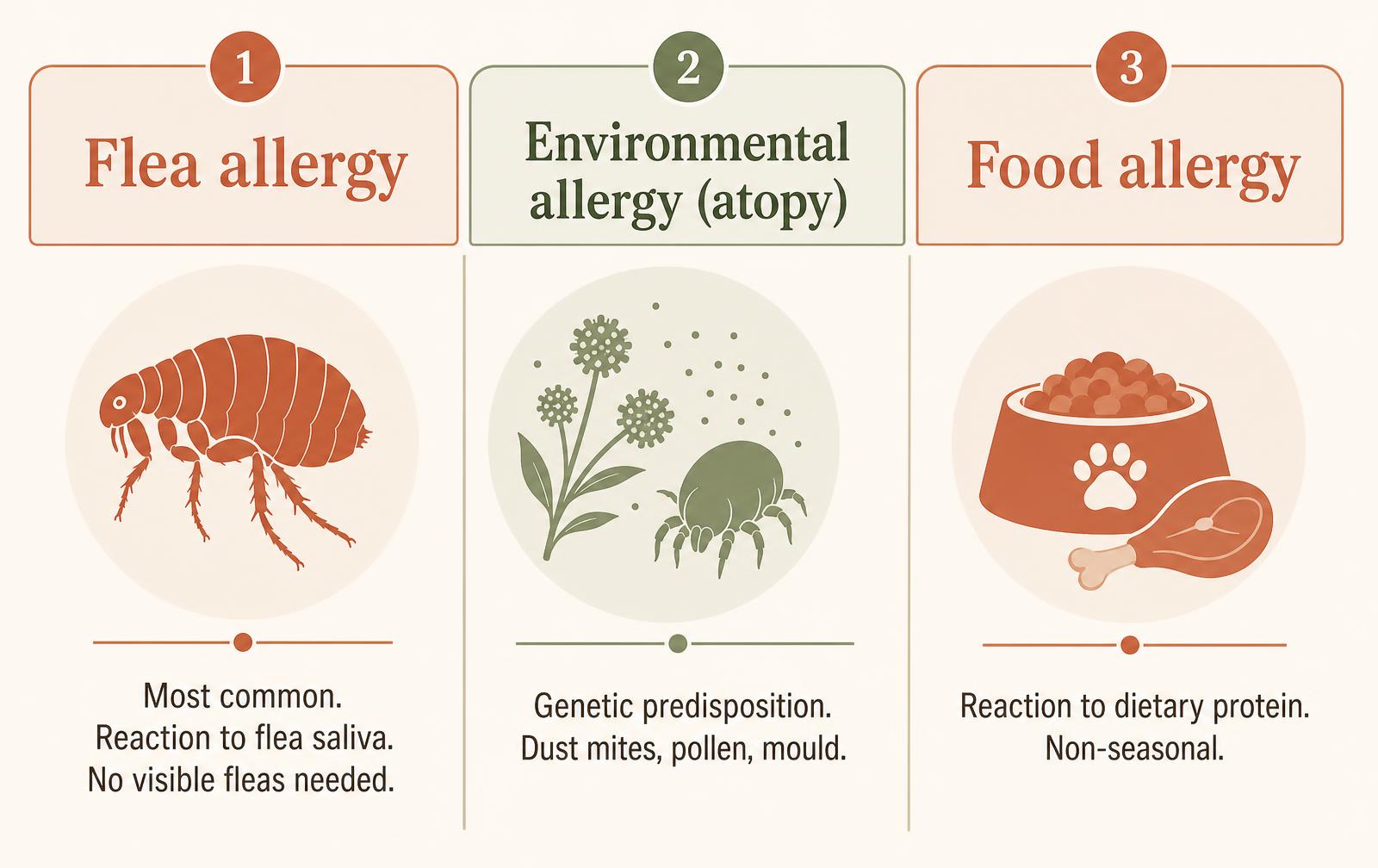
Almost all allergic skin disease in dogs and cats falls into one of three categories. Understanding the differences is essential before any investigation begins.
Flea allergy dermatitis (FAD) is a reaction not to fleas themselves but to proteins in flea saliva. A single flea bite can trigger a reaction that persists for weeks. FAD is the most common allergic skin condition in dogs and cats in the UK, and it is the one most often missed because owners don't see fleas. A pet with FAD typically grooms compulsively and removes the fleas before anyone can find them. The absence of visible fleas does not rule out FAD.
Environmental allergy, or atopic dermatitis, is a chronic, genetically influenced condition in which the immune system reacts to common environmental substances — house dust mites, pollens, moulds, grass. These allergens enter through a defective skin barrier rather than being inhaled, which is why the primary signs are in the skin rather than the nose. Atopic dermatitis is the second most common allergic skin condition in dogs, typically beginning between six months and three years of age. It is either seasonal (pollen triggers) or year-round (dust mites).
Food allergy, or cutaneous adverse food reaction (CAFR), is a reaction to a specific dietary protein. Unlike environmental allergy, it is typically non-seasonal — the pet itches at the same rate regardless of the time of year. In dogs, the most commonly identified triggers are beef, dairy, chicken and wheat; in cats, fish, dairy and beef appear most frequently. Food allergy accounts for around 20–30% of allergic skin disease in pets, but it matters disproportionately because the treatment is entirely dietary rather than pharmaceutical.
Step one: exclude flea allergy
Before investigating food or environmental allergy, flea allergy must be excluded — thoroughly, for a sustained period, in every pet in the household.
The clinical reasoning is straightforward. FAD is the most common cause of allergic skin disease in UK dogs and cats, and its treatment is simple and cheap. Investigating other causes before doing this wastes time and money, and can produce misleading results if the pet remains flea-exposed throughout a food elimination trial.
Effective flea exclusion means applying a veterinary-grade flea preventive to every pet in the household for at least six to eight weeks. Flea treatments vary considerably in efficacy — isoxazolines (the class that includes products such as Bravecto and Simparica) are currently considered the gold standard for flea allergy management. Treating the environment too — washing bedding, vacuuming thoroughly — removes the reservoir of flea eggs and larvae that sustains an infestation regardless of what's applied to the pet.
If the pet improves after six to eight weeks of rigorous flea control, that is strong evidence that FAD was part of the problem. If it doesn't improve despite rigorous flea control, the investigation moves to the next step.
Treat secondary infections alongside everything else
This is the part of allergic skin disease management that owners most often don't know about, and that vets most often address first.
Almost all dogs and cats with chronic allergic skin disease develop secondary bacterial (usually Staphylococcus) and yeast (Malassezia) infections on top of the underlying allergy. These infections cause itching independently — they don't just reflect the allergy, they worsen it — and they can mask the true severity of the underlying condition by adding their own layer of itch.
The clinical consequence is that an allergic pet with an active secondary infection will itch at a rate that reflects both the allergy and the infection combined. Treating only the allergy while the infection persists will never bring itching fully under control. And attempting a food elimination trial while a skin infection is active complicates the results: the pet may still itch from the infection even if the food trial is working.
This is why current AAHA guidelines for allergic skin disease start with treating secondary infections and parasites before embarking on any allergy-specific investigation. It is not a delay to the important work; it is the important work.
Signs of secondary infection include greasy or smelly skin, crusting, increased redness, and patches of hair loss that change in character or location. A vet will typically take skin cytology — a quick swab examined under a microscope — to confirm what organisms are present and guide treatment.
Food allergy: the elimination diet trial
Food allergy in dogs and cats cannot be reliably diagnosed by blood tests or saliva tests. This is one of the most important facts in this guide, because a significant commercial industry has grown around selling exactly those products.
Serum IgE testing for food allergens, RAST tests, saliva-based allergy panels — none have been validated as reliable diagnostic tools for food allergy in companion animals. The 2023 AAHA guidelines for allergic skin disease in dogs and cats do not recommend them for diagnosing food allergy. A 2025 systematic review in Frontiers in Veterinary Science examining diagnostic testing for allergen sensitisation in canine atopic dermatitis found no validated serum test for food allergens. An online service offering to identify your pet's food allergies from a kit is selling something the science does not support.
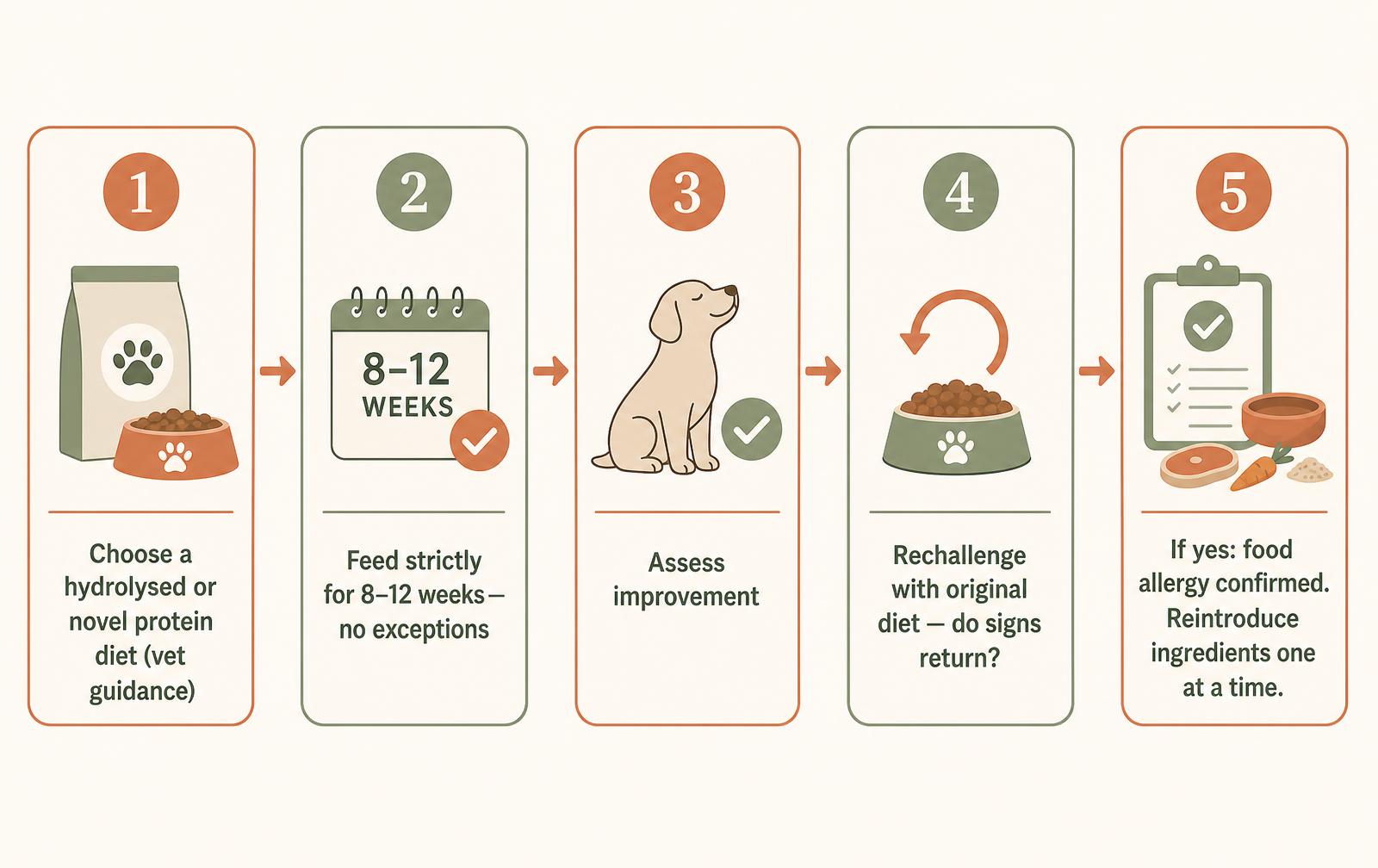
The only validated method for diagnosing food allergy is an elimination diet trial.
The trial works as follows. The pet is fed a diet containing only one protein source and one carbohydrate source that it has never eaten before — a novel protein diet — or a diet made from proteins that have been broken down into fragments too small to trigger an immune reaction — a hydrolysed protein diet. Every other food source is eliminated for the full trial period: treats, flavoured medications, chews, table scraps, flavoured toothpaste. A single exception can be enough to sustain a reaction and invalidate the trial.
The trial runs for a minimum of eight weeks, and twelve weeks if needed. At the end of the trial, if the pet has improved, the original diet is reintroduced. If symptoms return within days to two weeks, that confirms food allergy. Individual ingredients can then be systematically reintroduced to identify the specific trigger.
On diet choice: prescription hydrolysed diets manufactured under controlled conditions are generally preferred over over-the-counter hypoallergenic products. Studies using PCR testing have found undeclared animal proteins in commercially available pet foods — cross-contamination during manufacturing introduces proteins the label doesn't list. A pet with a true food allergy that is reacting to trace contamination will not improve on a diet that appears appropriate on the label. Prescription diets are manufactured under stricter controls.
On novel protein diets: these can work, but the range of proteins a pet has genuinely never eaten narrows considerably in an animal that has eaten many commercial foods. Cross-reactivity is also possible — some dogs allergic to beef react to lamb or venison despite never having eaten them. A vet or veterinary nutritionist can help identify whether a true novel protein is available for the individual animal.
Home-cooked elimination diets are an alternative when a suitable commercial diet cannot be found, but must be formulated by a veterinary nutritionist to ensure nutritional balance throughout the trial period.
Environmental allergy: investigation and long-term management
If flea allergy has been excluded and food allergy has been investigated and either ruled out or identified and treated, environmental allergy is the likely remaining diagnosis. In practice, many dogs and cats are atopic from the beginning, but working through the exclusion process matters because it may identify a concurrent or simpler cause — and because treatment of environmental allergy is a long-term commitment.
Diagnosis of atopic dermatitis is primarily clinical — based on history, pattern of signs, breed, age of onset, and exclusion of other causes. In dogs, a scoring system called the Favrot criteria gives around 85% diagnostic accuracy when five or more criteria are met. In cats, the clinical picture is more variable.
Allergy testing for environmental allergens — intradermal skin testing or serum IgE testing for environmental allergens — is used not to diagnose atopy, which is a clinical diagnosis, but to identify which specific allergens are triggering the reaction in order to design an allergen-specific immunotherapy programme. Unlike food allergy tests, environmental allergen tests have a more established evidence base when used for this specific purpose, though they are not perfect.
Allergen-specific immunotherapy (ASIT) — commonly called allergy shots, though sublingual drops are also used — is the only treatment for environmental allergy that addresses the underlying immune dysregulation rather than suppressing symptoms. A bespoke vaccine is formulated based on allergy test results and given in gradually increasing doses over months. Response takes time, typically three to twelve months, and not all pets respond fully. Studies show meaningful improvement in a significant proportion of atopic dogs and cats. ASIT is particularly worth considering in younger pets, in those reactive to multiple allergens, or where long-term pharmaceutical management is otherwise the only option.
Pharmaceutical management covers a range of options, and the right choice depends on the individual pet, severity and owner circumstances.
Oclacitinib (Apoquel) is a JAK inhibitor that provides rapid, targeted itch relief — typically within hours. It is one of the most prescribed medications for atopic dermatitis in dogs and has a good safety profile with appropriate monitoring. A 2025 case report described kidney injury associated with oclacitinib overdose, reinforcing the importance of using it at the prescribed dose and monitoring renal function in pets on long-term use. It is licensed in dogs; use in cats is off-label.
Lokivetmab (Cytopoint) is a monthly injectable monoclonal antibody that neutralises IL-31, the primary signal driving itch in atopic dermatitis. It provides four to eight weeks of itch relief per injection with a good tolerability profile. It is now also licensed for cats in some markets.
Ciclosporin (Atopica) is an immunosuppressive agent with a slower onset than Apoquel or Cytopoint — typically four to six weeks — but useful for long-term management. It requires periodic monitoring.
Corticosteroids such as prednisolone are effective, fast-acting and inexpensive, and remain appropriate for short-term management of acute flares. Long-term use carries significant side effects including increased thirst and urination, weight gain, muscle wasting, increased infection risk and adrenal suppression. Current guidelines recommend using them at the minimum effective dose and avoiding long-term use where alternatives are available.
Adjunct therapies — marine omega-3 fatty acids, regular medicated shampoos, skin barrier-supporting sprays and spot-ons — have modest evidence as standalone treatments but form a useful layer of support within a multimodal plan. They can help reduce the overall medication burden by lowering the itch threshold.
How dogs and cats present differently
The same allergy looks different across species, and misidentifying the signs can lead to misdiagnosis.
Dogs with atopic dermatitis classically present with paw licking and chewing (often the earliest sign), face rubbing against furniture or carpet, recurring ear infections (one of the most consistent signs — recurrent otitis in a young dog should always prompt consideration of allergy), redness and rash in the armpits, groin, between the toes and around the anus, and scratching the body particularly around the flanks and belly.
Cats present through several distinct patterns that are easy to miss or misattribute. Overgrooming and self-induced alopecia produces bilateral symmetrical hair loss, often on the belly, inner thighs and flanks — cats are private groomers and owners may not witness the grooming itself. Miliary dermatitis produces tiny crusted papules scattered across the coat, which feel like small seeds under the fingers. Head and neck pruritus — scratching around the head, face and neck, sometimes producing open wounds — is more typical of food allergy in cats. Eosinophilic granuloma complex covers a range of skin lesions including raised pink plaques, ulcers on the lip and linear skin thickening on the abdomen. These are not diseases in themselves but reaction patterns that allergy can trigger.
In cats, corticosteroids remain more commonly used than in dogs, partly because some cat-specific options are more limited and cats tolerate steroids reasonably well. The elimination diet trial follows the same principles as in dogs. Intradermal testing in cats is more technically demanding and is usually performed by specialists.
The diagnostic order: a summary
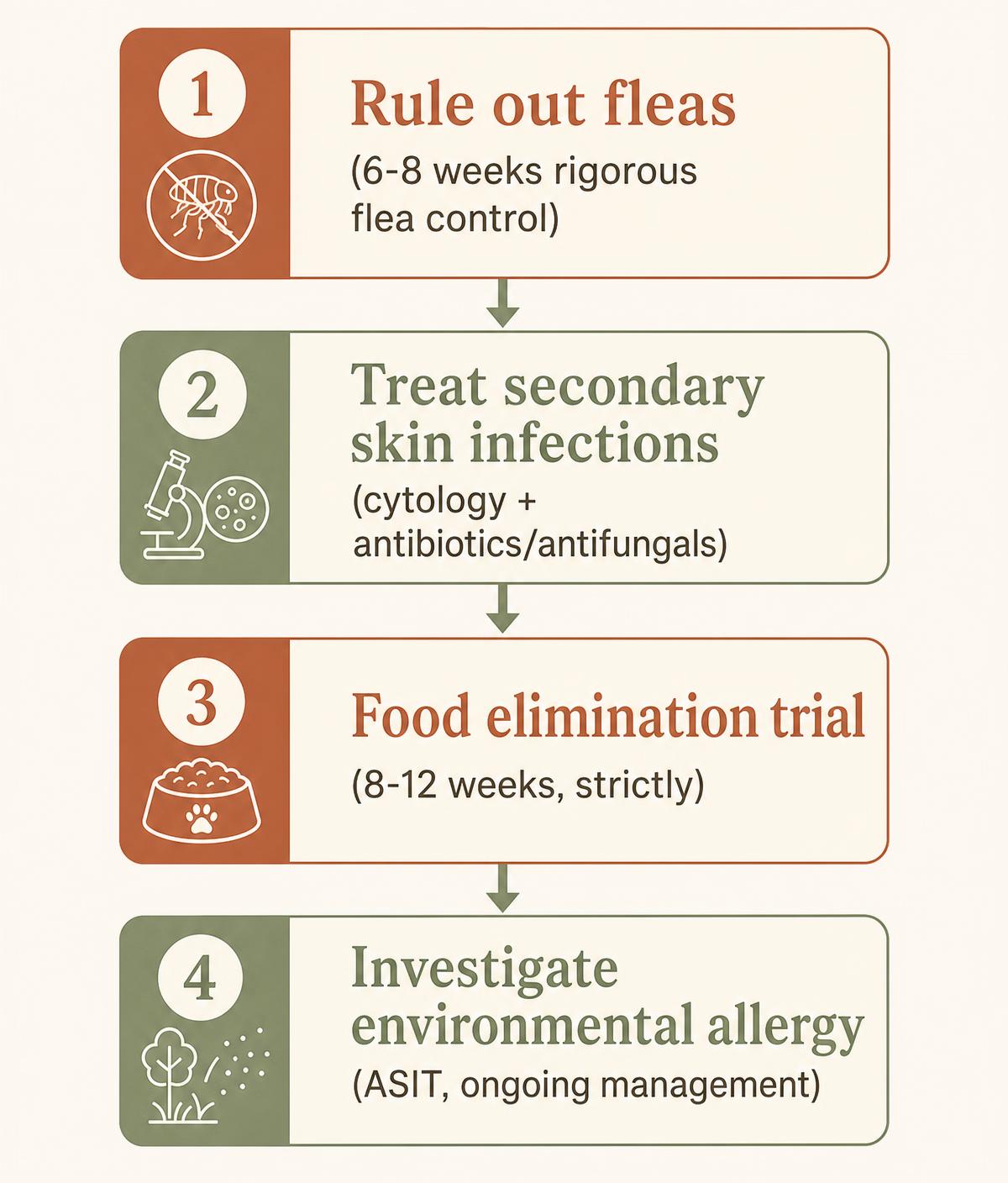
Walking through the causes in the right order prevents years of misdiagnosis and misdirected treatment.
Step 1: Rigorous flea control for six to eight weeks across all pets in the household. If the pet improves, FAD was likely involved. If not, proceed.
Step 2: Treat any secondary skin infections identified on cytology. Continue flea control throughout.
Step 3: Food elimination trial for eight to twelve weeks if signs are non-seasonal or food allergy is suspected. All other food sources strictly eliminated. If improvement and rechallenge confirms, food allergy is the diagnosis. If not, proceed.
Step 4: Atopic dermatitis is the likely diagnosis. Manage symptoms while investigating environmental allergens for possible ASIT.
What you can do at home
Allergic skin disease is primarily managed with veterinary input, but several things genuinely help between appointments.
Flea control, always. Even in an atopic dog where fleas are not the primary cause, flea exposure lowers the itch threshold and worsens symptoms. Year-round flea prevention in every pet in the household is part of allergy management for any allergic animal.
Bathing with a veterinary shampoo removes allergens, surface bacteria and yeast from the skin and can provide meaningful itch relief for several days. Current evidence supports bathing two to three times a week with an appropriate shampoo as a useful adjunct to other management. Use lukewarm water and a shampoo recommended by your vet rather than a human product.
Marine omega-3 fatty acids (EPA and DHA) have supportive evidence for skin health and a modest anti-inflammatory effect. They are unlikely to control allergy alone but can reduce the medication burden as part of a broader plan.
Monitor and record. Keep a simple note of when itching is worst, where it occurs on the body, whether it is seasonal, what the pet has been eating, and how it responds to treatments. This information is genuinely useful at vet appointments and helps track whether management is working over time.
Minimise known triggers. For house dust mite allergy — one of the most common environmental triggers — regular washing of bedding at 60°C, avoiding fabric-covered dog beds that accumulate mites, and using mattress-like wipe-clean surfaces can meaningfully reduce allergen load.
Try this today
If your pet is scratching, licking or rubbing and you're managing it with over-the-counter products alone, note down three things before your next vet appointment: where on the body the signs are worst, whether they are worse at any particular time of year, and exactly what flea prevention is being used and how consistently. Those three questions shape the entire diagnostic approach and will make the appointment considerably more productive.
Signs worth knowing
In dogs: persistent paw licking or chewing; recurring ear infections, particularly if both ears and recurring after treatment; redness between the toes, in the armpits, groin or around the anus; face rubbing against furniture or carpet; patchy hair loss from scratching; skin that is darkened, thickened or greasy; a smell that returns quickly after bathing.
In cats: symmetrical hair loss, particularly on the belly or inner thighs; tiny crusted bumps scattered through the coat; scratching around the head, face and neck; open wounds from self-trauma around the neck; raised pink plaques or ulcers on the lip or skin; overgrooming that you witness or that produces unusual amounts of fur in the litter tray.
Any of these in a young adult or adult animal, recurring or persistent, warrants a veterinary assessment rather than continued home management with over-the-counter products.
When to see a specialist
Most allergic skin disease can be investigated and managed by a general practice vet. But referral to a veterinary dermatologist is worth considering when the diagnosis is unclear after systematic investigation, a food elimination trial has been completed correctly and results are ambiguous, standard medications are not providing adequate control, allergen-specific immunotherapy is being considered and the practice doesn't offer allergy testing, or secondary infections are recurring very frequently despite treatment. Veterinary dermatologists can also perform intradermal skin testing — the most accurate method for identifying environmental allergens — which is not universally available in general practice.
The Bottom Line
Allergic skin disease in dogs and cats is genuinely complex — but the complexity is manageable when approached systematically. Most pets end up on long-term pharmaceutical management without anyone having established clearly which type of allergy they have, because the investigation wasn't done in the right order or wasn't done thoroughly enough.
Work through it properly: fleas and ectoparasites first, secondary infections alongside, food allergy by elimination diet if indicated, environmental allergy last. Don't spend money on food allergy blood tests or saliva kits. Don't accept recurring ear infections, paw licking or skin infections as normal facts of life in an itchy pet. And if general practice management is not providing adequate control, ask about referral to a veterinary dermatologist.
The goal of managing allergic skin disease is not just reducing the itch score. It is finding the cause, treating what can be treated causally, managing what cannot, and keeping the pet comfortable and the skin healthy for the long term.
This guide provides general information and is not a substitute for veterinary advice. Allergic skin disease in dogs and cats should be assessed and managed with veterinary input. If your pet has persistent or worsening skin signs, ear infections or itching, please make an appointment.
Related reading: Why Does My Dog Keep Getting Ear Infections? · Do Dog and Cat Supplements Actually Work? · Are Flea Treatments Harming the Environment? · Cats Are Experts at Hiding Illness
Common questions