Preventive Vet Care · Dog & Cat · 13 Aug 2026
Are Flea Treatments Harming the Environment?
By Burrow · 13 Aug 2026
TL;DR
- Flea and tick treatments remain important medicines. Parasites cause real health problems, and no responsible vet is suggesting you stop treating your pet.
- Fipronil and imidacloprid, two common flea treatment ingredients, are in British waterways at scale. A June 2026 independent review describes the situation as one of the most significant pollution events in recent history.
- Pets contribute through bathing and swimming. VMD-funded research confirms wastewater, and treated pets swimming in natural water, as pathways.
- The VMD Call for Evidence on these products ran April to June 2026 and has now closed. The regulator is considering next steps, including whether these products should require professional advice at the point of sale.
- The practical response is not to stop treatment. It's to be more considered about whether your pet needs it, apply it correctly, and keep recently treated dogs out of natural water for at least four days.
- Talk to your vet about your pet's actual parasite risk rather than treating on a fixed routine.
For millions of pet owners, applying a flea treatment is an unremarkable part of looking after a dog or cat. A pipette is opened. A few drops applied to the skin. The treatment disappears beneath the fur, and presumably that's the end of it.
Except it isn't.
Two insecticides commonly used in flea and tick treatments, fipronil and imidacloprid, have been detected in British waterways at levels that environmental scientists describe as causing severe harm. A 212-page independent review published by Wildlife and Countryside Link in June 2026 found the two substances are causing "severe and potentially irreversible harm" in what the review's author called "one of the most significant pollution events in recent history", with more than 8,000kg of each flowing through British waterways into the sea over the past eleven years.
That's a harder finding than most pet owners will have encountered. And it leaves an uncomfortable question: should we still be using these treatments? The answer isn't simply yes or no.

Why flea treatment matters, and why this matters too
Fleas and ticks are not simply irritating. Flea infestations can cause intense itching, skin inflammation, allergic reactions and anaemia in vulnerable animals. Fleas transmit tapeworms. Ticks carry Lyme disease and other serious infections. The case for parasite control is real.
Which is why the conversation about environmental impact shouldn't tip into a simplistic argument that flea treatments are unnecessary. They aren't. The more useful question, and the one veterinary thinking is beginning to ask more seriously, is whether every animal needs the same treatment, at the same frequency, throughout the year.
What's in a spot-on flea treatment
There are numerous flea and tick medicines available in the UK, using different active ingredients and different methods of delivery. Two are now attracting significant environmental attention: fipronil and imidacloprid.
Both are insecticides. They work precisely because they are toxic to insects. That creates an obvious problem when enough of the chemical leaves the animal and reaches an ecosystem that contains insects it was never intended to harm.
Fipronil and imidacloprid were largely restricted or banned for outdoor agricultural use in the UK following EU regulations. Their impact on bees and other pollinators was the primary concern there. Veterinary use continued on the assumption that individual pet treatments represented negligible environmental exposure. That assumption has not held up.
How flea treatment gets from your dog into a river
You don't need to apply flea medicine beside a river for it to end up there.
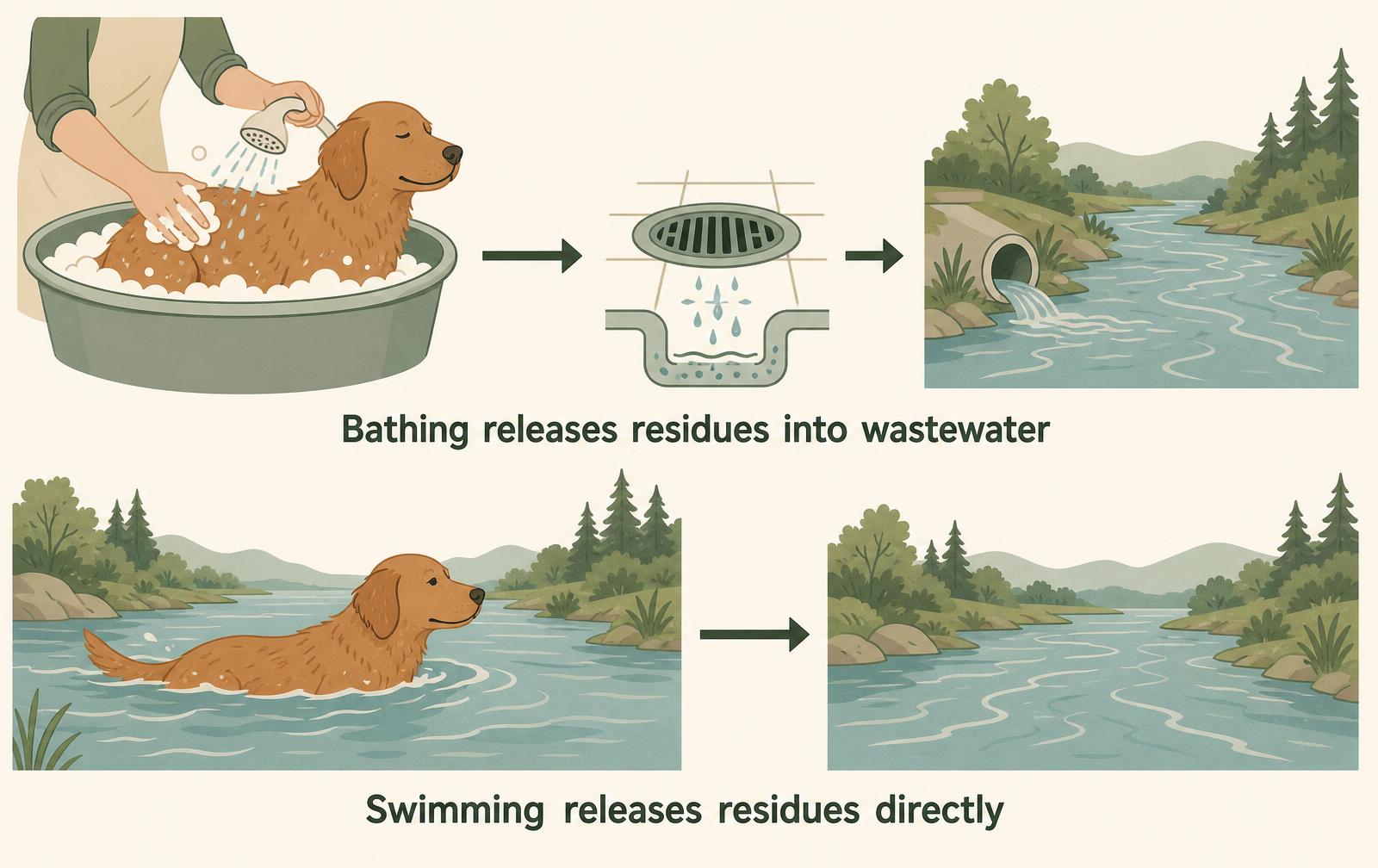
A topical treatment is applied to the animal's skin and coat. Residues leave the pet through two main routes. The first is bathing: if a treated dog is washed, residues enter household wastewater and, from there, sewage systems that are not designed to filter insecticides at these concentrations. The second is swimming: a dog treated with a topical product that enters a river, lake or stream transfers residues directly into the water.
VMD-funded research identified both pathways clearly. The scale emerges from the number of animals involved: the UK has around 21 million pet cats and dogs, and spot-on parasite treatments are among the most commonly purchased pet healthcare products.
The independent Wildlife and Countryside Link review concluded that fipronil and imidacloprid pollution in UK waterways needs to be reduced by approximately 98% and 84% respectively to return to potentially acceptable levels. Those are very large reductions, and they reflect how far the current situation is from where it needs to be.
Why aquatic insects matter
A mayfly isn't an animal most of us spend much time worrying about. Ecologically, they matter a great deal. Aquatic insects form a critical part of food webs supporting fish, birds and other wildlife. An insecticide doesn't distinguish between a flea on a Labrador and a dragonfly larva in a stream. Sufficient concentrations reaching the environment expose non-target species to a substance designed to kill insects. That's why this issue has drawn attention well beyond veterinary medicine.
Where the regulatory process stands
The VMD launched a Call for Evidence on products containing fipronil and imidacloprid on 16 April 2026. That consultation closed on 11 June 2026. The VMD is now considering next steps, including whether these products, many of which are currently on the general sales list and available without professional advice in supermarkets, should in future only be available through vets, pharmacists and suitably qualified persons.
No blanket ban on these treatments has been proposed or is under consideration. The Government has been explicit that animal welfare remains a priority and that a full ban on sale is not being considered. The debate is about how and when these medicines are sold and used, not whether parasites need controlling.
What has changed is the regulatory direction of travel. The combination of the independent review's findings, the VMD's own research, and the closed Call for Evidence makes tighter controls look increasingly likely.
Does every pet actually need monthly flea treatment?
This is where owners should stop and think rather than follow a fixed routine.
Parasite risk genuinely varies between animals. A hunting cat living outdoors doesn't face the same exposure as an indoor cat in a city flat. A dog regularly walked through long grass and woodland has different tick risks from one that stays on pavements. An animal that's had a flea problem in the last few months is in a different position from one with no history of infestation.
The Government's own position acknowledges that prophylactic parasite treatment can be justified in some circumstances, not that it's automatically justified in all of them. Other factors worth considering include where you live, whether other pets in the household have parasites, recent travel, your pet's health, and what local prevalence of ticks or fleas is like in your area.
The sensible question to ask a vet isn't "which flea treatment should I buy?" It's "what parasite protection does my pet actually need given how it lives?"
What to do now
There is no need to stop current treatment suddenly or without advice. But several practical steps are straightforward and evidence-based.
Keep recently treated dogs out of natural water for at least four days. The VMD's Be Spot On Aware campaign is explicit on this: rivers, streams, lakes and other natural bodies of water. For a dog that swims regularly, this is worth factoring into when treatment is applied.
Bathe your dog before treatment, not shortly after. If a bath is needed, do it first and apply the treatment afterwards, rather than the other way around.
Use the correct dose and follow the instructions. Never use a treatment designed for dogs on a cat: some ingredients are acutely toxic to cats. Never exceed the recommended dose assuming more is better.
Dispose of used pipettes in household waste. Not rinsed into a sink, not in recycling. The VMD specifically advises household rubbish. It sounds trivial; multiplied across millions of treatments, it isn't.
Talk to your vet about whether your pet's routine is still appropriate. This is the most important step. A vet who knows your pet can give you a more considered view than a product label.
What about tablets instead?
Oral parasite treatments avoid the obvious problem of topical residues washing directly from fur into water. That makes them worth asking about. But it doesn't automatically make every oral treatment environmentally harmless or appropriate for every animal. Different medicines target different parasites, have different safety profiles and leave the body through different routes.
The solution isn't to swap one product for whichever alternative looks greener without considering the animal's needs. Parasite control should start with the animal's actual risk. Then the environmental consequences of the available options can be considered alongside it, ideally with a vet.
The same principle applies to most of what gets sold for pets on a health claim, from parasite products to supplements: start with what the animal actually needs, then look at the evidence for the product.
Try this today
Before your next flea treatment purchase, look at what you're buying and check whether it contains fipronil or imidacloprid (it will be listed in the active ingredients). If it does, note the four-day swimming restriction and factor it into timing. Then, at your next vet visit, ask about your pet's actual parasite risk and whether the product you're using is still the right one. That single conversation is probably the most useful thing you can do right now.
The bottom line
Flea treatment has traditionally been presented as simple routine: apply it regularly, don't think about it much. The environmental evidence makes that harder to justify as a universal approach.
Fleas and ticks remain genuine health risks, and effective medicines remain important. But those medicines are also entering ecosystems at a scale that independent reviewers are now calling one of the most significant pollution events in recent history. That's not a reason to stop protecting your pet. It is a reason to be considerably more considered about how you do it.
Understand your pet's actual parasite risk. Use the appropriate product, correctly. Keep recently treated dogs out of waterways. Dispose of packaging properly. And ask your vet whether the routine you've always followed is still the right one.
This is general information, not veterinary advice. Speak to your vet about the parasite-control approach appropriate for your pet, and always follow the instructions on any treatment you use.
Common questions
Frequently asked.
Keep reading
Further reading.
Want plain-English notes on pet health and the things that affect it? Join The Once-Over, our weekly note from Hazel.