Preventive Vet Care · Dog & Cat · 30 Jul 2026
Do Dog and Cat Supplements Actually Work? What the Evidence Says
By Burrow · 30 Jul 2026
TL;DR
- Most dogs and cats on a complete commercial diet don't need supplements. Good food at the right amount is the foundation, and most supplements can't compensate for a poor one.
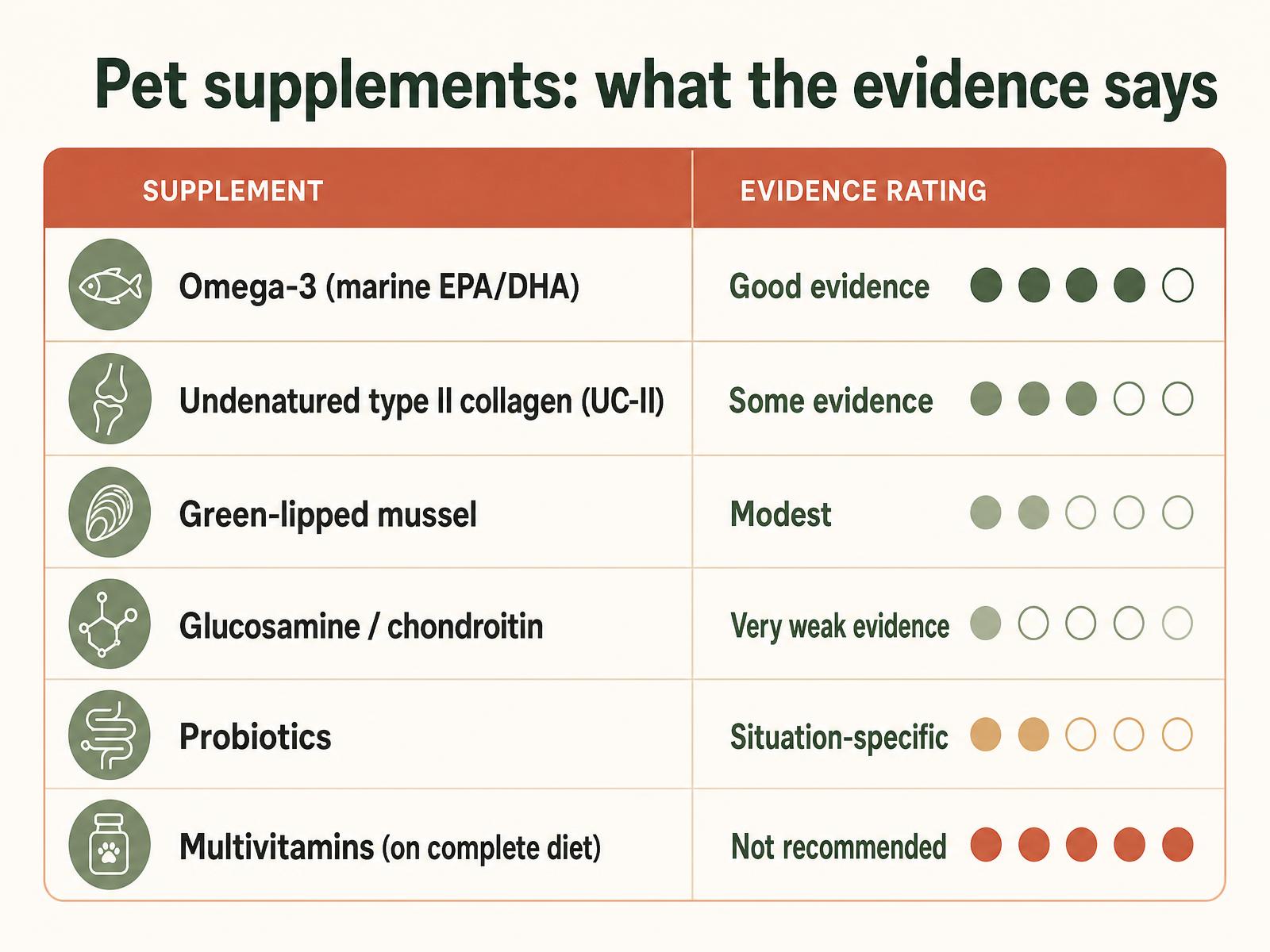
- Omega-3 fatty acids (marine EPA/DHA) have the strongest evidence base of any pet supplement, for joint pain, skin and coat health, and more.
- Glucosamine and chondroitin have very weak evidence. A 2022 systematic review of over 1,500 publications found no meaningful effect on pain in dogs and cats with arthritis, and recommended they should no longer be used for that purpose.
- Probiotics have genuine uses in specific situations, particularly acute diarrhoea, but the broad wellness claims on most products aren't supported.
- Multivitamins are largely unnecessary for pets already on a quality complete diet, and can cause harm at high doses.
- The market is largely unregulated. A product can claim to 'support joint health' with no clinical evidence. Third-party testing and transparent ingredient quantities are the minimum markers of quality worth looking for.
Walk into any pet shop, open any veterinary waiting room catalogue, or search online for joint support, skin health, or gut wellness for a dog or cat, and you will find hundreds of products. Most of them make confident claims. Most of those claims rest on very little, and some of the most widely bought supplements in the UK have been shown, in rigorous systematic review, to be of no meaningful benefit at all.
That doesn't mean supplements are useless. A handful have genuinely good evidence behind them, and for the right dog or cat in the right situation, they make a real difference. The problem is telling them apart from the rest, because the market is set up to make that as difficult as possible.
This is the straight read.

First: do most pets even need supplements?
Let's start here, because the honest answer affects everything that follows.
A dog or cat eating a complete, balanced commercial diet that meets FEDIAF or WSAVA nutritional guidelines is already getting the nutrients it needs for normal, healthy function. Modern pet food, whatever its other shortcomings, is formulated to cover the essentials. Adding a multivitamin on top of that mostly produces expensive urine, and in some cases — vitamin A toxicity in dogs is a real and documented problem — causes harm.
Supplements fill genuine gaps. They are most useful where a specific, evidence-backed ingredient addresses a specific, identified need: an arthritic dog that would benefit from omega-3, a cat recovering from a GI upset where a targeted probiotic has evidence, a dog on a home-prepared diet that isn't nutritionally balanced. They are much less useful as general wellness add-ons in a pet that's already eating well and at a healthy weight.
The biggest evidence-backed interventions for most pets aren't supplements at all. They are: food quality, appropriate portion size, maintaining a healthy weight, and regular veterinary care. Supplements work best as a layer on top of those foundations, not instead of them.
The regulation problem
Before getting to individual ingredients, this matters enormously.
In the UK, pet supplements sit in a regulatory grey area. Unlike veterinary medicines, they don't have to prove efficacy before going on sale. A product can claim to "support joint health," "promote a healthy coat," or "boost immunity" with no clinical evidence for those claims, no requirement to disclose the actual doses of active ingredients, and no independent verification of what's actually in the bottle.
The practical consequence is that the market rewards confident marketing far more than rigorous evidence. Products with good branding and emotional appeal outsell products with better evidence all the time, because the buyer has no reliable way to tell the difference from the label.
A few markers of quality worth looking for on any supplement:
- Transparent ingredient quantities — not hidden in a "proprietary blend." You need to know the dose of each active ingredient to know whether it matches what the evidence was tested at.
- Third-party testing — an independent certificate of analysis, not just the manufacturer's own quality claims.
- Strain-level identification for probiotics — "contains beneficial bacteria" tells you nothing useful; the specific strain is what the evidence applies to.
- Peer-reviewed evidence at the relevant dose — not just "studies show omega-3 supports joint health" but evidence that the specific form and dose in this product produces the claimed effect.
What the evidence actually says
A 2022 systematic review and meta-analysis published in a peer-reviewed journal examined 1,578 publications on nutraceuticals and enriched diets in dogs and cats with arthritis — the most thorough assessment of this category conducted. Its findings are the foundation of this section, and they are considerably less comfortable for the supplement industry than the product labels suggest.
Omega-3 fatty acids (marine EPA and DHA) — good evidence
The standout supplement across the evidence base, and the one worth prioritising if you're going to add anything. The 2022 review found "evident clinical analgesic efficacy" for omega-3-enriched diets and omega-3 supplements in dogs and cats with arthritis. Beyond joints, omega-3 has consistent support for skin and coat health, particularly in dogs with atopic dermatitis or allergic skin conditions, and some evidence for cognitive, heart and kidney benefits in older animals.
Marine-sourced is what matters. The EPA and DHA found in fish oil and marine algae oil are the active forms. Plant-sourced omega-3 — flaxseed, for example — provides ALA, which converts to EPA and DHA only very poorly in dogs and cats, and should not be treated as equivalent. If your pet doesn't tolerate fish-based products, algae oil is a good alternative source of the same compounds.
One practical note: at higher doses, omega-3 can interact with NSAIDs and anticoagulants. If your dog is on either, tell your vet before adding omega-3.
Glucosamine and chondroitin — very weak evidence
These are the most widely sold joint supplements for pets, and the most consistently recommended by well-meaning owners and some practices. The 2022 systematic review found a "very marked non-effect" for chondroitin-glucosamine products in canine and feline arthritis pain, and concluded that "these products should no longer be recommended for pain management." The University of Illinois veterinary medicine service reaches the same conclusion.
They are not harmful. But the evidence for the money spent — and these products are not cheap — does not hold up. If your pet is already on them and you believe you see a benefit, that is worth discussing with your vet. But starting them on the basis of current evidence is hard to justify.
Undenatured type II collagen (UC-II) — some evidence
A more promising option than glucosamine for joint support, though the evidence is at the "weak efficacy" level rather than strong. Some positive individual trials exist, and the mechanism is plausible. If supplementing for joint support beyond omega-3, this has a better evidence base than glucosamine.
Green-lipped mussel — modest evidence
Widely sold in the UK, and contains some marine omega-3 alongside glucosamine and chondroitin. Any benefit is most likely coming from the omega-3 content. A reasonable omega-3 source if your pet takes it willingly, but not a supplement with strong independent evidence for the claims made beyond that.
Probiotics — specific and situational
The picture here is more nuanced than both the enthusiasts and the sceptics allow. Probiotics do have evidence behind them, but it is strain-specific, situation-specific, and often much weaker than the marketing implies.
The clearest evidence is for acute GI upsets. Enterococcus faecium SF68 has randomised controlled trial data showing it shortens the duration of acute diarrhoea in dogs versus placebo — a specific strain, a specific outcome, a real effect. Some other strains have similar acute-use evidence. For chronic GI disease, immune function, behavioural effects, coat quality and the various other wellness claims on most probiotic products, the evidence is considerably thinner.
The practical upshot: a targeted probiotic may be useful for an acute gut issue, particularly in a dog or cat that gets recurring episodes. As a general daily wellness supplement, the claims being made by most products significantly outrun what the research supports.
When choosing a probiotic, look for strain-level identification (not just genus and species), a guaranteed CFU count at the end of shelf life rather than just at manufacture, and evidence specifically for dogs or cats rather than human data being extrapolated.
Multivitamins — largely unnecessary, occasionally harmful
For a pet on a complete commercial diet, a multivitamin adds nothing meaningful and creates a small but real risk of over-supplementing fat-soluble vitamins (A, D, E and K), which accumulate in the body rather than being excreted. Vitamin A toxicity in dogs — bone pain, lethargy, weight loss — is a documented condition, usually from excess supplementation or a diet too high in liver.
Multivitamins are most relevant where there is a specific identified deficiency, usually in a pet on a home-prepared or raw diet that hasn't been properly balanced by a veterinary nutritionist. In that context they fill a genuine gap. As a general daily addition to a balanced commercial diet, the evidence for benefit is absent.
The one principle worth applying
If there's a single rule to carry from this piece, it's this: before spending money on any supplement, ask whether there is peer-reviewed evidence, at the dose in the product, for the specific claim being made, in dogs or cats.
Not anecdote. Not "studies suggest." Not human research extrapolated to pets. Peer-reviewed evidence for that ingredient, at that dose, producing that effect, in the species you have.
For omega-3 and the evidence around joint pain, that evidence exists. For glucosamine and chondroitin, the evidence runs the other way. For most of what lines the shelves, the answer is somewhere in between: some small studies, some plausible mechanisms, and a very large gap between what the label claims and what the research actually demonstrates.
Does my pet actually need anything?
For a dog or cat on a quality complete diet, at a healthy weight, with no specific diagnosed condition, the honest answer is probably not. The foundations matter more than anything in a bottle: good food at the right amount, appropriate exercise, a healthy weight, and regular vet checks.
If your dog has arthritis, adding a quality marine omega-3 is a reasonable, evidence-backed step alongside whatever your vet has prescribed — see The Joint Health Guide for the full management picture. If your cat keeps getting GI upsets, asking your vet about a specific targeted probiotic is sensible. If your pet is on a home-prepared diet, involving a veterinary nutritionist to assess whether supplementation is needed is important.
Beyond those specific situations, the most useful thing you can do is be sceptical of confident claims, check for transparent ingredient quantities and third-party testing, and talk to your vet before starting anything, particularly if your pet is already on medication.
The bottom line
The pet supplement market is vast, largely unregulated, and full of products whose claims are far ahead of their evidence. That doesn't mean supplements are worthless — omega-3 has genuine, well-evidenced benefits, and targeted probiotics have a real role in specific situations. But the most widely sold supplement in the pet joint-health category, glucosamine and chondroitin, has been shown in systematic review to have no meaningful effect on pain, which is precisely what it's sold for.
Before spending money on anything, ask whether the evidence is there for that ingredient, at that dose, in dogs or cats. For omega-3, it is. For most of what else lines the shelves, the gap between the label and the research is very large indeed. The foundations — good food, a healthy weight, appropriate exercise and regular vet care — do more for most pets than anything in a bottle.
This is general information, not veterinary advice. Always tell your vet what supplements your pet is taking, particularly if they are on medication, and discuss any specific health concerns before starting a new supplement.
Common questions
Frequently asked.
Keep reading
Further reading.
Want plain-English notes on pet health and the evidence behind it? Join The Once-Over, our weekly note from Hazel.