Explainer · Cat & Small Pet · 22 Jul 2026
How Long Can You Leave a Cat or Small Pet Alone?
By Burrow · 22 Jul 2026
TL;DR
- A healthy adult cat shouldn't be left alone for more than about 12 hours as a routine, and never more than 24, even with food and water out.
- It isn't really about the food running out. A day is long enough for a spilled water bowl, a health emergency, a dirty tray, or a cat eating something it shouldn't.
- Cats aren't as independent as their reputation. They form real attachments and can suffer separation-related stress.
- Small animals are less forgiving, not more. Rabbits, guinea pigs and hamsters need daily care, and a rabbit can become critically ill within a day.
- For any absence beyond a day, arrange a daily visitor, ideally twice daily — a sitter, friend, neighbour or professional — or use a cattery.
- Dogs are different: they can't be left this way at all and need someone with them, a sitter, or boarding.
It's the season for it: the holiday's booked, the cat seems unbothered, and a big bowl of biscuits feels like enough. It usually isn't.
Summer is when this question gets asked most, and answered worst. Cats have a reputation for aloof self-sufficiency, and small animals are quietly assumed to look after themselves if you leave enough food, so every year plenty of pets are left for a long weekend, or longer, with a heaped bowl and a hopeful goodbye. The evidence is clear that this is riskier than it feels, and that the animals people think are the most independent are sometimes the least forgiving of being left. Here is the honest version of how long you can really leave a pet, and what to do instead.
The honest number for cats: about 12 hours
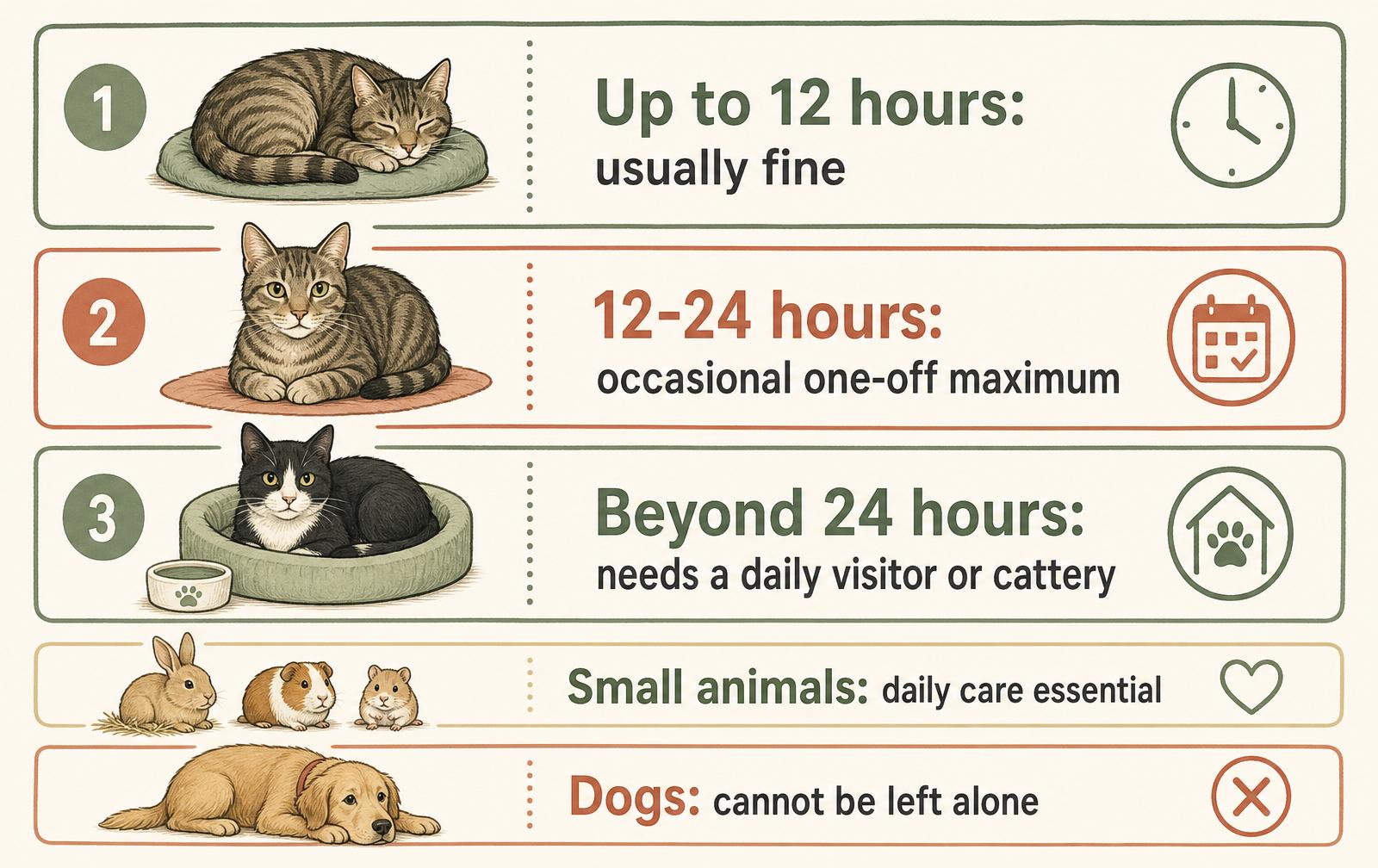
Let's start with the figure people most want, and least like. The consensus across UK welfare organisations, including Cats Protection, is that a healthy adult cat should not be left entirely alone for more than around 12 hours as any kind of regular occurrence. An occasional single overnight, up to roughly 24 hours, is something most healthy adult cats can manage if everything is properly set up, but 24 hours is an absolute ceiling for a one-off, not a plan, and never something to repeat across consecutive days.
That rules out the classic summer arrangement: heading off for a long weekend, or a week, leaving a mountain of biscuits and trusting the cat to cope. It can't, not safely, and not for that long.
Kittens, elderly cats, and any cat with a medical condition need checking far more often than this. Young kittens should only be left a few hours at a time.
Why a day is the limit, when the food would last longer
The instinctive objection is reasonable: if there's plenty of food and water down, why does the clock matter? Because the risk was never really about running out of food. It's about everything else that a day is long enough to go wrong.
In any twenty-four hours, a water bowl can be knocked over or go stagnant, wet food can spoil, and a litter tray can become dirty enough that a fastidious cat refuses to use it, holding on in a way that risks urinary problems, or toileting elsewhere out of distress. A cat can have a genuine health emergency — a blocked bladder, a sudden illness, an injury — with no one there to notice or act. And an unsupervised cat is a curious one: things get chewed, swallowed, climbed and knocked over when nobody's watching. None of these is solved by leaving more food. They're solved by a person actually laying eyes on the cat each day.
There's a hydration angle worth knowing too. Cats evolved from desert animals and often obtain much of their total water through food. A single bowl can be knocked over or become unappealing while you're away, so provide more than one fresh water source in different spots. A fountain may suit an individual cat, but it isn't reliably better than a bowl.
The independence myth
Underlying all of this is a belief that cats simply don't mind, that they're solitary, self-contained creatures who rather enjoy the house to themselves. There's a grain of truth in it, and a well-provided-for cat may indeed be content pottering about alone for a day. But the wider idea that cats are emotionally indifferent to us is wrong. Cats form real attachments to their people, and can experience separation-related stress when left too long, which shows up as over-grooming to the point of bald patches, changes in appetite, excessive hiding, or toileting outside the tray.
So the honest picture is not "cats don't need us." It's "cats hide their needs well," which is a theme worth remembering — because a cat quietly coping is not the same as a cat that's fine. (For more on how cats mask illness in particular, see How to Tell If Your Cat Is Unwell.)
Small animals: less forgiving, not more
Here is the part that most surprises people. Rabbits, guinea pigs, hamsters and other small pets are often treated as the easiest animals to leave — small, quiet, tucked away in a cage with plenty of food. In welfare terms they are among the least suitable to leave, and they need daily care and checking, without exception.
The reason is that small animals go downhill frighteningly fast, and often silently, because as prey animals they hide illness by instinct. Rabbits are the starkest example: a rabbit that stops eating can develop gut stasis, a genuine emergency, within a day, and in warm weather flystrike can cause severe, life-threatening damage in a matter of hours. A guinea pig or hamster that becomes unwell can decline just as quickly. Add the daily need for fresh food and water, a clean living area, and, in summer, twice-daily flystrike checks for rabbits, and it's clear that "leave extra food for the weekend" isn't a mild shortcut — it's a real danger.
The rule for small animals is simple: they need someone providing hands-on daily care and actually looking at them every day. They cannot be left to fend for themselves even for a single full day in the way a cat sometimes can. For what a proper setup looks like day-to-day, see our guides on rabbit care and hamster care.
And dogs, briefly
For completeness: dogs can't be left this way at all. They're social animals with far greater needs for company, exercise and toileting, and leaving a dog alone overnight, let alone for a holiday, isn't an option. A dog needs someone staying with it, a live-in or day sitter, a boarding kennel, or to come with you. If you have a dog, holiday plans have to be built around that from the start.
What good care actually looks like
For any absence longer than a day, the answer is straightforward: arrange for a person to come in and care for your pet. What matters is the quality of that arrangement.
At least once a day, ideally twice. A single daily visit is the minimum for a cat; twice is better, and small animals often need it. The visitor should do more than tip food in — they should check the animal over, refresh water, clean the tray or living area, and make sure nothing's wrong.
Choose the right carer. A trusted friend, neighbour or family member can be ideal, or a professional pet sitter. For cats, a good cattery is an alternative, though many cats find staying in their own home less stressful than being moved. For small animals, in-home daily care or a small-animal boarder works well.
Introduce them beforehand. Where you can, have your sitter meet your pet before you go, and note down the routine: feeding amounts and times, litter or cleaning habits, hiding spots, quirks, and anything to watch for.
Leave a plan for when things go wrong. Your vet's details, your pet's normal routine and any medication, and clear instructions on what to do and who to call in an emergency. Make sure the carer can actually get your pet to a vet if needed.
Set the environment up well. Multiple water sources, a spare clean litter tray, a safe space free of hazards, and familiar comforts. A pheromone diffuser can help an anxious cat settle.
It's worth knowing, too, that this isn't only good practice — it's the law. The Animal Welfare Act 2006 requires you to meet your pet's welfare needs at all times, including while you're away, so a plan that fails — an empty water bowl, no one checking — can leave you responsible.
The bottom line
The comfortable assumption, that cats are independent and small animals are low-maintenance, is precisely what leads people to leave them too long. A healthy cat can manage up to about half a day alone, and a single overnight at a push, but beyond that it needs a person visiting daily. Small animals need daily care full stop, and can decline dangerously fast without it. And dogs can't be left at all.
None of this has to spoil a holiday. It just means the pet's care is part of the plan, not an afterthought — a trusted daily visitor, a proper handover, and a plan for emergencies. Sort that, and you can go away knowing the animal you left behind is genuinely being looked after, rather than merely left with a full bowl and good intentions.
This is general guidance, not veterinary advice. If your pet is unwell before you travel, or a carer notices anything wrong while you're away, contact a vet promptly. For rabbits and small animals in particular, a loss of appetite is an emergency, not something to wait on.
Common questions
Frequently asked.
Keep reading
Further reading.
Want plain-English notes on pet health and the things that affect it? Join The Once-Over, our weekly note from Hazel.