Nutrition · Cat · 18 Sept 2026
Does Your Cat Need a Water Fountain?
By Burrow · 18 Sept 2026
TL;DR
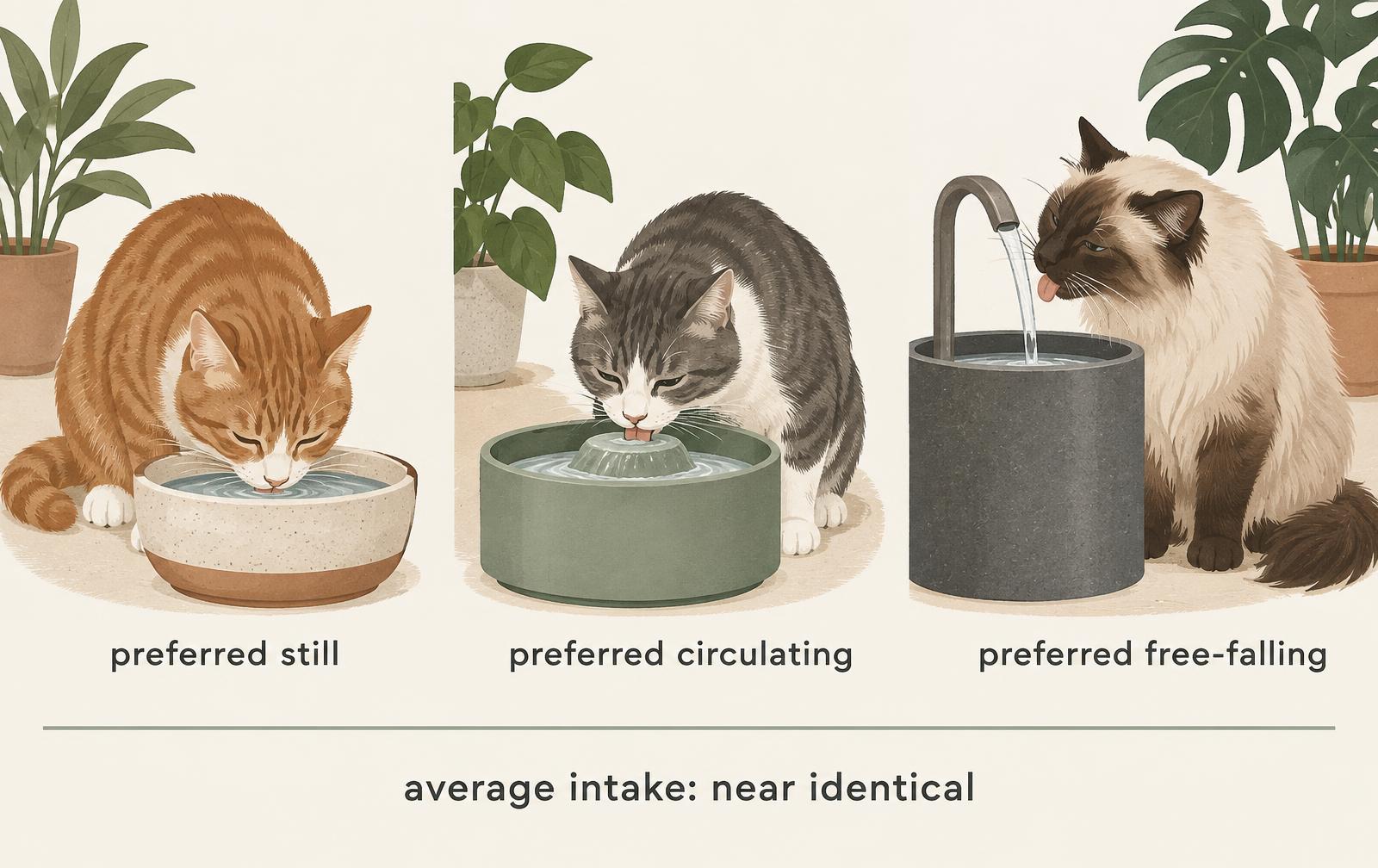
- A 2019 randomised crossover study in 14 cats compared still, circulating and free-falling water. Average intake was near-identical: 27.5, 26.3 and 26.1 ml/kg/day.
- No meaningful differences were found in urine volume, urine specific gravity or urinary relative supersaturation.
- Individual preferences were real, and they varied. One cat preferred circulating water, another free-falling, another still.
- In an earlier home study, an apparent fountain advantage disappeared once a dietary inconsistency was excluded — and one cat refused the fountain entirely, showing behavioural signs until it was removed.
- A 2026 scoping review of 32 publications concluded we still don't have a well-established optimal water intake requirement for cats.
- Dietary moisture moves the numbers more than the container does. Cats drink more free water on dry food, but total water intake is greatest on wet food.
The claim is that cats instinctively prefer running water, so a fountain makes them drink more. The controlled evidence doesn't support that as a general rule — but it does show something more useful.
Water fountains have become one of the more successful cat products of the last decade, and the reasoning behind them sounds sensible. Cats descend from desert animals, they're prone to urinary problems, and plenty of them show more interest in a running tap than a full bowl sitting on the kitchen floor.
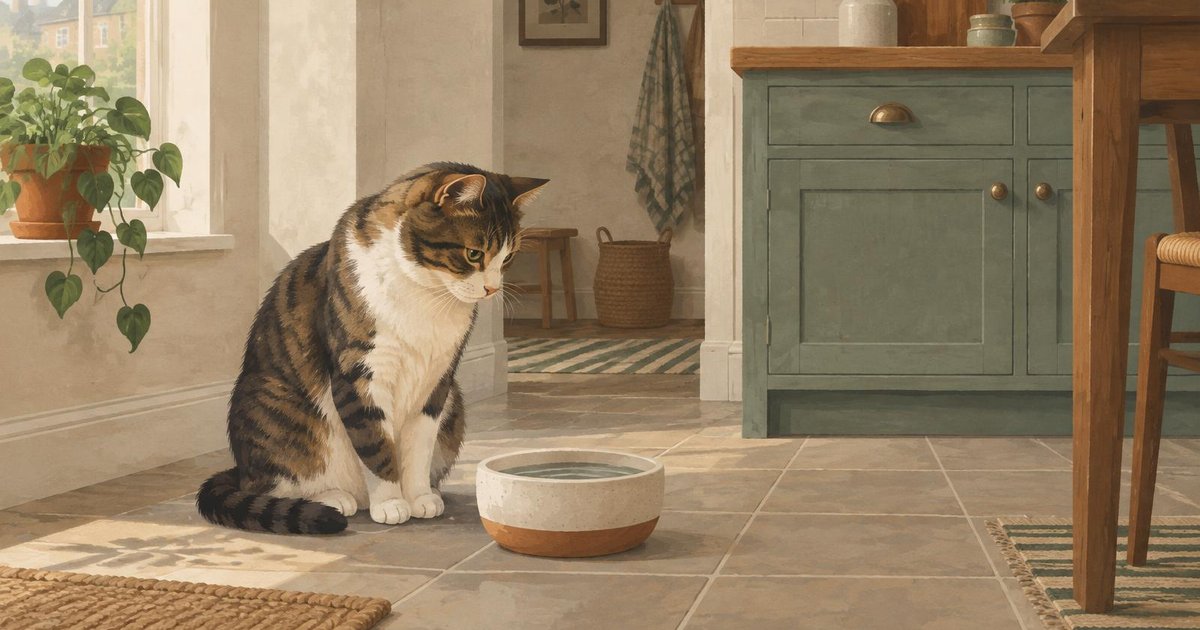
The controlled research tells a different story, and a more interesting one. Cats don't appear to have a universal preference for running water. Some do prefer it. Some prefer a still bowl. At least one cat in the published literature disliked a fountain enough to stop drinking from it altogether.
Which means fountain versus bowl is probably the wrong question to be asking.
What the controlled evidence shows
The most useful study here is a 2019 randomised crossover experiment in 14 healthy cats, comparing still water, circulating water and free-falling water.
Average daily intake was essentially identical across all three: 27.5 ml/kg/day for still, 26.3 for circulating and 26.1 for free-falling. There were no meaningful differences in urine volume, urine specific gravity or urinary relative supersaturation — the measures that would indicate an actual clinical benefit rather than just a higher number in a bowl.
But the individual data is where it gets interesting. The cats weren't uniform. One preferred circulating water. Another preferred free-falling water. Another preferred still water. The group average concealed three different animals with three different opinions.
An earlier home-based study offered thirteen cats both a bowl and a fountain. Fountain intake initially appeared higher — until one cat with a dietary inconsistency was excluded from the analysis, at which point the effect disappeared. Urine concentration wasn't improved either way.
And one cat in that study disliked the fountain sufficiently that it refused to drink from it, developing excessive grooming and vomiting before the fountain was removed.
That's a small detail from a small study, and it shouldn't be over-read. But it's a useful corrective to the assumption that a fountain is at worst neutral. For at least one cat, it wasn't.
What we still don't know
A scoping review published this year examined 32 publications on feline hydration spanning 1975 to 2025, and one of its conclusions is worth stating plainly: we don't have a well-established optimal water intake requirement for cats.
That's a significant gap. A great deal of hydration advice is given as though the target is known and the only question is how to hit it. The review found that water intake was influenced by diet format, dietary protein and amino acid content, salt, osmolytes and water viscosity — and was not affected by whether the water source was static or flowing.
It also found that groups of cats at high risk of lower urinary disease consuming roughly 42 to 51 ml per kilogram of bodyweight in total water daily tended to have urine specific gravity below 1.035, and that this occurred in groups fed wet diets or dry diets with nutrient-enriched water. Not in groups given fountains.
Dietary moisture is the bigger lever
Here's the distinction that makes sense of a lot of confusing advice.
Cats on dry food drink more free water than cats on wet food. That's intuitive and it's what owners observe — the water bowl empties faster. But a 2026 study reinforced what the wider evidence suggests: total water intake is greatest when cats eat wet food, because the water arrives with the food rather than needing to be drunk separately.
Wet food is roughly 70–80% water by weight. Dry food is around 10%. A cat eating wet food takes in a substantial volume without visiting a bowl at all, and it doesn't fully compensate for the difference by drinking more when it eats dry.
So an owner watching the water bowl is watching the wrong number. Free water consumption goes up on dry food. Total water intake goes down.
The hierarchy that's actually useful
Rather than fountain versus bowl, the more sensible way to think about this runs roughly in this order.
Total water intake is what matters physiologically — not how much a cat drinks, but how much water enters the animal.
Moisture from food plus water voluntarily drunk is what makes up that total, and diet format is the larger of those two levers.
Individual drinking preference comes next, and it's genuinely individual. Some cats prefer moving water. Some don't. Watching your own cat tells you more than any general rule.
Location, number and accessibility of water sources matters and costs nothing — multiple stations, away from food and litter trays, in quiet spots a cat can drink from without feeling exposed.
Fountain versus bowl sits at the bottom. It's the variable most owners think about first and the one the evidence suggests matters least on average.
Where fountains genuinely fit
International Cat Care's current guidance treats fountains as one option among several rather than a hydration necessity, and explicitly recognises that preferences vary between individuals. That's a fair reflection of the evidence.
If your cat clearly likes a fountain, use one. There's no argument here for removing something a cat is using happily, and fountains have practical advantages — filtration, circulation, and holding more water than a bowl if you're out for long periods.
Introduce a fountain gradually and keep a familiar bowl available at first. Some cats need time to accept an unfamiliar piece of equipment that makes noise and moves, and the study where a cat refused to drink is a reminder that the introduction matters.
What the evidence doesn't support is buying a fountain as a clinical intervention. If your vet has told you to increase your cat's water intake — because of urinary problems, kidney disease, or a history of stones — changing the container is unlikely to be sufficient on its own.
Try this today
Spend a week watching how your cat drinks rather than how much. Does it use the bowl, the tap, a glass of water you left out, a puddle on the windowsill? Does it approach the bowl and then walk away? Where in the house does it choose?
That's more useful information than any general claim about what cats prefer, because the research is clear that cats differ. And if your cat is entirely on dry food and you've been trying to improve its hydration by changing the water, the larger lever is on the other side of the equation.
The Bottom Line
The claim that cats instinctively prefer running water doesn't hold up as a general rule. Controlled studies show near-identical intake across still, circulating and free-falling water, with no improvement in the urinary measures that would indicate clinical benefit — and with individual cats going in different directions, including towards the still bowl.
If your cat likes a fountain, use one. If it prefers a bowl, there's no good evidence you're depriving it of better hydration by sticking with the bowl. And if increasing water intake is medically important, changing the water container alone probably isn't enough.
The bigger lever is what's in the food. Cats drink more free water on dry food, but take in more water overall on wet — which means the bowl you've been watching was never the number that mattered.
This is general information and not veterinary advice. If your cat has a history of urinary problems or kidney disease, or you've been advised to increase its water intake, discuss the approach with your vet. Straining to urinate or inability to pass urine in a cat is an emergency.
Related reading: When Does a Cat Actually Start Getting Old? · Your Older Cat Looks Healthy. But Is It? · The Cat Behaviour Guide
Common questions
Frequently asked.
Keep reading
Further reading.
Want calm, evidence-led notes on pet health research? Join The Once-Over, our weekly note from Hazel.