Preventive Vet Care · Dog · 13 Nov 2026
Does Your Dog Need Tick Treatment in Winter?
By Burrow · 13 Nov 2026
TL;DR
- **Winter ticks are uncommon, not absent.** UK surveillance records far fewer ticks in winter than in spring and summer, but some turn up most winters.
- **One UK tick stays active in cooler weather.** The ornate dog tick, documented in parts of Essex, Devon and west Wales, is typically active in autumn and winter, and has been linked to babesiosis in dogs that never left the UK.
- **Risk depends on the walk.** Long grass, woodland, heath and land grazed by deer or sheep carry more risk than pavements and town parks.
- **Vets are moving away from blanket treatment.** UK veterinary bodies advise a risk-based approach, partly because some treatments are reaching rivers. Don't stop a prescribed product without talking to your vet.
- **Check and remove, all year.** Removing ticks promptly reduces the chance of infection.
Ticks are far less common on UK dogs in winter, but they do not disappear. One species found in parts of England and Wales can remain active through the colder months and has been linked to a serious canine disease, so whether your dog needs treatment through winter depends less on the calendar than on where, and how, it is walked.

For most of the year, tick treatment is a familiar part of owning a dog. In winter, many owners wonder whether it is still needed, and the honest answer is that it depends. Ticks become much less active in cold weather, but mild spells are common in a British winter, and one tick species found in a handful of UK areas is typically active in autumn and winter, when others are quiet. At the same time, vets are increasingly being asked to avoid treating every pet all year round by default. Working out what your own dog needs means looking at where it walks, not just at the month.
How common are ticks in winter?
The UK Health Security Agency (UKHSA) runs a Tick Surveillance Scheme, which collects ticks sent in by the public, vets and others. Its records for the sheep or deer tick, the species most often found on UK dogs, show a strong seasonal pattern. Over the past ten years, England has averaged around 150 records in June, compared with about 8 in November, 3 in December, 2 in January and 4 or 5 in February. Last winter followed the same pattern, with three records in November, three in December, none in January and two in February.
These are surveillance submissions, not a count of every tick in England. The scheme depends on ticks being found, recognised and sent in, and it includes ticks collected from people as well as animals. People may also be less likely to look for or send in ticks in winter. The pronounced seasonal difference is consistent with much lower winter activity, but the figures cannot tell us precisely how likely a dog is to meet a tick on a particular walk, and they cover only the sheep or deer tick. The Merck Veterinary Manual notes that ticks may be active whenever the temperature is above about 4°C, and mild spells like that are common in many parts of the UK.
Research on dogs fills in some of the picture. The Big Tick Project, a large survey led by the University of Bristol and supported by the animal health company MSD, found that 30% of more than 12,000 dogs examined at vet practices in spring and summer 2015 carried at least one tick. The authors noted that the figure was probably inflated by how practices were recruited, and the survey did not cover winter, although the same research team reported finding ticks biting dogs through two UK winters.
The tick that stays active in cooler weather
The sheep or deer tick, Ixodes ricinus, accounts for around 89% of ticks found on UK dogs, according to the Big Tick Project, and it is most active in spring and autumn. A different species, the ornate dog tick, Dermacentor reticulatus, behaves differently. Researchers describe it as typically active during autumn and winter, with some activity in spring, often at times when other ticks are quiet.
In the UK, established populations have been documented in parts of Essex, Devon and west Wales, mostly in coastal dunes and grassland, although a 2017 review noted that it had more recently been found in urban green space in Essex. Its distribution continues to be monitored, and dogs elsewhere should not automatically be considered free of risk.
The ornate dog tick matters because it can carry Babesia canis, a parasite that destroys red blood cells. Not every ornate dog tick is infected, but in the winter of 2015 to 2016, four dogs in Harlow, Essex, that had never travelled abroad were diagnosed with babesiosis. A survey of the field where they had been walked found ornate dog ticks carrying the parasite. Further cases followed in untravelled dogs in Romford in 2016, one of which died, and near Ware, Hertfordshire, in 2017. Local measures, including signs, a barrier to the field and advice on tick prevention, appeared to help, with no further cases reported from the Harlow site. For dogs walked where this tick is known to live, winter is not a low-risk season.
Why vets are moving away from treating everyone all year
For years, the default advice was year-round treatment for every dog. That is changing. In 2021, the British Veterinary Association (BVA), the British Small Animal Veterinary Association and the British Veterinary Zoological Society published a joint position, updated in 2025, asking vets to avoid blanket treatment and instead assess each animal's risk, including its lifestyle and the potential harm to the environment. The update also advises avoiding spot-on treatments, where possible, for dogs that swim or are bathed, because of growing evidence that some flea and tick products are reaching rivers.
The same position identifies factors that raise a dog's risk of ticks, including walking through long grass and on land where deer or sheep are present. In its advice for owners, the BVA describes the risk of tick-borne disease in UK pets as low but not negligible, and recommends discussing with your vet whether a tick product is needed based on your pet's lifestyle, health and local tick levels.
Not everyone puts the emphasis in the same place. ESCCAP UK, a parasite advisory body funded by the animal health industry, stresses that ticks are a year-round risk, and some research and commentary on ticks has been sponsored by companies that make tick products. That does not make it wrong, but it is worth knowing when weighing advice.
If your dog already has prescribed tick protection, talk to your vet before changing or stopping it. The right schedule depends on the product, your dog's exposure and local risks, and some products protect against other parasites as well as ticks.
Working out your own dog's risk
In practice, the questions that matter most are about how your dog spends its time outdoors:
- Where does it walk? Woodland, heath, moorland, long grass and land grazed by deer or sheep carry more risk than pavements, gardens and short-mown parks.
- Where do you live? Ticks are more common in some regions than others. The Big Tick Project found the highest rates in Scotland and south-west England. If you walk your dog in parts of Essex, Devon or west Wales where the ornate dog tick has been found, winter risk is higher.
- Does it travel? Dogs that have been abroad can bring back tick species and infections not normally found in the UK.
- Does it swim? If your dog regularly swims or is bathed, ask your vet about treatments other than spot-ons.
A dog that spends the winter on town pavements may need a different plan from one that runs through deer-grazed woodland every weekend. Your vet can help you weigh these factors, and may suggest year-round treatment, seasonal treatment or treatment only when needed.
Check, remove, repeat
Whatever you decide about treatment, checking for ticks matters all year, and for dogs at substantial risk it complements preventive products rather than replacing them. The Merck Veterinary Manual notes that the bacteria that cause Lyme disease need time to pass from a tick to a dog, usually more than a day of feeding, so prompt removal reduces the risk. That is a reason to check soon after walks, not a safe window to rely on. The BVA advises checking around the ears, neck, legs and between the toes, and feeling for small lumps, as ticks can be easier to feel than to see.
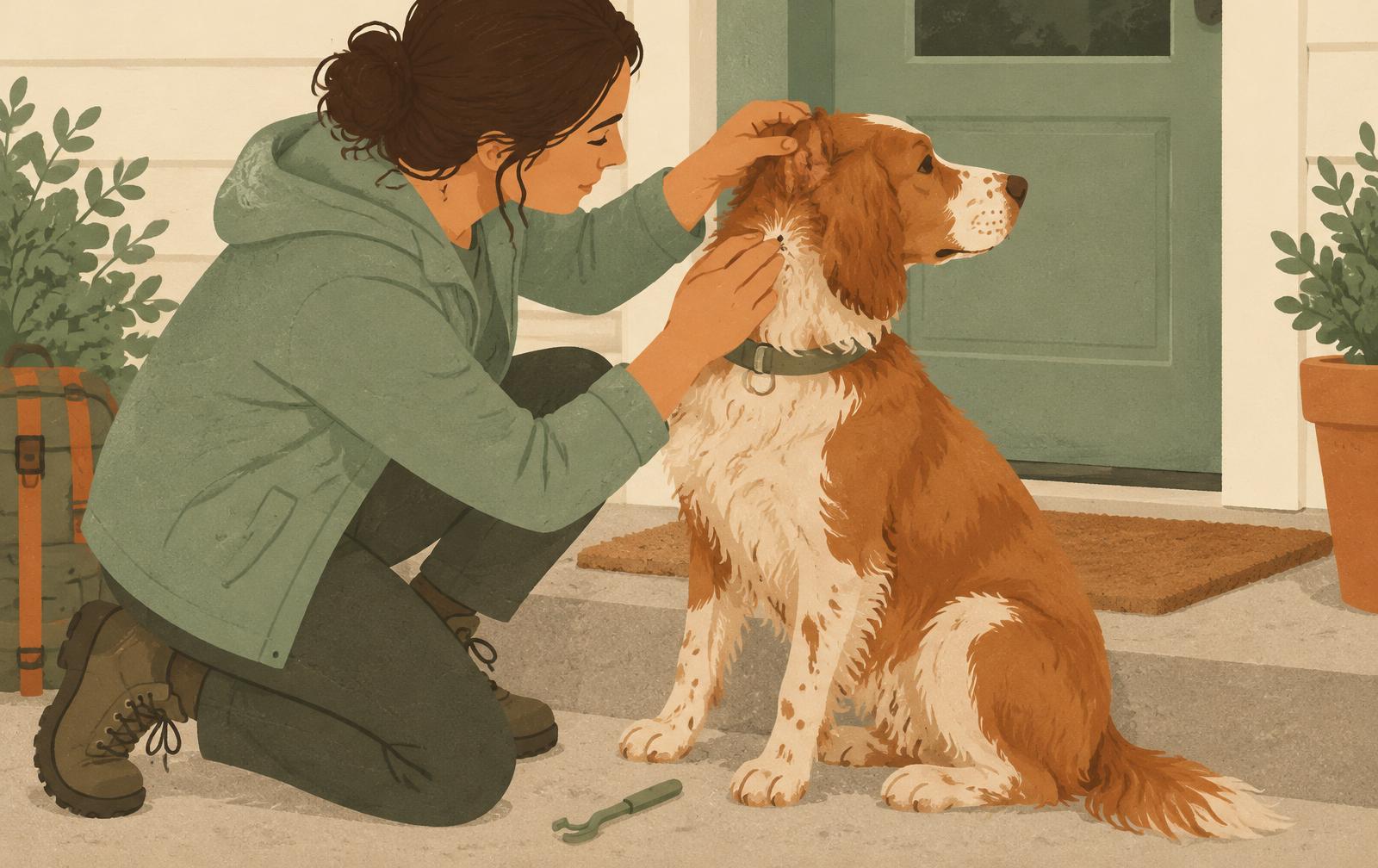
How you remove a tick depends on what you use. With a purpose-made tick removal tool, the BVA advises following the tool's instructions. The most common technique involves sliding it under the tick and gently lifting it off with a twisting motion. With fine-tipped tweezers, UKHSA advises gripping the tick as close to the skin as possible and pulling upwards slowly and firmly, without squeezing the body. The US Centers for Disease Control and Prevention advises against using petroleum jelly, heat or other substances to make a tick detach. The BVA suggests wearing gloves and cleaning the area with a pet-safe antiseptic afterwards. If the area becomes swollen or sore, see your vet.
Signs to watch for
Most dogs bitten by ticks do not become ill, but it helps to know the warning signs. Merck notes that Lyme disease in dogs most often causes lameness that comes and goes or shifts between legs, along with fever, reduced appetite, lethargy and swollen lymph nodes, and that most dogs that test positive show no signs at all.
Babesiosis is much less common in the UK but more serious. Guidance from Defra and the Animal and Plant Health Agency lists lethargy, weakness, vomiting, loss of appetite, fever, pale gums and dark-coloured urine among the signs. If your dog shows pale gums, dark urine or sudden weakness, particularly after walks in areas where the ornate dog tick has been found, contact your vet straight away. Babesia canis cannot pass from dogs to people.
Try this today
After your dog's next walk, run your hands over its coat and check its ears, neck, legs and paws for ticks. Buy a tick removal tool, read its instructions and keep it by the door. Then think about where your dog walks through winter, and whether you are in or near parts of Essex, Devon or west Wales. At your dog's next vet visit, ask whether its tick treatment plan matches its actual risk, rather than simply renewing what you already use, and don't stop a current product before you have had that conversation.
The Bottom Line
Ticks are far less common on UK dogs in winter, but they do not vanish, and in parts of Essex, Devon and west Wales, the ornate dog tick is typically active in the colder months and has been linked to babesiosis in dogs that never left the country. Whether your dog needs treatment through winter depends on where and how it is walked, and UK veterinary bodies now encourage vets and owners to decide on that basis rather than treating every dog all year by default. Talk to your vet before changing any current product, check your dog after walks in grass or woodland, remove ticks promptly and correctly, and contact your vet if your dog shows signs of illness.
This article is for general information and does not replace veterinary advice. Talk to your vet about the right tick control plan for your dog, and contact them straight away if your dog seems unwell after a tick bite.
Common questions
Frequently asked.
References
Sources.
- UK Health Security Agency. UKHSA data dashboard: Ticks (Ixodes ricinus). Updated August 2026.
ukhsa-dashboard.data.gov.uk - Abdullah S, Helps C, Tasker S, Newbury H, Wall R. Ticks infesting domestic dogs in the UK: a large-scale surveillance programme. Parasites & Vectors. 2016;9:391.
doi.org - Newbury H, Howell J, Wall R, Abdullah S. The Big Tick Project: a national survey. Vet Times. May 2016.
vettimes.com - Medlock JM, Hansford KM, Vaux AGC, et al. Distribution of the tick Dermacentor reticulatus in the United Kingdom. Medical and Veterinary Entomology. 2017;31(3):281–288.
doi.org - de Marco MDM, Hernández-Triana LM, Phipps LP, et al. Emergence of Babesia canis in southern England. Parasites & Vectors. 2017;10:241.
doi.org - Wright I. Babesiosis in Essex, UK: monitoring and learning lessons from a novel disease outbreak (letter). Parasites & Vectors. 2018;11:132. Publication sponsored by Bayer Animal Health.
doi.org - Defra and Animal and Plant Health Agency. Babesia canis: questions and answers.
assets.publishing.service.gov.uk - BVA, BSAVA and BVZS. Policy position on responsible use of parasiticides for cats and dogs. September 2021, updated 2025.
bva.co.uk - British Veterinary Association. Protecting your pet from ticks: a guide for UK pet owners. 26 March 2025.
bva.co.uk - Merck Veterinary Manual. Lyme Borreliosis in Animals.
merckvetmanual.com - UK Health Security Agency (formerly Public Health England). Tick awareness leaflet.
assets.publishing.service.gov.uk - Centers for Disease Control and Prevention. What to do after a tick bite.
cdc.gov
Keep reading
Further reading.
Want plain-English notes on preventive pet care? Join The Once-Over, our weekly note from Hazel.