Preventive Vet Care · Dog · 05 Oct 2026
Does Your Dog Need Monthly Lungworm Prevention?
By Burrow · 05 Oct 2026
TL;DR
- Lungworm is spreading in Britain. Fox prevalence rose from 7.3% to 18.3% between two comparable national surveys, reaching areas that previously had none.
- It can be fatal, and the signs are often not respiratory. Bleeding problems, collapse and neurological signs all occur, and infection can be silent for months.
- Preventive products reduce infection, but not uniformly. One widely cited study reported 94.9% reduction in worm burden — while still recovering adult worms from nine of ten treated dogs.
- Not all wormers cover lungworm. This is the single most common gap in owner understanding.
- The risk is geographically patchy. Slug infection rates vary enormously between areas only a hundred miles apart.
- Nobody can currently identify which individual dogs need monthly prevention. A 2026 review says the data doesn't exist.
The parasite is spreading, the preventive products work reasonably well, and nobody can yet tell you whether your particular dog needs them. Those three things are all true at once.
Lungworm is one of the few parasites in British veterinary medicine where the marketing and the science point in roughly the same direction — it is genuinely spreading, it can genuinely kill dogs, and monthly prevention does genuinely reduce infection.
What's much less settled is the question an owner actually wants answered: does my dog need it?
A 2026 review in the Veterinary Nursing Journal puts the problem plainly. Identifying the dogs at meaningful risk is the hard part, and the authors conclude that we do not have robust enough data to identify these dogs beyond assessing for lifestyle characteristics.
So this is a piece about holding two things apart. The evidence that prevention works is reasonable. The evidence about who needs it is not.
What it actually is
Angiostrongylus vasorum isn't really a lungworm, despite the name. The adult worms live in the pulmonary arteries and the right side of the heart, which is why it's sometimes called the French heartworm. Dogs become infected by eating slugs or snails carrying the larvae — often accidentally, since slugs can be very small and end up on grass, in water bowls, or on toys left outside.
Foxes are the main wildlife reservoir, and that's where the clearest evidence of spread comes from. Taylor and colleagues examined 442 foxes across Great Britain in 2013 and 2014, repeating the methods of an identical survey conducted in 2005 and 2006. Overall prevalence had risen from 7.3% to 18.3%, with significant increases in most regions. Northern Britain went from zero to 7.4%. The south-east went from 23.2% to 50.8%.
That's a genuine expansion over eight years, measured the same way twice.
The signs are frequently not what you'd expect
This is the part that catches owners and sometimes vets out.
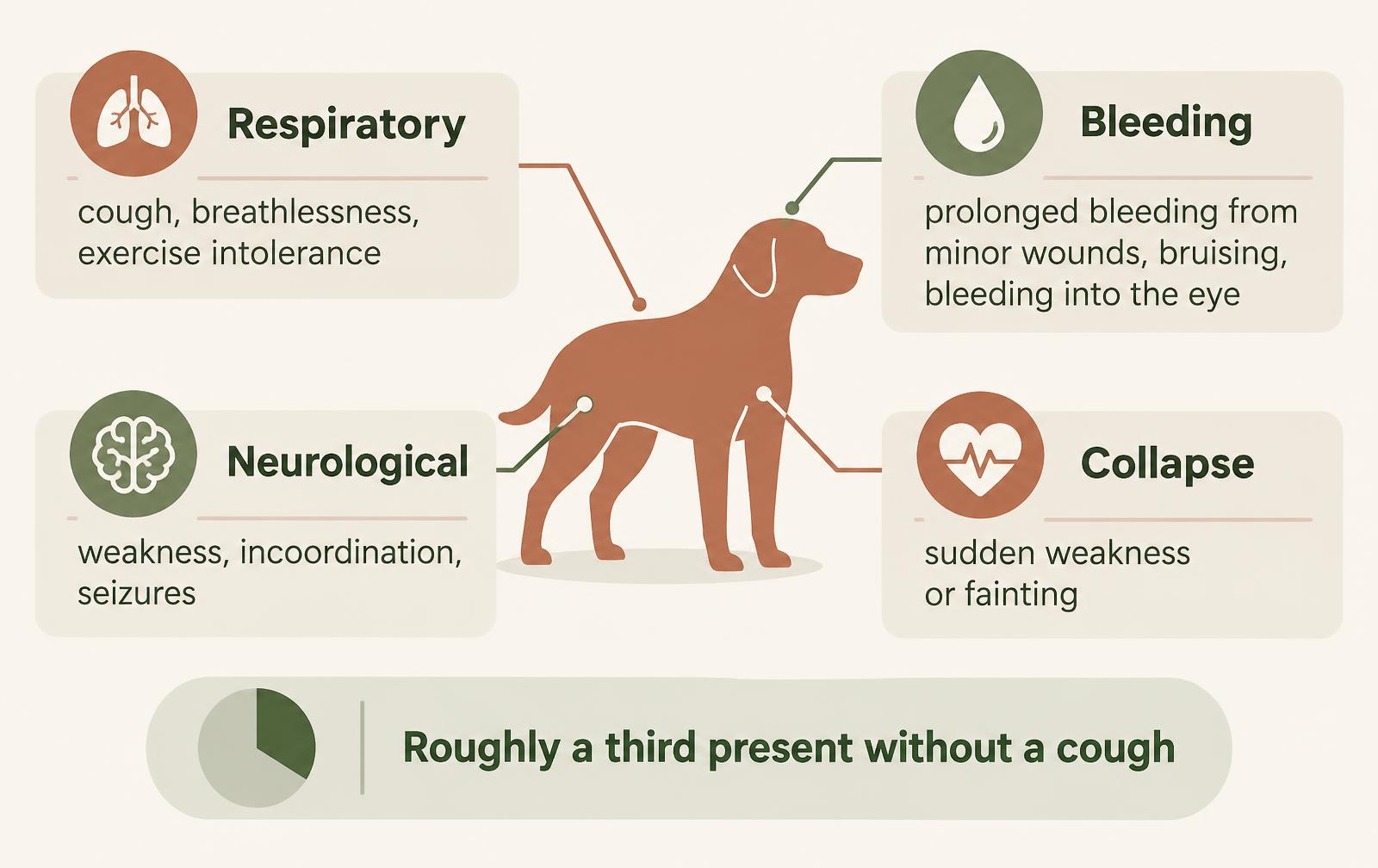
Because the parasite lives in the heart and pulmonary circulation, the obvious assumption is that it causes a cough. It often does — but published case series have found only around two-thirds of affected dogs present with respiratory signs at all.
The others present with something else entirely. Around 15% present with bleeding problems, because the parasite interferes with normal clotting — prolonged bleeding from a minor wound, bruising, bleeding into the eye, or haemorrhage after routine surgery. Neurological signs occur in a smaller proportion, as does collapse. Ocular cases have been documented.
ESCCAP's diagnostic guidance for UK vets describes angiostrongylosis as a crucial differential in any dog presenting with respiratory, coagulopathy, neurological or collapse signs of unknown cause. That breadth is the point: a dog with an unexplained bleeding problem and no cough may still have lungworm.
Infection can also remain subclinical for months, which means a dog can be infected, shedding larvae and apparently well.
Where the risk actually is
Lungworm is not evenly distributed, and the differences are stark.
A study comparing slug populations in Swansea — a known endemic hotspot — with Bristol, where cases are rare, found A. vasorum in 29.4% of slugs in Swansea against 0.3% in Bristol. A separate survey in south Wales reported 43% prevalence using PCR. These are the same country, a couple of hours apart.
Habitat matters too. Research examining where dogs and gastropods actually overlap found parasite prevalence was around 65 times more likely in woodland and scrub, and around 62 times more likely in amenity grassland, than in other habitat types.
In dogs themselves, UK prevalence sits below 4% overall, rising above 16% in dogs presenting with consistent clinical signs. A serological survey of 4,030 UK dogs, predominantly in southern Britain, found 1.32% antigen-positive and 3.2% antibody-positive.
Age appears to matter as well. A study of 897 dogs attending practices in southern Great Britain found younger age associated with a greater likelihood of testing positive — consistent with other research showing dogs under two are more likely to be infected, probably because of how much more they scavenge, play with and eat.
What prevention actually achieves
Here the evidence is reasonable but more nuanced than product marketing suggests, and the nuance is worth having.
The most frequently cited study, by Lebon and colleagues in 2016, treated ten beagles monthly with a combination of afoxolaner and milbemycin oxime while challenging them repeatedly with infective larvae, against ten untreated controls. The headline figure is a 94.9% reduction in worm burden, with faecal larval shedding reduced by around 99.9%.
That's a real effect. But it describes burden reduction rather than prevention of infection, and adult worms were still recovered from nine of the ten treated dogs, at counts between one and twenty-four. Two subsequent peer-reviewed papers characterise the same work less favourably — a 2020 study notes that three monthly treatments with that combination did not achieve efficacy above 90%, and a 2026 paper describes infections as reduced "to a lesser extent" by it than by the product being tested.
Other combinations perform better. A single treatment with spinosad plus milbemycin oxime given 30 days after infection achieved 98.8% preventive efficacy, with no worms found in five of eight treated dogs against a control group carrying between 22 and 98 worms each.
And a field study of 622 client-owned dogs in Denmark and Italy, run over ten months, found two placebo-treated dogs acquired A. vasorum while none of the dogs on monthly sarolaner, moxidectin and pyrantel did.
So the fair summary is: monthly prevention substantially reduces infection and larval shedding, products differ in how well they do it, and complete prevention isn't guaranteed by any of them.
The thing most owners don't know
Not all wormers cover lungworm.
A great many owners worm their dogs routinely and reasonably assume they're covered. Standard intestinal wormers — the ones most people buy for roundworm and tapeworm — frequently have no activity against A. vasorum at all, and the protective products require monthly administration rather than the quarterly schedule many owners follow for intestinal worms.
If you want to know whether your dog is protected, the useful question for your vet is specific: does what I'm currently using cover lungworm, and how often does it need to be given?
Why nobody can tell you if your dog needs it
This is the honest centre of the subject.
The parasite is spreading. The products work. The disease can kill. All of which sounds like a straightforward case for giving monthly prevention to every dog — and plenty of practices do recommend exactly that.
But the 2026 Veterinary Nursing Journal review puts the difficulty plainly: the data to identify which dogs are genuinely at risk doesn't exist beyond assessing lifestyle characteristics. We can say that living in an endemic area raises risk. We can say that young dogs, dogs that scavenge, and dogs that eat slugs and snails are more exposed. We cannot say with any precision what the absolute risk is for a particular dog in a particular postcode with a particular set of habits.
That's an uncomfortable place for an owner to be, and it's worth naming rather than papering over. The decision ends up being a judgement made with your vet about your dog's lifestyle and your local picture, rather than a calculation anyone can currently do properly.
What tilts it is the asymmetry. Monthly prevention is a modest, low-risk intervention. Established angiostrongylosis is a serious disease with variable presentation, a treatment picture that isn't fully settled, and the capacity to kill. For many dogs that asymmetry makes prevention a reasonable default even without precise risk data.
And there's a treatment problem too
Worth knowing, because it strengthens the case for not getting there.
A survey of UK primary care veterinary surgeons found fenbendazole was the most frequently selected drug for confirmed cases, chosen by 45% of vets — despite being unlicensed for this purpose in the UK and having no clear established protocol. The researchers noted that the absence of a protocol means treatment of affected dogs may be suboptimal, increasing the risk of morbidity and mortality.
Treatment also isn't entirely straightforward even when it works. Severe breathing difficulty and fluid accumulation can occur after treatment, as dying worms provoke a reaction, and these post-treatment complications sometimes need managing in their own right.
Try this today
Find whatever you last used to worm your dog and look at what it actually covers. If the packaging doesn't mention Angiostrongylus vasorum or lungworm specifically, it probably doesn't.
Then, rather than asking your vet whether your dog needs lungworm prevention as a yes-or-no question, ask two better ones: how common is it round here, and does what we're currently using cover it? Those have answers. The general question largely doesn't.
The Bottom Line
Three things are true simultaneously, and most coverage picks one.
Lungworm is spreading in Britain, measurably and in both directions geographically. The preventive products reduce infection meaningfully, though not uniformly and not completely. And nobody can currently tell you whether your individual dog is at enough risk to need them.
That last point isn't a reason to dismiss prevention. It's a reason to have a more specific conversation than the one most owners have. How common is it where you live and walk? What does your current wormer actually cover? Does your dog eat slugs, scavenge, or spend time in woodland and long grass?
Those questions have answers. And given that established lungworm is serious, variably presented, and not entirely straightforward to treat, the asymmetry tends to favour prevention for many dogs even in the absence of precise risk data.
Just check what you're already giving. A good many owners are worming diligently against something else entirely.
This is general information and not veterinary advice. Decisions about parasite prevention should be made with your vet. If your dog develops a persistent cough, unexplained bleeding or bruising, sudden weakness or collapse, seek veterinary attention.
Common questions
Frequently asked.
References
Sources.
- Taylor CS, et al. Increased prevalence and geographic spread of the cardiopulmonary nematode Angiostrongylus vasorum in fox populations in Great Britain. Parasitology, 2015;142(9):1190–1195.
https://pubmed.ncbi.nlm.nih.gov/26027539/ - Veterinary Nursing Journal, Volume 41(2), April 2026 — review of canine angiostrongylosis risk assessment.
https://vnj.bvna.org.uk/vnj-volume-41-2-april-2026/0080961001773737105/p25 - Lebon W, et al. Monthly administrations of milbemycin oxime plus afoxolaner chewable tablets to prevent Angiostrongylus vasorum infection in dogs. Parasites & Vectors, 2016;9:485.
https://www.ncbi.nlm.nih.gov/pmc/articles/PMC5010729/ - Becskei C, et al. Efficacy of orally administered combination of moxidectin, sarolaner and pyrantel for the prevention of Angiostrongylus vasorum infection in dogs.
https://pmc.ncbi.nlm.nih.gov/articles/PMC7391663/ - Schnyder M, et al. Seroepidemiological survey for canine angiostrongylosis in dogs from Germany and the UK using combined detection of Angiostrongylus vasorum antigen and specific antibodies.
https://pmc.ncbi.nlm.nih.gov/articles/PMC3762218/ - Morgan ER, et al. Angiostrongylus vasorum infection in dogs: presentation and risk factors.
https://pubmed.ncbi.nlm.nih.gov/20692767/ · https://www.sciencedirect.com/science/article/pii/S0304401710003705 - Böhm C, et al. Assessment of the combination of spinosad and milbemycin oxime in preventing the development of canine Angiostrongylus vasorum infections.
https://www.sciencedirect.com/science/article/pii/S0304401713005864 - ESCCAP UK & Ireland. Canine Lungworm Angiostrongylus vasorum — Diagnostic Recommendations.
https://www.esccapuk.org.uk/uploads/docs/4ide6ec4_0988_ESCCAP_UK_Diagnostic_Recommendations__Canine_lungworm_v2.pdf
Keep reading
Further reading.
Want calm, evidence-led notes on parasites, prevention and what the research actually shows? Join The Once-Over, our weekly note from Hazel.