Seasonal Health · Dog · 05 Oct 2026
Are Wild Mushrooms Poisonous to Dogs?
By Burrow · 05 Oct 2026
TL;DR
- Most dogs recover. A study of 421 ingestions reported 98.6% survival, with 45% of mushrooms identified as non-poisonous and 64.4% of cases managed at home.
- Dogs don't necessarily respond like humans. There are documented canine deaths from toxins rarely or never reported as fatal in people.
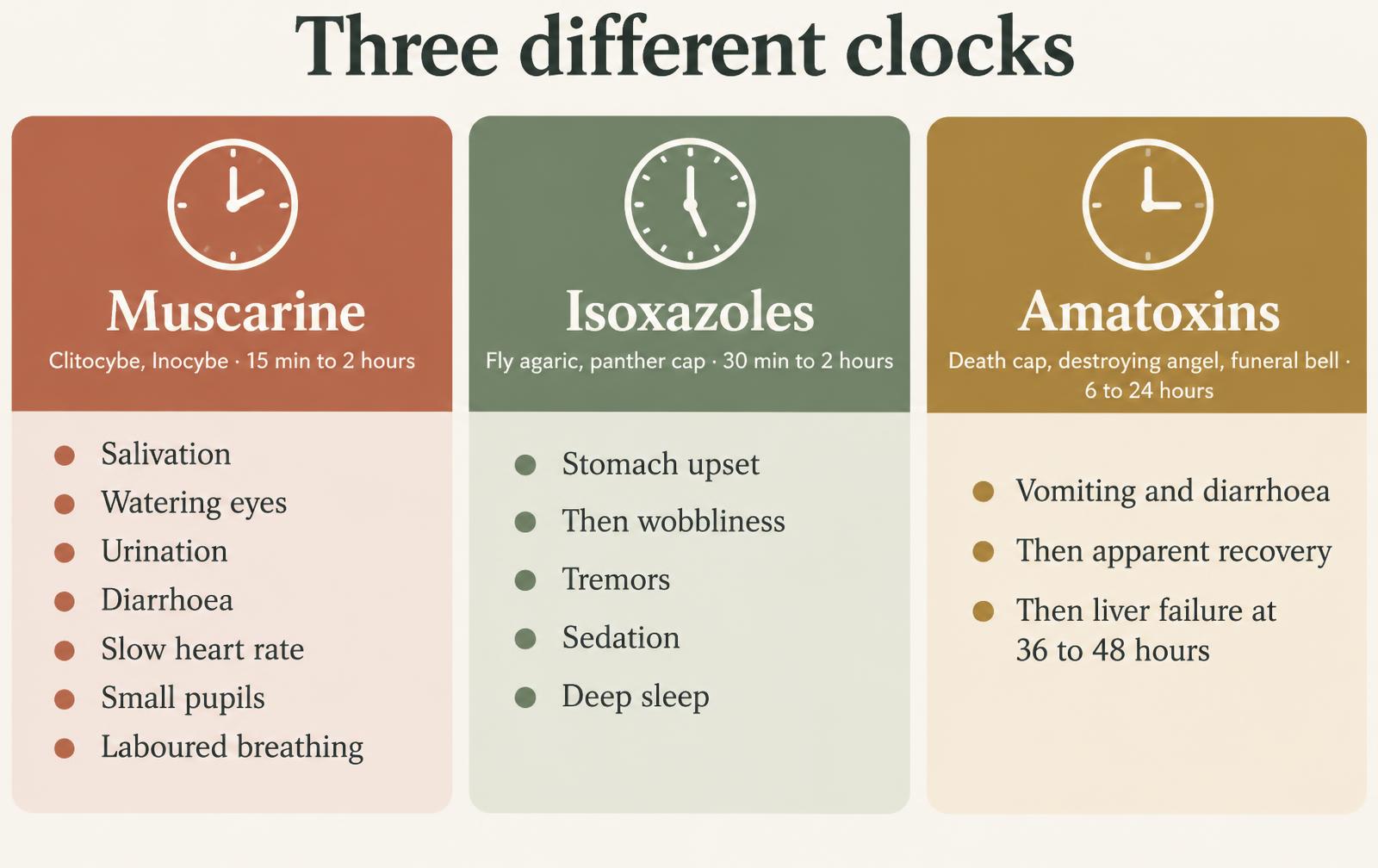
- Three toxin groups, three timescales. Muscarine acts in 15 minutes to two hours. Fly agaric toxins in 30 minutes to two hours. Amatoxins take six to twenty-four hours.
- Amatoxins produce a false recovery before liver failure develops at around 36 to 48 hours.
- Fast signs don't mean safe. A dog may have eaten several species growing together.
- The garden may matter more than the woods. In that study, 61.5% of ingestions happened in gardens against 20.9% in woodland.
- Veterinary guidance is to treat every ingestion as potentially toxic, because identification is unreliable.
Most dogs that eat a wild mushroom recover. But the toxins involved behave in very different ways, and the most dangerous of them are silent for the first day.
Autumn brings fungi up everywhere — woodland and parkland, but also damp lawns, the base of garden trees, bark mulch and the verges of ordinary walking routes.
The reassuring part first. In a Norwegian study of 421 mushroom ingestions by dogs, the survival rate was 98.6%, the mushrooms involved were identified as non-poisonous in 45% of cases, and 64.4% of cases were managed at home. A dog that grabs something off a lawn is much more likely to be fine than not.
The complication is that the exceptions don't behave in one predictable way. Different toxin groups produce entirely different pictures on entirely different timescales — and some toxins that rarely trouble people have killed dogs.
Most mushrooms do very little
Worth establishing properly, because alarm isn't useful either.
The Norwegian series of 421 cases found 45% of the mushrooms involved were identified as non-poisonous outright, 64.4% of cases were managed at home without hospitalisation, and overall survival was 98.6%. Six dogs died. A UK report from first-opinion practice similarly describes mushroom toxicosis as rarely diagnosed and poorly represented in the veterinary literature, while suggesting it's probably under-diagnosed rather than genuinely rare.
So the baseline expectation for a dog that eats a mushroom is recovery, often without treatment.
The reason veterinary guidance still says to treat every ingestion as potentially toxic is that you can't tell in advance which case you've got — and for a few species, the window in which treatment works best closes before the dog looks unwell.
Three toxin groups, three different clocks
This is what makes mushroom poisoning harder to think about than most toxins, and why "watch for symptoms" is poor advice.
Muscarine — found in Clitocybe and Inocybe species, including fool's funnel — acts on the autonomic nervous system. Signs appear within 15 minutes to two hours: heavy salivation, watering eyes, urination, diarrhoea, vomiting, a slowed heart rate, constricted pupils, and noisy or laboured breathing from increased airway secretions. Recovery typically follows within 6 to 24 hours. A case series of five dogs with witnessed Inocybe ingestion found vomiting, drooling, diarrhoea, depression and a raised heart rate, with all five recovering fully on supportive care.
Isoxazoles — ibotenic acid and muscimol, found in fly agaric (Amanita muscaria) and panther cap (A. pantherina) — act on the central nervous system. Signs appear within 30 minutes to two hours, with recovery usually in 4 to 24 hours. The picture is gastrointestinal upset followed by neurological signs: wobbliness, tremors, sedation, and often a deep coma-like sleep.
Amatoxins — found in death cap (Amanita phalloides), destroying angel (A. virosa), funeral bell (Galerina marginata) and some Lepiota species — target the liver, with the kidneys affected secondarily. The latent period is six to twenty-four hours, rarely longer. This is the group that kills by a slower and less obvious route.
Dogs don't necessarily respond like humans
This is the point most coverage misses, and it matters.
In the 421-case series, six dogs died. Two followed ingestion of Amanita muscaria, with one each after Cortinarius rubellus, Amanita virosa, Clitocybe rivulosa and an Inocybe species.
Fly agaric and the muscarine mushrooms are on that list. The death cap, despite being the most notorious mushroom in Europe, is not.
That's worth pausing on, because muscarine isn't generally associated with human fatalities, and the toxins in fly agaric aren't considered lethal to people either. Yet both appear among documented canine deaths. Mycological guidance suggests dogs may be more sensitive to these compounds than humans are — the evidence for that is observational rather than established physiology, but the practical conclusion is sound enough: "not dangerous to humans" is not a useful reassurance when it's your dog that ate it.
There's a related point about treatment. Atropine is used for muscarinic effects. The UK Veterinary Poisons Information Service specifically advises against using it in ibotenic acid poisoning such as Amanita muscaria, because it may exacerbate the clinical effects. Two superficially similar presentations, two different responses — which is one concrete reason identification matters.
The false recovery
With amatoxins, the sequence runs in four phases, and the third and fourth are where dogs are lost.
First a latent period of at least six hours in which the dog appears entirely normal. In one experimental study in beagles, that period lasted around 16 hours.
Then a gastrointestinal phase — vomiting, abdominal discomfort, diarrhoea, lethargy. Unpleasant, but not obviously catastrophic.
Then the dog appears to improve. During this phase, severe hypoglycaemia can develop as liver glycogen breaks down, and this is a genuine cause of death rather than a footnote: in one study, 50% of dogs given lethal doses of amanitins or pieces of death cap died of hypoglycaemia one to two days after exposure.
Finally, fulminant liver failure with associated clotting disorders. In the beagle study, liver damage was maximal at about 48 hours, and four of twelve dogs died with signs of hepatic coma between 35 and 54 hours. Survivors' bloodwork returned to normal by around day nine.
An owner whose dog vomited last night and seems brighter this morning has every reason to think the worst is over. With this group, that's precisely the dangerous moment.
Two exceptions are worth knowing. Puppies, and dogs that eat large amounts, can die within 24 hours rather than following the slower course. And the Merck Veterinary Manual notes that a short latent period doesn't necessarily mean a good prognosis — a dog may have eaten a mixture of lethal and non-lethal species growing in the same patch, with the fast-acting one declaring itself first.
The bigger risk may be your garden, not the woods
This is the finding that most changes what an owner should actually do.
In the 421-case series, 61.5% of mushroom ingestions happened in gardens. Only 20.9% involved mushrooms growing in forests or woodland. Among dogs that ate muscarine-containing mushrooms, the garden accounted for 83.3% of cases.
That's Norwegian data and it doesn't tell us the exact distribution of risk in Britain. But it challenges the intuitive picture of mushroom poisoning as something that mainly happens on woodland walks — and it points at the part of the problem an owner can actually control.
Garden mushrooms appear at the base of trees, in bark mulch, in compost, along shaded borders and straight out of damp lawns after rain. The practical answer is to remove them as they come up rather than attempting to identify them. They return after rain, so it becomes a periodic job through the autumn rather than a one-off.
Why identification is a trap
The instinct to work out what it was before deciding whether to worry is natural and unhelpful.
Several lethal species are visually unremarkable. The funeral bell is a small brown mushroom indistinguishable at a glance from dozens of harmless small brown mushrooms. The destroying angel is plain white. Experienced mycologists use spore prints, microscopy and careful examination of the base of the stem, which is frequently left in the ground when something is picked.
Mycological guidance also suggests dogs may take a particular interest in Amanita phalloides and Inocybe species, possibly because of their fishy odour. That's an observation rather than an established explanation, but it isn't an encouraging one.
Which is why veterinary toxicology guidance is to treat all mushroom ingestions on a worst-case basis, in case it was an Amanita.
What to do
Photograph it, or bag a sample. The cap, gills and base, ideally with the base dug out intact. Paper rather than plastic, which degrades it more slowly. Identification can genuinely change the treatment, as the atropine point above shows.
Note the time. The latent period largely determines the prognosis and the clinical decisions, so when it happened matters as much as what happened.
Call your vet the same day, even if your dog seems entirely well. With amatoxins, waiting for symptoms means waiting past the point where treatment works best.
Don't induce vomiting yourself. That's a decision for a vet.
Treatment depends on the species and the timing. It may involve decontamination, repeated doses of activated charcoal — which matters because amatoxins undergo enterohepatic circulation, being excreted in bile and reabsorbed from the gut, so interrupting that cycle reduces absorption substantially — intravenous fluids, glucose monitoring given the hypoglycaemia risk, and liver and kidney monitoring.
Suspected amatoxin poisoning requires intensive veterinary treatment. Intravenous silibinin, a milk thistle derivative, is one treatment used to limit amanitin uptake into liver cells, although much of the direct canine evidence comes from experimental studies rather than naturally occurring poisoning. In a 1984 beagle study, none of the dogs treated with silibinin died, compared with four of twelve untreated dogs. Penicillin G has also been shown to reduce amanitin uptake into liver cells. Both depend on being given early.
Try this today
Walk your garden and look at the base of trees, in bark mulch, in compost, and along damp shaded edges. Mushrooms come up overnight after rain and most people don't register them until they're established.
Clear anything you find. On the available evidence that's where most ingestions actually happen — rather than deep in the woods, which is where most owners assume the risk lives.
The Bottom Line
The honest position holds two things together. Most dogs that eat a wild mushroom recover, often without treatment. And the exceptions include toxins that barely register in humans.
What makes this different from other seasonal hazards is that there isn't one clock. Muscarine and fly agaric declare themselves within a couple of hours. Amatoxins take most of a day, then produce an apparent recovery while the liver is being damaged. A dog that seems better the next morning may be in the quietest phase of the most dangerous poisoning.
So the rule ends up simpler than the biology. You can't identify them reliably. The dangerous ones don't all behave the same way. Photograph it, note the time, and ring the vet the same day.
And have a look round the garden this week. On the evidence, that's where it's most likely to happen.
This is general information and not veterinary advice. If you think your dog has eaten a wild mushroom, contact your vet or Animal PoisonLine on 01202 509000 the same day, even if your dog appears well.
Common questions
Frequently asked.
References
Sources.
- Seljetun KO, Kragstad TK. Mushroom ingestions in dogs: a retrospective study of 421 cases. Veterinary Record Open, 2023.
https://bvajournals.onlinelibrary.wiley.com/doi/full/10.1002/vro2.60 - Veterinary Poisons Information Service. Fungal ingestion in companion animals.
https://www.vpisglobal.com/2014/09/10/fungal-ingestion-in-companion-animals/ - Merck Veterinary Manual. Overview of Mushrooms Toxic to Animals.
https://www.merckvetmanual.com/toxicology/poisonous-mushrooms/overview-of-mushrooms-toxic-to-animals - Merck Veterinary Manual. Toxin Latent Period >6 Hours After Ingestion of Mushrooms.
https://www.merckvetmanual.com/toxicology/poisonous-mushrooms/toxin-latent-period-6-hours-after-ingestion-of-mushrooms - Merck Veterinary Manual. Hepatotoxins in Small Animals.
https://www.merckvetmanual.com/digestive-system/hepatic-diseases-of-small-animals/hepatotoxins-in-small-animals - Seljetun KO, von Krogh A. Acute Inocybe mushroom toxicosis in dogs: 5 cases (2010–2014). Journal of Veterinary Emergency and Critical Care, 2017;27:212–217.
https://onlinelibrary.wiley.com/doi/10.1111/vec.12567 - Vogel G, et al. Protection by silibinin against Amanita phalloides intoxication in beagles. Toxicology and Applied Pharmacology, 1984.
https://www.sciencedirect.com/science/article/abs/pii/0041008X84900875 - North American Mycological Association. Mushroom Poisonings in Dogs and Cats.
https://namyco.org/interests/toxicology/mushroom-poisonings-in-dogs-and-cats/
Keep reading
Further reading.
Want plain-English notes on seasonal pet hazards and the things that affect your dog's health? Join The Once-Over, our weekly note from Hazel.