Seasonal Health · Dog · 28 Aug 2026
Blue-Green Algae and Dogs: The Summer Risk
By Burrow · 28 Aug 2026
TL;DR
- Blue-green algae isn't actually algae. It's cyanobacteria, and some species can produce powerful toxins affecting the liver or nervous system.
- A bloom has been confirmed on the Thames between Sunbury Lock and Teddington Lock. The official warning remains in place.
- You cannot tell whether a bloom is toxic simply by looking at it. Treat official warnings — and suspicious-looking water — seriously.
- A dog doesn't necessarily have to swim to be exposed. Dogs can drink contaminated water, swallow it while swimming, or ingest contaminated material from their coat while grooming.
- Poisoning can develop rapidly. Some neurotoxins can produce signs within an hour; toxins affecting the liver may cause illness within 24 hours.
- There is no specific antidote. Suspected exposure warrants immediate veterinary advice rather than waiting for symptoms.
Would you know if the water your dog swims in is toxic?
Blue-green algae is in the Thames right now. It doesn't always look the way you might expect — and some of the toxins produced by cyanobacteria can act extremely quickly.
The Environment Agency confirmed a blue-green algae bloom on the Thames between Sunbury Lock and Teddington Lock on 20 August, and the warning remains in place. People are being advised to avoid contact with the affected water and to keep pets out of it. Warm, slow-moving water during dry summer conditions can create exactly the environment in which cyanobacteria multiply and blooms develop — and in the case of the Thames, Kingston Council says drought conditions, reduced flows and warmer water have contributed to the current bloom.
Most dog owners know, in a general way, that blue-green algae is something to avoid. Fewer know that it isn't actually algae, that a dog doesn't necessarily have to swim to be exposed, or that you cannot tell whether a particular bloom is producing dangerous toxins simply by looking at it. That last point is the one worth remembering. If water is known or suspected to contain blue-green algae, don't let your dog enter it or drink from it.

What blue-green algae actually is
Blue-green algae is a misleading name. It isn't a plant or a true algae — it's cyanobacteria, a large group of photosynthetic bacteria found naturally in freshwater environments. Their presence alone doesn't mean a lake or river is poisonous. Problems arise when conditions allow cyanobacteria to multiply rapidly and produce a bloom. Warm temperatures, sunlight, nutrients and relatively still or slow-moving water all encourage this growth.
Some cyanobacteria can produce toxins. Others don't. And even among toxin-producing cyanobacteria, the amount of toxin present can vary. That creates the fundamental problem for anyone standing beside a lake or river: you cannot tell by looking whether a particular bloom is producing toxins. A spectacular green surface isn't necessarily more toxic than a less dramatic one. Visual inspection cannot establish whether dangerous cyanotoxins are present.
If an official warning is in place, the water should be treated as unsafe regardless of how it looks that day.
Why the current Thames warning matters
On 20 August, the Environment Agency confirmed a blue-green algae bloom after testing water samples from the Thames. The affected stretch runs from Sunbury Lock to Teddington Lock, including the Ham and Kingston designated bathing water. Kingston Council says current drought conditions have contributed to the problem — lower river flows and warmer water have created conditions favourable to cyanobacterial growth, and the bloom may persist for several weeks.
That is notable because many people associate blue-green algae primarily with stagnant ponds, lakes and reservoirs. It can occur in rivers too. And this particular stretch of the Thames runs through heavily used recreational areas where dogs routinely walk, paddle and swim. The official advice is straightforward: keep pets out of the affected water until the warning is lifted.
Warm weather already asks a lot of dogs — our guide to keeping your pet cool in hot weather covers the swimming-as-cooling question in more detail, and this is the summer caveat that goes with it.
The exposure routes owners can miss
The most obvious scenario is a dog jumping into affected water and drinking it. But that is not the only route.
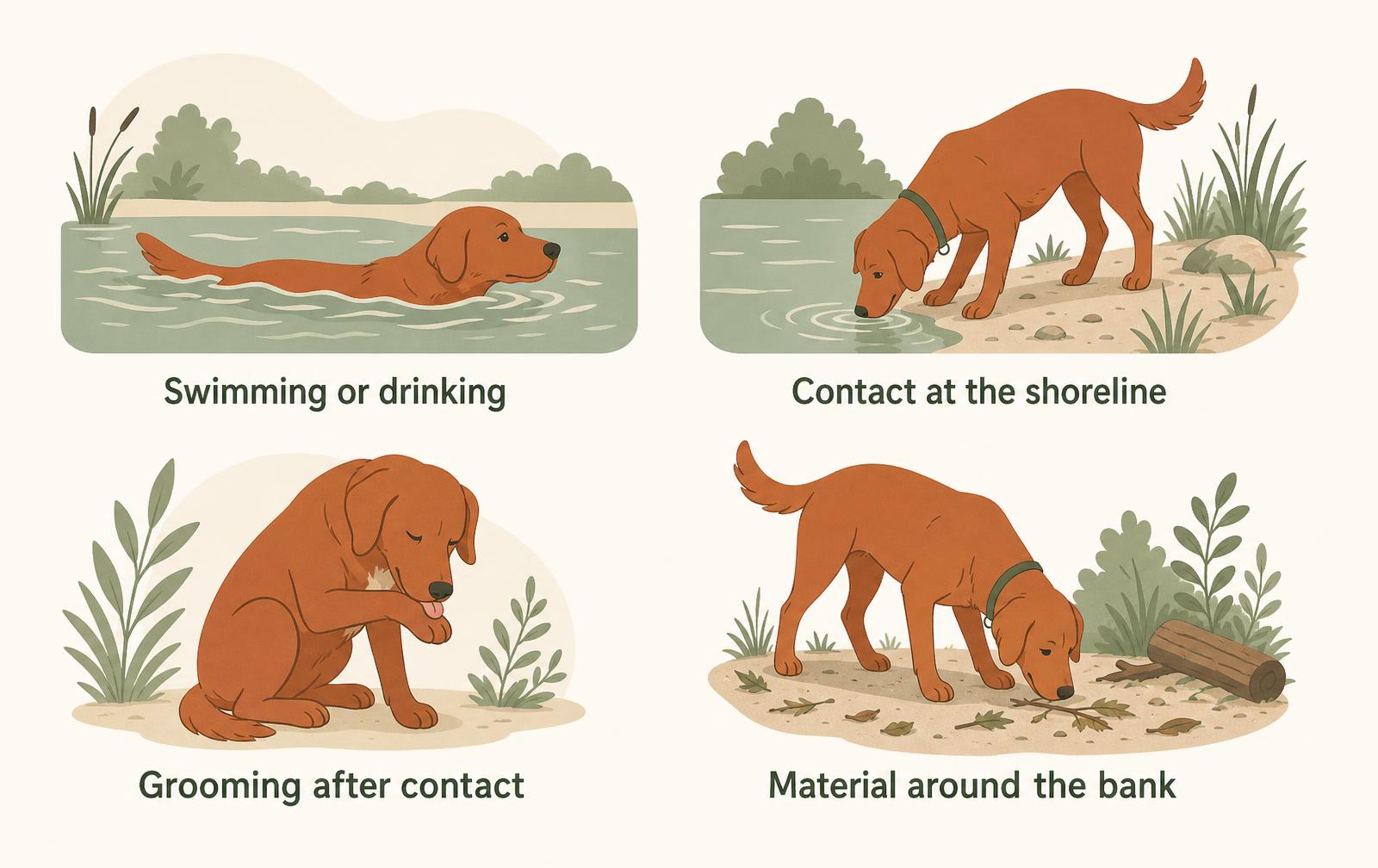
Swimming or drinking. Dogs can swallow contaminated water directly while drinking from the bank or inadvertently while swimming, retrieving toys or playing.
Contact at the shoreline. Wind and currents can push cyanobacterial material towards the bank, allowing it to accumulate around the water's edge. Dogs investigating the shoreline may come into contact with it even if they never properly swim.
Grooming after contact. This is particularly easy to overlook. A dog that has paddled or swum through affected water can carry contaminated material on its fur and then ingest it while grooming. That is why veterinary guidance recommends preventing a dog from licking its coat and rinsing it thoroughly with clean fresh water following suspected contact.
Material around the bank. Cyanobacterial material can become stranded around shorelines as water levels change. Dogs are naturally inclined to sniff, lick and investigate things along the bank, so avoiding the affected shoreline matters as well as preventing swimming.
What a bloom looks like — and why appearance isn't enough
There isn't one reliable appearance. Blue-green algae may produce green or blue-green scum, streaks resembling paint across the surface, green, brown or blue discolouration, floating clumps or flakes, foam accumulating near the shoreline, or coloured mats around the water's edge. Despite the name, blooms aren't necessarily blue-green — different organisms and conditions can produce green, brown, reddish or dark-coloured material. The current Thames bloom has been described by Kingston Council as potentially resembling green or blue paint on the water or riverbank.
Dead fish or other wildlife around a water body should also make you cautious. But none of these observations can tell you whether toxins are present. And if a water body has an active official warning, don't assume it has become safe because the bloom appears less obvious than before. Wait until the relevant authority formally lifts the warning.
What poisoning can look like
Different cyanobacteria produce different toxins, so there isn't one characteristic picture of blue-green algae poisoning in dogs. Two groups are particularly important.
Toxins affecting the nervous system can act extremely quickly. Signs can include excessive salivation, muscle tremors, wobbliness, weakness, difficulty breathing, paralysis, seizures and collapse. Neurological signs can appear within an hour of exposure.
Toxins affecting the liver generally develop more slowly. Early signs can include vomiting, diarrhoea, loss of appetite, lethargy and weakness. Severe poisoning can progress to pale gums, abnormal bleeding, jaundice, shock, kidney impairment and liver failure. These effects generally develop within 24 hours, although the precise course depends on the toxin, the amount ingested and the individual animal.
The important point is not to wait for a specific symptom. If you know or strongly suspect your dog has been exposed to blue-green algae, contact a vet before symptoms develop.
What to do immediately
Remove your dog from the water and keep it away from the affected shoreline.
Don't let it lick its coat. Contaminated water or material may remain on the fur after contact.
Rinse thoroughly with clean fresh water to remove material from the coat before your dog can ingest it through grooming.
Contact a vet immediately. Tell the practice you are concerned about possible cyanobacteria exposure, what happened and approximately when. If your regular practice is closed, contact an emergency veterinary service. Animal PoisonLine also provides advice to pet owners in the UK on 01202 509000.
Don't wait for symptoms. There is no specific antidote for cyanobacterial poisoning. Treatment is primarily decontamination and supportive veterinary care, and because some cyanotoxins act rapidly, prompt assessment is important.
Do not induce vomiting unless a veterinary professional specifically instructs you to.
How to check before you go
There is no single database guaranteeing every waterway in Britain is free of cyanobacteria, but there are useful checks. The UK Centre for Ecology and Hydrology runs the Bloomin' Algae app, which allows people to report suspected blooms and see reports submitted around the UK. Local authorities, landowners and the Environment Agency publish warnings for specific waterways when blooms are confirmed. Before letting a dog swim somewhere during warm weather, check for current warnings, look at the water and shoreline for unusual scum or discolouration, and never ignore an official blue-green algae notice because the water appears normal that day. Take fresh water for your dog rather than relying on natural water sources during the walk.
Water quality is one of those pet-health topics that runs both ways — we looked at the other direction, what pet products do to rivers, in Are Flea Treatments Harming the Environment?
Try this today
Think about where your dog regularly swims. If that's a lake, pond, reservoir or river, find out who manages it and where they publish safety notices. Check for current warnings before your next visit during warm or dry weather. And if you arrive somewhere and the water looks suspicious, keep your dog out. There will always be another walk.
The bottom line
Blue-green algae doesn't need to turn an entire lake bright green to deserve your attention. Some cyanobacteria produce toxins capable of causing severe liver or neurological injury in dogs, and you cannot determine whether a particular bloom is toxic simply by looking at it.
The current bloom between Sunbury and Teddington makes that risk unusually tangible for dog owners in and around London. But the lesson applies anywhere dogs swim in freshwater during warm weather. If there is an official warning, keep your dog out of the water and away from affected material on the shoreline. If you suspect your dog has already been exposed, prevent it from licking its coat, rinse it with clean fresh water and contact a vet immediately.
Don't wait for symptoms to tell you whether the water was toxic.
This is general information and not a substitute for veterinary advice. If you think your dog has been exposed to blue-green algae, contact a veterinary professional immediately. Animal PoisonLine: 01202 509000.
Related reading: Are Conkers and Acorns Poisonous to Dogs?
Common questions
Frequently asked.
Keep reading
Further reading.
Want plain-English notes on pet health and the things that affect it? Join The Once-Over, our weekly note from Hazel.