Nutrition · Dog · 14 Aug 2026
Does Your Dog Need a Healthier Gut?
By Burrow · 14 Aug 2026
TL;DR
- Dogs have a complex gut microbiome involved in digestion, metabolism and interactions with the immune system.
- Diet can change it. Fibre, protein, starch and other dietary components influence both the microorganisms present and what they produce.
- An altered microbiome, or dysbiosis, is associated with gastrointestinal disease including chronic enteropathies — though the direction of cause and effect isn't always clear.
- Probiotics aren't all interchangeable. Any benefit depends on the specific strain, formulation, dose and condition being treated.
- A July 2025 systematic review of postbiotics found no statistically significant differences between postbiotic and control groups in dogs — a reminder that biotic products vary widely in what the evidence actually shows.
- For most healthy dogs, a nutritionally complete diet is a much better starting point than trying to optimise the microbiome with supplements.
Probiotics, prebiotics, gut-health tests and microbiome-supporting foods are everywhere in the pet aisle. Here's what the science actually supports — and where it still has a long way to go.
The microbiome has transformed how we think about human health. The same idea is now moving rapidly into pet care. Probiotic powders for dogs, microbiome-supporting food, prebiotic treats, gut-health tests, supplements promising better digestion, stronger immunity and healthier ageing.
There is real science behind some of this. A dog's digestive tract contains a vast and complex community of bacteria and other microorganisms involved in digestion, metabolism and interactions with the immune system. Diet can alter that community, and researchers have found characteristic changes in dogs with several gastrointestinal diseases. But there is an important distinction between knowing that the microbiome matters and knowing how to optimise it. We are not there yet. And that gap is considerably more interesting than the marketing.
First: what actually is the microbiome?
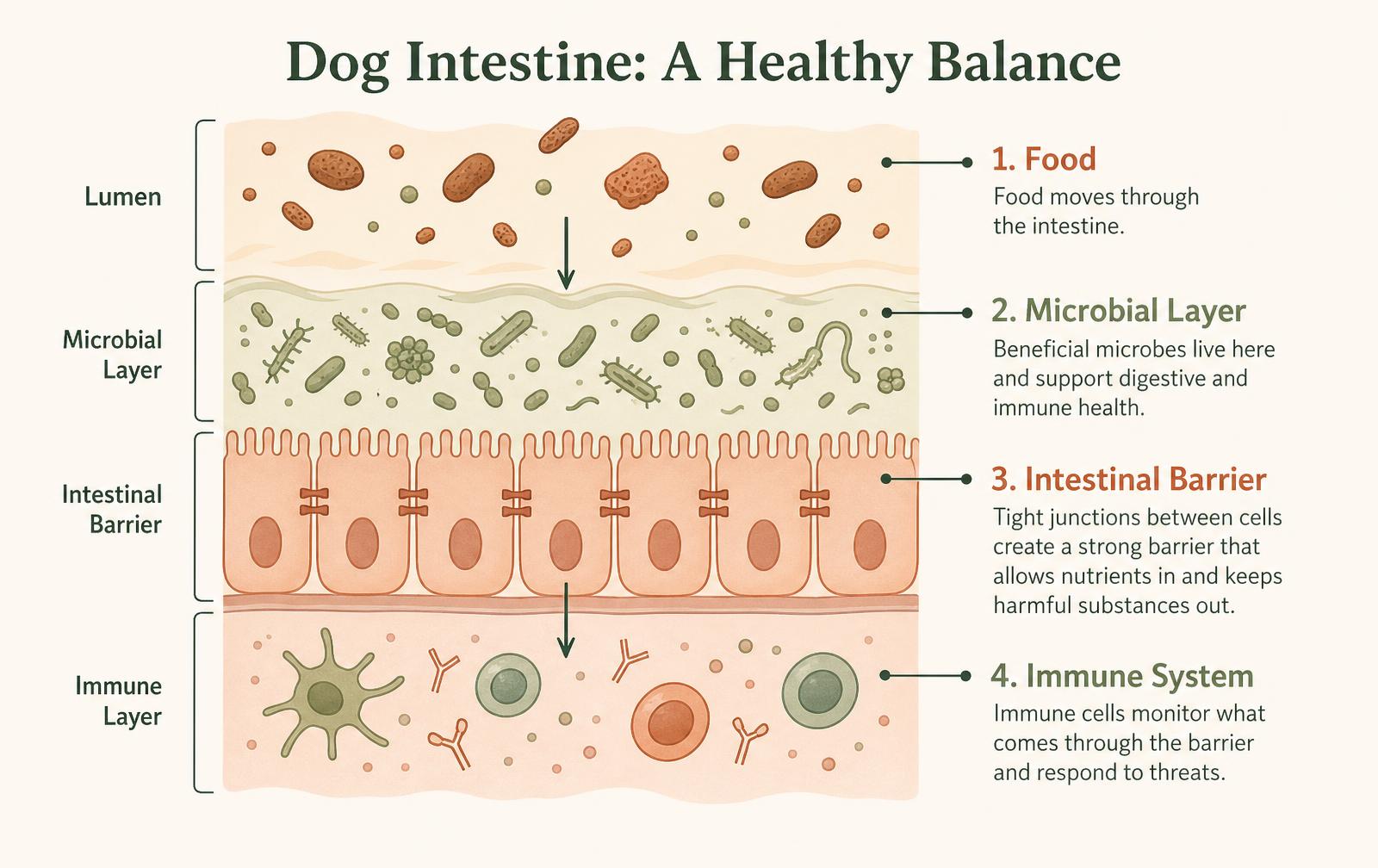
Your dog's intestine isn't simply a tube through which food passes. It contains an extraordinarily complex ecosystem of microorganisms — bacteria, fungi, viruses and other organisms — whose collective genetic material is commonly referred to as the gut microbiome.
These organisms interact with food entering the intestine, producing metabolites and participating in processes involving nutrient metabolism, the intestinal barrier and the immune system. The microbiome isn't fixed. Age, diet, environment, medication and disease can all influence it. Even changing the proportions of fibre, protein or carbohydrate in a dog's food can shift microbial populations and the substances they produce.
That has led researchers to increasingly treat the intestinal microbiome as a functional part of the dog's gastrointestinal system rather than simply a collection of passengers living inside it.
What does a healthy dog microbiome look like?
This is where things get complicated, because there isn't currently a single ideal collection of bacteria that every healthy dog should have.
Two healthy dogs can have different microbial communities while those communities perform many of the same useful functions. Researchers describe this partly in terms of functional redundancy: different bacteria can sometimes perform similar jobs. That makes simplistic claims about increasing "good bacteria" and eliminating "bad bacteria" difficult to justify. The more useful question may ultimately be what the microbiome does, rather than simply which microorganisms are present.
What is dysbiosis?
You'll likely have seen this word on pet supplements. Dysbiosis broadly describes an unfavourable alteration in the intestinal microbial ecosystem.
Researchers have identified dysbiosis in dogs and cats with a range of gastrointestinal disorders, and chronic enteropathies are a particularly important area of investigation. But there's an important problem with interpretation. Finding a different microbiome in a sick dog doesn't necessarily prove that the altered microbiome caused the illness. Disease itself can change diet, intestinal movement, inflammation and medication use, all of which can alter the microbiome. In some cases dysbiosis may contribute to disease. In others it may partly result from it. Most likely the relationship runs in both directions — which is one reason microbiome science remains such an active area of veterinary research.
Diet probably matters more than the supplement aisle
One of the clearest findings from canine microbiome research is that diet affects the gut microbial ecosystem. The amounts and types of fibre, starch and protein reaching the intestine influence microbial populations and the metabolites they produce, and changes can occur relatively quickly after dietary changes.
Fibre is particularly interesting because certain fibres reach the large intestine where microorganisms ferment them. Some of the resulting compounds — including short-chain fatty acids — interact with the intestinal environment and host cells. This is where prebiotics enter the picture. Rather than adding microorganisms, prebiotics are substrates that can be used by microorganisms already living in the gut. That distinction matters.
If you want a practical starting point, it's worth checking that the basics are right first: how much you're actually feeding and whether your dog's weight is stable.
Probiotic, prebiotic, synbiotic: what's the difference?
The terminology has become confusing enough to be worth separating clearly.
Probiotics contain live microorganisms intended to provide a health benefit.
Prebiotics are substrates selectively used by microorganisms in ways intended to benefit the host.
Synbiotics combine microorganisms and substrates.
Postbiotics — an increasingly common term — are preparations involving inactivated microorganisms or their components that may confer a health benefit.
Veterinary researchers are actively investigating all of them. Collectively, they're sometimes described as biotics.
Do probiotics actually work for dogs?
Sometimes — and that's a much more precise answer than it sounds.
Studies have reported potential benefits from particular probiotic or synbiotic preparations in certain gastrointestinal conditions. Research has explored their use in acute diarrhoea, chronic enteropathies and other digestive disorders, and specific strains — notably Enterococcus faecium SF68 — have genuine randomised controlled trial evidence for shortening episodes of acute diarrhoea.
But a probiotic isn't a single treatment. Different products contain different organisms, strains, combinations and quantities. Evidence supporting one particular preparation for one particular condition cannot automatically be applied to every product carrying the word "probiotic." Earlier systematic reviews found studies were often small and at moderate-to-high risk of bias, with limited evidence of clinically meaningful effects in several situations. More recent veterinary reviews remain interested in the potential of biotics while continuing to highlight unanswered questions around product selection, mechanisms, optimal quantities and safety.
On postbiotics specifically: a July 2025 systematic review and meta-analysis published in Microorganisms (Bonel-Ayuso et al.) evaluated 69 eligible studies on postbiotic administration in dogs and found no statistically significant differences between postbiotic and control groups across key outcomes. That's a notable finding given how enthusiastically postbiotics are being marketed, and a useful reminder that "biotic" is not a guarantee of effect.
In short: probiotics aren't nonsense, but they aren't a universal solution either. The strain, the condition and the dose all matter enormously. It's the same pattern that shows up across pet supplements generally.
Does a healthy dog need a probiotic?
There's currently little reason to assume every healthy dog needs a daily probiotic supplement. If your dog eats a nutritionally complete diet, has normal stools, maintains a healthy weight and has no gastrointestinal problems, adding a supplement specifically to "balance" their microbiome may provide little measurable benefit.
And because probiotic effects can be strain-specific, buying whichever product has the most impressive packaging is not an approach grounded in evidence. If your dog has recurrent diarrhoea, chronic digestive problems or another gastrointestinal condition, that's a different conversation — and one worth having with your vet rather than in a pet shop.
What about gut microbiome tests?
This is likely to become a much bigger area of pet health. Commercial tests can analyse microorganisms in a dog's stool and compare the results with reference populations. Scientifically, that's genuinely interesting.
Clinically, interpretation is considerably harder. A microbiome varies between individuals, and knowing that a dog's microbial composition differs from a reference population doesn't automatically tell us what that dog needs. Microbiome analysis is already useful in veterinary research and specialised clinical contexts, but consumers should be cautious about assuming a colourful microbiome report provides the same kind of actionable diagnosis as a conventional veterinary test. The technology may eventually become much more useful — but the science needs to catch up with the data first.
Antibiotics complicate the picture
One of the more important developments in veterinary microbiome research concerns antibiotics. Antibiotics can substantially alter intestinal microbial communities, while antimicrobial resistance has made unnecessary antibiotic use a major concern in both human and veterinary medicine. That has encouraged researchers to investigate dietary strategies, probiotics and other microbiome-targeted approaches as potential alternatives in some gastrointestinal conditions.
This doesn't mean antibiotics are harmful and should be avoided when medically necessary. It means they should be used appropriately, for conditions where there's a genuine reason to use them. Responsible use is different from avoidance — a distinction that also matters when deciding whether kennel cough needs antibiotics.
Try this today
Before reaching for a probiotic, spend five minutes honestly assessing your dog's current diet. Is it nutritionally complete and appropriate for their age, size and health? Are portion sizes right? Is weight stable? The overall quality and suitability of the diet matters considerably more than adding a fashionable supplement on top of a poor one. If the diet is good and stools are normal, that's the baseline the microbiome research is actually asking you to protect — not disrupt with unnecessary supplementation.
The bottom line
The dog microbiome is real, important and increasingly relevant to veterinary medicine. What isn't yet justified is the idea that every healthy dog needs its microbiome fixed. Diet clearly influences intestinal microorganisms. Dysbiosis is associated with gastrointestinal disease. Particular probiotics may have useful roles in particular circumstances. But researchers are still working out which interventions work, for which dogs, and why.
For now: feed your dog well, pay attention to persistent digestive changes, and treat probiotics as a potentially useful tool in specific situations rather than an essential part of every dog's daily routine.
This is general information and not veterinary advice. Persistent diarrhoea, vomiting, appetite changes, weight loss or other gastrointestinal symptoms should be assessed by a vet.
Common questions
Frequently asked.
Keep reading
Further reading.
Want plain-English notes on pet health and the evidence behind it? Join The Once-Over, our weekly note from Hazel.