Nutrition · Dog & Cat · 18 Sept 2026
Are Vegan Diets Safe for Dogs and Cats?
By Burrow · 18 Sept 2026
TL;DR
- Digestibility, nutritional adequacy and long-term health are three different questions. The new review principally adds evidence to the first.
- The review included 31 studies, but only seven assessed fully vegan or vegetarian diets. Much of the evidence concerned individual plant or microbial ingredients.
- The evidence is heavily weighted towards dogs. Twenty-two studies were dog-specific, only two were cat-specific, and seven applied to both species.
- The BVA accepts that it is possible to feed dogs a plant-based diet, while stressing the difficulty of balancing one correctly and the lack of robust long-term safety data.
- For cats, its position is substantially more cautious: current research suggests a complete vegan or vegetarian feline diet is not possible, because cats are obligate carnivores and suitable synthetic essential amino acids are lacking.
- Much of the health-outcome evidence remains limited, with small studies and substantial reliance on owner-reported outcomes.
- Under UK animal welfare law, owners have a duty to provide a suitable diet. Whatever the owner's own dietary choices, the animal's nutritional requirements come first.
A new review of 31 studies says plant-based pet food is digested about as well as meat-based food. That's a narrower finding than the headlines suggest — and the answer looks quite different depending on whether you have a dog or a cat.
Interest in plant-based pet food has grown quickly, driven by environmental concerns, farmed animal welfare, and owners wanting their pets' diets to reflect their own. The market has followed, and so has the argument.
A review published this year in Animals examined 31 studies on the digestibility of vegan and vegetarian diets and plant-based ingredients in dogs and cats, concluding that plant-based ingredients and diets are generally well digested, with digestibility broadly comparable to conventional animal-based alternatives. That's a real finding and worth knowing. It's also a specific finding, and it has sometimes been discussed as though it settles a much broader question than it actually addresses.
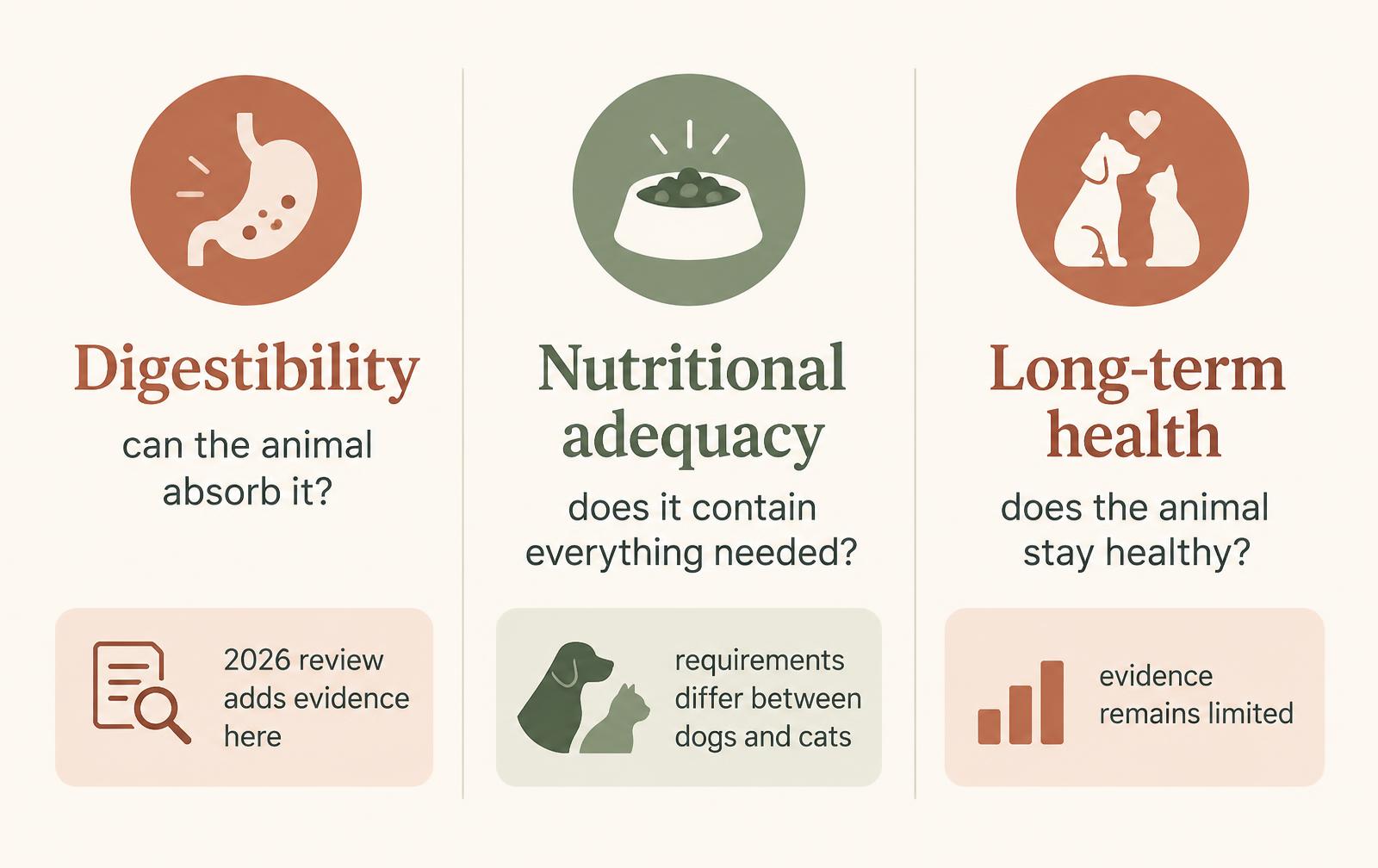
There are three separate questions here, and they're easy to collapse into one. Can the animal digest the food? Does the food contain everything the animal needs? And does the animal stay healthy on it long-term? The new review provides useful evidence on the first. It doesn't settle the second or third — and even its evidence on the first is considerably stronger for dogs than cats.
What the new review actually found
The review, published in Animals in 2026, assessed 31 studies examining the digestibility of vegan and vegetarian diets and plant-based or microbial ingredients in dogs and cats. Twenty-two studies were specific to dogs, two were specific to cats, and seven applied to both.
Across a range of study designs, ingredients and measurement methods, digestibility was generally high. Plant protein sources including soy derivatives, pulses, grains, potato protein, quinoa and microbially fermented proteins could be digested effectively, and the review concluded that digestibility was broadly comparable with animal-based ingredients and conventional diets.
That's meaningful. A longstanding objection to plant-based pet food is that dogs and cats simply can't digest plant ingredients effectively, and the available digestibility evidence doesn't support such a sweeping claim.
But there's an important qualification. Only seven of the 31 studies assessed the digestibility of fully vegan or vegetarian diets — six of those specific to dogs, one applicable to both species. Much of the literature reviewed therefore tells us how well animals digest particular plant or microbial ingredients rather than what happens when an animal is fed a complete plant-based diet over the long term.
The review also wasn't designed to establish whether these diets are suitable for puppies, kittens, senior animals or animals with compromised digestive function — it says so itself. And it didn't answer the larger health question, because digestibility measures what can be broken down and absorbed, not whether everything the animal needs was present in the first place.
Why digestibility isn't the whole question
A diet can be highly digestible and still be nutritionally inadequate. If an essential nutrient isn't present in sufficient quantity, efficiently digesting everything else doesn't solve the problem.
This distinction matters particularly for cats. Cats are obligate carnivores in a physiological sense, with specific nutritional requirements arising from the way their metabolism has evolved — including requirements that differ from those of dogs.
Taurine is the familiar example. Cats cannot synthesise enough taurine to meet their needs and therefore require an adequate dietary supply, and severe deficiency can cause retinal degeneration and dilated cardiomyopathy. There are other differences too. Cats require preformed vitamin A because their ability to convert plant-derived beta-carotene is limited. They have specific requirements involving nutrients including arachidonic acid and arginine, while vitamin B12 is naturally supplied through animal-derived foods.
That doesn't mean every individual nutrient must necessarily come from an animal carcass. Synthetic supplementation is already part of conventional commercial pet-food formulation — taurine, for example, is routinely added to many commercial cat foods.
The more difficult question is whether all of a cat's nutritional requirements can be supplied reliably, in suitable forms and quantities, in a completely plant-based diet, and whether cats remain healthy when fed that diet over years. The current evidence doesn't answer that confidently. And that's where dogs and cats begin to separate.
Where the evidence stands for dogs
The evidence for dogs is considerably more developed than it is for cats, and broadly encouraging. A number of studies have examined health outcomes in dogs eating plant-based diets, and several have reported outcomes comparable with, or in some measures apparently better than, those seen in dogs eating conventional diets. Reviews have consequently found no strong evidence that appropriately formulated vegan diets are inherently harmful to dogs, while also emphasising the limitations of the underlying evidence.
Those limitations matter, and the BVA's own position describes them bluntly: the studies are usually small-scale and usually based purely on owner-reported data, so further long-term, controlled work is needed to demonstrate nutritional safety. That means claims that vegan diets have been proved healthier than conventional diets go beyond what the evidence can currently support. But the opposite claim — that dogs inherently require meat and therefore cannot be maintained on a plant-based diet — is also difficult to sustain.
The BVA changed its position in 2024 following a review by a working group involving veterinary and nutrition experts. Its current position states that it is possible to feed dogs a plant-based diet, while attaching important caveats: owners should be aware of the difficulty of balancing such diets for nutritional needs, the lack of robust long-term safety data, and the need to monitor their dog's health for long-term impacts.
That's a materially different situation from cats.
Where the evidence stands for cats
Here the evidence becomes much thinner. Only two of the 31 studies in the 2026 digestibility review were specifically about cats, and the wider health-outcome literature is similarly limited. A small number of studies have reported generally reassuring findings in cats fed plant-based diets, but the evidence base is nowhere near large or robust enough to establish long-term safety confidently.
Some of that research relies heavily on owner-reported health, which is useful information with limitations. An owner can tell researchers whether their cat appears healthy, how often it visits a vet and whether it has developed obvious disease. That's not the same as researchers independently examining cats, analysing blood samples and following nutritional biomarkers and clinical outcomes over many years. It also creates a potential source of bias, since people who have made a deliberate ethical or environmental decision to feed their cat a vegan diet may have strong expectations about whether that diet is working. That doesn't invalidate their observations — it means those observations need to be interpreted for what they are.
The BVA's current position is therefore substantially more cautious for cats than dogs. It states that current research suggests it is not possible to form a complete vegan or vegetarian diet for cats, because they are obligate carnivores and there is a lack of suitable synthetic essential amino acids available.
That's stronger than saying simply that more research would be useful. It's also the current professional position many UK owners will encounter when discussing the subject with their vet.
The part nobody mentions: everyone here has an interest
This is worth saying because the plant-based pet-food debate has become unusually polarised.
The 2026 digestibility review was written by Professor Andrew Knight, an animal-welfare academic who has published extensively on vegan and plant-based pet diets and has advocated publicly for their potential animal-welfare and environmental benefits. The paper lists affiliations including the Sustainable Pet Food Foundation alongside three universities. None of that demonstrates that its findings are wrong — researchers routinely specialise in subjects they care deeply about, and their work still has to be judged on its methods, data and conclusions. But this isn't a neutral assessment arriving in an otherwise empty debate.
There are interests on the other side too. The British Veterinary Association has had a corporate partnership with Mars Petcare, one of the world's largest pet-food companies and a major producer of conventional animal-based pet food. Knight has publicly argued that this represents a significant conflict of interest when the BVA comments on plant-based diets. Again, that doesn't demonstrate that the BVA's nutritional position is wrong. A financial relationship doesn't make the underlying physiology disappear, just as an author's advocacy doesn't make digestibility data disappear.
Neither observation tells you who is right. Both tell you to look at the evidence underneath the claim rather than deciding according to who made it. And in this particular argument, that's unusually important.
What this means practically
If you're considering a plant-based diet for a dog, current evidence means this is no longer reasonably dismissed as inherently impossible. But there's a large difference between a commercially formulated complete diet and putting together meat-free ingredients at home. Choose a diet formulated to be nutritionally complete for your dog's life stage and check which recognised nutritional standard it claims to meet. Discuss the change with your vet, particularly if your dog has an existing medical condition, and agree whether any ongoing nutritional or health monitoring is appropriate for that individual animal. The objective isn't simply to remove animal ingredients. It's to replace everything nutritionally important that was supplied by them.
If you're considering a plant-based diet for a cat, the level of uncertainty is substantially greater. Cats have more specific nutritional constraints, considerably less research exists, and current BVA guidance does not support vegan or vegetarian feline diets. This is a decision to discuss with a vet — ideally one with appropriate nutritional expertise — before changing the diet rather than after. The fact that individual nutrients can theoretically be manufactured without animal tissue doesn't establish that currently available completely plant-based diets reliably reproduce the nutritional performance of conventional complete cat food over a lifetime. That's the evidence gap.
For puppies, kittens and animals with particular health needs, be more cautious still. The 2026 digestibility review did not establish suitability for puppies, kittens, senior animals or animals with compromised digestive function, and growth, pregnancy and lactation place particularly demanding nutritional requirements on an animal. An absence of evidence showing harm isn't the same as evidence establishing safety.
Whatever you feed, the owner's own dietary values are not the animal's nutritional requirements. UK animal-welfare legislation places a duty on owners and keepers to meet their animals' welfare needs, including providing a suitable diet. That doesn't make vegan pet food illegal. It means the relevant test is whether the diet adequately meets the needs of the animal eating it, not whether the owner considers the diet ethically preferable.
Try this today
If you're already feeding a plant-based diet, or considering one, turn the packet around — and don't start with the ingredients list. Look for whether the food is described as complete, what life stage it is intended for, and which recognised nutritional standard or formulation guidelines it claims to meet.
"Plant-based", "natural", "high protein" and "vet developed" are descriptions. "Complete" is the claim that actually matters nutritionally. Then take that information to your vet if you're considering a significant change. Nutrition basics for dogs and cats covers what that label does and doesn't promise.
The Bottom Line
The new review makes a useful contribution to this debate. Plant-based ingredients and diets appear to be well digested by dogs and, on much thinner evidence, cats. The idea that an animal simply can't extract nutrients from plant ingredients is too crude.
But digestibility isn't safety. For a diet to be safe it also has to provide every essential nutrient in an appropriate quantity and form, and ideally we want evidence showing that animals maintained on it remain healthy over years rather than weeks or months.
For dogs, the professional position has moved. A properly formulated, nutritionally complete commercial plant-based diet is now a credible option, although the long-term evidence remains thinner than we would ideally want. For cats, it hasn't moved nearly as far — their nutritional physiology is less forgiving, the research base is much smaller, and current BVA guidance remains against vegetarian and vegan feline diets.
And in both directions, some of the loudest voices in this argument have something at stake. That's not a reason to dismiss them. It's a reason to ask which of the three questions the evidence actually answers. Can they digest it? Does it contain everything they need? And do they remain healthy on it long-term? Those are not the same question, and right now they don't have equally good answers.
This is general information and not veterinary advice. Any significant change to a pet's diet should be discussed with your vet, particularly for cats, growing animals or pets with existing health conditions. Owners have a legal responsibility to provide a suitable diet that meets their animal's nutritional needs.
Related reading: Nutrition Basics for Dogs and Cats · How Much to Feed Your Dog · Does Your Dog Need a Healthier Gut?
Common questions
Frequently asked.
Keep reading
Further reading.
Want calm, evidence-led notes on pet health research? Join The Once-Over, our weekly note from Hazel.