Small Animals · Guinea Pig · 30 Jul 2026
Vitamin C Deficiency in Guinea Pigs: The Signs Every Owner Should Know
By Burrow · 30 Jul 2026
TL;DR
- Guinea pigs cannot make their own vitamin C and must get it from their diet every day. There are no reserves to draw on.
- Deficiency can develop in as little as two to three weeks on an inadequate diet, which is faster than most owners realise.
- Early signs are subtle: reduced appetite, lethargy, reluctance to move, rough coat. The obvious signs — swollen joints, bleeding gums, difficulty walking — come later.
- The most common mistake is feeding rabbit pellets instead of guinea pig pellets. Rabbit food contains no vitamin C.
- Water supplements are unreliable. Vitamin C degrades rapidly in water, particularly in light, and can put guinea pigs off drinking.
- Red bell peppers are the single best food source. Fresh vegetables, alongside a quality guinea pig pellet, are how most healthy guinea pigs get what they need.
- If you suspect deficiency, see a vet. It's treatable, and early intervention usually leads to a full recovery.
Guinea pigs can't make their own vitamin C. That single fact underpins almost everything that can go wrong with their diet.
Humans share the same limitation, which is why sailors on long voyages once died of scurvy and why we've always needed fruit and vegetables to stay healthy. Guinea pigs are in exactly the same position. Unlike cats, dogs and most other mammals, they lack the enzyme needed to convert glucose into ascorbic acid, which means every guinea pig depends entirely on its owner to supply enough vitamin C every single day.
When that supply falls short, the consequences can be serious. Vitamin C is essential for collagen production, the structural protein that holds blood vessels, skin, joints, gums and connective tissue together. Without it, those structures begin to fail, and the signs, when they arrive, can look alarming. The encouraging part is that this is one of the most preventable health problems in guinea pig care, and most owners can protect their animal completely with the right daily routine.
This piece covers what to watch for, why deficiency still happens despite owners' best efforts, and exactly what a guinea pig needs.
Why deficiency still happens
Guinea pig vitamin C deficiency is common enough to be one of the first things vets look for in an unwell guinea pig. Understanding why helps explain what actually prevents it.
The rabbit pellet mistake is probably the most frequent single cause, and one most owners don't know to look for. Guinea pig pellets are fortified with vitamin C. Rabbit pellets are not, because rabbits make their own. The bags look similar in many pet shops, the price is often the same, and unless you read the label carefully, the difference isn't obvious. A guinea pig fed rabbit food is receiving zero supplemental vitamin C through its pellets.
Pellet degradation catches even well-meaning owners. Vitamin C is unstable — it breaks down with exposure to heat, light and moisture. A bag of guinea pig pellets that's been open for more than six to eight weeks, or stored in a warm or light-exposed spot, may have lost most of its vitamin C content even if it looks and smells perfectly fine. The number on the label applies to fresh food, not to pellets that have been sitting in a cupboard for three months.
Water supplements give a false sense of security. Vitamin C degrades particularly quickly in water, often becoming negligible within hours, and especially fast in bright conditions or warm temperatures. Worse, the altered taste can reduce a guinea pig's water intake. Vets consistently advise against relying on water as the primary supplement delivery route for exactly these reasons. It's fine as an occasional extra but not as a foundation.
Illness increases requirements. A sick, stressed or pregnant guinea pig needs considerably more vitamin C than a healthy adult, which means an intake that was previously adequate may become insufficient during illness or recovery.
How quickly it develops
This surprises many owners: signs of deficiency can appear in as little as two to three weeks on an inadequate diet. There are no meaningful vitamin C stores to draw on, so the clock starts as soon as the dietary supply falls short. This is one reason it's worth knowing the early signs rather than only the advanced ones — the window between "not enough vitamin C" and "visibly unwell" is not as wide as it is for some other nutritional problems.
The signs: early to advanced
Guinea pigs are prey animals and, like other small animals, hide illness well. The early signs of vitamin C deficiency are exactly the kind of vague changes that are easy to attribute to a quiet day rather than a health problem. They also aren't specific to vitamin C deficiency — other conditions can produce the same picture — which is why a vet assessment matters rather than assuming diet is the issue and adjusting at home.
Early signs:
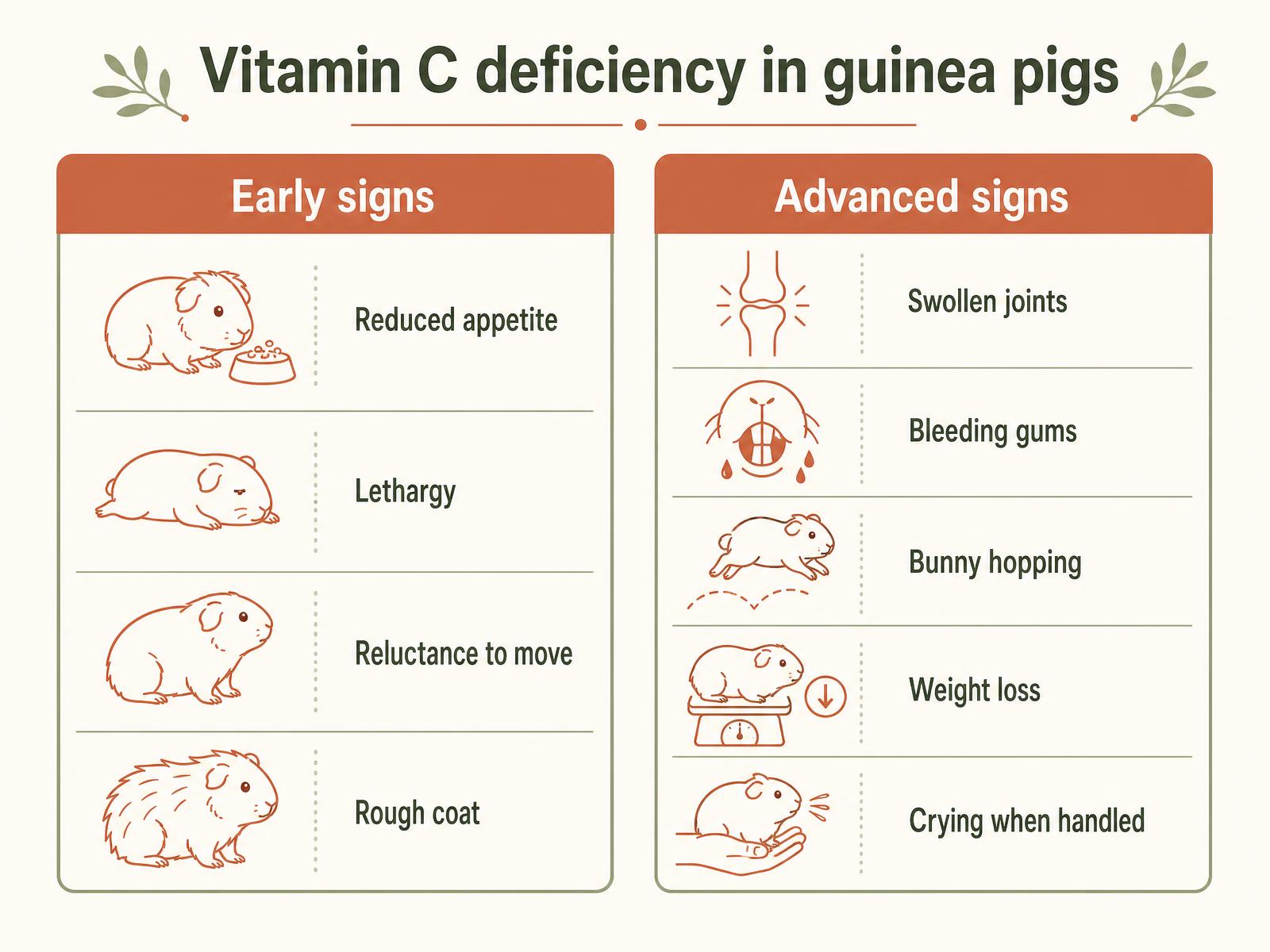
- Reduced appetite — eating less than usual, showing less interest in food, leaving vegetables that would normally be eaten quickly
- Lethargy — less active, sleeping more, not responding to attention with the usual curiosity
- Reluctance to move — sitting still more than usual, moving slowly, not exploring
- Rough or dull coat — fur losing its normal texture and sheen
- Slower wound healing — any small cuts or grazes taking unusually long to close
As deficiency progresses:
- Swollen or painful joints — particularly the hocks and knees, which may be visibly enlarged
- Limping or altered gait — favouring limbs, moving stiffly
- "Bunny hopping" — moving both hind legs simultaneously rather than alternating, a distinctive and advanced sign caused by pain in the hind joints
- Swollen or bleeding gums — the gums may look red, puffy or bleed on contact
- Loose teeth or dental problems
- Weight loss
- Crying out or squeaking when handled — particularly when the joints or abdomen are touched
The more advanced signs require prompt veterinary attention. A guinea pig showing these is past the "watch and wait" stage and needs treatment.
The best food sources
The most reliable way to keep a guinea pig's vitamin C levels right is through fresh food, every day. A quality guinea pig pellet provides a baseline, but fresh vegetables provide the consistent, reliable daily top-up, and some are considerably richer sources than others.
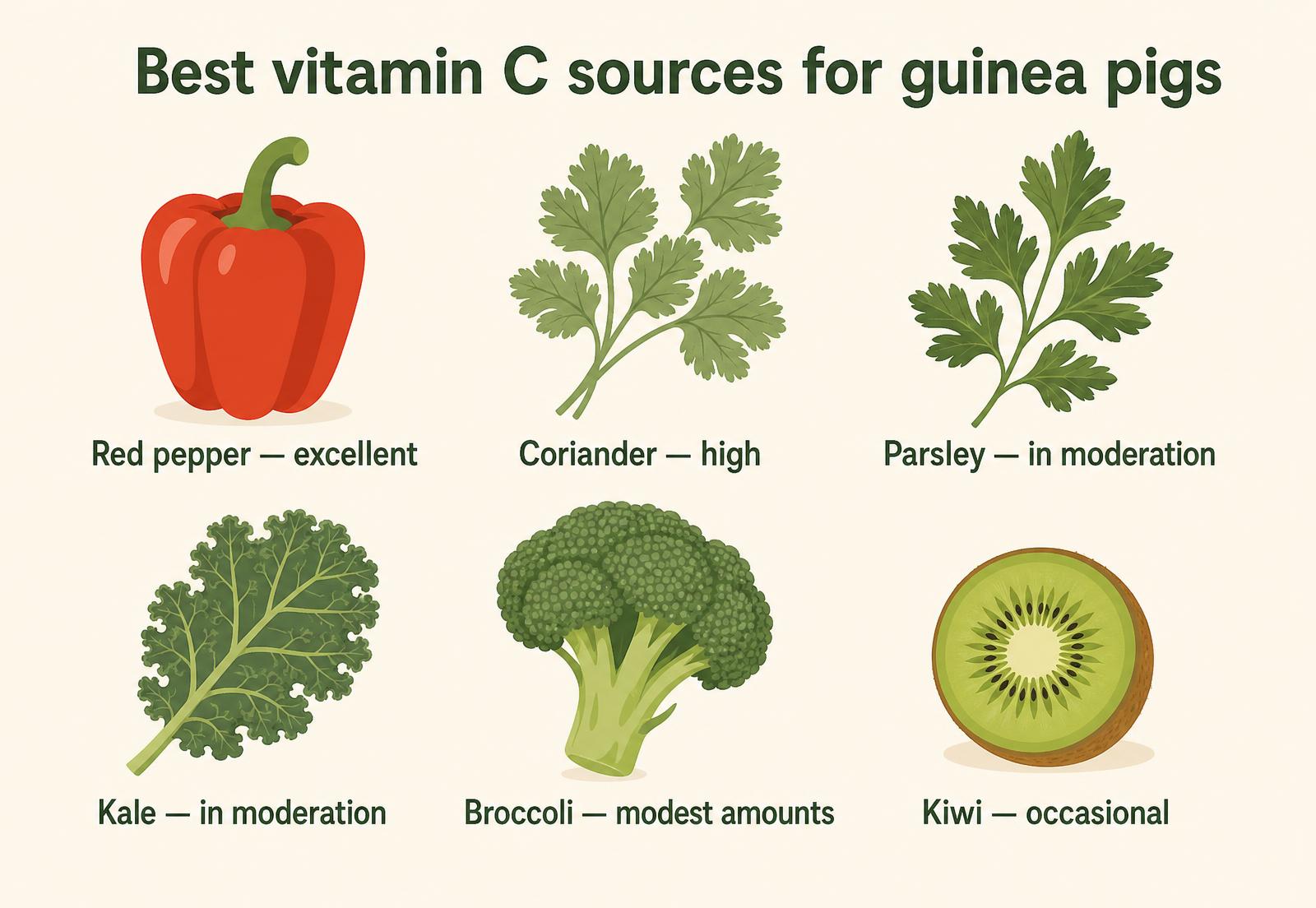
Red bell pepper is the standout. It's exceptionally high in vitamin C, widely available in the UK, and most guinea pigs eat it readily. A small piece of red pepper daily is one of the most practical things an owner can do. Green pepper is also good, though contains somewhat less.
Other reliable sources include:
- Coriander — high in vitamin C and usually very popular with guinea pigs
- Parsley — high in vitamin C but should be given in moderation because of its calcium content, which matters for urinary health
- Kale — a good source, again in moderation
- Broccoli — florets and leaves both work, in modest amounts
- Spinach — contains vitamin C but also oxalates, so in small quantities only
- Small amounts of kiwi — fine occasionally, but fruit should be limited because of sugar content
A useful practical rule: vary the vegetables across the week, keep the portions sensible, and let red pepper anchor the daily routine. The diet should be built on unlimited hay as the foundation, with fresh vegetables and a quality guinea pig pellet providing the vitamin C and additional nutrition alongside it. The PDSA's guinea pig diet guidance is a good UK reference for portioning.
Should you use supplements?
For a healthy guinea pig eating a good diet, supplements are generally not needed. Fresh vegetables and a quality guinea pig pellet that hasn't sat open for too long are enough to meet daily requirements for most adults in normal health.
Supplements become relevant in two situations. First, when a vet has diagnosed deficiency or suspects it, in which case a therapeutic dose of vitamin C is usually prescribed, often a much higher short-term dose than the maintenance level. Second, for guinea pigs that are unwell, pregnant, nursing, or known to have absorption issues — higher requirements mean the usual dietary intake may not be sufficient.
If supplements are needed, the best route is direct oral supplementation — vitamin C drops given orally, or food sprinkled with a powder form — rather than water. Water supplementation is not recommended as a primary approach because vitamin C degrades so quickly in solution that the dose becomes unpredictable, and altered taste may reduce water intake.
Do not attempt to give therapeutic doses at home without veterinary guidance. What a healthy guinea pig needs for maintenance is very different from the doses used to treat deficiency.
How vets diagnose it
Most vets make a working diagnosis based on clinical signs and diet history rather than blood tests. They will examine the guinea pig from nose to tail, look for joint swelling and coat changes, check the mouth, and ask about what and how much the guinea pig has been eating, how old the pellets are, and whether fresh vegetables have been included. Response to vitamin C treatment is often part of the diagnostic picture, since a guinea pig with true deficiency usually improves noticeably once supplementation begins.
In some cases, additional tests may be run to rule out other conditions that cause similar signs, since the early symptoms are not specific to vitamin C deficiency. Don't assume — let a vet confirm. The RSPCA's guinea pig health guidance is a useful starting point on when to seek help.
Prevention checklist
Most cases of vitamin C deficiency are entirely preventable with a consistent daily routine.
- ✓ Unlimited hay as the dietary foundation — always available
- ✓ Fresh vitamin C-rich vegetables daily — at least one good source such as red pepper or coriander every day
- ✓ Quality guinea pig pellets — not rabbit pellets, which contain no vitamin C
- ✓ Use pellets while fresh — open bags within six to eight weeks, store away from heat and light
- ✓ Don't rely on water supplements — they degrade too quickly to be a reliable source
- ✓ Check weight weekly — unexpected weight loss is an early warning sign
- ✓ Annual (or twice-yearly) vet checks — small animals hide illness, and regular check-ups catch problems before they become serious
The bottom line
Vitamin C deficiency is one of the few genuinely preventable health crises in guinea pig care. The animal cannot make what it needs, and the clock starts quickly once the supply runs low — deficiency can develop in as little as two to three weeks on a poor diet.
The prevention is simple: unlimited hay, fresh vitamin C-rich vegetables every day (red pepper is the easiest anchor), and quality guinea pig pellets that are fresh and stored correctly. Skip the rabbit pellets. Don't rely on water supplements. Check the pellet bag more often than you think you need to.
And if your guinea pig becomes quiet, stops eating, develops swollen joints or seems generally off, don't explain it away. Guinea pigs hide illness, and prompt veterinary assessment when something seems wrong can be the difference between a straightforward recovery and something much harder to reverse.
This is general guidance, not veterinary advice. If your guinea pig shows signs of illness or you're concerned about its diet, please speak to a vet with small animal or exotic experience.
Common questions
Frequently asked.
Keep reading
Further reading.
Want plain-English notes on small animal health and the everyday care that prevents problems? Join The Once-Over, our weekly note from Hazel.