Small Animals · Guinea Pig · 06 Nov 2026
Why Are So Many Guinea Pigs Ending Up in Rescue? The Breeding Risks Owners Don't See
By Burrow · 06 Nov 2026
TL;DR
- **Rescues are filling up.** The RSPCA took 419 guinea pigs into its national centres in England and Wales in 2025, 181 more than the year before.
- **Overbreeding is one cause.** The RSPCA also points to the cost of living crisis and gaps in owner knowledge.
- **Litters happen fast.** Females can become pregnant again within hours of giving birth, and male pups should be separated from females at three weeks.
- **Pregnancy is risky for sows.** Difficult births and pregnancy toxaemia can both be fatal, and the outlook after a caesarean is poor.
- **Get the sex confirmed.** Mis-sexed pairs are a common start. Never keep an entire male with females.
- **If she might be pregnant, call your vet.** Separate the male, but do not change her diet without veterinary advice.
The RSPCA recorded a sharp rise in guinea pigs entering its national centres in 2025, citing overbreeding, the cost of living crisis and gaps in owner knowledge. Accidental litters are part of the problem, and pregnancy can put females at serious risk.
Guinea pigs are often thought of as easy, low-maintenance pets. The numbers coming into rescue suggest otherwise. In a release marking Guinea Pig Appreciation Day, the RSPCA reported that 419 guinea pigs were taken into its national centres in England and Wales in 2025, 181 more than the previous year, and that many more went to its local branches, which are separately registered charities. The charity says over-breeding, the ongoing impact of the cost of living crisis and a lack of knowledge about the species are behind the rise. It has not said how much of the increase each factor accounts for, but unplanned breeding is the one owners can most directly prevent, and its costs fall first on the females.
How accidental litters happen
Guinea pigs mature remarkably young. The Merck Veterinary Manual says females typically reach sexual maturity at about 2 months, and that males can mate from 2 to 3 months. Blue Cross goes further, warning that male guinea pigs can become fertile from as young as three weeks. A female can also become pregnant again within hours of giving birth, so one mistake can quickly lead to repeated litters, and the RSPCA's inspectors regularly deal with homes where a few guinea pigs have become dozens.
The most common starting point is a pair that was assumed to be the same sex. The RSPCA notes that owners who believe they have bought two guinea pigs of the same sex may be engaging in wishful thinking, and that an unneutered male and a female kept together will soon produce pups. The Royal Veterinary College's exotics service makes the same point, noting that many guinea pigs sold by pet shops and backyard breeders are housed in mixed-sex groups and are occasionally already pregnant when they go home.
The risk does not end once the pups arrive. The Royal Veterinary College advises that pups feed from their mother for the first 21 days, and that at this point they should be sexed and every male separated from his mother and sisters to prevent further pregnancies. Waiting until young males look grown up can be too late.
Very few pet guinea pigs are neutered. A Royal Veterinary College study of guinea pigs under UK veterinary care in 2019 found that, of the 49,034 whose neuter status was recorded, just 2% were neutered. That does not mean every entire guinea pig is at risk, since many live in single-sex pairs or groups, but it shows how much depends on getting the sex right.
Why pregnancy is risky for the sow
Breeding is not a minor event for a female guinea pig. The Merck Veterinary Manual states that vets generally do not recommend that owners breed guinea pigs, and that breeding often reduces a female's lifespan. Difficult births, known as dystocia, are common in guinea pigs, and LafeberVet, a veterinary clinical reference, describes the prognosis for guinea pigs that need a caesarean section as poor to grave.
The traditional explanation for difficult births is the pelvis. Merck warns that a first pregnancy after 8 months of age can be very dangerous because of stiffening of the pubic symphysis, the joint between the two pubic bones at the front of the pelvis. The Royal Veterinary College puts the point of greater risk at around a year, advising that a sow over 12 months old who has not had a litter before may run into problems. A 2024 study has challenged the underlying explanation. Researchers scanned the pelvises of breeding and non-breeding sows from 3 to 12 months of age and found no ossification of the joint in either group, although females that had bred had a wider joint. The findings challenge the idea that the joint fuses with age, but they do not establish that first pregnancies in older sows are safe. The study was small, it did not measure how often difficult births occurred, and other anatomical or physiological factors may contribute.
Difficult labour is not the only danger. Pregnant guinea pigs can also develop pregnancy toxaemia, a potentially fatal condition. The Royal Veterinary College warns owners not to put an overweight pregnant sow on a diet, because restricting food at this stage can trigger it, while also cautioning against overfeeding pellets and muesli-style mixes, which can produce large pups that are difficult to deliver. Getting the balance right needs a vet's input rather than changes made at home.
Safe pairings
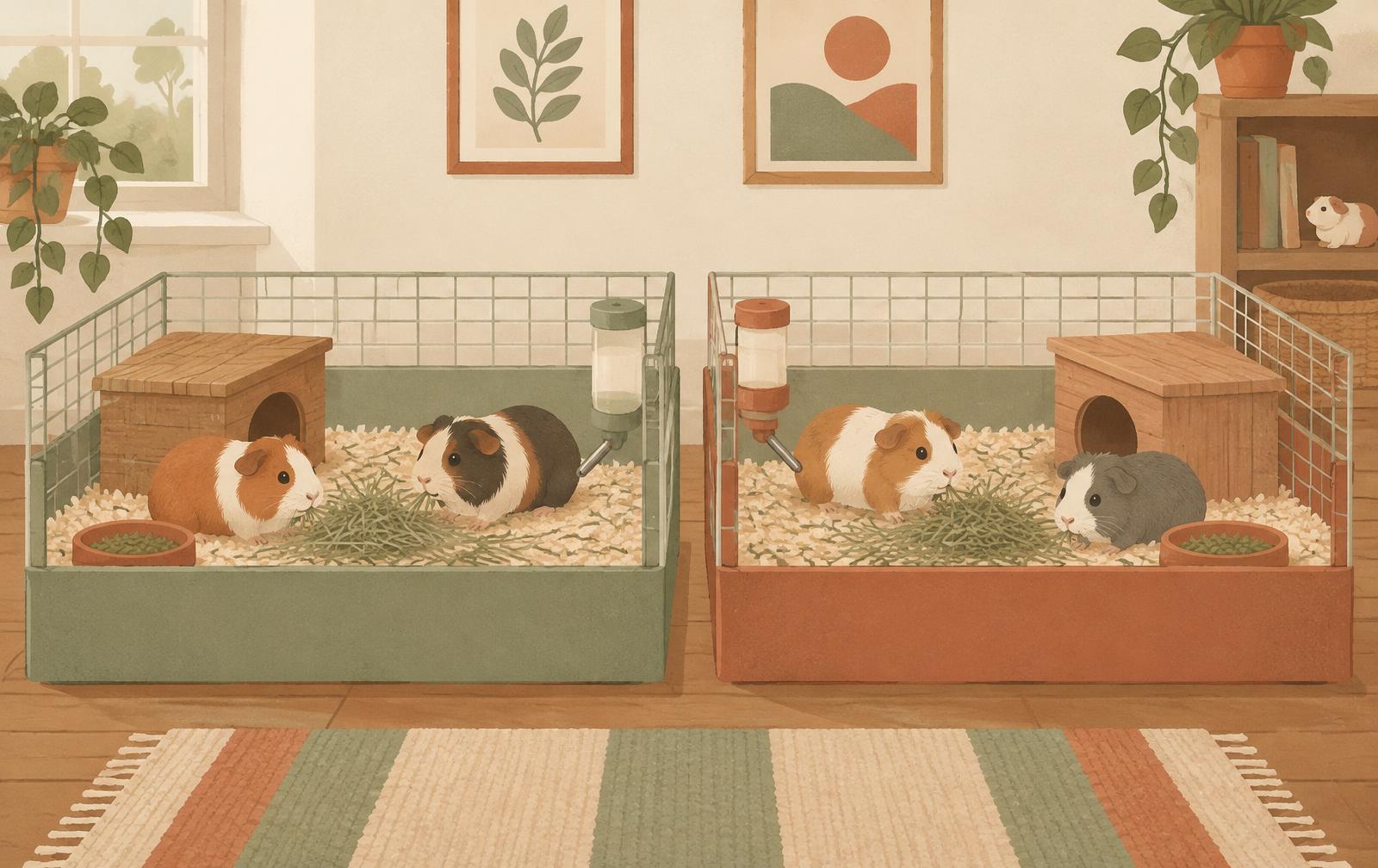
The RSPCA says guinea pigs should never be kept alone, and that they thrive in single-sex pairs or groups, or with a neutered male and one or more females. Suitable combinations include two compatible females, two compatible males, or one neutered male with one or more females. Blue Cross notes that pairs of males can get on very well, including unrelated males, and that whether they do is more about personality than hormones. Woodgreen adds that neutering does not reduce fighting between a male pair, so it is not a fix for males that do not get along. Whatever the combination, introductions should be gradual, with enough space and hiding places to avoid competition.
The RSPCA says males should be neutered before they are housed with females, and describes this as the best way to prevent unwanted litters. Neutering females is far less common, because the operation is more complicated. A neutered male is not safe with females straight away, though. Blue Cross advises waiting four to six weeks after the operation before introducing him to any females, because he may still be able to father pups during that time. Follow your vet's advice on when it is safe.
Have the sex of every guinea pig confirmed as soon as you bring them home, and do not rely solely on the shop or breeder. The RSPCA's guidance explains how to check, noting that a male's genitals look like a lowercase letter "i", but if you are unsure, ask your vet or a veterinary nurse. If you discover a mixed pair, separate them straight away.
If you think your guinea pig is pregnant
Separating the male prevents further mating, but it does not undo a pregnancy that may already be under way. Guinea pig pregnancies last 63 to 72 days, according to the Royal Veterinary College, so it can be weeks before a pregnancy is obvious. If a female has been living with an entire male, arrange a veterinary check rather than waiting to see whether her belly grows. The Royal Veterinary College's advice is to have every guinea pig sexed by an experienced vet or nurse, separate all males from all females, house pregnant sows indoors, and keep males well away from them, since housing males near sows can cause fighting and stress.
Diet matters during pregnancy. The Royal Veterinary College advises that pregnant sows need extra calcium and vitamin C, along with unlimited hay and a daily selection of vegetables, and ask an experienced vet to review the diet. Do not restrict food to stop her gaining weight, and do not try to manage a suspected pregnancy with supplements alone.
Know the warning signs before labour begins. The Royal Veterinary College lists straining or squeaking without producing pups, vaginal discharge without pups, excessive drooling, loss of appetite and collapse as signs that need immediate veterinary attention.
After the pups arrive
Guinea pig pups are born remarkably developed, with fur, open eyes and open ears, and they eat solid food from their first day. They still need to nurse, though. The Royal Veterinary College advises weighing them every couple of days to check they are gaining weight, and having any pup that is not gaining, not eating or looking unwell seen by a vet. At around three weeks, sex the pups and separate the males from their mother and sisters.
What vet records show about guinea pig health
The same Royal Veterinary College study gives a useful picture of what pet guinea pigs see the vet for. The most commonly recorded problems were overgrown nails, affecting more than a quarter of guinea pigs each year, followed by ringworm and eye ulcers, and the authors concluded that many common disorders were linked to how guinea pigs are kept. Among guinea pigs whose deaths were recorded, the median age at death was 4.03 years, lower than the five to six years the RSPCA gives as a typical lifespan. The most frequently recorded causes included anorexia, collapse and death around anaesthesia, although these are recording categories rather than the underlying diseases. The figures come from guinea pigs seen by vets in 2019, which may not reflect all pet guinea pigs.
The RSPCA points out that guinea pigs are prey animals and often hide signs of pain or distress, so owners should learn their normal behaviour and watch for changes. A guinea pig that goes off its food is one of those changes, and needs a vet.
Before you adopt or buy
As Christmas approaches, the RSPCA's figures are a reminder that guinea pigs should not be bought on impulse or given as surprise presents. They need a compatible companion, plenty of space, a diet based on hay with a reliable source of vitamin C, and access to a vet who sees small animals throughout their lives. Rescues, including the RSPCA, have many guinea pigs waiting for homes, usually already sexed by experienced staff.
Try this today
If you keep guinea pigs, make sure you know the sex of every one, using the RSPCA's guide or a quick check with your vet. If you have a mixed pair, separate them today, book a vet appointment for the female, and talk to your vet about neutering the male. If you have pups, note their age and plan to separate the males at three weeks.
The Bottom Line
The rise in guinea pigs coming into RSPCA care has several causes, but unplanned breeding is the one owners can most easily prevent. Guinea pigs mature within weeks, females can conceive again within hours of giving birth, and mis-sexed pairs are common. For the females involved, pregnancy carries real risk, from difficult births to pregnancy toxaemia, whatever the exact role of the pelvis turns out to be. Confirm the sex of every guinea pig, keep compatible same-sex pairs or a neutered male with females, separate male pups at three weeks, and talk to your vet as soon as you suspect a pregnancy.
This article is for general information and does not replace veterinary advice. If your guinea pig may be pregnant, is struggling to give birth or has stopped eating, contact your vet straight away.
Common questions
Frequently asked.
References
Sources.
- RSPCA. Guinea Pig Appreciation Day: RSPCA highlights rise of piggies in centres. 19 August 2026.
rspca.org.uk - RSPCA. Sexing guinea pigs.
rspca.org.uk - RSPCA. Guinea pigs: company.
rspca.org.uk - Royal Veterinary College, Beaumont Sainsbury Animal Hospital. Help, my guinea pig is pregnant!
rvc.ac.uk - Blue Cross. How to introduce guinea pigs.
bluecross.org.uk - Blue Cross. Neutering your small pet: FAQ.
bluecross.org.uk - Woodgreen Pets Charity. Neutering your guinea pig: what you need to know.
woodgreen.org.uk - Quesenberry KE, Donnelly TM. Breeding and Reproduction of Guinea Pigs. Merck Veterinary Manual (pet owner version).
merckvetmanual.com - LafeberVet. Dystocia in guinea pigs.
lafeber.com - Vieu S, Hugon H, Boucher S, Bercker C, Bruyas J-F, Fusellier M. Assessing pubic symphysis evolution in guinea pigs (Cavia porcellus): insights from computer tomography on primiparous and non-breeding females. Veterinary Medicine and Science. 2024.
doi.org - O'Neill DG, Taffinder JL, Brodbelt DC, Baldrey V. Demography, commonly diagnosed disorders and mortality of guinea pigs under primary veterinary care in the UK in 2019: A VetCompass study. PLOS ONE. 2024;19(3):e0299464.
doi.org
Keep reading
Further reading.
Want plain-English notes on small pet health and welfare? Join The Once-Over, our weekly note from Hazel.