Small Animals · Guinea Pig & Rabbit · 27 Sept 2026
Can Guinea Pigs Live With Rabbits?
By Burrow · 27 Sept 2026
TL;DR
- A 2020 UK survey of 4,590 guinea pig owners found guinea pigs housed with rabbits were reported to show fewer positive behaviours than those housed with other guinea pigs. A newer survey of 1,181 German-speaking carers cites that finding and backs the advice against mixed housing.
- That doesn't establish cause and effect. Both surveys were owner-reported and cross-sectional, and only a small proportion of respondents kept guinea pigs with rabbits.
- Current welfare guidance already advises against mixed housing because rabbits and guinea pigs communicate differently, have different nutritional requirements, and the size difference creates a risk of injury.
- A rabbit isn't a substitute for guinea pig company. Guinea pigs need social interaction with their own species.
- Popcorning is a form of locomotor play generally treated as a positive behaviour. Seeing it is encouraging; not seeing it doesn't by itself establish poor welfare.
- Guinea pigs cannot synthesise their own vitamin C and need a diet that reliably supplies it.
- Already have a long-established rabbit and guinea pig living together? Don't abruptly separate them after reading this. Existing relationships need to be considered individually.
Rabbits and guinea pigs can live alongside one another without an obvious disaster. That's not the same thing as good welfare — and new research on 1,181 guinea pig carers gives us a more interesting question: what does a guinea pig look like when things are going well?
For years, keeping a guinea pig with a rabbit was fairly standard advice. Both are small, both eat hay, both were traditionally kept in hutches. Pair them up and neither is alone. Current welfare guidance advises against it.
Owner survey research adds something to the discussion. In a large UK survey, guinea pigs housed with rabbits were reported to show fewer positive behaviours than guinea pigs housed with their own species, and a new study of 1,181 German-speaking carers cites that finding in recommending against the pairing. That doesn't prove that living with a rabbit causes poorer welfare — the research has important limitations, including its observational design and the small number of mixed-species households. But the result points in the same direction as existing guidance, which already advises against the pairing for independent social, nutritional and physical reasons.
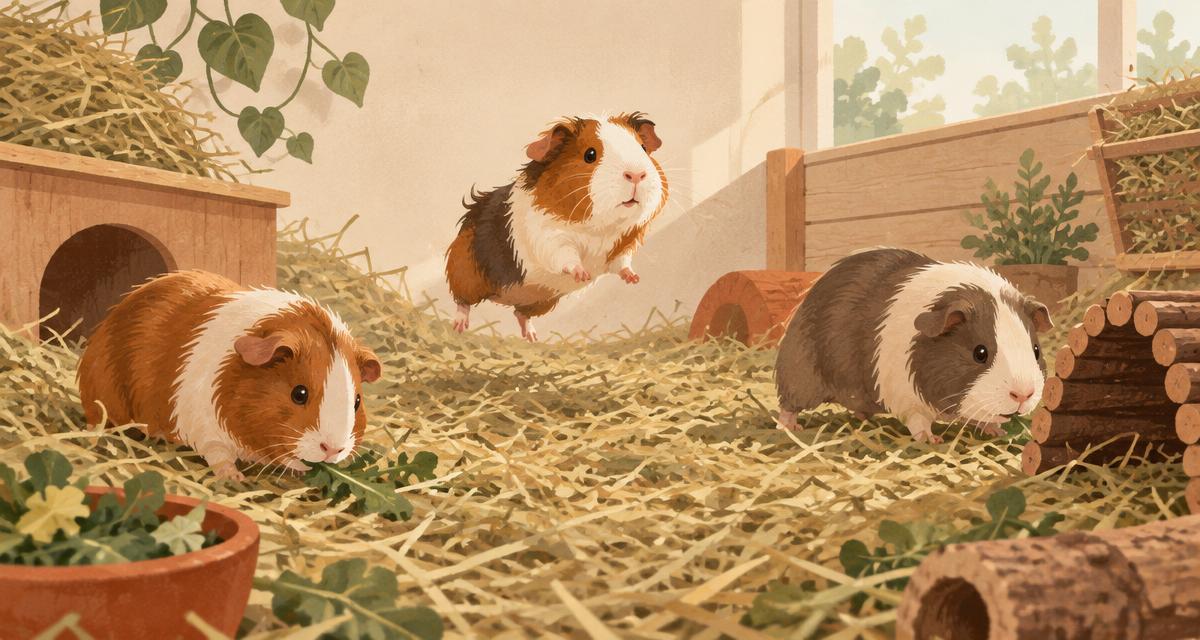
Perhaps more interestingly, the new research gives us a picture of what positive guinea pig welfare can look like. And sometimes it involves all four feet leaving the floor.
What the new research found
The study surveyed 1,181 German-speaking guinea pig carers about housing, husbandry, their interactions with their animals and the behaviours they observed.
The researchers were particularly interested in something that doesn't receive enough attention in pet welfare research: positive behaviour. Animal welfare isn't simply the absence of disease, injury or obvious distress — an animal can survive in an environment without displaying much of the behavioural repertoire associated with a good life.
They therefore asked about behaviours including locomotor play, which includes popcorning, alongside interactions between guinea pigs, resting and feeding alongside companions, exploration and other behaviours that may help describe positive welfare.
Several associations emerged between the animals' behaviour and aspects of their environment or their carers' interactions with them. On the old-fashioned rabbit pairing, the authors point to an earlier UK survey of 4,590 guinea pig owners (Harrup and Rooney, 2020), which found that guinea pigs housed with rabbits were reported to show fewer positive behaviours than guinea pigs housed with their own species. They conclude that co-housing the two species should be avoided — it is already banned in Austria.
That sounds compelling. But it needs context.
What the study can't tell us
Both were owner surveys, not direct behavioural observation by researchers. Everything depends on what carers noticed, remembered and reported, and someone highly engaged with their guinea pigs may notice behaviours another owner simply misses.
Both were also cross-sectional. It captured associations at one point rather than manipulating housing conditions and following what happened afterwards, which means it cannot show that one factor caused another. If owners who interact more frequently with their guinea pigs report more positive behaviour, it's possible that their interaction encourages that behaviour. It's equally possible that particularly sociable animals encourage their owners to interact with them more.
Mixed rabbit and guinea pig households were a small minority too — 5.8% of respondents in the German-speaking survey and 1.7% in the UK survey. And the German-speaking sample was self-selected: people who chose to complete a survey about guinea pig welfare, with the researchers themselves noting that participants appeared generally attentive to their animals' needs.
So the finding should not become "living with rabbits makes guinea pigs unhappy." What it gives us is a signal. And importantly, that signal points in the same direction as welfare recommendations that existed before the study.
The case against mixed housing doesn't depend on this study
Current RSPCA guidance advises against keeping rabbits and guinea pigs together, for several reasons.
They don't speak the same language. Both species are social, but that doesn't make them socially interchangeable. Guinea pigs communicate with other guinea pigs through a repertoire of vocalisations, postures, scent and physical interactions. Rabbits have their own social communication and behaviour. A rabbit's presence may provide some stimulation, but it isn't a substitute for guinea pig company, and sharing an enclosure isn't the same as meeting a guinea pig's need for social interaction with its own species.
This may be the most important distinction in the whole debate. An owner can look at a rabbit and guinea pig sitting peacefully beside one another and reasonably conclude that they get along. They may well do. But absence of conflict isn't the same thing as positive welfare.
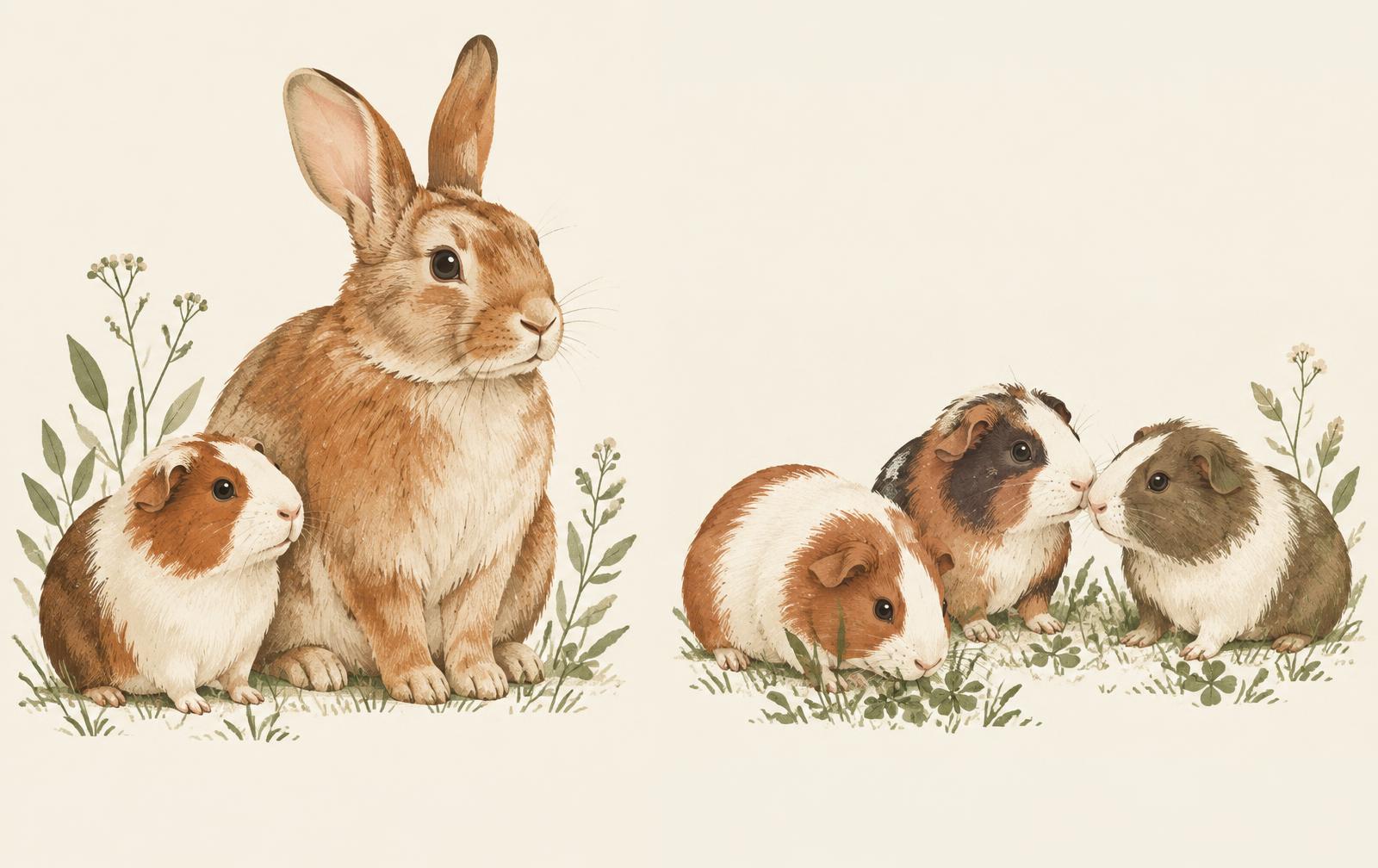
The size difference matters. Rabbits are considerably larger and more powerful than guinea pigs, which creates a physical risk even when neither animal is aggressive. A rabbit can injure a guinea pig by kicking, mounting or simply moving forcefully in a confined space, and current welfare guidance specifically identifies injury and bullying as concerns with mixed housing. This isn't an argument that rabbits are dangerous animals. It's an argument about putting animals of very different sizes and physical capabilities into the same enclosed space.
Their nutritional needs aren't identical. Both species need a high-fibre, hay-based diet, but there is one fundamental difference: guinea pigs cannot synthesise their own vitamin C. Like humans, they need to obtain it from their diet, which means appropriate fresh vegetables and herbs alongside fresh pellets formulated for guinea pigs. Rabbit food isn't a substitute, and that becomes practically awkward in a shared enclosure because animals don't necessarily respect the labels on their food bowls. The point isn't that one mouthful of rabbit pellets will cause deficiency. It's that a guinea pig's long-term diet needs designing for a guinea pig, rather than assuming that because both species eat hay their requirements are interchangeable.
Popcorning: what good can look like
This is perhaps the most enjoyable part of the new research.
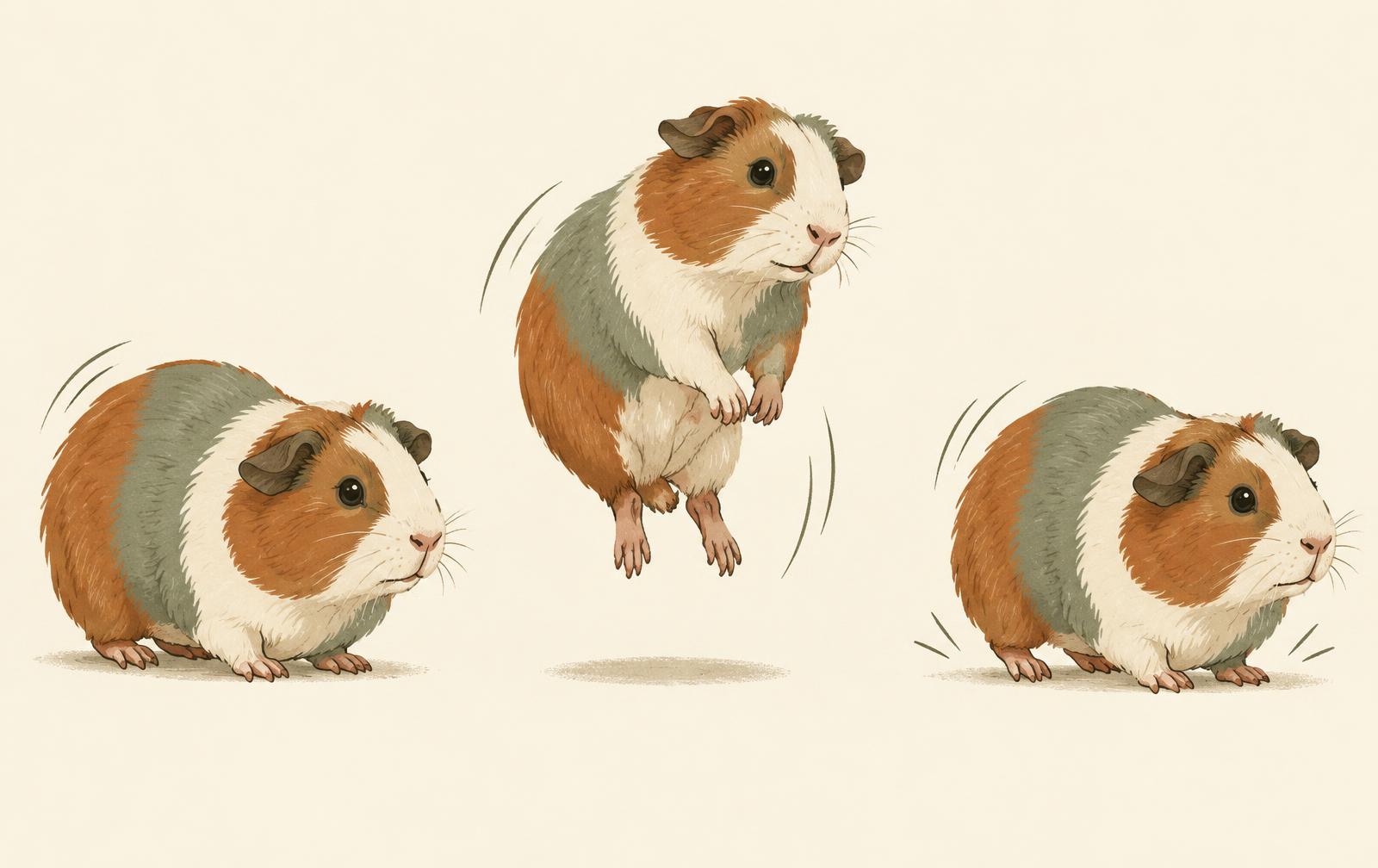
A guinea pig suddenly launches itself vertically from all four feet, sometimes twists in mid-air, lands and does it again. That's popcorning. More formally it's a form of locomotor play, and researchers generally interpret it as a positive behaviour.
The survey found locomotor play was common among the guinea pigs studied, and its frequency was associated with aspects of husbandry and human interaction. That gives owners something useful to notice.
But it shouldn't become another welfare test. A guinea pig that popcorns is displaying a behaviour we have good reason to interpret positively. A guinea pig that doesn't popcorn hasn't automatically failed a happiness test — age, temperament, health, environment and individual differences can all influence behaviour.
Seeing popcorning is encouraging. Not seeing it doesn't, by itself, establish poor welfare.
Positive welfare is more than popcorning
One useful thing about the study is that it doesn't reduce guinea pig wellbeing to a single appealing behaviour. The researchers looked at a wider range of behaviours and found associations with housing conditions and interactions between humans and animals. Positive interaction with carers, talking to the animals and providing food enrichment were among the factors associated with reported positive behaviours.
Those findings need the same caution as the rabbit result. We cannot conclude from a cross-sectional survey that talking to a guinea pig causes it to become happier.
But the broader idea is useful. Good guinea pig care isn't just food, water and the absence of illness. It should create opportunities to explore, forage, interact with other guinea pigs, rest safely and express normal behaviour. That is a considerably more ambitious standard than asking whether an animal is surviving.
What about group size?
Guinea pigs shouldn't normally be kept alone. UK welfare guidance commonly recommends keeping at least a compatible pair, while some specialist guidance favours groups of three or more.
There's a practical reason for the latter recommendation: if one animal in a pair dies, the survivor is suddenly completely alone while another suitable companion is found and introduced.
That doesn't mean every owner must immediately add a third guinea pig. Compatibility, sex, neuter status, available space and group dynamics all matter, and suitable arrangements can include compatible same-sex animals or a neutered male living with females. The important principle is simpler: guinea pigs need guinea pig company, and a rabbit doesn't fulfil that requirement merely because it shares the enclosure.
What about Bordetella?
There's another argument frequently made against rabbit and guinea pig housing: infectious disease.
Bordetella bronchiseptica can cause serious respiratory disease in guinea pigs, while rabbits can carry the organism without obvious signs of illness. Transmission can occur through close contact, respiratory secretions, aerosols and contaminated objects, which is one reason mixed housing is discouraged by welfare organisations.
But this part of the argument deserves qualification. Much of what is known about Bordetella disease in guinea pigs comes from laboratory populations rather than ordinary pet households. Disease in companion guinea pigs is less well characterised, and the risk of transmission specifically from a pet rabbit to a cohoused pet guinea pig hasn't been precisely quantified.
So there's a plausible infectious-disease concern. It just shouldn't be presented as though we know the probability that a rabbit will transmit Bordetella to the guinea pig sharing its enclosure. We don't need to exaggerate it — the social, nutritional and physical arguments against deliberately establishing mixed housing are already substantial.
What guinea pigs actually need
Start with their own species. A compatible pair is widely accepted as a minimum social arrangement, while larger compatible groups can work where there is sufficient space and appropriate group composition.
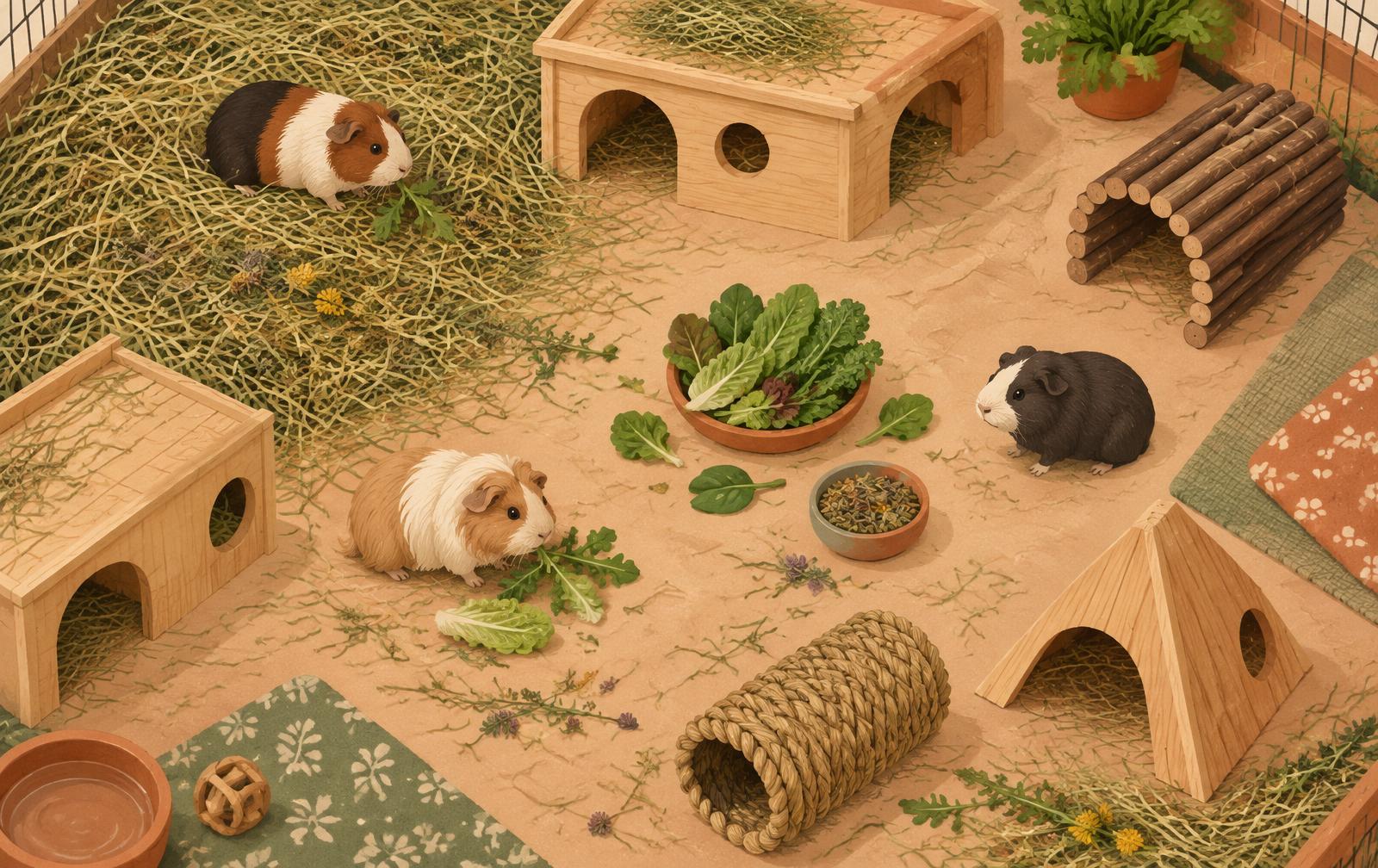
Then give them room to behave like guinea pigs. They need continual access to appropriate hay or grass, places to hide, opportunities to forage and explore, and a diet that reliably supplies vitamin C. They also need enough resources that living socially doesn't mean constantly competing for them.
Human interaction can form part of a good life too. The survey found associations between positive behaviour and ordinary owner interactions, including talking to guinea pigs and positive engagement. That's worth noticing precisely because it isn't a product. Good welfare isn't necessarily something else to buy — sometimes it's an environment that gives the animal more opportunity to do what guinea pigs naturally do.
Already have a rabbit and guinea pig living together?
Don't read this article and immediately separate animals that have lived together for years. That's a different situation from deciding whether to establish a new mixed-species pairing, and the RSPCA explicitly recognises the distinction — where an existing rabbit and guinea pig get on well, abruptly separating them may itself cause distress.
Instead, look at the arrangement more carefully. Can the guinea pig escape into areas the rabbit cannot enter? Is there any mounting, chasing or bullying? Can each animal reliably eat the food intended for its own species? Does the guinea pig have any contact with other guinea pigs? And is there enough space for both animals to move away from one another?
This is a situation worth discussing with a vet experienced in rabbits and guinea pigs rather than making an abrupt change on the basis of an article. The goal is better welfare, not following a rule at any cost.
Try this today
Watch your guinea pigs for ten minutes when they're naturally active. Don't try to make them perform — just watch.
Are they exploring? Foraging? Resting near one another? Communicating? Moving between different parts of their enclosure? Do you ever see locomotor play such as popcorning?
Then look at the enclosure from their perspective. Is there enough hay for animals to feed together without competing? More than one useful hiding place? Space to move away from each other? Something to forage for rather than everything arriving in a bowl? And, most importantly, does every guinea pig have another guinea pig it can interact with?
That's a better welfare audit than asking whether nothing obviously bad has happened.
The Bottom Line
A rabbit and guinea pig can share an enclosure without fighting. That's a remarkably low bar for deciding whether the arrangement is good.
The research doesn't prove that rabbits make guinea pigs less happy. An owner survey found an association between mixed housing and fewer reported positive behaviours in a relatively small subgroup of households. But the case against deliberately pairing the species doesn't depend on that result. Rabbits and guinea pigs communicate differently. Their nutritional requirements aren't identical. The physical size difference introduces a risk of injury. And a rabbit's presence doesn't replace the social interaction a guinea pig gets from another guinea pig.
The more interesting lesson from the research is what happens when we stop asking only whether something is wrong. Guinea pig welfare also means looking for what is going right: exploration, social interaction, foraging, play and the opportunity to make choices. Sometimes that includes a guinea pig unexpectedly launching all four feet into the air.
The question isn't simply whether rabbits and guinea pigs can live together. It's whether we're giving each species the chance to live like itself.
Burrow provides evidence-led pet health information and isn't a substitute for veterinary advice. If you have concerns about your guinea pig's diet, weight, breathing or behaviour, speak to a vet experienced in small mammals.
Common questions
Frequently asked.
References
Sources.
- Harrup AJ, Rooney NJ. Current welfare state of pet guinea pigs in the UK. Veterinary Record, 2020;186(9):282.
https://doi.org/10.1136/vr.105632 - Guinea Pig (Cavia porcellus) Welfare: Associations Between Husbandry Practices, Human–Animal Interactions, and Animal Behaviour. Animals, 2025;15(8):1157.
https://pmc.ncbi.nlm.nih.gov/articles/PMC12024334/ - RSPCA. Keeping rabbits and guinea pigs together.
https://www.rspca.org.uk/adviceandwelfare/pets/rabbits/company/rabbitsandguineapigs - RSPCA. Guinea pig diet.
https://www.rspca.org.uk/adviceandwelfare/pets/rodents/guineapigs/diet - RSPCA. Guinea pig welfare and companionship.
https://www.rspca.org.uk/adviceandwelfare/pets/rodents/guineapigs - Bordetella Bronchiseptica Vaccines in Pet Guinea Pigs? A Review of the Literature.
https://symbiosisonlinepublishing.com/veterinary-sciences/veterinary-sciences30.php
Keep reading
Further reading.
Want plain-English notes on small animal health and the everyday care that prevents problems? Join The Once-Over, our weekly note from Hazel.