Seasonal Health · Dog & Cat · 28 Aug 2026
Harvest Mites in Dogs and Cats: Why August Itching Isn't Always Fleas
By Burrow · 28 Aug 2026
TL;DR
- Harvest mites are tiny mites whose larvae can temporarily parasitise dogs, cats and other animals, including humans.
- They're particularly associated with late summer and autumn in the UK — the seasonal timing is the most useful diagnostic clue.
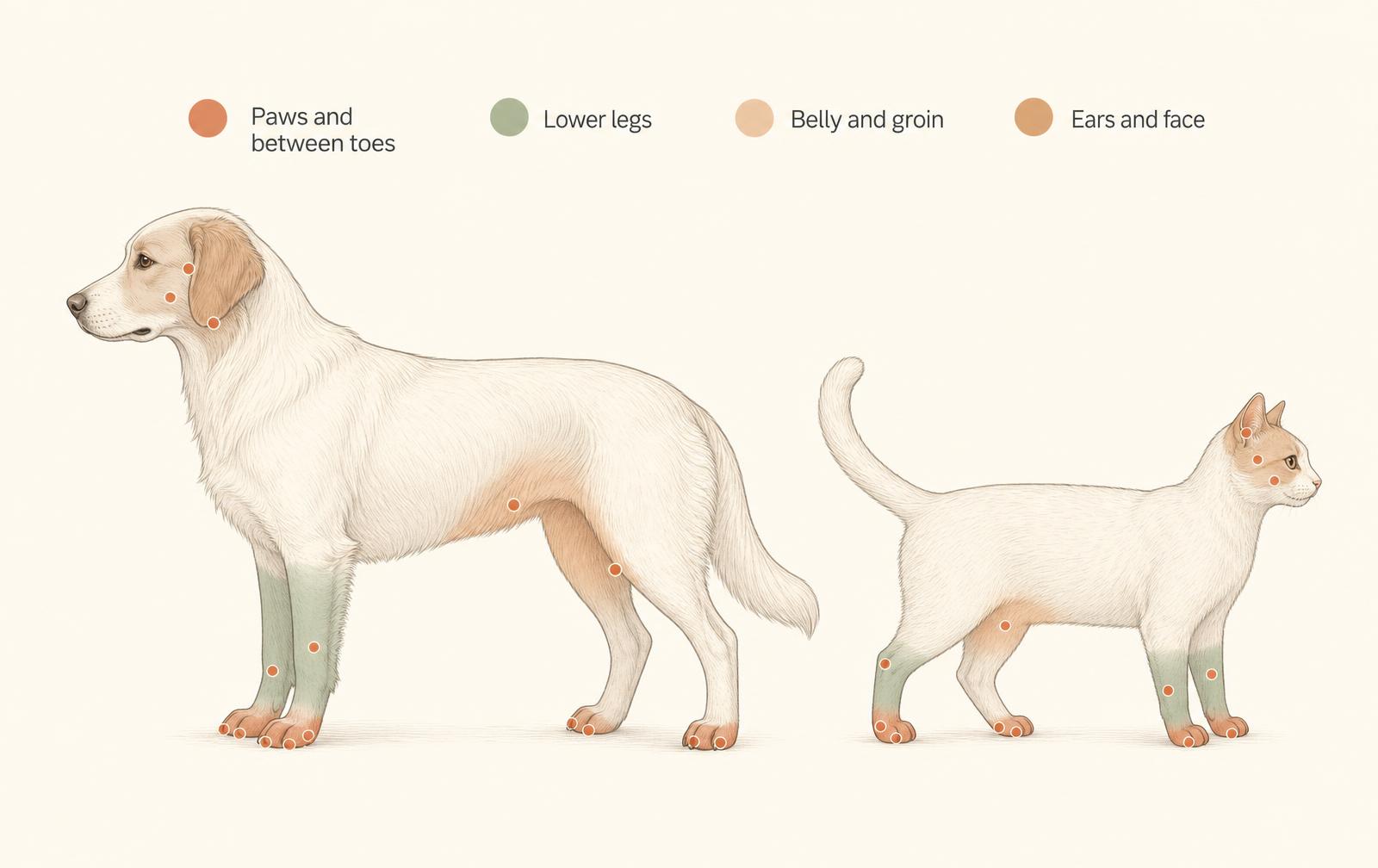
- Paws, legs, belly, ears and the face are the most common places to find irritation.
- The larvae can sometimes be seen as tiny orange or reddish dots clustered on the skin.
- Some pets barely react. Others become intensely itchy and can damage their skin through scratching and licking.
- Flea treatments don't automatically cover harvest mites. Products differ in what they're licensed to treat.
- Repeated late-summer itching deserves veterinary investigation rather than assuming it's simply a seasonal allergy.
Fleas and allergies usually get the blame. But when intense itching appears towards the end of summer — particularly around the paws, ears and belly — there is another possibility worth knowing about.
Late summer brings a particular skin problem for some dogs and cats. Harvest mites — sometimes called autumn mites or berry bugs — spend most of their lives unnoticed in the environment. But during their larval stage, the tiny orange parasites climb onto animals and feed on the surface of the skin. In Britain, that tends to happen from late summer into autumn, and for some pets the result is intense itching, inflammation and skin damage.
Because itching is much more commonly associated with fleas or allergies, the cause isn't always obvious. But there is a useful seasonal clue. A pet that becomes intensely itchy in the same places at roughly the same time each late summer may not have developed a new allergy at all. It may have encountered harvest mites.

What harvest mites actually are
The harvest mite found across much of Europe is Neotrombicula autumnalis, and its life cycle is important because only one stage causes problems for pets. Adult harvest mites live freely in the environment — they don't spend their lives on your dog or cat. It is the six-legged larvae that attach temporarily to animals. These larvae are extremely small, roughly pinhead-sized, and characteristically bright orange or reddish-orange. They climb vegetation and wait for a suitable host to pass, then settle in suitable areas of skin and feed for several days before dropping back into the environment to continue their development.
That makes harvest mite infestation quite different from the classic picture of fleas breeding continuously on and around a pet. The pet is effectively visiting the mites' habitat, not the other way around.
Why August?
The scientific name provides a clue: autumnalis. Harvest mite larvae become active during the warmer part of the year and are particularly associated with late summer and early autumn in the UK. Exactly when they appear varies with geography and weather, and their distribution can be remarkably localised — one field can be a problem while another nearby isn't, and a particular patch of garden can repeatedly expose a pet.
That's what makes the calendar potentially useful as a diagnostic tool. A dog that scratches throughout the year has a huge range of possible causes. A dog that becomes intensely itchy every August after walking through the same field gives the vet an additional and meaningful clue.
Where to look
Harvest mite larvae tend to settle where they can access relatively thin skin or where the pet's body comes into contact with vegetation. Common sites include between the toes, around the paws and lower legs, the belly and underside of the body, around the ears, the face, and areas around the groin. In cats, the ears and the areas between the toes are particularly common sites.
Sometimes the mites themselves provide the clue. Look very closely and you may see clusters of minute bright-orange dots against the skin. But don't expect always to find them — they're tiny, fur gets in the way, and by the time inflammation has become obvious the mites may no longer be present.
Why some pets itch so badly
Harvest mite larvae don't burrow deeply into the skin. They attach to the surface and release digestive enzymes that break down skin tissue, allowing them to feed. The resulting irritation varies considerably between individual animals — some carry larvae with relatively little reaction, while others appear to develop a pronounced hypersensitivity response.
For those animals, the itching can be intense. Signs include persistent scratching, licking or chewing the paws, biting at the legs or belly, rubbing the face, red or inflamed skin, small bumps or crusts, hair loss from repeated scratching, and broken or damaged skin.
Once scratching becomes severe, another problem can follow. Repeated licking, chewing and scratching damage the skin barrier, potentially allowing secondary bacterial or yeast infection to develop. At that point the original mites may only be part of what is making the pet uncomfortable.
Harvest mites or allergies?
Itchy paws, ears, belly and face are also classic locations for allergic skin disease. Fleas can cause intense itching too. A dog can have more than one problem at once. There isn't a symptom that allows an owner to say with certainty that the cause is harvest mites rather than something else. Instead, think about the pattern. Our allergy guide sets out how the allergic picture usually behaves, which makes the seasonal one easier to spot.
Timing. Did the problem appear in late summer or early autumn? Has something similar happened at this time of year before?
Location. Are the paws, lower legs, belly or ears particularly affected?
Environment. Has the pet been spending time in long grass, gardens or particular walking areas during peak mite season?
The orange clue. Can you see tiny orange or reddish clusters on the skin, particularly around the affected areas?
None of these proves the diagnosis. But together they can make harvest mites considerably more plausible — and worth raising with a vet rather than assuming the problem is a new allergy.
On fleas: don't rule them out simply because it's August. Fleas remain an important cause of itching year-round, and flea-allergic animals can react dramatically to relatively little exposure. Harvest mites are an additional possibility, not a replacement for thinking about fleas. And giving a flea treatment doesn't mean every external parasite has been covered — products differ in what they're licensed to treat, and a product effective against fleas isn't automatically appropriate for harvest mites. It's also worth knowing where those products end up when deciding how routinely to use them.
How a vet diagnoses harvest mites
Sometimes diagnosis is straightforward. Characteristic orange larvae in the right locations on an itchy pet at the right time of year can make the picture fairly convincing, and a vet may examine material from the skin or use tape sampling to look for mites under a microscope. But diagnosis can become more difficult when the mites have already left the host — the inflammatory reaction can persist after larvae have detached.
A vet will typically consider the time of year, where the pet has been walking, the distribution of skin lesions, whether mites can be demonstrated, flea control status, the possibility of secondary infection, and whether allergic skin disease may be present alongside or instead. That's why recurring seasonality is worth mentioning during an appointment. "She's itchy" is useful. "She's become itchy around her paws every August for three years" is much more informative.
What about treatment?
Treatment depends on the animal, the severity of the reaction and whether secondary skin infection has developed. A vet may recommend an appropriate antiparasitic treatment and, where necessary, something to control inflammation and itching. Secondary bacterial or yeast infection may need addressing separately.
The important thing is not to assume that whichever flea product happens to be in the cupboard will treat harvest mites. Veterinary medicines differ in their licensed uses, species suitability and active ingredients. Cats in particular should never receive a dog-only parasite treatment unless a vet has specifically confirmed it is safe — some ingredients used in canine products are highly toxic to cats.
Can you prevent them?
Prevention isn't always straightforward because the mites live in the environment rather than permanently on the animal. But if a pet repeatedly develops harvest mite problems, the pattern itself can help. You may find that exposure follows one particular field, an area of long grass, a certain part of the garden, or a regular late-summer walking route. Temporarily avoiding a known problem area during peak activity may reduce exposure, and keeping grass shorter in areas of the garden a susceptible pet uses regularly may help reduce contact. For a dog with a predictable seasonal history, speaking to a vet before the usual problem period can also be useful.
Try this today
If your dog or cat has suddenly become itchy, look at the calendar as well as the skin. Check carefully around the paws, between the toes, the lower legs, belly and ears for inflammation or tiny orange dots. Then think back — did the same thing happen around this time last year? Seasonality is information. If you need a veterinary appointment, mention it.
The bottom line
When a dog or cat suddenly becomes itchy, fleas and allergies are obvious suspects. In late summer, add another one to the list. Harvest mite larvae are tiny, seasonal and picked up from the environment. Some animals barely notice them; others develop intense irritation, particularly around the paws, legs, belly and ears.
The most useful clue may not be something you can see on the skin at all. It may be when it happens. If the same pet develops the same pattern of itching at roughly the same time each year, tell your vet. Sometimes the calendar is part of the diagnosis.
This is general information and not a substitute for veterinary advice. Persistent or severe itching, skin damage or suspected infection should be assessed by a veterinary professional.
Related reading: Are Conkers and Acorns Poisonous to Dogs?
Common questions
Frequently asked.
Keep reading
Further reading.
Want plain-English notes on pet health and the things that affect it? Join The Once-Over, our weekly note from Hazel.