Preventive Vet Care · Dog · 06 Aug 2026
Are Dental Chews Worth It for Dogs?
By Burrow · 06 Aug 2026
TL;DR
- Most dental chews have no clinical evidence. The pet shop shelf is full of products with confident claims and no trials behind them.
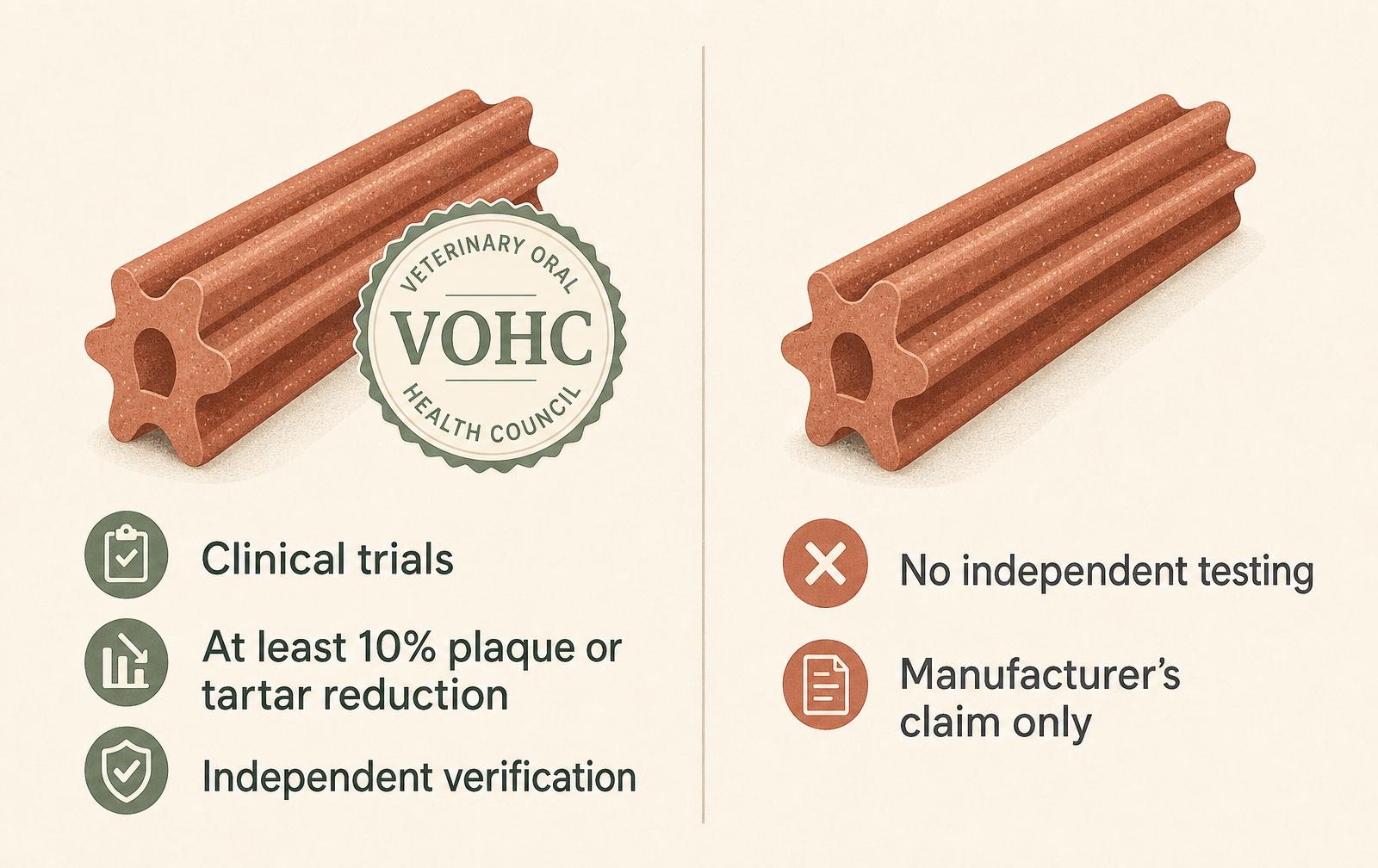
- The VOHC seal is the one reliable marker. Products carrying it have demonstrated at least a 10% reduction in plaque or tartar in controlled studies.
- Dental chews work through mechanical abrasion, and some also contain active ingredients that work via saliva. Neither reaches under the gumline.
- They must be used daily to produce the results shown in trials. Once or twice a week provides minimal long-term benefit.
- Dental chews are a supplement to brushing, not a replacement.
- Bones, antlers and hard chews are not recommended — they're among the most common causes of fractured teeth in dogs.
Walk down any pet shop aisle and you'll find dozens of products claiming to clean your dog's teeth. Most of them have no clinical evidence at all. Here's how to tell the difference.
The dental chew market is enormous, and most of it is built on marketing rather than proof. A product can claim to "support dental health", "reduce plaque" or "freshen breath" with no clinical trial behind it whatsoever, and the packaging often looks identical to products that do have evidence. Most owners have no reliable way to tell which is which.
This piece cuts through that. The honest answer to whether dental chews are worth it is: some are, most aren't, and there's a straightforward way to know which is which before you spend any money.

The one marker that matters: the VOHC seal
The Veterinary Oral Health Council is an independent body that reviews submitted data from clinical trials to assess whether pet dental products actually do what they claim. Products that demonstrate a statistically significant reduction in plaque or tartar — a minimum of 10% in controlled studies — are awarded the VOHC Seal of Acceptance.
That seal is the only independent, evidence-gated standard in the pet dental product market. It's awarded separately for plaque control, tartar control, or both, so it's worth checking which specific claim a product has been accepted for. And it's not a permanent award — products can lose it if they change formulation.
Before buying any dental product for your dog, look for the VOHC seal on the packaging. If it isn't there, the product hasn't been tested to the standard that demonstrates efficacy. That doesn't mean it definitely doesn't work — but it means you're taking the manufacturer's word for it rather than seeing independent evidence.
How dental chews actually work
Dental chews reduce plaque through two mechanisms: mechanical abrasion from the chewing action, and in some formulations, active ingredients that work through saliva to support plaque control across the full oral environment.
The mechanical side is straightforward: the texture and resistance of the chew scrubs the tooth surface as the dog chews, disrupting plaque before it can harden into calculus. This is why texture matters — a chew that a dog swallows in two bites without much chewing engagement provides far less benefit than one that requires sustained chewing.
The active ingredient side varies by product. Some chews contain enzymes, polyphosphates or other compounds that work chemically to reduce plaque formation. VOHC-accepted products that rely on these ingredients are typically required to meet a higher reduction threshold to earn the seal.
Neither mechanism reaches below the gumline, which is where periodontal disease actually progresses. This is the fundamental limitation of any chew, and why they supplement rather than replace brushing and professional dental care — something our dental guide sets out in full.
The daily use requirement
Here is the point most people miss, and the one that explains why so many owners feel dental chews aren't working.
The clinical trials behind VOHC acceptance are based on daily use. Giving a chew once or twice a week will not produce the plaque and tartar reduction shown in studies. The mechanism requires consistent daily contact with the tooth surface to keep plaque disrupted before it mineralises. An occasional chew provides minimal long-term benefit, however good the product is.
This matters practically because dental chews aren't cheap, and the temptation is to use them as an occasional treat rather than a daily routine. Used daily, a good VOHC-accepted chew provides genuine benefit. Used irregularly, it's largely money spent on something your dog enjoys chewing but that isn't doing the dental job.
Size, calories and chewing style
A few practical points worth knowing before choosing a product.
Size must match the dog. A chew too small is a choking risk. One too large provides less chewing engagement because the dog can't grip it effectively. Most VOHC-accepted products come in size-matched ranges based on body weight — use them.
Calories count. Dental chews contribute to daily caloric intake, sometimes significantly. For a small dog, a daily chew can represent a meaningful proportion of the day's calories. Account for it by trimming the main meal slightly, particularly if your dog is already on the heavier side. Our feeding guide covers daily calorie management in more detail.
Match the chew to your dog's chewing style. Hard chews suit strong, enthusiastic chewers. Softer varieties are better for older dogs, dogs with dental sensitivity, or those who tend to swallow rather than chew. A chew that's gone in thirty seconds is providing minimal mechanical benefit.
What dental chews can't do
It's worth being direct about the limits, because the marketing often isn't.
Dental chews cannot treat existing dental disease. They can reduce the rate at which new plaque accumulates, but they cannot reverse gum infection, treat a tooth root abscess, or clean below the gumline. A dog with established periodontal disease needs a professional dental clean under anaesthetic, not a chew.
They are also not a substitute for brushing. Daily brushing, particularly along the gumline, disrupts plaque where the disease begins, and no chew replicates that. The two work best together: brushing for the gumline, a VOHC-accepted chew for additional surface plaque control.
A firm note on bones and hard chews
Bones, antlers, deer hooves and similar very hard chews are consistently cited as one of the most common causes of fractured teeth in dogs. A fractured tooth is painful, often requires extraction, and always needs veterinary attention. Whatever the appeal — and dogs clearly enjoy them — the dental trade-off is poor. Our dental guide, and the AAHA dental care guidelines, both advise against them.
The honest verdict
Yes, dental chews are worth it — with conditions attached. A VOHC-accepted chew used daily, in the right size for your dog, with the calories accounted for, provides a genuine, evidence-backed reduction in plaque and tartar. That's a useful contribution to a dog's dental health, particularly for dogs that resist brushing.
But they're one layer of a wider routine, not a solution on their own. Use them alongside brushing where possible, have a professional dental assessment at least annually, and don't let a fresh-smelling chew substitute for the vet's assessment of what's going on under the gumline.
The bottom line
Most of what's sold as a dental chew has no clinical backing. The VOHC seal is the one marker that means the product has actually been tested. Used daily, in the right size, a VOHC-accepted chew provides a genuine and useful contribution to your dog's dental health. Used occasionally, or chosen for the wrong reasons, it's largely a tasty treat with a dental sticker on the bag.
Use them alongside brushing, not instead of it. And if your dog already has bad breath or visible dental disease, start with a vet appointment rather than a chew.
This is general guidance and not veterinary advice. For specific dental concerns about your dog, please speak to your vet.
Common questions
Frequently asked.
Keep reading
Further reading.
Want plain-English notes on pet health and the things that affect it? Join The Once-Over, our weekly note from Hazel.