Tortoise · All · Seasonal
The Tortoise Hibernation Guide
Published 13 Nov 2026 · ✓ Researched
TL;DR
- **Not every tortoise should hibernate.** Tropical and some North African species should never be hibernated, and any tortoise that has been unwell, is underweight or is very young needs a vet's advice first.
- **Hibernation is not compulsory.** Veterinary guidance differs on its benefits in captivity. Some vets support carefully managed hibernation for species that naturally do it, while others consider good year-round care an acceptable alternative.
- **The garden is the riskiest place.** In a Royal Veterinary College study, tortoises hibernated in the garden were about six times more likely to die than those hibernated in a fridge.
- **Temperature is everything.** Aim for a steady 5°C, within a range of roughly 2 to 9°C, measured where the tortoise sits. Below freezing can cause blindness or death, and too warm burns through the reserves a tortoise needs in spring.
- **Wind down gradually,** following a plan agreed with your vet. Uncontrolled cooling before hibernation was linked to a higher risk of death.
- **Weigh regularly.** Expect a loss of around 1% of body weight a month. Contact your vet promptly about any loss clearly faster than that, rather than waiting.
- **Act on warning signs.** A tortoise that passes urine or droppings during hibernation should be woken and checked. One that isn't active within 24 to 48 hours of warming, or hasn't eaten or passed urine within seven days, needs a vet.
Hibernation is a natural part of life for many of the tortoises kept in Britain, but it is also the time of year most likely to make them ill. Much of the risk comes down to how it is done, and some tortoises should not be hibernated at all.
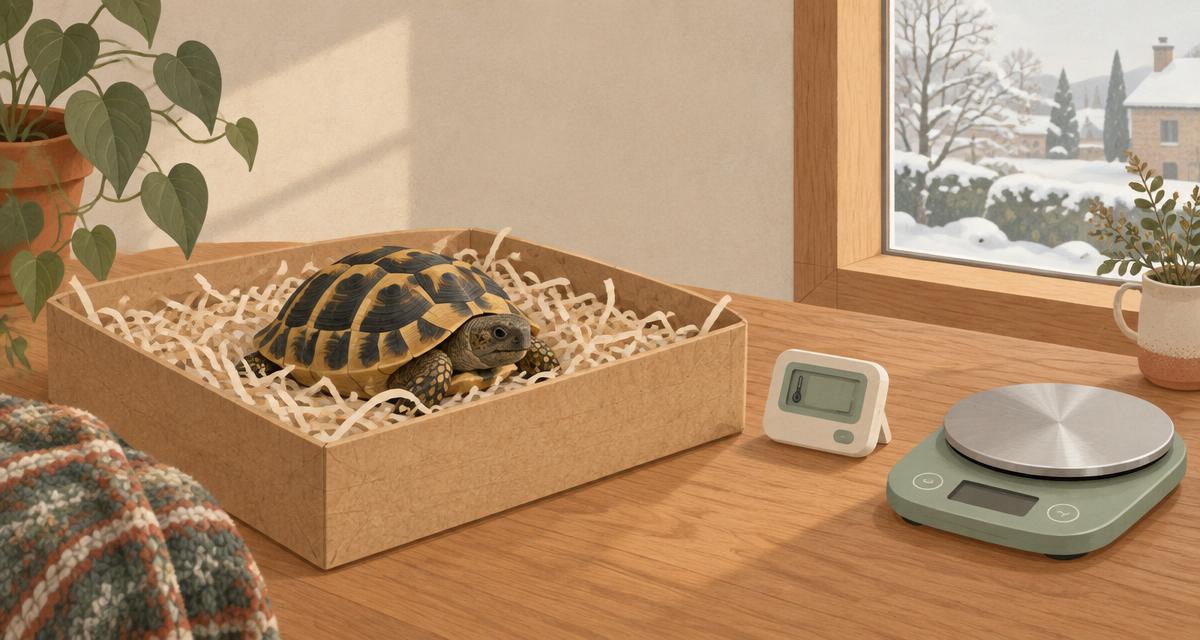
For many tortoise owners, hibernation is simply something that happens in winter. The tortoise slows down, stops eating and goes into a box until spring, much as tortoises have done in British homes for generations. Veterinary advice has moved a long way from that picture. The old image of a tortoise in a shoebox in the attic has been replaced by fridges, thermometers, regular weighing and pre-hibernation vet checks, and vets now differ on whether captive tortoises need to hibernate at all.
The reason for the change is that hibernation carries real risk. A tortoise that is unwell going in, kept too warm or too cold, left in the garden, or allowed to sleep for too long can emerge dehydrated, weakened or not at all. In a 2016 British Veterinary Association survey of vets who had treated tortoises in the previous year, 56% said loss of appetite or weight loss after hibernation was among the problems they saw most often, and 45% believed owners' lack of understanding contributed directly to it.
This guide sets out what the current evidence and veterinary advice say about deciding whether to hibernate, preparing a tortoise, choosing a method, looking after it through the winter and waking it safely, along with the alternative of keeping it awake. It is a guide to the decisions involved, not a substitute for a plan agreed with a vet who has experience of reptiles.
What hibernation is, and why it matters
Strictly speaking, tortoises do not hibernate. Hibernation describes what warm-blooded mammals do, and the reptile equivalent is called brumation, a state of inactivity and reduced metabolism triggered by falling temperatures. Most owners and many vets still call it hibernation, and this guide uses both terms.
In the wild, the species commonly kept in Britain brumate through cold winters in southern Europe and central Asia. Researchers believe it helps them conserve energy at a time of year when there is little to eat, and it may play a part in triggering breeding in spring. The Royal Veterinary College's exotics service notes that hibernation can have advantages even for captive tortoises, slowing growth and allowing natural annual hormonal changes.
The difficulty is that a British winter is not a Mediterranean one. It can be longer, wetter and more erratic, with mild spells that wake tortoises up and cold snaps that drop below freezing. A captive tortoise also depends entirely on its owner to provide the right conditions. That is why the RVC describes hibernation as the time of year most likely to be associated with health problems, including immune suppression, dehydration, freezing and attacks by rodents.
What the research found
Until recently, there was very little UK research on how pet tortoises fare during hibernation. In 2022, researchers at the Royal Veterinary College published the results of a survey of owners in Vet Record, covering 270 Hermann's, spur-thighed and Horsfield's tortoises that had been through at least one hibernation.
Of those 270 tortoises, 21 (7.78%) died during hibernation, and 7.22% of the survivors had problems afterwards, meaning they took more than a week to start eating or showed other signs of ill health. These figures describe the tortoises represented in this survey, not the proportion of all pet tortoises that die during hibernation in a typical year. Most owners in the study used a fridge or chiller (64.7%), with 27% using a box and 8.3% leaving their tortoise to hibernate in the garden.
Three findings stood out. Tortoises hibernated in the garden were about six times more likely to die than those in a fridge, and about five times more likely to have problems afterwards. Tortoises kept without regular temperature monitoring were about three times more likely to die. And tortoises whose temperature dropped in an uncontrolled way before hibernation were about two and a half times more likely to die. When these factors were analysed together, the method of hibernation was the one that independently predicted death. The most common problem owners reported during hibernation was the tortoise's surroundings becoming too warm.
The study does not prove that fridges are safe in themselves. Owners who use fridges may differ from those who leave tortoises in the garden in experience, equipment and care in other ways, and the survey relied on owners' own reports. The researchers note that owners were recruited through tortoise interest groups and online forums, so they were probably better informed than average. Only 11 of the surviving tortoises were taken for a post-hibernation vet check, and only one of those had reported problems, so the true rate of problems may be higher. Species, age, sex and previous illness made no significant difference to survival in this sample. An earlier UK study of imported tortoises in the 1980s, when garden hibernation was the norm, found annual death rates of 23 to 29%, with most deaths linked to hibernation.
Should your tortoise hibernate?
This is the first decision, and it is worth making with your vet rather than by default.
Some species should never be hibernated. The RVC advises against hibernating leopard tortoises, African spurred (sulcata) tortoises, red-footed and yellow-footed tortoises, Egyptian tortoises, southern Turkish spur-thighed tortoises and the North African forms of spur-thighed tortoise, including Libyan and Tunisian types, as well as most terrapins and turtles. Attempting to hibernate a species that does not naturally do so can be fatal.
Species that can usually be hibernated include Hermann's tortoises, Horsfield's (Russian) tortoises, marginated tortoises and many Mediterranean spur-thighed tortoises. Because spur-thighed tortoises from warmer regions should not be hibernated, it is important to be sure of your tortoise's species and origin. If you are not certain, ask your vet.
Some individuals should not be hibernated, whatever their species. The RVC advises against hibernating any tortoise that has had significant health problems in the previous year or is not of sufficient size, and says underweight or unwell tortoises should be kept awake instead. The Tortoise Protection Group advises owners not to attempt hibernation with a tortoise that is less than completely healthy. Advice on young tortoises varies. Some veterinary guidance has suggested waiting until a tortoise's second, third or fourth winter, while the RVC suggests juveniles can be allowed short hibernations of around six weeks. Your vet can advise on your tortoise.
Vets differ on whether it is needed. The British Small Animal Veterinary Association has said there seems to be no evidence that hibernating a captive tortoise in the UK brings additional health benefits, and that keeping a steady temperature in its usual enclosure, with a secure hide if it slows down, is ideal. Others, including the RVC, point to benefits such as slower growth and natural hormonal cycles. Neither position rests on controlled trials, and the long-term effects of never hibernating a species that naturally does so are not well understood. What both sides agree on is that only fit, healthy tortoises should be hibernated, and only with careful preparation.
Before you start: the vet check
The RVC strongly recommends an annual pre-hibernation vet check in the autumn. A vet can weigh and examine your tortoise, look for signs of illness that would make hibernation unsafe, such as nasal discharge, swollen eyes or limbs or changes inside the mouth, and may suggest testing a faecal sample to make sure it is not going into hibernation with a heavy parasite burden. It is also the time to agree a plan, including how long to fast your tortoise, how to cool it, how long it should hibernate for and what to do if something goes wrong.
Weigh your tortoise yourself before hibernation and write the figure down. You will need it as a baseline for weighing through the winter. Use digital scales, and the same scales each time.
Timing
Veterinary organisations have advised delaying hibernation until November or December, keeping tortoises warm with heat lamps through autumn rather than letting them go down early as the weather turns. A hibernation that starts too early is likely to be too long, and the British Veterinary Zoological Society has described hibernating a tortoise for too long as the greatest risk factor for problems afterwards, whatever method is used. An overlong hibernation can drain energy stores and lead to dehydration and a build-up of toxins.
Preparation takes several weeks, so a tortoise starting its wind-down in mid-November would typically be ready to hibernate in December. If you have not started and are unsure, it is not too late to keep your tortoise awake this winter instead.
Winding down
A gradual wind-down matters for two reasons. It mimics the slow decline in temperature and daylight a wild tortoise would experience, and it gives the gut time to empty, so that food left inside does not ferment during hibernation. The RVC study linked uncontrolled cooling before hibernation with a higher risk of death.
What follows is an example of the RVC's approach, not a universal schedule. The right preparation depends on your tortoise's species, size, age, health and how it has been kept, and food withdrawal in particular needs care: a tortoise that is too cool while digesting can have problems, and one fasted for too long uses up reserves it needs. Have a vet with reptile experience confirm the fasting period and cooling plan for your tortoise before you begin.
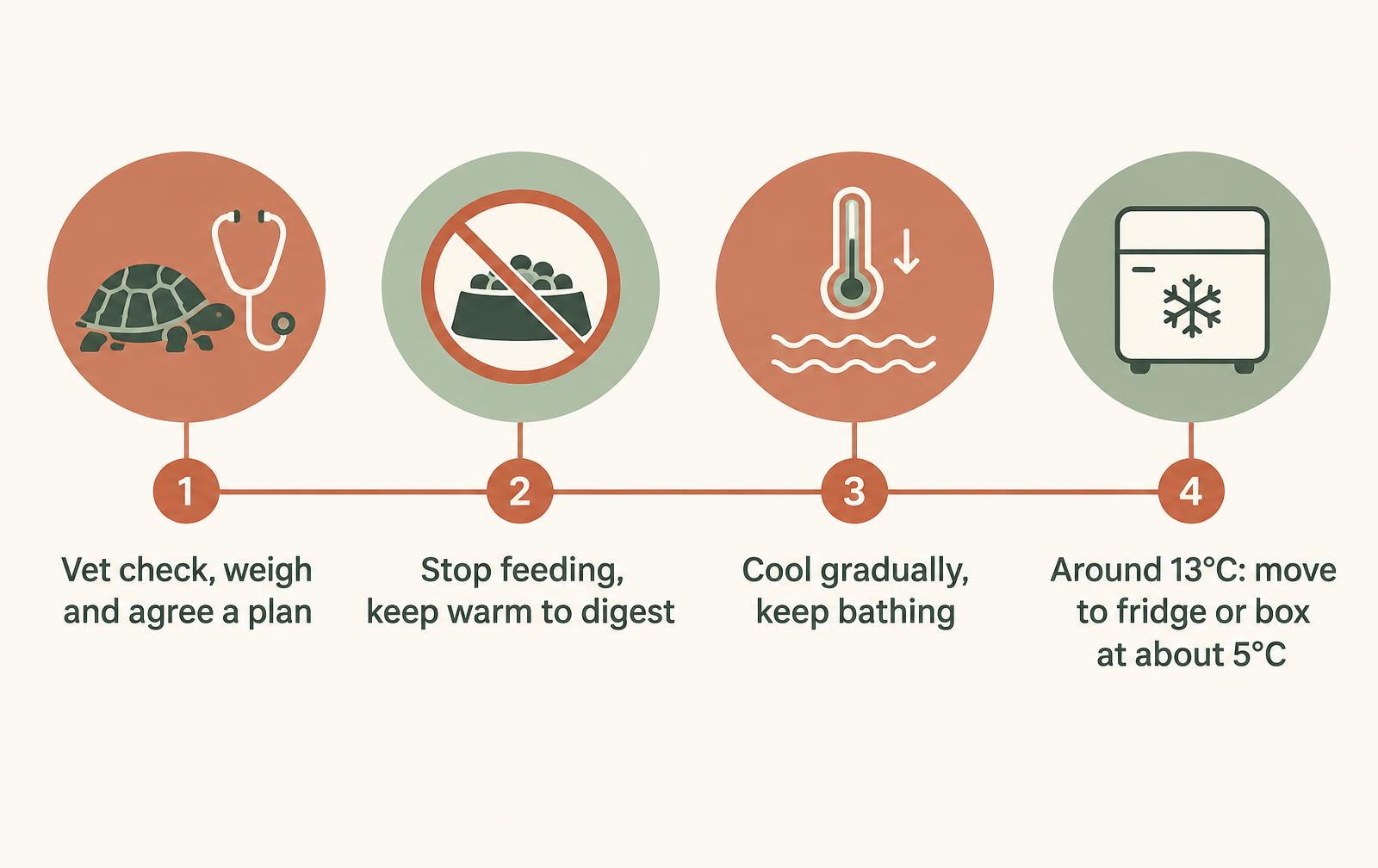
In the RVC's guidance, feeding is stopped but the tortoise is kept warm for the first week, so that it can digest what it has already eaten. After that, temperatures are reduced slowly, by about 5°C a week. For tortoises kept indoors, the RVC gives the example of leaving the basking lamp on for around nine hours a day in the first week, then turning it off for the following three weeks, while slowly lowering any thermostatically controlled heating. Some owners instead give the tortoise increasing time in a cool outbuilding or cold frame during the day, which exposes it to shorter days and lower temperatures, while still bringing it inside overnight.
Throughout the wind-down, the RVC advises bathing your tortoise at least every other day, so that it goes into hibernation with a full bladder, which acts as an important water reserve through the winter. Use shallow, lukewarm water in a container with high sides, keep the water below the tortoise's chin so it can hold its head clear, and stay with it while it bathes. Once the tortoise's body temperature has fallen to around 13°C, it can be moved to its fridge or hibernation box.
Choosing a method
Garden hibernation
Leaving a tortoise to dig in and hibernate in the garden, sometimes called self or natural hibernation, is not advised by the RVC. In the British climate it can lead to an overlong hibernation, and tortoises can be flooded, frozen or attacked by predators. It was by far the riskiest method in the RVC study. It also makes it difficult to tell when a tortoise has stopped hibernating, which delays help if something goes wrong.
The fridge method
Fridge hibernation has become the method most widely recommended by vets, because it allows the temperature to be controlled and the tortoise to be checked easily. The BVZS has described it as a safe and reliable option that avoids some of the hazards of older methods, such as frostbite and injuries from rodents, provided the temperature is stable, correct and regularly monitored.
That condition matters. Never put a tortoise into an untested fridge, or assume that the thermostat setting reflects the temperature where the tortoise will sit. Use an appliance set aside for the purpose rather than a household fridge that is opened throughout the day, run it empty with a thermometer inside for several days first to check it holds a steady temperature, and agree a plan with your vet for power cuts or for the temperature straying too low or too high. A digital thermometer with a temperature alarm is a useful extra safeguard alongside a maximum and minimum thermometer.
The RVC notes some further practical points. Temperatures vary depending on where the tortoise sits in the fridge, with higher shelves slightly warmer, so a thermal probe or digital maximum and minimum thermometer is essential. Fridges also dry the air and have poor ventilation. The RVC suggests opening the door for about 30 seconds each day to let air in and check on the tortoise, and keeping a topped-up bowl of water in the bottom of the fridge to maintain humidity. Glass-fronted chiller cabinets make it easier to see the tortoise and many have fans that help ventilation, but they need careful monitoring, as some may not stay cool enough. Tortoises in a fridge do not need insulating, although many owners provide some substrate so the tortoise can bury itself.
The box method
Box hibernation uses two boxes, one inside the other, for insulation. The RVC suggests a large, rodent-proof wooden box such as a tea chest as the outer box, with small air holes in the sides and wire mesh over both the holes and the top to keep vermin out. The base and sides are lined with thick pads of polystyrene or newspaper. The tortoise goes in a smaller inner box with air holes, filled between a third and three-quarters full with polystyrene chips or shredded newspaper. Hay and straw should be avoided. The inner box needs to be easy to open for checks.
The main weakness of the box method is temperature control, since the box depends on the temperature of the room or outbuilding it is kept in. The Tortoise Protection Group notes that milder winters in recent years have caused problems for many keepers who used boxes, particularly with young tortoises, and that many are now choosing fridges instead. If you use a box, keep a thermometer inside it and check the temperature at least daily.
During hibernation
Keep the temperature steady at around 5°C. The RVC advises keeping hibernating tortoises at about 5°C, within a range of 2 to 9°C. Temperatures below freezing can cause a tortoise to lose its eyesight or die. Temperatures that are too warm are also harmful, because a tortoise that becomes too active uses up its fat and the energy stored in its liver, which it needs when it wakes. Check a maximum and minimum thermometer daily, so you know not just the current temperature but how far it has strayed overnight.
Weigh every one to two weeks, using the same scales and the same method each time, either the tortoise on its own or in its inner box. Veterinary advice is that brief handling to weigh will not disturb hibernation. The RVC describes typical weight loss of around 1% of the pre-hibernation weight a month, so a 1,000g tortoise might lose around 10g in a month, although individual tortoises vary. A sudden drop, a loss that keeps running clearly above that rate, or any other sign that something is wrong warrants prompt veterinary advice. The RVC regards a loss of 8 to 10% as a sign that something is seriously wrong, but that is far more than a tortoise would be expected to lose over a normal hibernation. Do not wait for a loss on that scale before seeking help.
Know when to intervene. If your tortoise passes urine or droppings during hibernation, the RVC advises starting the waking process as soon as possible and having it checked by a vet, as this can mean hibernation is not going normally. Also contact your vet if it is losing weight faster than expected, if the temperature has dropped below freezing or risen well above the recommended range, or if it seems to be waking repeatedly. A tortoise that has woken during a warm spell should not simply be put back without advice.
How long to hibernate
How long a tortoise should hibernate depends on its species, size, age and health. The RVC suggests waking juveniles after around six weeks, and says adults usually hibernate for 8 to 12 weeks, and no more than about three months. The RVC researchers note that 10 to 12 weeks is generally accepted for captive Mediterranean tortoises, and up to 14 weeks for Horsfield's tortoises, which naturally hibernate for longer in the wild. Agree a planned length with your vet before you start, and put the date in your diary.
Waking up
When the planned period is over, the RVC advises moving the tortoise in its box to a safe, light indoor space at around 20 to 25°C and leaving it to warm gradually for a few hours. It should start to stir. Check it for any discharge from the nose, eyes or vent, and gently clean away any dust or discharge from its face with warm water and cotton wool. Its mouth should be pink. A white, fluffy-looking tongue can be a sign of infection and needs a vet.
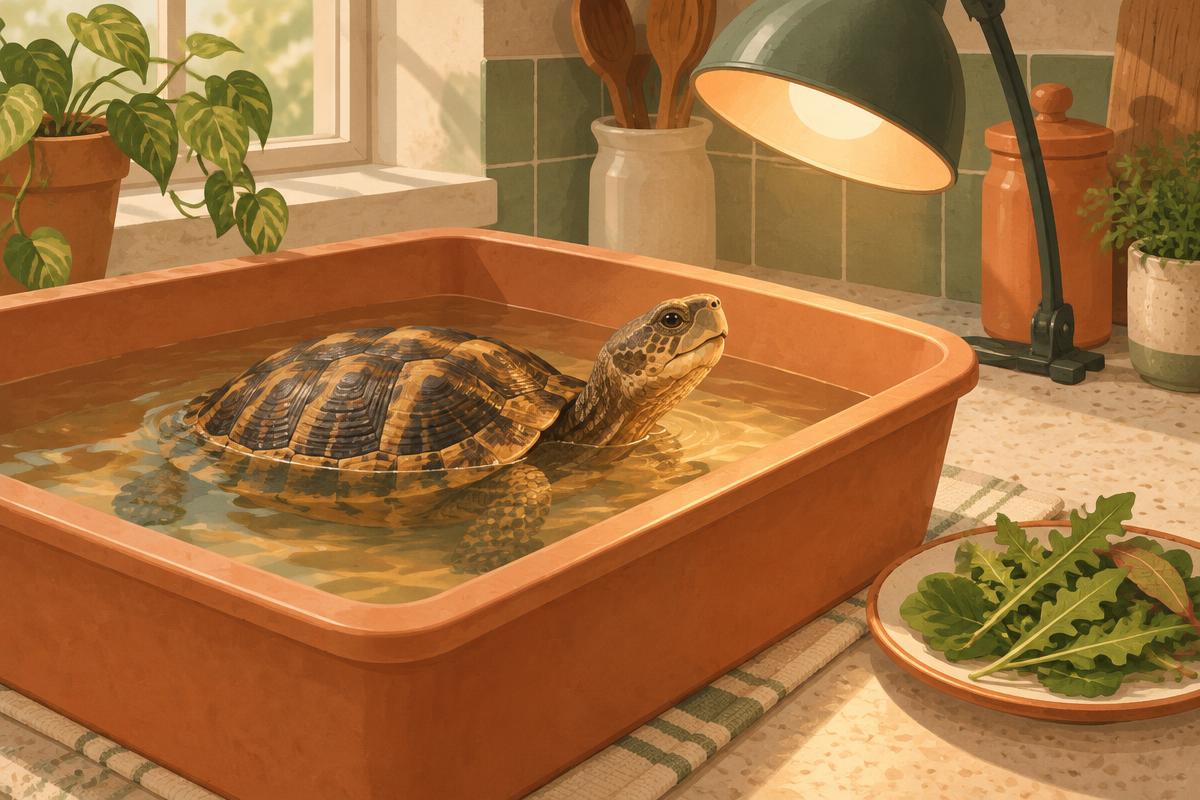
Then give it a warm bath. The RVC suggests a container with high sides and water just below the tortoise's chin, so that it can drink while keeping its head clear, for 20 to 30 minutes twice a day over the first two weeks. Stay with it while it bathes. Bathing encourages the tortoise to drink and to pass urine and droppings, clearing waste that has built up during hibernation, but it is not a treatment for a tortoise that is unwell or seriously dehydrated.
After bathing, move the tortoise to a warm set-up with full-spectrum lighting, raising the temperature slowly over the following week until the basking spot reaches around 32 to 35°C. Once it is warm and hydrated, offer light, leafy foods to begin with before moving back to its normal diet. Keep it indoors until the weather is reliably warm enough to go outside during the day. Weigh it after waking, and contact your vet if it has lost weight.
Once a tortoise is awake and eating, it should stay awake. The RVC warns that warm spells in February that break hibernation are a particular hazard of the British climate, and that a tortoise woken early should be kept active with heating and lighting if the weather turns cold again.
When to see a vet after waking. A tortoise that remains lethargic or weak, seems dehydrated, has difficulty breathing, has cloudy eyes or appears unable to see, or has an abnormal discharge after warming needs prompt veterinary attention. The RVC advises consulting your vet if a tortoise is not active within 24 to 48 hours of being moved somewhere warm, and booking an appointment if it has not eaten or passed urine or droppings within seven days, even if it otherwise seems well. Do not wait seven days if something seems wrong. Post-hibernation loss of appetite is one of the most common reasons tortoises are seen by vets, and it is easier to treat early.
The alternative: keeping your tortoise awake
Overwintering, or keeping a tortoise awake through the winter, is the right choice for species that should not hibernate and for any tortoise that is underweight, unwell or otherwise unsuitable. For many owners it is also a reasonable choice in its own right.
Overwintering is not simply leaving a tortoise indoors. A room that feels warm to a person can be too cool for a tortoise to stay active and digest its food, and a tortoise that slows down in a half-heated room is neither properly awake nor safely hibernating. It needs a properly equipped enclosure with species-appropriate heating, a basking spot and a temperature gradient, UVB lighting, a suitable day length, hydration and good nutrition throughout the winter. Reptiles other than snakes need UV light to make vitamin D3 and absorb calcium, and without it they can develop metabolic bone disease.
The RVC's advice is to keep providing the same heating and lighting as during the rest of the year, to reduce the seasonal cues that encourage a tortoise to slow down. Extra room heating may be needed to keep temperatures within the normal range for the species, and maximum and minimum temperatures should be checked more often than usual, since they are likely to fluctuate in winter. The Tortoise Table advises not letting the room drop below 12 to 15°C at night, which is more likely in an outbuilding than in the house, and providing light as bright as the tortoise would experience outdoors in summer. More frequent bathing can help encourage a tortoise to stay awake, drink and pass urine and droppings.
A tortoise kept awake may need to be fed little and often through the colder months, and brought out each morning to bask and eat under its lamp. Ideally a weed-based diet continues all year round, although shop-bought greens may be needed in winter when wild plants are scarce. Some keepers grow suitable plants in a greenhouse to keep up a year-round supply.
Common mistakes
Hibernating a tortoise that isn't fit. Illness, low weight or a recent health problem all make hibernation riskier. If in doubt, keep it awake.
Starting too early. Letting a tortoise go down in October as the weather cools risks an overlong hibernation. Keep it warm and active until the planned wind-down.
Skipping the wind-down, or following someone else's schedule. Cooling a tortoise suddenly, or hibernating it with food still in its gut, was linked to a higher risk of death in the RVC study. Agree a plan for your own tortoise.
Leaving it in the garden. The riskiest method in the research, exposing tortoises to flooding, freezing and predators.
Trusting an untested fridge or no thermometer. Without measuring the temperature where the tortoise sits, you cannot know whether it is too warm or too cold.
Waiting too long on weight loss. Act on losses clearly faster than about 1% a month, not when a large proportion of the tortoise's weight has gone.
Ignoring urine or droppings during hibernation. This is a sign to start waking the tortoise and get it checked.
Hibernating too long. Agree a length in advance and stick to it.
Waiting too long after waking. A tortoise that isn't active within 24 to 48 hours of warming, or hasn't eaten or passed urine within a week, needs a vet, and one that looks unwell needs a vet sooner.
Half-heating an overwintering tortoise. A tortoise kept awake needs full heating, a basking spot and UVB lighting, not just a warm-ish room.
Try this today
Check your tortoise's species and, if it is a spur-thighed tortoise, whether you know its origin, since some should never be hibernated. If you plan to hibernate it, book a pre-hibernation vet check and agree a plan, weigh it on digital scales and record the figure, and buy a digital maximum and minimum thermometer. If you plan to use a fridge, set it up and run it empty with the thermometer inside for a few days before your tortoise goes in, so you know it holds a steady temperature. If anything about your tortoise's health or your set-up gives you pause, keep it awake this winter instead, with full heating and UVB lighting.
The Bottom Line
Hibernation is part of the natural life of many tortoises, but in captivity in Britain it is also the most dangerous time of their year, and the evidence suggests that much of the risk lies in how it is done. In the only substantial UK study, tortoises hibernated in gardens, cooled suddenly or kept without temperature monitoring fared markedly worse.
If you decide to hibernate your tortoise, start with a vet check and a plan agreed with your vet, wind it down gradually, keep it at a steady 5°C in a tested fridge or well-insulated box with a thermometer you check every day, weigh it regularly and act early on any warning sign, and wake it on time. If your tortoise is not fully healthy, is a species that should not hibernate, or you are not confident in your set-up, keeping it awake through the winter in a properly heated and lit enclosure is a perfectly good alternative.
Guides on Burrow are researched carefully and written to be useful, but they aren't a substitute for veterinary advice. Speak to a vet with experience of reptiles before hibernating your tortoise, and seek veterinary help promptly if your tortoise loses weight faster than expected, passes urine or droppings during hibernation, or seems unwell after waking.
Related reading: The Fireworks Guide · Winter Housing for Rabbits and Guinea Pigs · Does Your Fish Tank Need Different Care in Winter?
Common questions
Frequently asked.
References
Sources.
- Baldrey V, Guezennec L, Hedley J. Risk factors influencing brumation success in captive tortoises in the United Kingdom. Veterinary Record. 2022.
doi.org - Royal Veterinary College Exotics Service. Tortoise hibernation guidelines. Reviewed December 2024.
rvc.ac.uk - Royal Veterinary College. Tortoise post-hibernation checks.
rvc.ac.uk - Royal Veterinary College. Tortoise pre-hibernation health checks.
rvc.ac.uk - British Small Animal Veterinary Association. Vet organisations give advice on tortoise hibernation (BVA, BSAVA and BVZS release, including BVA Voice of the Veterinary Profession survey, Spring 2016). 18 October 2016.
bsava.com - British Small Animal Veterinary Association. Reptile Awareness Day 2023. 21 October 2023.
bsava.com - Tortoise Protection Group. Hibernation.
tortoise-protection-group.org.uk - The Tortoise Table. Overwintering your tortoise.
thetortoisetable.org.uk