Fish & Aquatics · Fish · 24 Jul 2026
White Spot in Goldfish: What It Is and What to Do
By Burrow · 24 Jul 2026
TL;DR
- White spot (ich) is a parasite, not a fungus or an injury. The spots are the parasite feeding under the fish's skin.
- It's usually a stress problem underneath. The parasite is often present in small numbers and only takes hold when fish are weakened, most often by poor water quality or too small a tank.
- You must treat the whole tank, not the fish. If one fish has it, the tank has it.
- The parasite can only be killed at one stage of its life cycle, which is why treatment takes time and repeat doses, and why stopping early fails.
- It can encrust the gills with no visible spots at all. A goldfish gasping at the surface with no spots may still have it.
- Act fast. Caught early it's very treatable; left alone it's frequently fatal.
A scattering of white grains on the fins looks alarming, and it is. But it's also usually telling you something about the tank, not just the fish.
White spot is probably the most common disease in home aquariums, and one of the most treatable if it's caught early. It's also badly served by the advice available: most of what's written about it is aimed at tropical fishkeepers, and goldfish are cold-water fish with rather different needs. Follow tropical guidance too literally and you can stress a goldfish considerably while trying to cure it.
Here's what white spot actually is, how to recognise it, including the version that shows no spots at all, and how to think about treating it sensibly.
What white spot actually is
White spot, also called ich or ick, is caused by a microscopic parasite, Ichthyophthirius multifiliis. Despite appearances, the spots aren't fungus, growths, or grains of anything stuck to the fish. Each one is a parasite that has burrowed into the skin and is feeding on the fish's tissue and body fluids, with the fish's own skin cells swelling around it, which is what makes the characteristic white cyst.
They look like someone has sprinkled salt or fine sugar over the fish, usually starting on the fins and spreading across the body. Each spot is around a millimetre across, so they're visible to the naked eye, and easier to spot on darker fish or against the fins of pale ones.
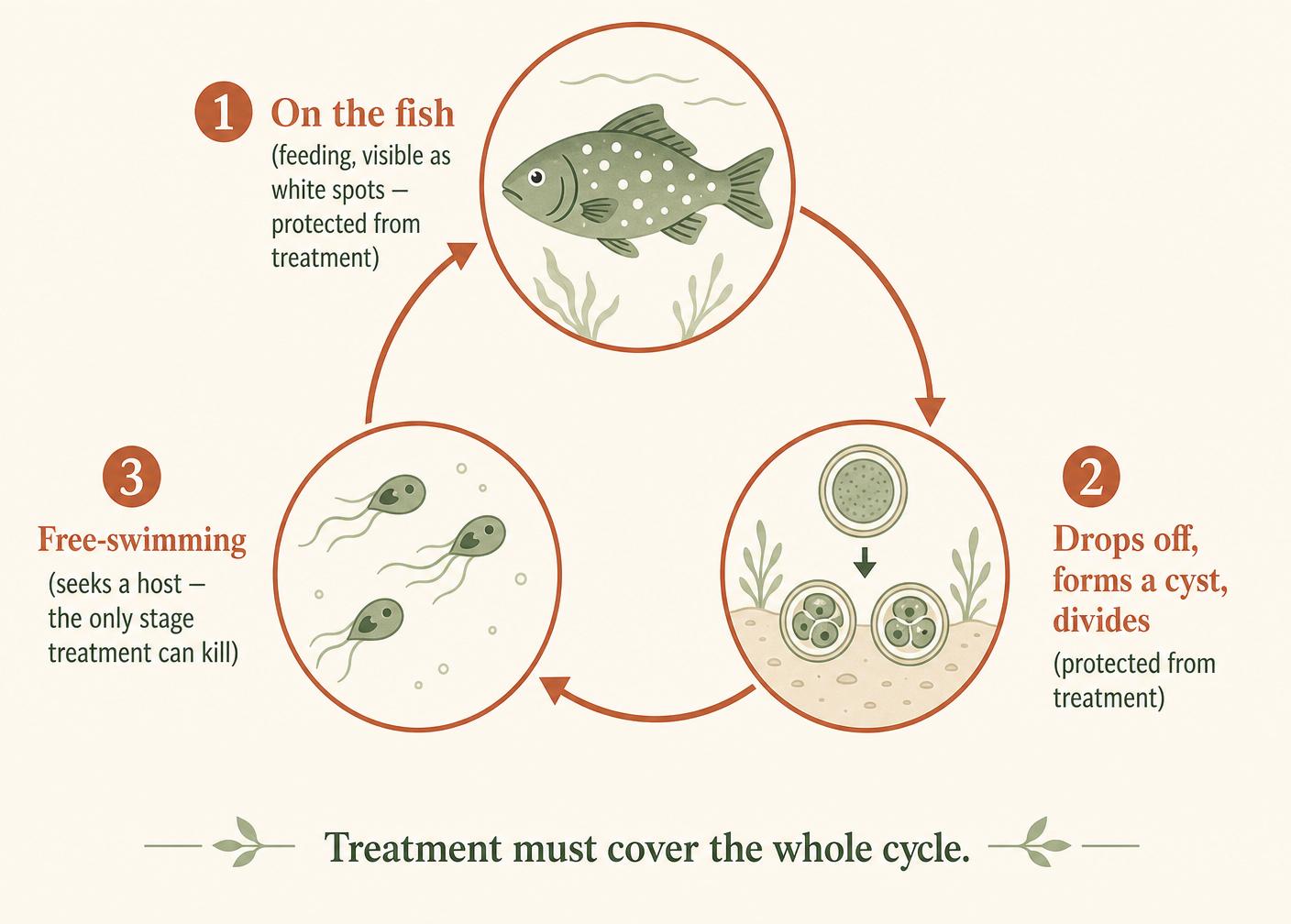
The important thing to understand is the life cycle, because it dictates everything about treatment. The parasite feeds on the fish, then drops off, encysts on the gravel or the glass, and divides into hundreds of new parasites, which are released to swim free and find a host within a couple of days. Crucially, the parasite can only be killed by treatment during that free-swimming stage. While it's embedded in the fish, it's protected, and while it's encysted, it's protected too. That's why treatment must continue over a period covering the whole cycle, and why stopping as soon as the spots vanish is the classic mistake that lets it come straight back.
The cycle runs faster in warmer water and slower in cold, so in a goldfish tank it can take a week or more, which means patience is part of the cure.
Why it happened
Here's the part most guides skip, and the part that matters most.
White spot rarely arrives from nowhere. The parasite is often present in small numbers in an established aquarium, kept in check by the fish's own immune system, and it only overwhelms them when something has weakened the fish. Almost always, that something is stress, and in goldfish tanks the usual culprit is water quality.
Goldfish are messy. They produce a great deal of waste for their size, and they're very often kept in tanks that are too small, under-filtered, or infrequently cleaned. The result is rising ammonia and nitrite, which damages gills and suppresses the immune system, and a fish in that state is exactly what the parasite is waiting for. Other common stressors include sudden temperature swings, overcrowding, bullying, and the arrival of a new fish that wasn't quarantined, which is the other classic route by which ich enters a tank.
So while you should absolutely treat the outbreak, the more useful question is what let it take hold. An outbreak of white spot in a goldfish tank is very often the tank telling you it isn't big enough, clean enough, or well enough filtered. Treat the parasite and change nothing else, and it tends to return.
The signs, including the one people miss
The obvious sign is the spots themselves, but the behavioural signs often come first, and there's one presentation with no spots at all.
Look for:
- Tiny white spots like salt grains, on the fins first, then across the body
- Flashing — the fish rubbing or scraping itself against gravel, ornaments or the glass, trying to dislodge the irritation
- Clamped fins, held tight against the body rather than open
- Lethargy, hanging listlessly or isolating itself
- Rapid or laboured breathing, or hanging at the surface or near the filter outflow where oxygen is highest
That last one deserves particular attention. White spot can completely encrust a fish's gills without producing a single visible spot on the body or fins. A goldfish that's breathing heavily, gasping at the surface, and behaving oddly, but looks otherwise unmarked, may well have gill ich. It's frequently missed for exactly that reason, and because the gills are where the real damage is done, it's the more dangerous presentation. Don't rule white spot out just because you can't see any.
Treating it: the principles
We're deliberately not going to give you doses and temperatures here, and it's worth explaining why. Much of the advice online, including the standard "raise the temperature to 28–30°C to speed the life cycle," is written for tropical aquariums. Goldfish are cold-water fish. Heating them that far is stressful in itself, and warm water holds less oxygen, which is precisely what a fish with damaged gills can least afford. Salt doses and medication strengths vary by product and by what else is in your tank. Getting those numbers slightly wrong can do more harm than the parasite.
So the sensible approach is to follow the principles, and take the specifics from a proper aquatic treatment or an expert who can see your tank.
Treat the whole tank, not the fish. If one fish has visible spots, the parasite is in the water and on the substrate, and every fish is exposed. Removing the affected fish to a bucket solves nothing.
Use a proper white spot treatment and follow its instructions exactly. UK aquatic retailers sell licensed treatments designed for this, and they come with dosing instructions matched to tank volume. Follow the repeat-dose schedule precisely, because that's what covers the life cycle.
Remove activated carbon from your filter first. Carbon absorbs medication and will strip the treatment straight back out of the water. This step is missed constantly, and it's why treatments "don't work."
Keep treating after the spots disappear. The visible spots vanishing means the parasites have dropped off to reproduce, not that they're gone. Completing the full course is what breaks the cycle.
Improve the water while you treat. Regular partial water changes (following your treatment's guidance on redosing) reduce free-swimming parasites and ease the stress on the fish, and good aeration helps a fish with compromised gills.
Ask an aquatic specialist if you're unsure. A good aquatic shop will advise on the right product for your setup, and for a valued or badly affected fish, vets with fish experience do exist. The Ornamental Aquatic Trade Association (OATA) publishes accessible guidance on ich and other common problems.
Preventing the next outbreak
Because white spot is usually opportunistic, prevention is mostly about not giving it the opening.
Quarantine new fish before adding them to an established tank. This is the single most effective preventive measure and the one most often skipped. New arrivals are the commonest way ich enters a healthy aquarium.
Get the tank right. Goldfish need far more space and filtration than they're usually given. An adequately sized, well-filtered, well-maintained tank is the foundation of a fish's immune health, and the reason some tanks never see an outbreak while others get them repeatedly. The RSPCA's guidance on keeping fish is a good starting point for what "adequate" really means.
Test your water, and change it regularly. Ammonia and nitrite should be zero. A test kit is inexpensive and tells you what the fish can't.
Avoid sudden changes in temperature or water chemistry, and don't overcrowd. If you're new to keeping fish while juggling other pets, our note on how long you can leave a pet alone covers the maintenance rhythm that keeps tanks stable.
The bottom line
White spot is a parasite, it's common, and it's very treatable if you catch it early and see the course through. Treat the whole tank rather than the fish, take your doses from a proper aquatic treatment rather than the internet, remember to pull the carbon out of the filter, and keep going after the spots disappear.
But treat the cause as well as the outbreak. In goldfish, white spot is usually opportunistic, and it takes hold because something has weakened the fish, most often a tank that's too small, too dirty, or too lightly filtered for animals that produce as much waste as goldfish do. Fix that, quarantine new arrivals, and you may never see it again. The same underlying principle — get the environment right and most problems don't get a foothold — runs through our Hamster Care guide too.
This is general information, not veterinary advice. Fish medications vary in strength and suitability, so always follow the instructions on a licensed aquatic treatment and seek advice from an aquatic specialist or a vet with fish experience, particularly if fish are struggling to breathe.
Common questions
Frequently asked.
Keep reading
Further reading.
Want plain-English notes on pet health and the things that affect it? Join The Once-Over, our weekly note from Hazel.