Fish & Aquatics · Fish · 16 Oct 2026
Are Your Aquarium Fish Stressed? How to Tell
By Burrow · 16 Oct 2026
TL;DR
- **Check the water early.** The Merck Veterinary Manual describes poor water quality as the most common cause of environmentally induced disease in fish, which makes a water test a sensible first step whenever fish seem unwell.
- **Two water problems kill most directly.** Merck names low dissolved oxygen and high ammonia as the two water-quality problems most likely to kill fish directly.
- **Behaviour changes are the early signs.** Gasping at the surface, scratching against objects, loss of appetite, drooping fins and leaving the shoal are all worth acting on.
- **Some "stress signs" are normal for some fish.** Gouramis and other labyrinth fish breathe at the surface, and some catfish swim upside down.
- **Several fish gasping at once is urgent.** Check the filter and aeration and test the water straight away.
- **New tanks are a high-risk period.** The filter bacteria that remove ammonia take weeks to establish, so the safest approach is to cycle the tank before adding fish.
- **Group size matters for shoaling species.** In a controlled study, neon tetras and white cloud mountain minnows showed less aggression and darting in larger groups.
A fish that stops eating, leaves its shoal or starts gasping at the surface may be giving an early warning that something is wrong. Knowing what is normal for its species, and testing the water promptly, gives you the best chance of acting in time.
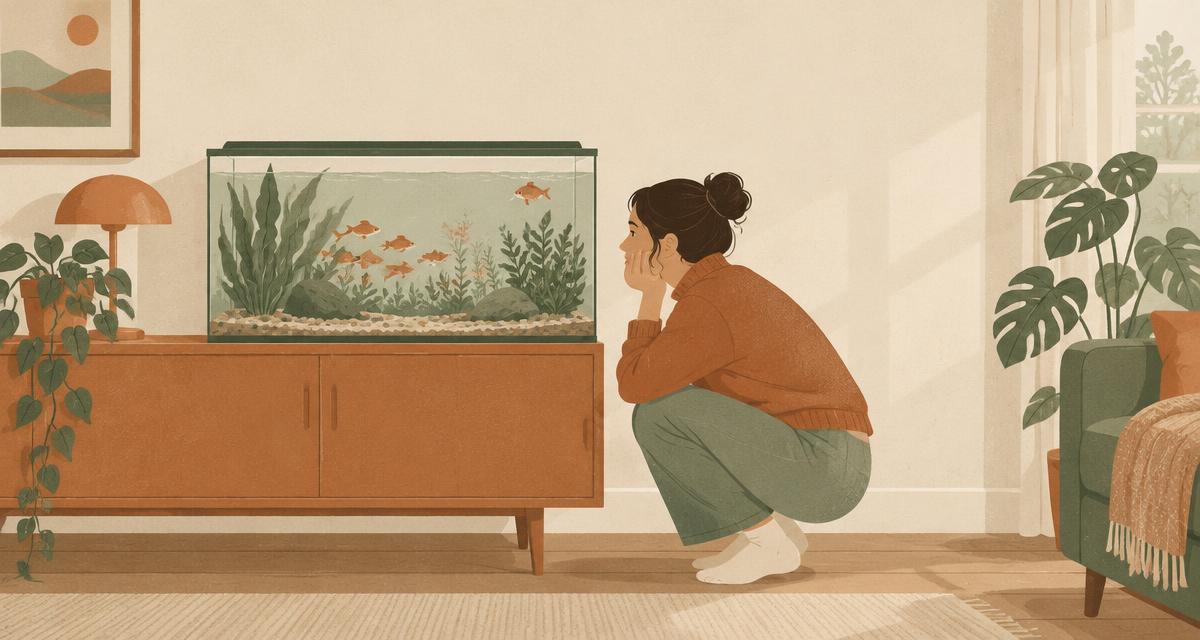
Fish are easy to overlook. They don't vocalise and they can't come to you, so their early signals are easy to miss or to mistake for normal behaviour. Fish welfare is also less well studied than that of most pets. A 2026 review in the Journal of Fish Biology notes increasing attention to fish welfare across aquaria, research, farming and fisheries, and describes how welfare can be assessed through both outcome-based measures, such as a fish's behaviour and condition, and input-based measures, such as the water it lives in. For a home aquarium, that translates into two habits: watching your fish closely, and testing the water regularly.
Start with the water
In a home aquarium, fish live in a small, closed volume of water that holds everything they excrete. The Merck Veterinary Manual describes poor water quality as the most common cause of environmentally induced disease in fish, and identifies low dissolved oxygen and high ammonia as the two water-quality problems most likely to kill fish directly. Its pet owner chapter lists stress, poor water quality, overcrowding and failure to quarantine new or sick fish as the causes behind many of the disorders seen in pet fish.
Fish excrete ammonia across their gills. In an established aquarium, bacteria in the filter convert that ammonia to nitrite and then to nitrate, which is far less toxic and is removed by regular partial water changes and live plants. These are Merck's veterinary reference values for routine testing of a freshwater aquarium:
| What to test | Merck reference value (freshwater) |
|---|---|
| Ammonia | 0 mg/L |
| Nitrite | 0 mg/L |
| Nitrate | Below 20 mg/L |
| pH | 6.5 to 9.0 |
| Chlorine and chloramine | 0 mg/L |
Individual species have their own preferred ranges, particularly for pH, so check the needs of the fish you keep. Ammonia readings also need interpreting with care. Most aquarium kits measure total ammonia, which includes both the more toxic un-ionised form and the less toxic ammonium form. Merck explains that the toxic form makes up a larger share as pH and temperature rise, with pH having the bigger effect, so the same reading can mean a different level of danger in different tanks. Zero remains the target in an established aquarium, but any detectable result should be read alongside pH and temperature.
Merck adds that many pet shops have limited water-testing capabilities and use less accurate tests, and recommends that keepers buy and use their own test kits. Keeping a simple log of your results makes it much easier to spot a change.
The signs to look for
The RSPCA's checklist for a healthy fish is a useful baseline. A healthy fish eats quickly and enthusiastically, breathes with gills rising and falling rhythmically, is active, alert and sociable, has bright, clear eyes, holds its fins away from its body, not drooping or folded, swims freely and evenly, and has smooth scales with no sign of injury.
Changes from that baseline are what matter. These are the ones most worth acting on:
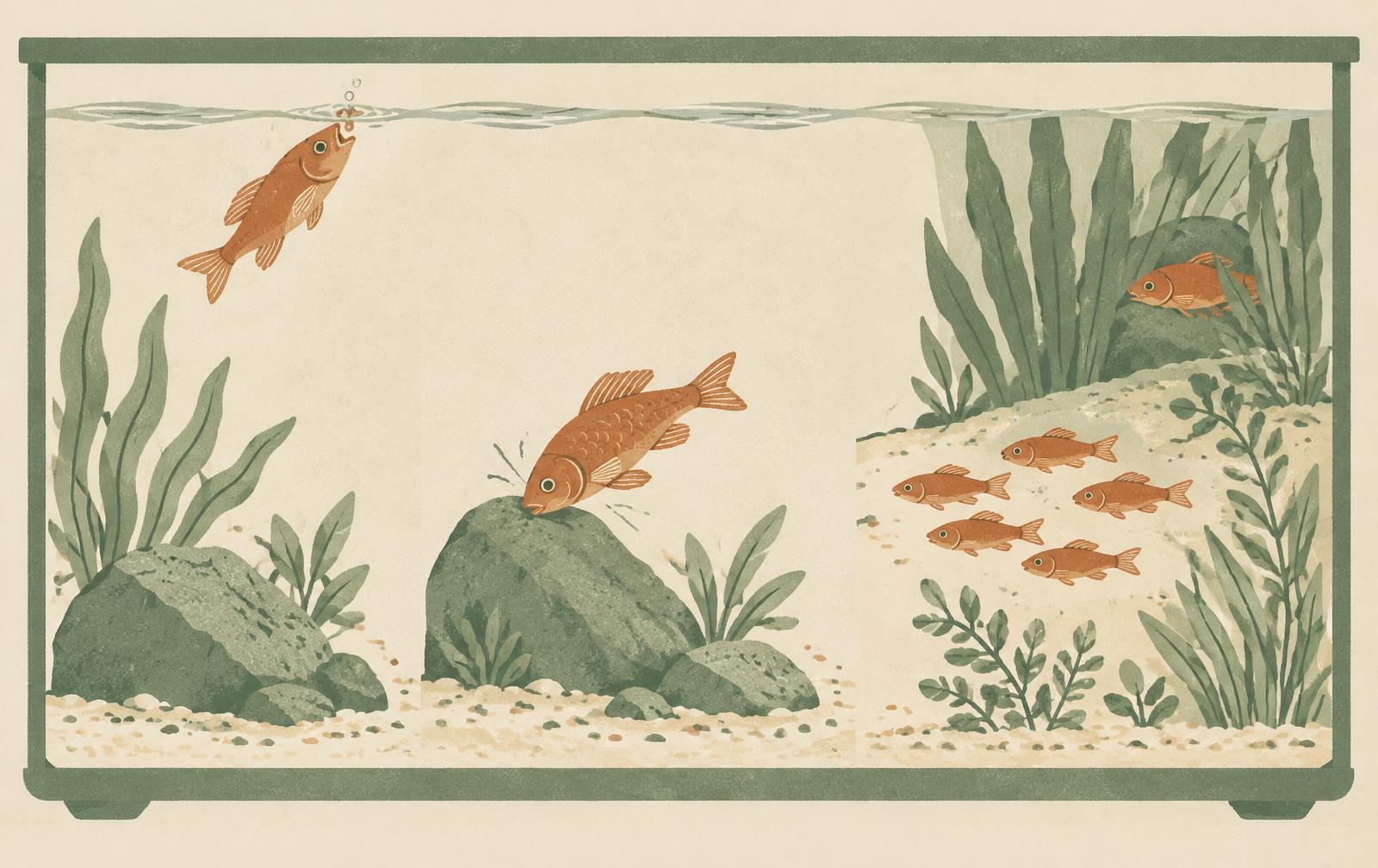
Gasping at the surface. A fish that continuously gulps at the surface may be short of oxygen, and the RSPCA lists this as a sign of oxygen starvation or poor water quality. Merck calls it "piping" and lists low dissolved oxygen, high nitrite and gill disease as the main possible causes. Fish crowding near the surface or near the filter outflow can be a sign of the same thing.
Rubbing or scratching against objects. Fish that dart and rub against rocks, gravel or decorations, sometimes called flashing, may be irritated by parasites on the skin or gills. Merck lists flashing among the signs of several common skin and gill parasites.
Off food or slower to feed. A loss of appetite is one of the most common early signs that something is wrong, and Merck lists poor appetite among the signs of ammonia exposure.
Lethargy, or spinning and erratic swimming. Merck describes fish exposed to ammonia as lethargic and off their food, and notes that severe ammonia poisoning can cause spinning, disorientation and convulsions.
Drooping or folded fins, and changes in colour. Fins held close to the body instead of spread are on the RSPCA's list of signs to watch. A dull colour, pale patches or extra mucus on the skin can point to parasites or poor water.
Leaving the shoal or hiding more. The RSPCA notes that a fish that leaves the rest of its shoal may be sick. A sudden increase in hiding, or a fish that has stopped coming out at feeding time, is worth checking too.
When several fish are gasping
If several fish are suddenly gasping at the surface, treat it as urgent. Check straight away that the filter, heater and any air pump are working, increase aeration if you can, and test the water immediately for ammonia, nitrite, pH and temperature. If ammonia or nitrite is high, or you suspect something has contaminated the tank, a partial water change with dechlorinated, temperature-matched water is usually the quickest way to bring levels down. Merck recommends a change of at least 50% as soon as high ammonia is found. There is one important exception. If total ammonia is very high and the water is acidic, which can happen in a tank that has been topped up for a long time without proper water changes, Merck warns that a large water change can raise the pH quickly and turn the ammonia into its more toxic form. In that situation, get specialist advice before making a big change. If fish do not improve once the water is corrected, contact a vet with fish experience.
When "stress signs" are normal
Not every unusual behaviour is a problem, and knowing your species makes a big difference. The RSPCA points out that gouramis and other labyrinth fish naturally breathe air from the surface, so surface visits are not a warning sign in these species, and that some catfish swim upside down quite normally. Many catfish and loaches are nocturnal and spend daylight hours hidden, while bottom-dwelling species naturally rest on the substrate.
The useful question is whether the behaviour is new or different for that fish. A betta that always rests on a leaf near the surface is behaving normally. A tetra that has stopped shoaling and sits alone in a corner is not.
The new tank problem
The first weeks of a new aquarium are the riskiest. Merck describes "new tank syndrome" as a build-up of ammonia, followed by nitrite, that happens when fish are added before the filter bacteria have become established. It typically appears in the first two to three weeks, and Merck notes that a new filter usually takes around six weeks to become fully established, although cycling times vary with temperature, pH, the filter and the method used. Merck also notes that beginners are prone to overstocking and overfeeding new tanks, which makes the spikes worse.
The safest approach is to establish the filter before any fish go in. Merck describes the methods keepers use: adding commercially available nitrifying bacteria from a reputable source, or "feeding" the bacteria with fish food or ammonium chloride before fish are added, often called fishless cycling. Once ammonia and nitrite have peaked and fallen to zero and nitrate has started to rise, the filter is working. Even then, add fish a few at a time, feed sparingly, and keep testing as the stock builds up.
Hidden water problems
Three less obvious problems catch out experienced keepers too.
Chlorine and chloramine. Tap water in the UK is treated with chlorine or chloramine, and Merck notes both are highly toxic to fish. It also describes chronic low-level chlorine exposure as a surprisingly frequent problem even for experienced aquarists, with signs that include ragged fins, excess mucus, cloudy eyes and lethargy. Always treat new water with a dechlorinator suitable for chloramine, and follow the dose for your tank's volume.
Topping up without changing water. Merck describes "old tank syndrome", where an aquarium that is only ever topped up to replace evaporation, with no old water removed, gradually loses its buffering capacity. The pH can then crash, killing the filter bacteria and causing a sudden rise in ammonia. Regular partial water changes, removing old water and replacing it, prevent this.
Temperature swings. Merck notes that sudden temperature changes of even a few degrees can compromise a fish's immune system, and the RSPCA adds that tropical fish in water that is too cold swim slowly, while water that is too hot holds less oxygen. A reliable heater and thermometer, checked daily, are basic equipment.
Company and space
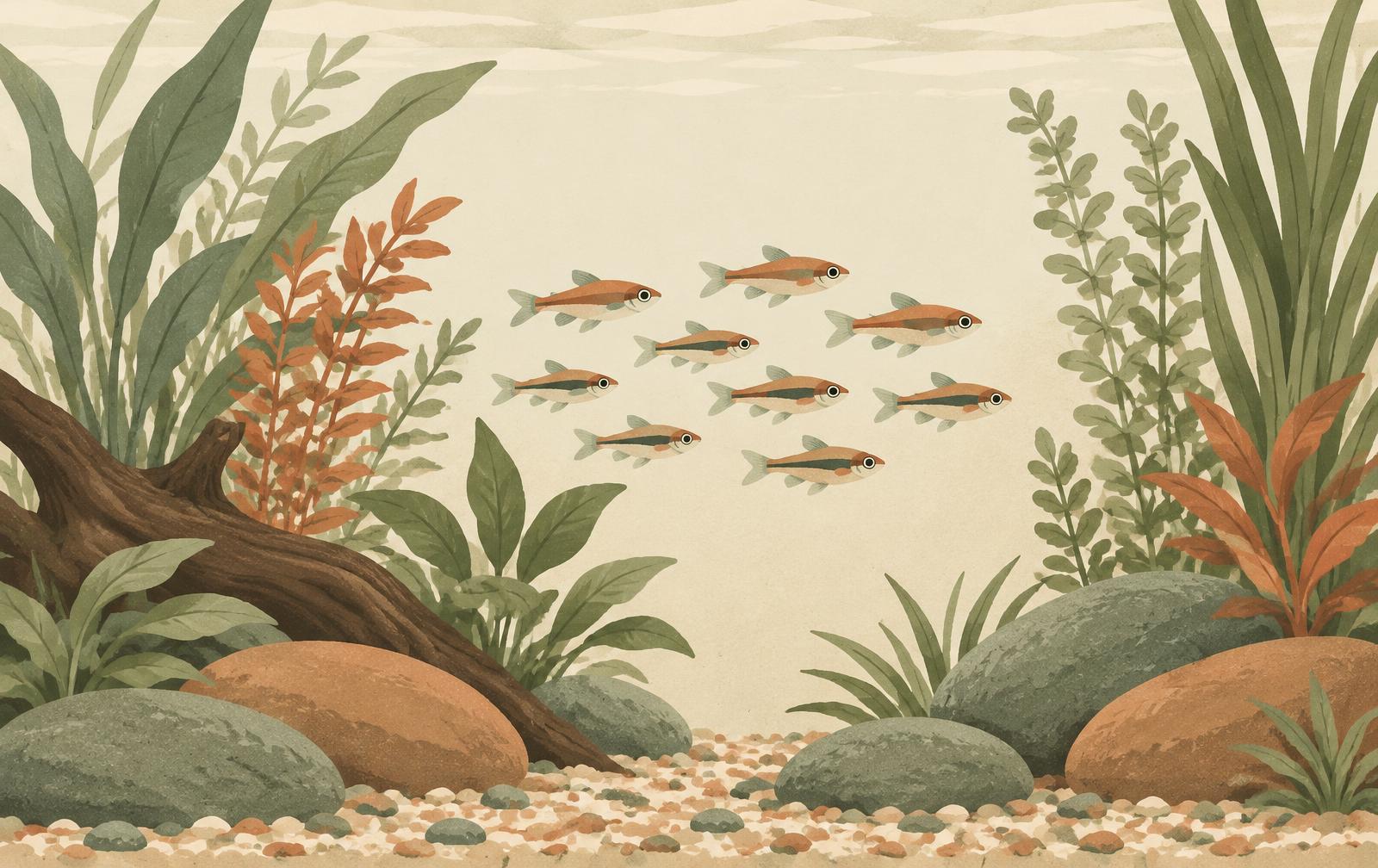
Stress is not only chemical. A controlled study published in Applied Animal Behaviour Science tested how group size affected four species commonly kept in home aquaria. Neon tetras and white cloud mountain minnows showed less aggression and less darting, and spent more time shoaling, in larger groups. Larger groups also improved the welfare measures for tiger barbs, but there was no clear link between group size and welfare in angelfish. The authors concluded that the effect of group size is species-specific, which is the practical lesson: shoaling species need to be kept in groups, while other species, such as male bettas, should not be kept together.
Good water quality does not automatically mean good welfare. Fish also need enough space, suitable companions and places to shelter. Keeping too many fish increases waste, but it can also create social pressures, such as competition and harassment, that no water test will detect. Our earlier piece on fish enrichment covers what else a well-planned tank can offer.
What to do if you are worried
The RSPCA's advice is to check water quality first, because many common fish health problems are linked to poor water. Test ammonia, nitrite, nitrate, pH and temperature, and compare the results with your log. If anything is out of range, correct the water before reaching for a medication, because treating a fish without fixing its environment rarely works, and some treatments can stress fish or damage filter bacteria further.
If the water is fine and the signs persist, look at the social side too: a bullied fish, an incompatible tank mate or a shoal that is too small. If fish are still unwell, or are dying, contact a vet with an interest in fish. The RSPCA recommends a specialist fish vet for diagnosis and treatment. Many fish diseases, including parasites and bacterial infections, can only be confirmed by examining skin or gill samples under a microscope.
Try this today
Spend five minutes watching your tank at feeding time, at your fish's eye level. Check that every fish comes out to eat, that fins are spread, that breathing looks steady and that no fish is hanging at the surface or sitting apart. Then test the water for ammonia, nitrite, nitrate, pH and temperature with your own kit, and write the results down with the date. Next time something looks wrong, you will have a baseline to compare it with.
The Bottom Line
Stress in aquarium fish often shows up first in behaviour: gasping, flashing, lost appetite, folded fins or a fish that leaves its shoal. Some of those behaviours are normal for particular species, so knowing your fish matters. Water quality is the first thing to check, especially ammonia, nitrite, oxygen and chlorine, and several fish gasping at once needs action straight away. But clean water is not the whole story: shoaling fish need company, all fish need space and shelter, and a tank can test perfectly while its fish are still under social pressure. Test regularly with your own kit, keep a record, and change water properly instead of just topping up.
This article is for general information and does not replace veterinary advice. If several fish are gasping, or fish are unwell or dying, act quickly and contact a vet with experience in fish.
Common questions
Frequently asked.
References
Sources.
- Fish welfare in a changing world: new developments and current challenges. Journal of Fish Biology. 2026. Fisheries Society of the British Isles briefing paper.
https://doi.org/10.1111/jfb.70423 - Francis-Floyd R, Petty BD. Disorders and Diseases of Fish. Merck Veterinary Manual (pet owner version). Last updated April 2026.
https://www.merckvetmanual.com/all-other-pets/fish/disorders-and-diseases-of-fish - Francis-Floyd R, Yanong RPE, Petty BD. Environmental Diseases of Aquatic Animals in Aquatic Systems. Merck Veterinary Manual (professional version). Last updated June 2026.
https://www.merckvetmanual.com/exotic-and-laboratory-animals/aquatic-systems/environmental-diseases-of-aquatic-animals-in-aquatic-systems - RSPCA. Fish health and welfare.
https://www.rspca.org.uk/adviceandwelfare/pets/fish/health - Saxby A, Adams L, Snellgrove D, Wilson RW, Sloman KA. The effect of group size on the behaviour and welfare of four fish species commonly kept in home aquaria. Applied Animal Behaviour Science. 2010;125(3–4):195–205.
https://doi.org/10.1016/j.applanim.2010.04.008
Keep reading
Further reading.
Want plain-English notes on pet health and the research behind it? Join The Once-Over, our weekly note from Hazel.