Fish & Aquatics · Fish · 14 Aug 2026
Do Fish Get Bored? What the Science Says About Fish Enrichment
By Burrow · 14 Aug 2026
TL;DR
- Fish are considerably more cognitively capable than their reputation suggests. Goldfish have spatial memory lasting months. Archerfish recognise individual human faces. Several species can solve problems and learn from each other.
- Understimulation produces measurable stress responses in fish. A 2025 global synthesis found environmental enrichment significantly reduces stress markers across multiple species.
- "Boredom" in fish isn't identical to human boredom — but the welfare consequences of an unstimulating environment are real and well-documented.
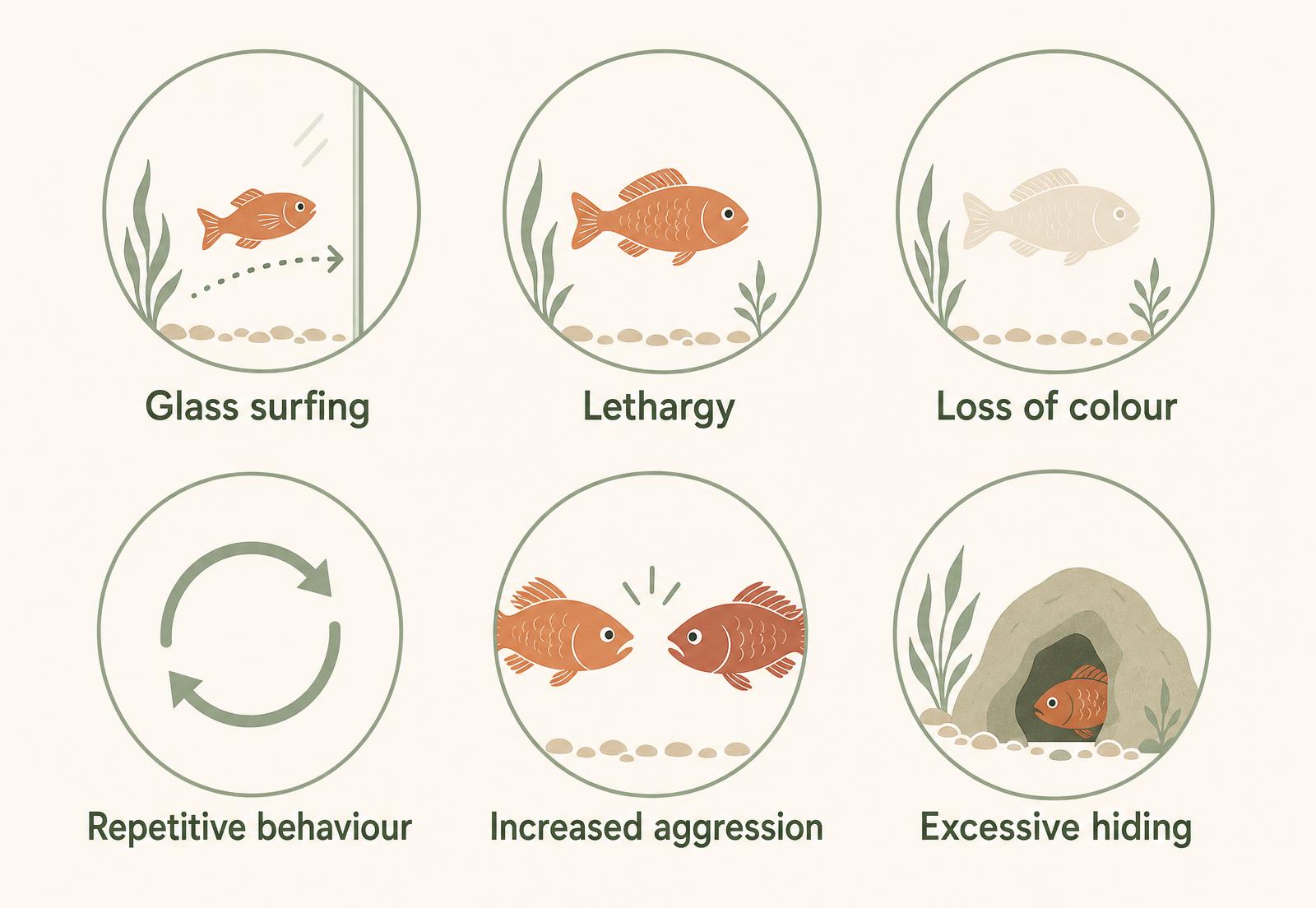
- The signs are recognisable: glass surfing, lethargy, loss of colour, repetitive swimming patterns, increased aggression, excessive hiding.
- Live plants are the single most effective enrichment addition for most home aquariums. Everything else builds from there.
- Most enrichment costs nothing beyond some thought about how the tank is set up and how feeding is done.
The three-second memory myth is wrong. It's also been used to justify keeping fish in conditions that no longer hold up to scrutiny.
Few beliefs about fish are more persistent than the idea that they have a memory of around three seconds and therefore can't really suffer from a dull environment. Swim around the bowl, forget the bowl, swim around the bowl again. If it's all new every few seconds, nothing can be truly boring.
It isn't true. Goldfish can navigate mazes they were trained in months earlier. Archerfish can identify 44 individual human faces. Various fish species learn routines, form associations, demonstrate problem-solving and adapt to changing conditions in ways that require real memory and cognitive engagement. The three-second myth is a convenient fiction — and it's had real welfare consequences, because it gave people a reason not to worry too much about the environment they were keeping their fish in.
What the science actually shows is more interesting, and more demanding.
What fish can actually do
The case for fish enrichment starts with what fish are actually capable of, because the justification for bare, featureless environments usually rests on the assumption that cognitive simplicity means cognitive needs don't matter.
That assumption doesn't hold up.
Goldfish, trained to navigate a maze, remember the correct route for months after training ends. Several species demonstrate spatial memory using both egocentric cues (their own position) and environmental landmarks — the same cognitive tools mammals use. Cleaner wrasses demonstrate apparent self-recognition in mirror tests. Cichlids trained to discriminate between stimuli show flexible learning: they can adapt when the rules change, which requires a level of cognitive flexibility that wasn't expected of fish until relatively recently.
The example that tends to make the strongest impression on people unfamiliar with fish cognition is archerfish — the species that spits jets of water to knock insects from branches above the surface. Archerfish can reliably identify and distinguish between 44 different human faces. Face recognition is a cognitively demanding task. It's not a reflex; it's a learned discrimination that requires both memory and the ability to generalise across varying conditions of light, angle and expression.
None of this means fish experience the world the way a dog or a person does. The cognitive architecture is very different. But it does mean there is something going on, and that an environment that provides nothing to engage with is not meeting the animal's behavioural needs.
What the welfare research says
Fish welfare science has been slower to develop than mammal welfare science, partly because the assumption of cognitive simplicity made it seem less urgent. That's changing.
A 2025 global synthesis of research on environmental enrichment in fish — drawing on multiple species and experimental designs — found that enrichment produced statistically significant reductions in stress markers across the studies reviewed. A separate review on cognitive enrichment in aquaculture settings explicitly named boredom as a welfare concern, stating that cognitive enrichments must be calibrated carefully: stimulation that's too low risks boredom; too high risks chronic stress. The positioning of boredom as a genuine welfare concern in peer-reviewed fish welfare literature is relatively recent, and it matters.
The word "boredom" applied to fish needs some qualification. Fish almost certainly don't experience boredom the way a person waiting for a bus does — the subjective experience of time passing slowly, the awareness of wanting something different. What they do experience is the behavioural and physiological consequences of insufficient environmental complexity: stereotypic movement, elevated stress hormones, reduced immune function, increased aggression, and a general deterioration in the quality of what a fish's life looks like under observation. Whether we call that boredom or something else is partly a semantic question. Whether it matters is not.
The signs of an understimulated fish
These are the behaviours most commonly associated with fish that aren't getting sufficient environmental engagement. They can also indicate illness or poor water quality — and water quality should always be checked first. But in a tank with clean, stable water and fish still showing these signs, understimulation is worth considering.
Glass surfing. Swimming repeatedly along the same stretch of glass, usually vertically or in tight repetitive patterns. This is one of the most recognisable signs and one of the most commonly misread as "normal fish behaviour."
Lethargy. A fish that hovers in one spot, doesn't respond to activity at the surface, or shows no interest in exploring the tank. Some species are naturally calmer than others, so baseline matters — a change from the individual fish's normal is more telling than any absolute standard.
Loss of colour. Many fish show dulled or faded colouration when chronically stressed. The same species in a well-enriched, appropriate environment often shows considerably more vivid colour than the same species in a bare tank.
Repetitive behaviours. Any stereotypic movement — the same circuit, the same path, the same action repeated in a way that doesn't seem to serve a foraging or social purpose — suggests the animal is finding insufficient novelty in its environment.
Increased aggression. Particularly in fish that weren't previously aggressive, or that are directing aggression at tankmates they previously ignored.
Excessive hiding. Some hiding is normal and healthy. A fish that rarely emerges, doesn't come to the surface for feeding, and seems to have disengaged from the tank environment may be overwhelmed by a threat it can't escape, or simply responding to a barren environment with withdrawal.
Signs that come with physical changes rather than behavioural ones — spots, frayed fins, gasping at the surface — point somewhere else. White spot in goldfish is a common example, and one that needs treating rather than enriching.
What actually helps
The good news is that fish enrichment doesn't require expensive equipment or significant effort. Most of what helps costs little or nothing beyond some thought about how the tank is set up and how it's managed day to day.
Live plants are the single most impactful addition for most home aquariums. They provide cover — fish need places to retreat to, and the availability of cover reduces chronic background stress. They provide surfaces to investigate and pick at, which engages natural foraging behaviour. They move with water flow, providing dynamic visual stimulation. And they make the tank more biologically stable, which is good for water quality as well as enrichment. Artificial plants provide cover but not the other benefits. For tanks where live plants aren't practical, silk plants are preferable to hard plastic ones.
Varied substrate and structure. A flat, uniform substrate with one plastic ornament offers nothing to explore. Varied substrate depth, different textures (gravel alongside sand in some setups), driftwood, rocks arranged to create different levels and spaces — all of these give fish a tank that has variation in it, and variation is what curiosity requires.
Hiding places for every fish. Enrichment and refuge are related. A fish that has somewhere to go when it wants privacy is a fish that can regulate its own stress. The absence of hiding places keeps fish in a state of permanent exposure, which is stressful for prey species by definition.
Feeding enrichment. Most fish are fed in the same spot, at the same time, in the same way. Scatter feeding — distributing food across the tank surface rather than dropping it in one place — immediately triggers foraging behaviour. Sinking food reaches bottom dwellers in a more naturalistic way. Some fish will engage with floating feeders that move. None of this requires buying anything.
Occasional rearrangement. Moving decorations or plants periodically introduces novelty. For some species, particularly those prone to territorial behaviour, rearrangement during introductions of new fish also helps reset territorial claims. Don't change everything at once — keep some familiar landmarks — but small changes keep the environment from becoming completely predictable.
Appropriate social groups. Many fish species are profoundly social and suffer in isolation. A single neon tetra in a tank designed for six is not a fish that will thrive behaviourally. Research the social requirements of every species you keep and meet them. This is enrichment in the most fundamental sense.
Flow variation. Many fish species are native to environments with flow — rivers, streams, tidal zones. A tank with a single return creating the same current in the same place provides nothing to navigate. Adjusting flow, adding a second outlet, or positioning returns to create interesting currents engages fish that are adapted to moving water.
If you're setting a tank up from scratch, or reassessing one that isn't working, The Fish Tank Guide covers size, filtration and the nitrogen cycle in detail — all of which sit underneath everything here.
A note on overenrichment
The welfare research on this point is clear enough to be worth stating. Enrichment that's too complex, too unpredictable or too intense can produce chronic stress rather than benefit. A tank that's constantly rearranged, that has too many fish species with incompatible needs, or that provides stimulation the fish has no way to escape from is not an enriched environment — it's an overwhelming one. The goal is an environment that provides opportunities for engagement without removing the fish's ability to choose when to engage and when to retreat.
Try this today
Look at your tank honestly and ask: if I were the size of one of those fish, what is there to do in there? Is there anywhere to hide? Is there variation in the substrate? Are there different levels to occupy? If the answer is mostly "not really," start with live or silk plants and one or two additional hiding spots. The improvement in fish behaviour is often visible within days.
The bottom line
The three-second memory myth didn't just misrepresent fish — it gave people permission not to think too hard about the environments they were keeping them in. The evidence from fish cognition and welfare research doesn't support that permission any more.
Fish are cognitively capable enough to be affected by their environment in meaningful ways. An understimulated fish shows it: glass surfing, lethargy, dull colour, repetitive behaviour. A well-enriched one shows that too: active exploration, good colour, natural behaviour, less aggression. The difference costs less than most fishkeepers expect, and starts with live plants, hiding spots, and some thought about how feeding works.
This is general information and not veterinary advice. If your fish is showing signs of illness — not just behavioural changes — test the water and speak to a specialist or a vet with aquatic experience.
Common questions
Frequently asked.
Keep reading
Further reading.
Want plain-English notes on pet health and the things that affect it? Join The Once-Over, our weekly note from Hazel.