Fish · All · Routine
The Fish Tank Guide
Published 13 Aug 2026 · ✓ Researched
TL;DR
- A fish tank is an ecosystem, not a container. Establishing and maintaining that ecosystem correctly is what determines fish health.
- Decide which fish you want before you buy a tank. Tank size, temperature, filtration and setup all depend on the species.
- The nitrogen cycle is the single most important concept in fishkeeping. Fish produce toxic ammonia; bacteria in the filter convert it to less harmful compounds, and establishing those bacteria takes time.
- Test the water, not the calendar. A tank is cycled when ammonia and nitrite read zero and nitrate reads above zero. There is no reliable fixed timeline.
- Bigger tanks are easier to maintain, not harder. Larger volumes buffer against chemical changes and forgive mistakes.
- Fish bowls are inappropriate for any fish. They lack filtration, water volume and adequate oxygenation.
- Clear water is not the same as healthy water. A tank can look pristine and be biologically unsafe.
How to choose, set up and maintain a healthy aquarium — and why the best tank isn't the most expensive one, but the one designed around the fish that will live in it.
Fish have a reputation as easy, low-maintenance pets. The RSPCA describes them as potentially challenging animals whose needs require preparation, investment, time and genuine care. Both things are true simultaneously — fishkeeping is enormously rewarding and genuinely manageable — but the gap between those two descriptions is where most beginners run into trouble.
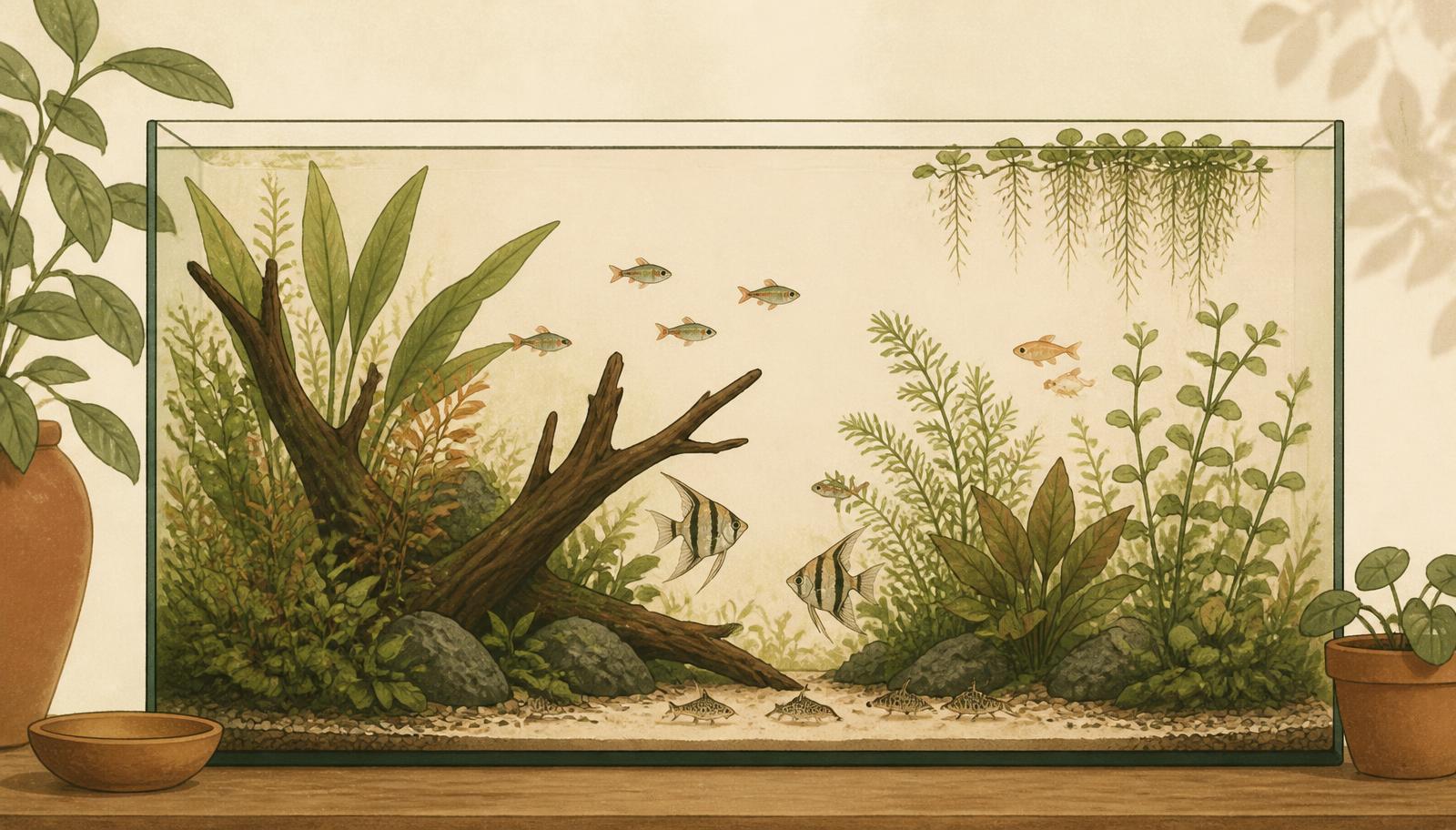
The single most useful thing to understand before buying anything is this: a fish tank is not a container. It's an ecosystem. The glass, the water, the filter, the substrate and the fish themselves are all part of a living biological system that has to be established, understood and maintained. Get that right and you'll have a healthy, fascinating aquarium. Get it wrong and you'll have cloudy water, sick fish and considerable frustration.
This guide starts from the beginning and works through everything you actually need to know.
Before you buy a tank
The single most common mistake in fishkeeping is buying the tank and the fish at the same time, or buying the tank before deciding which fish will go in it.
Tank size, heating requirements, filtration strength, water chemistry and setup all depend entirely on the species you want to keep. A tank appropriate for fancy goldfish is completely wrong for tropical community fish. A setup suited to a single betta is inadequate for a school of danios. Start with the fish, not the equipment.
Before spending anything, ask yourself:
- Which species do I actually want to keep?
- How large will they grow as adults (not the size of the fish in the shop)?
- What temperature do they need?
- Do they need to live in a group?
- What are their water chemistry requirements?
- What do they eat?
- Which part of the aquarium do they occupy — surface, midwater or bottom?
- Are they compatible with the other species I'm considering?
Adult size is particularly important. Many popular aquarium fish are sold as juveniles. A small catfish in a shop may grow to 50cm or more. The RSPCA specifically warns that species including certain large catfish, giant gouramis and pacu routinely outgrow domestic aquariums. The fish in the shop tells you what you're buying today. The adult species tells you what you're committing to.
Budget realistically before you start. Beyond the tank itself, you'll need filtration, a heater if required, a thermometer, a water test kit, water conditioner, substrate, plants or decorations, a gravel vacuum, a dedicated bucket and a net. None of these are optional extras.
What size fish tank do you need?
This is one of the most important decisions you'll make, and the answer is almost always: bigger than you think.
The RSPCA recommends starting with more than the minimum required for your chosen species, and advises a starting aquarium larger than roughly 40 litres (approximately 45 × 30 × 30 cm). That's a floor, not a target.
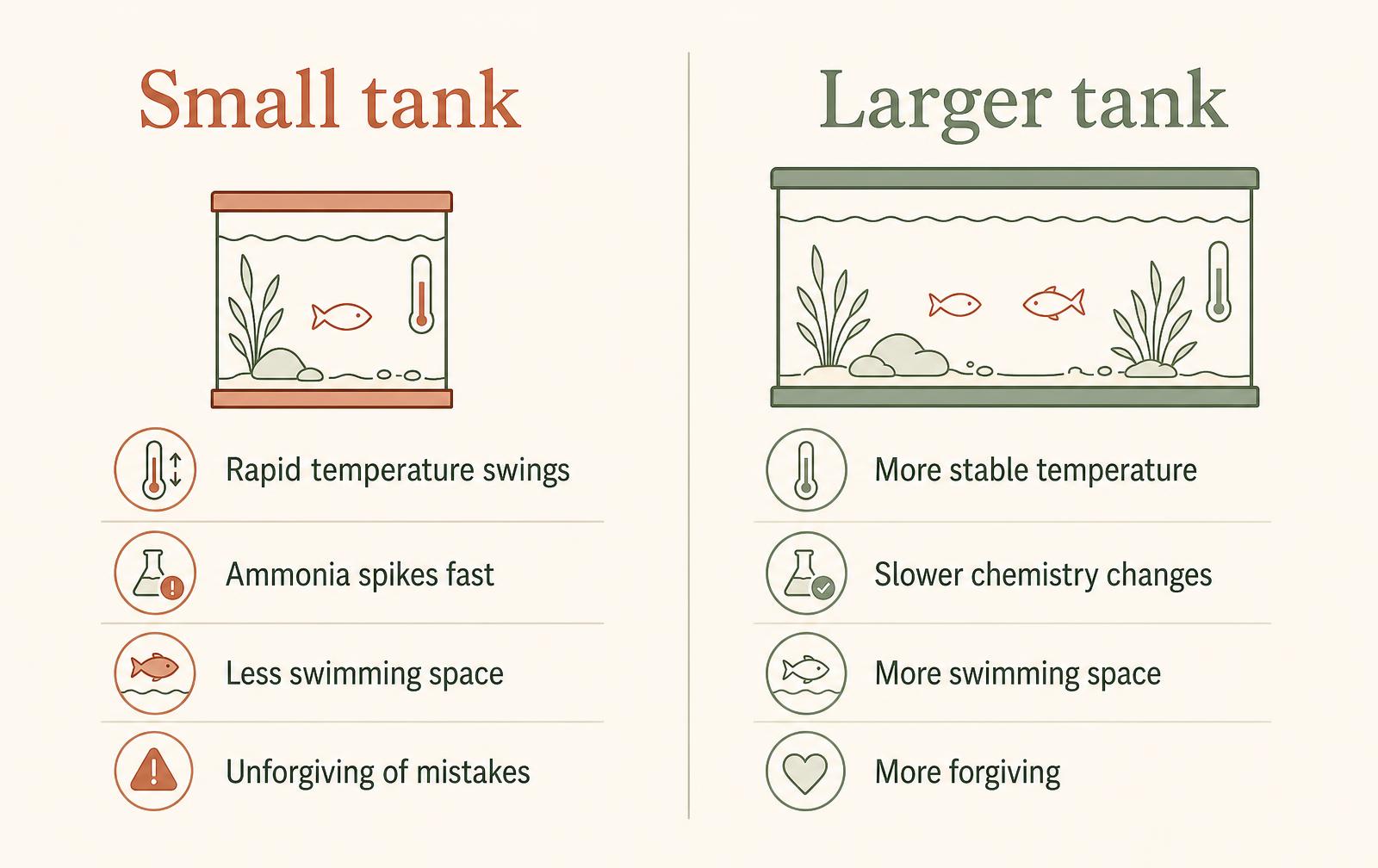
Here's the counterintuitive reality: a larger aquarium is genuinely easier to maintain than a small one, not harder.
Water volume is your buffer. In a large tank, fish waste dilutes across a greater volume of water, ammonia rises more slowly, temperature fluctuates less sharply, and you have more time to notice and correct problems before they become crises. In a small tank, everything happens faster — water quality degrades rapidly, mistakes have immediate consequences and the margin for error is narrow.
Avoid any simple "X litres per fish" or "one inch of fish per gallon" formula. These rules are too crude to be useful. Stocking capacity depends on species, adult size, body shape, behaviour, filtration capacity, oxygen requirements, temperature and waste production. A slender 5cm tetra is not equivalent to a stocky 5cm goldfish. The RSPCA treats volume-per-length calculations as rough guidelines only, not reliable prescriptions.
Goldfish specifically: the goldfish bowl is entirely inappropriate for goldfish. A single fancy goldfish — the round-bodied varieties including Oranda, Ryukin and Fantail — needs a minimum of 75–90 litres in a properly filtered aquarium. A single common or comet goldfish, the slim-bodied variety often seen at fairgrounds, needs 200 litres or more, grows to 30cm or beyond, and is genuinely a pond fish that happens to tolerate indoor tanks when given adequate space. Keeping either in a bowl is a welfare problem, not a reasonable starting point.
Fish bowls: a welfare problem
It's worth being direct about this, because the fish bowl occupies such a prominent place in how most people picture keeping fish.
Fish bowls fail on every welfare measure that matters. The water volume is typically far too small to maintain stable chemistry or temperature. Filtration is either absent or wholly inadequate. Oxygenation is poor, since surface area — where gas exchange happens — is minimal relative to the volume. Waste accumulates rapidly. There is no room for the fish to swim normally.
No fish does well in a bowl. This includes goldfish, bettas, and any other species commonly sold for use in them. Whatever the pet shop may suggest, a bowl is not an appropriate home.
Freshwater, tropical or marine?
The three broad categories of home aquarium have fundamentally different requirements.
Cold-water freshwater — the category most associated with goldfish — doesn't require a heater in most UK homes, but does require excellent filtration (goldfish produce a great deal of waste), significant water volume, and regular maintenance. Despite their reputation as easy beginners' fish, goldfish are demanding in terms of space and water quality.
Tropical freshwater — the most popular category globally — requires a heater to maintain stable temperatures, typically 24–28°C depending on species, but offers an enormous variety of fish including tetras, danios, rasboras, corydoras, livebearers, cichlids, bettas and many others. Well-chosen community tropical tanks are genuinely rewarding and manageable for beginners with the right setup.
Marine (saltwater) — requires saltwater chemistry management, higher-specification equipment, greater cost, and considerably more technical knowledge. Marine aquariums can be extraordinary but are not recommended as a starting point. Begin with freshwater and consider marine once you're confident with water chemistry and maintenance.
The equipment you actually need
The filter is the most important piece of equipment in any aquarium. Filters do three jobs: mechanical filtration (physically trapping debris), biological filtration (providing a home for the beneficial bacteria that process toxic waste), and sometimes chemical filtration (removing specific substances through specialist media). The biological element is by far the most important, which is why the nitrogen cycle section below matters so much. For goldfish, filter flow rate should be at least two to three times the tank volume per hour — goldfish produce significantly more waste than most tropical species. For tropical community tanks, three to five times the tank volume per hour is a reasonable starting point.
A heater with a thermostat is essential for tropical fish and generally unnecessary for goldfish in UK homes. Always pair a heater with a thermometer — heater thermostats can fail in either direction.
A water test kit — liquid test kits rather than strip tests, which are less reliable — covering at minimum ammonia, nitrite, nitrate and pH. This is not optional. You cannot manage water quality you cannot measure.
Water conditioner removes chlorine and chloramine from tap water before it's added to the tank. Both substances harm fish and, critically, kill the beneficial bacteria in your filter. Use it every single time you add tap water, including during water changes.
Substrate, plants and decorations serve biological and welfare purposes, not just aesthetic ones. Live plants absorb nitrate and provide oxygen. Hiding spots reduce fish stress. Open swimming areas allow natural behaviour. Design the tank around what the fish need, not around how it looks.
What you probably don't need at the start: UV sterilisers, CO2 injection systems, protein skimmers (these are marine equipment), automatic feeders, or specialist supplements that promise to accelerate cycling. A bacterial starter product can help, but it doesn't eliminate the need to cycle properly.
Filtration explained
A filter is not simply removing visible dirt from the water. It's maintaining the biological balance that keeps the aquarium safe for fish.
Mechanical filtration physically traps solid debris — uneaten food, fish waste, plant matter — preventing it from decomposing in the water column. The sponge or floss media you see when you open a filter is doing this job.
Biological filtration is where the real work happens. Beneficial bacteria colonise the filter media, and to a lesser degree the substrate and decorations, and process the toxic compounds produced by fish waste.
Chemical filtration uses specialist media to remove specific substances. Activated carbon is the most common — it removes certain chemicals, odours and discolouration. It's useful in some circumstances but not an essential part of every setup.
The most important rule about filter maintenance: never clean filter media in tap water. Tap water contains chlorine, which kills the beneficial bacteria you've spent weeks establishing. Rinse filter media in a bucket of water taken from the tank. Do this gently and only partially at any one time — you want to remove debris that's reducing flow, not sterilise the media. An aggressively cleaned filter can cause an ammonia spike in an established tank, because you've removed the bacteria that were processing the waste.
The nitrogen cycle: the most important section in this guide
Understanding the nitrogen cycle is the difference between a fishkeeper and someone who keeps buying fish to replace the ones that keep dying.
Fish produce waste. That waste, along with uneaten food and decaying plant matter, breaks down into ammonia. Ammonia is highly toxic to fish — even small concentrations cause stress, suppress the immune system and, at higher levels, kill. In the wild, ammonia disperses into vast volumes of water. In a closed aquarium, it accumulates.
The solution is biological: two types of bacteria colonise your filter and process the ammonia. The first converts ammonia into nitrite — which is also toxic, but less so than ammonia. The second converts nitrite into nitrate — far less toxic and manageable through regular water changes and plant uptake. That progression, ammonia to nitrite to nitrate, is the nitrogen cycle.
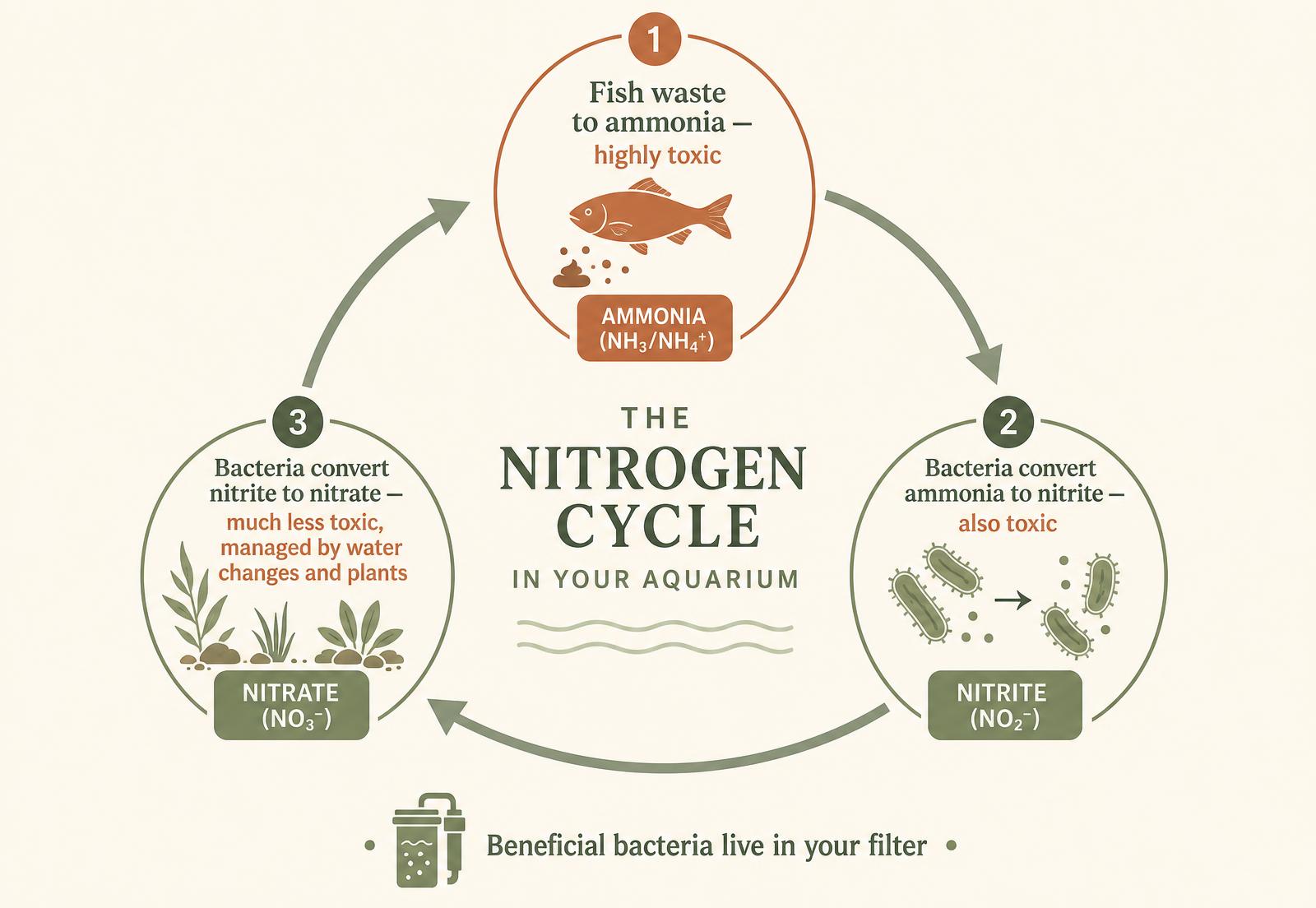
The critical fact for new aquariums is this: those bacteria don't exist yet. They have to grow. They colonise your filter media, substrate and decorations over time, fed by the ammonia in the tank. Until they're established, your tank cannot safely process fish waste. This is why adding fish to a new, uncycled tank — even one with perfectly clear water — causes what's known as New Tank Syndrome: a rapid, toxic ammonia spike that kills fish within days to weeks.
Fishless cycling, step by step
Fishless cycling is the recommended approach and the method the RSPCA strongly advises. You establish the bacterial colony before any fish enter the tank, by adding a source of ammonia to feed the developing bacteria.
- Set up the tank fully with substrate, filter, heater if needed, decorations and conditioned tap water.
- Add a source of ammonia — pure, unscented household ammonia dosed to roughly 2–4 ppm on your test kit, or a small amount of fish food left to decompose. Do not add fish.
- Test ammonia and nitrite daily. After a week or two, nitrite will begin to appear as the first bacteria establish themselves. This is progress.
- Continue testing. Eventually nitrite peaks and falls as the second bacteria establish. Nitrate will begin to appear.
- When ammonia reads zero, nitrite reads zero, and nitrate reads above zero, do a 50% water change to reduce nitrate. The tank is ready for its first fish.
Test the water, not the calendar. There is no reliable fixed timeline. Cycling typically takes four to eight weeks, but can be shorter with mature filter media added from an established tank, or longer in cold temperatures. What matters is the test results, not how many days have passed. The RSPCA specifically cautions that cycling has no fixed duration and that fish should only be added after ammonia and nitrite have risen and subsequently returned to zero.
Understanding your water
Clear water is not the same as healthy water. This is one of the most important things to internalise as a fishkeeper. A tank can look perfectly clean and be biologically dangerous for fish. The only way to know what's actually happening is to test it.
Ammonia should be zero in an established, cycled tank. Any reading above zero is a warning: something has gone wrong with the biological filtration, there's been overfeeding, there's a dead fish decomposing somewhere, or the tank is overstocked for its filter capacity.
Nitrite should also be zero in an established tank. Like ammonia, any reading above zero needs immediate investigation and action — partial water changes to dilute it while you find the cause.
Nitrate accumulates steadily and is managed primarily through regular partial water changes. Most freshwater fish tolerate nitrate well at lower levels but suffer at higher concentrations. Keep nitrate below 20–40 ppm for most community species, lower for more sensitive fish.
pH measures acidity and alkalinity on a scale of 0–14, with 7 being neutral. Different species have evolved in water of different pH — tetras from the Amazon prefer soft, acidic water; African cichlids prefer hard, alkaline conditions. Research the requirements of your chosen species and match the setup to them rather than trying to adapt the fish to your tap water chemistry.
GH (general hardness) measures dissolved mineral content. KH (carbonate hardness) measures the water's buffering capacity — its ability to resist pH swings. Both matter for species sensitive to water chemistry.
Chlorine and chloramine from tap water must be neutralised with water conditioner before any tap water enters the tank, including during water changes. They harm fish and kill the beneficial bacteria in the filter.
Temperature should be appropriate for the species and, more importantly, stable. Sudden temperature swings suppress the immune system and cause stress. A drop of even a few degrees during a water change can shock fish. Match the temperature of replacement water to the tank before adding it.
Plants, substrate and the aquarium environment
The best aquariums are designed around what the fish need rather than around aesthetics. A beautifully arranged tank that doesn't meet its inhabitants' environmental requirements is a welfare problem dressed up as decoration.
Live plants offer genuine benefits: they absorb ammonia and nitrate, produce oxygen, reduce algae growth by competing for nutrients, and provide hiding places and grazing surfaces. They're not essential, but they contribute to a more stable environment and more natural behaviour.
Artificial plants are fine for fish that don't specifically benefit from live plants, and much easier to maintain. Silk plants are preferable to hard plastic ones — hard plastic edges can damage delicate fins.
Substrate affects water chemistry (certain substrates buffer pH), provides a home for beneficial bacteria and, for bottom-dwelling species, is a welfare consideration in itself. Corydoras and loaches naturally sift through soft sand, and a gravel substrate with sharp edges damages their barbels.
Hiding places are a welfare essential, not a decoration choice. Fish that cannot retreat from perceived threats experience chronic stress. Caves, plant thickets, driftwood and rock formations should allow every fish in the tank to find shelter when it needs to.
Avoid sharp decorations. Any ornament with rough or sharp edges can tear fins and create wounds that become entry points for infection.
Choosing your fish
Rather than a list of recommended species — which ages quickly and depends entirely on your setup — it's more useful to explain how to evaluate any species before buying.
Before purchasing any fish, find out:
- Adult size. Not the size in the shop. Not the maximum recorded specimen. The typical adult size of a healthy individual.
- Schooling or shoaling requirements. Many fish are profoundly stressed alone. Neon tetras kept singly will be unhealthy; they need a group of at least six, ideally more.
- Temperature range. And whether it overlaps with everything else in the tank.
- Water chemistry requirements. pH, hardness, and whether they match your tap water.
- Territorial behaviour. Some species are peaceful in a community; others will kill tankmates.
- Feeding requirements. Will they accept dry food? Do they need live or frozen food? Are they nocturnal feeders? Will they compete successfully with faster-feeding tankmates?
- Aquarium level. Surface dwellers, mid-water fish and bottom dwellers create a natural stocking balance. A tank full of bottom dwellers is both overcrowded at the substrate and empty elsewhere.
- Compatibility with existing fish. Fin-nipping species with long-finned varieties is a predictable problem. Large predatory fish with small fish they can swallow is another.
When buying fish, look for tanks that are clean, well-maintained and not overcrowded. Fish should be swimming normally, with fins erect and undamaged. Avoid fish showing white spots (which may indicate white spot disease), sores, damaged fins, unusual swimming patterns, or concave bellies suggesting starvation or disease. The RSPCA recommends these criteria specifically.
How many fish can you keep?
There's no universal formula, and the "one inch of fish per gallon" rule is too crude to be useful. Stocking depends on species, adult size, body shape, behaviour, filtration capacity and waste production.
Think in terms of bioload — the biological demand each fish places on the system — rather than simple numbers. A single large goldfish produces more waste than ten small tetras. A territorial species claiming territory is effectively occupying space that makes stocking lower than simple calculations suggest.
In practice:
- Stock to adult sizes, not juvenile sizes.
- Add fish gradually rather than all at once. Adding the full planned population in one go overwhelms the biological filter.
- Schooling species need enough of their own kind to behave naturally — factor this into planning.
- Monitor water parameters after adding new fish. A nitrite or ammonia spike tells you the filter is struggling with the increased bioload.
Bringing your first fish home
The transition from shop to aquarium is a stress point for fish. Done well, it's manageable. Done badly, it can be fatal.
Quarantine new fish for two to four weeks in a separate tank before introducing them to an established aquarium. This is standard practice for experienced fishkeepers and the single most effective way to prevent disease transfer. A new fish can look healthy and carry white spot, bacterial infections or internal parasites that spread through an established tank. A small quarantine tank doesn't need to be elaborate — a basic cycled setup is enough.
Temperature acclimation. Float the sealed bag in the aquarium for fifteen to twenty minutes before opening it. This equalises the water temperature gradually.
Water chemistry acclimation. Over another fifteen to twenty minutes, gradually add small amounts of tank water to the bag, acclimating the fish to any differences in pH and hardness.
Release the fish, not the bag water. Use a net to transfer the fish into the aquarium. Do not pour the shop water into your tank — it may contain disease or chemicals you don't want.
Dim the lights for a few hours after introduction, and reduce feeding. Give the fish time to settle without additional stress.
Add fish gradually over weeks rather than all at once, so the biological filter can adjust to the increasing bioload.
Feeding without overfeeding
Overfeeding is one of the most common causes of water quality problems in home aquariums. Uneaten food decomposes, driving ammonia up and triggering exactly the water quality crisis you've worked to prevent.
Feed only what fish consume within approximately two to five minutes, once or twice a day for most species. Observe the fish while they eat. Remove any uneaten food promptly with a net or siphon.
Species diet matters. Herbivores, omnivores and carnivores have different nutritional requirements. Research what each species in your tank actually needs rather than feeding everything the same flake food. Bottom dwellers may need sinking pellets or wafers rather than surface or mid-water foods that never reach them. The same principle applies across pet species — our nutrition basics guide covers why "complete and balanced" matters.
Your aquarium routine
Daily:
- Observe fish — look for changes in behaviour, appearance or appetite
- Check temperature and equipment (filter running, heater functioning)
- Feed appropriately and remove uneaten food
- Check for dead fish
Weekly:
- Test water parameters (ammonia, nitrite, nitrate; pH if relevant)
- Partial water change of 20–30%, using conditioned water at tank temperature
- Vacuum substrate gently to remove accumulated waste
- Remove algae from the glass if needed
- Inspect plants and remove dying leaves
Every two to four weeks:
- Clean filter media — gently, in tank water, never tap water
- Check equipment for wear
Periodically:
- Review fish health and growth
- Check compatibility as fish mature
- Monitor adult sizes against the available space
How to tell if your fish is unwell
The RSPCA notes that poor water quality contributes to many fish health problems. Before investigating disease, test the water. A sick fish in clean, well-established water needs a different response from a sick fish in a tank with elevated ammonia or nitrite.
Signs of illness to watch for:
- Loss of appetite
- Gasping at the surface (often low oxygen, or ammonia and nitrite poisoning)
- Abnormal swimming — spinning, listing, inability to maintain position
- Flashing: rubbing against the substrate or decorations
- Hiding more than usual
- Clamped fins held tight against the body
- White spots resembling salt grains (white spot disease, also called ich)
- Damaged, fraying or rotting fins
- Bloating, or scales standing away from the body
- Sores, ulcers or unusual patches
- Colour changes or loss of colour
Common conditions in freshwater aquariums include white spot, fin rot, fungal disease and swim-bladder problems, among others. We've covered white spot in goldfish in detail because it's so commonly encountered by beginners. Whatever condition you suspect, test the water as well as looking at the fish — addressing the environment is usually part of the treatment.
The biggest beginner mistakes
| Mistake | Why it matters | Better approach |
|---|---|---|
| Buying fish before researching the species | Adult size, behaviour and requirements only become apparent later | Research first, buy after |
| Too small a tank | Small volumes are unstable and unforgiving | Bigger than the minimum; RSPCA advises over 40 litres to start |
| Adding fish before cycling | An ammonia spike kills fish | Fishless cycle until ammonia and nitrite both read zero |
| Adding too many fish at once | Overwhelms the biological filter | Add gradually over weeks |
| Overfeeding | Uneaten food drives ammonia up | Only what fish eat in two to five minutes |
| Never testing water | You can't detect invisible problems | Weekly testing is standard practice |
| Cleaning the filter in tap water | Kills beneficial bacteria | Always rinse in tank water |
| Assuming clear water means healthy water | Ammonia and nitrite are invisible | Test the water, not how it looks |
| Mixing incompatible species | Temperature, behaviour or size mismatches | Research compatibility before purchase |
| Treating disease without checking water | Many disease presentations have water quality as an underlying cause | Test first, treat second |
The fish tank checklist
Before adding any fish, confirm the following.
Setup:
- Tank sized for adult species requirements, not juvenile size
- Suitable location chosen, away from direct sunlight, radiators and draughts
- Filter installed and running, sized correctly for the species
- Heater installed and set if required
- Thermometer reading the correct temperature
- Substrate, plants and decorations in place
- Water added and conditioned
- All equipment functioning
Cycling:
- Tank cycled using the fishless method
- Ammonia reading: zero
- Nitrite reading: zero
- Nitrate reading: above zero
- 50% water change done before adding fish
Fish selection:
- Species researched: adult size, temperature, water chemistry, behaviour
- Compatibility confirmed between all intended species
- Shoaling and schooling numbers confirmed
- Feeding requirements understood
- Quarantine tank available, or a plan in place
Only then: add the fish.
The bottom line
The best fish tank isn't the most expensive or the most beautiful. It's the one designed around the fish that will live in it — sized appropriately, filtered correctly, cycled before they arrive, and maintained consistently.
Get the nitrogen cycle right. Size the tank for the adult fish, not the juvenile. Test the water regularly and trust the results rather than how the water looks. Add fish gradually. Feed carefully. Never clean the filter in tap water.
Every fish health problem we see in beginners' tanks traces back to one of those fundamentals being skipped or misunderstood. Get them right, and fishkeeping is genuinely rewarding, stable and long-lived.
Guides on Burrow are researched carefully and written to be genuinely useful, but they aren't a substitute for specialist aquatic advice. For specific fish health concerns, speak to a reputable aquatic specialist or a vet with fish experience.
Related reading: White Spot in Goldfish: What It Is and What to Do · Do Pet Supplements Actually Work?
Common questions