Preventive Vet Care · Dog & Cat · 20 Aug 2026
Your Dog Ate a Grape. What Happens Next?
By Burrow · 20 Aug 2026
TL;DR
- Grapes, raisins, sultanas and currants can cause acute kidney injury in dogs and cats.
- A new UK study identified 31,425 probable canine cases and 1,030 probable feline cases across 64 emergency veterinary centres between 2018 and 2024.
- Mortality was 0.9% in dogs and 11.8% in cats in this emergency-care dataset.
- Fresh-grape exposure was associated with higher mortality than processed grape products in both species — roughly three times the relative risk in dogs. The study was observational and cannot prove fresh grapes are intrinsically more toxic.
- The toxic mechanism is still not fully resolved. Tartaric acid is the leading suspect, but is not yet a complete explanation.
- There is no reliable safe dose. Quantity alone should not be used to decide whether veterinary advice is needed.
- Prompt decontamination was the strongest predictor of survival in the study's analysis.
- December was the peak month, driven by mince pies, Christmas cake and fruit cake.
Most dog owners know grapes are dangerous. What they usually don't know is why, how much is too much, or why fresh grapes may be more dangerous than raisins.
A major UK study published this week has added some surprisingly useful detail. Researchers analysed records from 64 emergency veterinary centres between 2018 and 2024, identifying 31,425 probable canine cases and 1,030 probable feline cases involving grapes, raisins, sultanas or currants — one of the largest datasets on grape-product exposure in pets ever assembled.
Several findings challenge the assumptions most owners make. Fresh grapes were associated with higher mortality than raisins and sultanas. Feline mortality was far higher than canine. Chocolate eaten at the same time did not increase mortality in this dataset. And among all the variables examined, early gastrointestinal decontamination emerged as the strongest predictor of survival.
The practical message, however, remains simple. If your dog or cat eats grapes, raisins, sultanas or currants, call your vet promptly. Don't wait for symptoms.
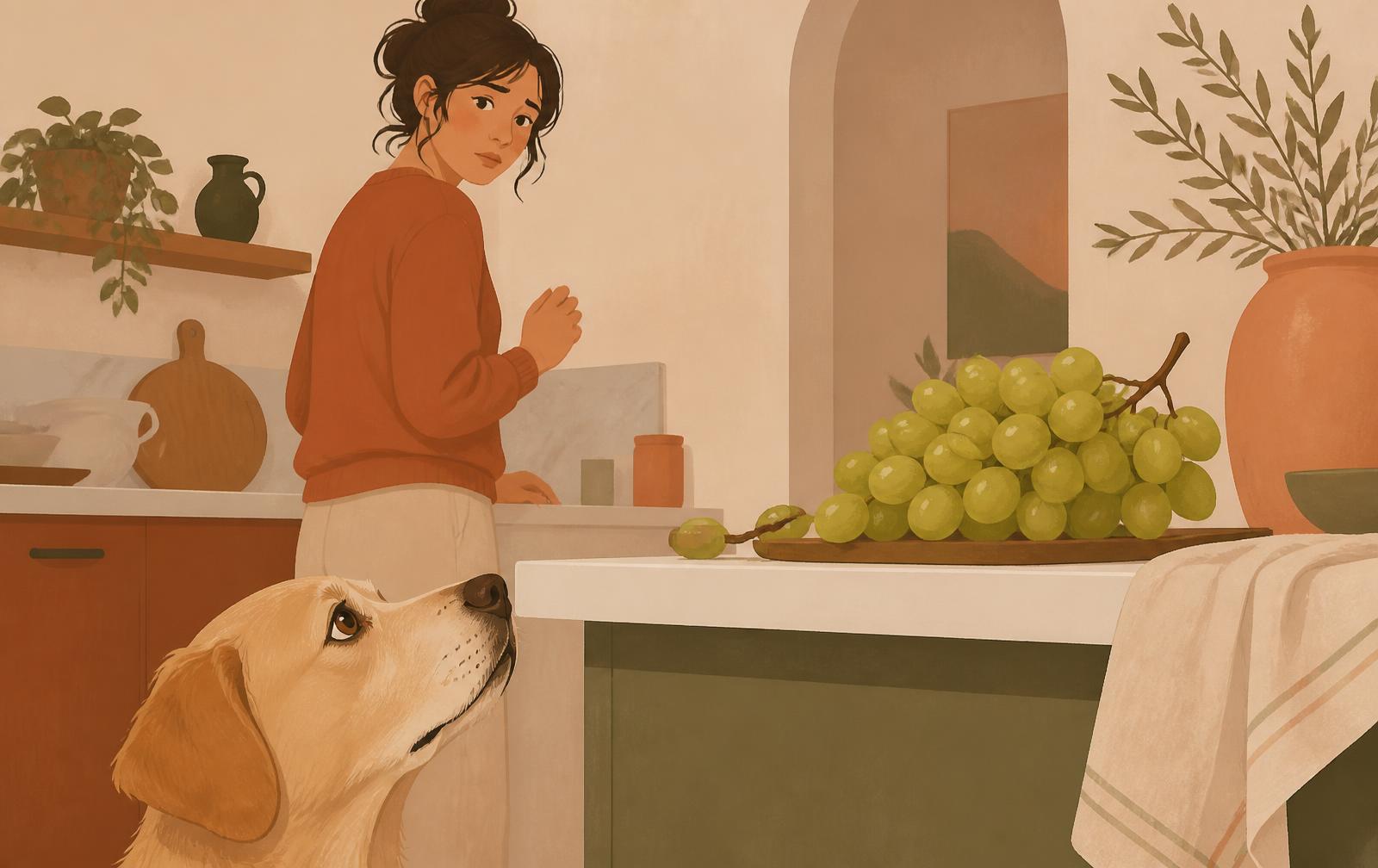
Why are grapes toxic to dogs?
For a surprisingly long time, veterinary medicine has had an unsatisfactory answer: we don't fully know.
Grapes and raisins have been linked to acute kidney injury in dogs for decades, but researchers have struggled to identify exactly which component causes the damage. Tartaric acid is currently the leading suspect — grapes contain it in concentrations of up to 2%, and canine kidney cells lack a transporter that protects human kidney cells from it, which may explain why dogs are uniquely vulnerable where humans are not. Post-exposure kidney pathology in affected dogs shows damage to the proximal tubular cells, consistent with a nephrotoxin. But the authors of the new study are careful not to present the case as closed. The exact toxic pathway remains unresolved.
That uncertainty matters. With chocolate, vets can often estimate risk using the type of chocolate, quantity and the dog's weight. Grapes are far less predictable. Two dogs can eat similar amounts and have very different outcomes. That is why there is no grape equivalent of a chocolate toxicity calculator that owners can safely rely on at home.
Surely one grape isn't enough to matter?
It might not be. But that is not the same as knowing it is safe.
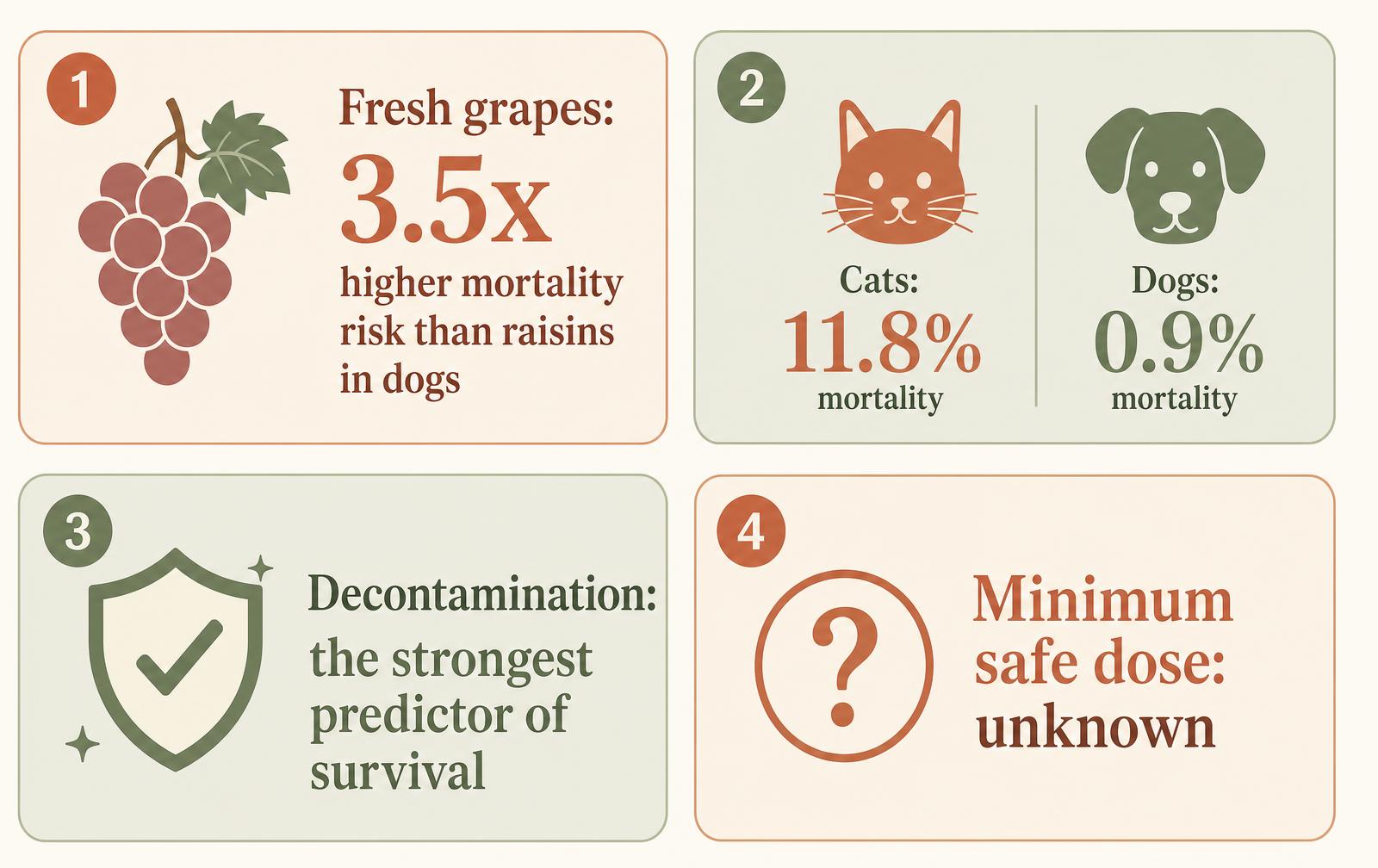
A single grape represents a very different dose for a 2kg Chihuahua than a 35kg Labrador. Grapes also vary in size and composition. And published case reports have documented acute kidney injury following small quantities — veterinary literature still does not provide a confidently established minimum safe dose. The new study couldn't resolve that question because the amount eaten was not consistently recorded across thousands of emergency cases.
So if your dog takes one grape from the floor, the sensible response is not panic. It is also not "it's only one." Call your vet, explain what happened and let them assess it.
The surprising finding: fresh grapes did worse than raisins
This is probably the most counterintuitive result in the paper. Most people would assume raisins are more dangerous — they're dried grapes, more concentrated, a smaller piece of fruit containing more of whatever causes harm.
Yet among the recorded canine cases, exposure to fresh grapes was associated with 3.47 times the mortality risk of processed grape products. In cats, the relative risk was 3.13.
That does not mean a gram of fresh grape is proven to be three and a half times more toxic than a gram of raisin. The study was observational, not a controlled dose-matched experiment. Quantities eaten were often uncertain, and treatment patterns differed between cases. The authors discuss the possibility that management differences could partly explain the result — processed-fruit cases received more intensive treatment more consistently, which may have improved their outcomes.
The right conclusion is not "fresh grapes are worse than raisins." It is "fresh grapes should not be treated as the safer option." Both warrant prompt veterinary advice.
Cats were affected less often — but outcomes were worse
The study was overwhelmingly canine: 31,425 probable dog cases against 1,030 probable feline cases. That reflects the reality that cats are generally more selective around food and far less likely to encounter grapes opportunistically.
But the mortality figures moved sharply in the other direction. Canine mortality was 0.9%. Feline mortality was 11.8%. This is one of the most striking findings in the paper, because feline grape toxicity has historically been far too poorly characterised to study properly at scale — prior case series have numbered in the dozens at most.
It does not necessarily mean an individual cat is inherently thirteen times more vulnerable than an individual dog. These are different populations arriving at emergency centres under different circumstances. But it does make one thing clear: grape exposure is not a dog-only problem. If your cat eats grapes or raisins, call your vet too.
What actually seems to improve survival
This is where the study becomes most practically useful. The researchers examined multiple variables associated with outcome. In their decision tree analysis, gastrointestinal decontamination was the strongest discriminator of survival — in dogs, cases that underwent emesis showed uniformly high survival; in cats, activated charcoal was the dominant factor, associated with markedly higher survival than those that didn't receive it. Once decontamination had occurred, downstream variables including age and ingestion type largely lost their prognostic importance.
This is not an instruction to induce vomiting at home. It is a reason to call early enough that a vet can decide whether decontamination is appropriate, before the window closes.
Don't wait for symptoms
One of the difficult things about grape exposure is that a dog may initially look completely normal. That can create false reassurance. Owners think: he's fine, I'll keep an eye on him. But kidney injury does not announce itself immediately.
Signs associated with grape toxicity can include vomiting, diarrhoea, lethargy, loss of appetite, abdominal discomfort, changes in thirst and urination, and in severe cases reduced or absent urine production. By the time obvious signs develop, the opportunity for early decontamination has passed.
The best time to call is when you discover the grapes are missing — not when the dog starts looking ill.
Don't induce vomiting at home
Search the internet after a poisoning scare and instructions for making a dog vomit appear quickly. This is one area where improvised treatment can cause additional problems. Whether vomiting is appropriate depends on what was eaten, how long ago, the species, the animal's condition, and whether anything else was ingested. Cats and dogs are managed differently.
Do not use salt, hydrogen peroxide or other home remedies unless specifically instructed by a veterinary professional. Call a vet and follow their guidance.
Why December is the danger month
The study found 22% of probable canine cases occurred in December. That is not because dogs develop a taste for grapes at Christmas — it is because raisins, sultanas and currants appear in almost everything. Mince pies, Christmas pudding, Christmas cake, fruit cake, panettone, biscuits. Food left on coffee tables. Plates abandoned beside sofas. Guests who don't know that dried grapes are dangerous to dogs.
The Christmas risk is less about the fruit bowl than the buffet.
What about chocolate and raisins together?
Chocolate co-ingestion was not associated with increased mortality from grape-product exposure in this study. That does not mean chocolate is suddenly harmless when eaten alongside raisins — it has its own well-established toxicity in dogs, and the risk depends heavily on type and quantity. It simply means that within this dataset, eating chocolate alongside grape products was not associated with a worse outcome from the grape exposure. For an owner whose dog has eaten a mince pie, the practical advice is unchanged: tell the vet everything the animal has eaten.
Try this today
Check every cupboard, table and counter where food is accessible to your pet and think about what's in it — particularly anything baked. Keep the ingredients list of any product your pet might have eaten. If you're not sure what was in something, that label is what the vet will ask for. A few minutes of checking now is worth more than any amount of searching for information after an incident.
What to do if your dog eats a grape
Step 1: Remove access. Stop the animal eating any more.
Step 2: Establish what was eaten. Fresh grapes or processed fruit, approximate quantity, time of ingestion, and whether anything else was consumed.
Step 3: Know your pet's weight. An approximate recent figure is useful for your vet.
Step 4: Call your vet promptly. Do this even if your dog appears completely normal.
Step 5: Don't induce vomiting yourself. Follow veterinary instructions.
Step 6: Take packaging with you. If the exposure involved cake or biscuits, the ingredient list may reveal additional risks.
The Bottom Line
Grape poisoning remains one of the stranger problems in veterinary medicine. We know grapes and raisins can cause serious kidney injury. We still don't know exactly why. We can't give owners a reliably safe dose. And this week, a huge UK dataset produced another surprise: fresh-grape exposures were associated with higher mortality than processed fruit, while feline cases had markedly worse outcomes than canine.
But the most useful finding is less mysterious than any of that. Act early. If your dog or cat eats grapes, raisins, sultanas or currants, don't wait to see whether they become unwell. Call your vet, explain what happened and let them decide what needs to happen next.
And in December, watch the mince pies.
This is general information and not veterinary advice. If your dog or cat has eaten grapes, raisins, sultanas or currants, contact a veterinary professional promptly.
Related reading: Are Flea Treatments Harming the Environment? · Arthritis in Dogs: The Early Signs Most Owners Miss · How to Check Your Dog's Gum Colour
Common questions
Frequently asked.
Keep reading
Further reading.
Want plain-English notes on pet health and the things that affect it? Join The Once-Over, our weekly note from Hazel.