Preventive Vet Care · Dog & Cat · 14 Aug 2026
Can AI Diagnose Your Pet?
By Burrow · 14 Aug 2026
TL;DR
- AI is already being tested across veterinary medicine — X-rays, ultrasound, heart monitoring, skin disease, cancer screening and wearables.
- An NC State study found an AI stethoscope performed on a par with final-year vet students at detecting canine heart murmurs, but experienced clinicians were better. The AI was trained on human, not animal, data.
- A separate study found a different AI murmur algorithm achieved 90.9% accuracy in dogs, comparable to experienced vets — showing how much results vary by system and training data.
- A 2026 audit of 71 commercial veterinary AI products found most lack proper transparency and validation disclosure.
- General AI chatbots shouldn't be treated as vets. They can't examine an animal and can produce incorrect information.
- For pet owners, AI is currently most useful before and between appointments — helping organise symptoms, understand information and prepare better questions.
AI is already listening to your dog's heart. The question is whether it's any good at it — and what that tells us about where this technology is really headed.
A study by researchers at North Carolina State University has put one common veterinary AI application to the test: an AI-enabled digital stethoscope designed to identify heart murmurs in dogs. The results are instructive about where this technology currently stands.
The AI performed on a par with final-year veterinary students. Experienced clinicians performed better. And there was one finding that explains why: the diagnostic AI in these stethoscopes was trained on human heart data, not canine or feline data. Vets were reportedly second-guessing their own clinical judgement based on the device's readings — a reminder that impressive technology and reliable technology aren't always the same thing.
That doesn't mean veterinary AI is failing. A systematic survey published in Frontiers in Veterinary Science examined 22 studies of AI applications across veterinary imaging, disease prediction, wearables, clinical decision support and large language models, and found genuinely promising results across all of them — alongside significant gaps in external validation and real-world testing. The future looks considerably less like replacing your vet and considerably more like giving vets and pet owners better tools.
AI has arrived in veterinary medicine
Veterinary medicine presents an unusually interesting challenge for artificial intelligence. Animals can't tell a clinician where it hurts. A vet instead combines information from the owner with observation, physical examination, medical history, diagnostic tests and clinical experience.
AI potentially adds another layer. Machine-learning systems can analyse quantities of data far beyond what an individual person could process, looking for patterns in images, sounds, laboratory results and continuous data from wearable sensors. The Frontiers systematic survey found AI applications spanning diagnostic imaging, cardiovascular disease detection, dermatology, oncology, wearable monitoring and clinical decision support. Some reported results are genuinely impressive. But there is an enormous difference between recognising a pattern in a dataset and practising veterinary medicine.
What happened when AI listened to dogs' hearts
A stethoscope seems an unlikely place for an AI revolution, but it's one of the most instructive examples of where this technology currently stands.
The NC State study tested the EKO Core 500 — a digital stethoscope designed for human patients and used widely in human medicine — on 54 dogs and 51 cats. Of the 38 dogs found to have a heart murmur by the veterinary cardiologist, the AI correctly identified 33. Fourth-year students matched this performance. Experienced clinicians outperformed both. The diagnostic AI had been trained on human data, not dog or cat data, and vets were reportedly second-guessing their own clinical judgement based on the device's readings.
That last point is the most important one. A tool that causes experienced practitioners to doubt their own clinical judgement is a tool being used beyond its validated scope.
The picture is more nuanced than a single study suggests. A separate study by researchers at Seoul National University, using a different AI algorithm trained specifically on canine heart recordings from 406 dogs, achieved 89.9% sensitivity, 92.7% specificity and 90.9% overall accuracy — comparable to experienced veterinarians. That contrast is instructive. The key variable wasn't AI versus humans. It was whether the AI had been trained on appropriate, species-specific data.
The accuracy numbers need context
You'll increasingly encounter veterinary AI products claiming accuracy rates of 90%, 95% or higher. Some published studies genuinely report figures in that territory for particular tasks. But 95% accurate doesn't mean an app has a 95% chance of correctly diagnosing whatever is wrong with your dog.
A system might have been trained to answer a much narrower question: is this particular abnormality present in this particular type of image? Real veterinary medicine is messier. Animals have multiple conditions. Symptoms overlap. Image quality varies. Breeds differ dramatically. Owners provide incomplete histories. Rare diseases appear.
A February 2026 systematic audit of 71 commercial veterinary AI products found what it called a "Transparency Gap" — a significant divergence between the sophisticated clinical capabilities marketed and the actual transparency and validation disclosure in the product documentation. Most products lacked independent external validation. The Frontiers systematic survey made the same point: fragmented datasets, insufficient external validation, species differences and a shortage of prospective real-world evaluation remain significant barriers to widespread clinical adoption. A laboratory benchmark isn't a consulting room.
Where AI could make the biggest difference
The most useful veterinary AI may turn out to be considerably less dramatic than an artificial veterinarian.
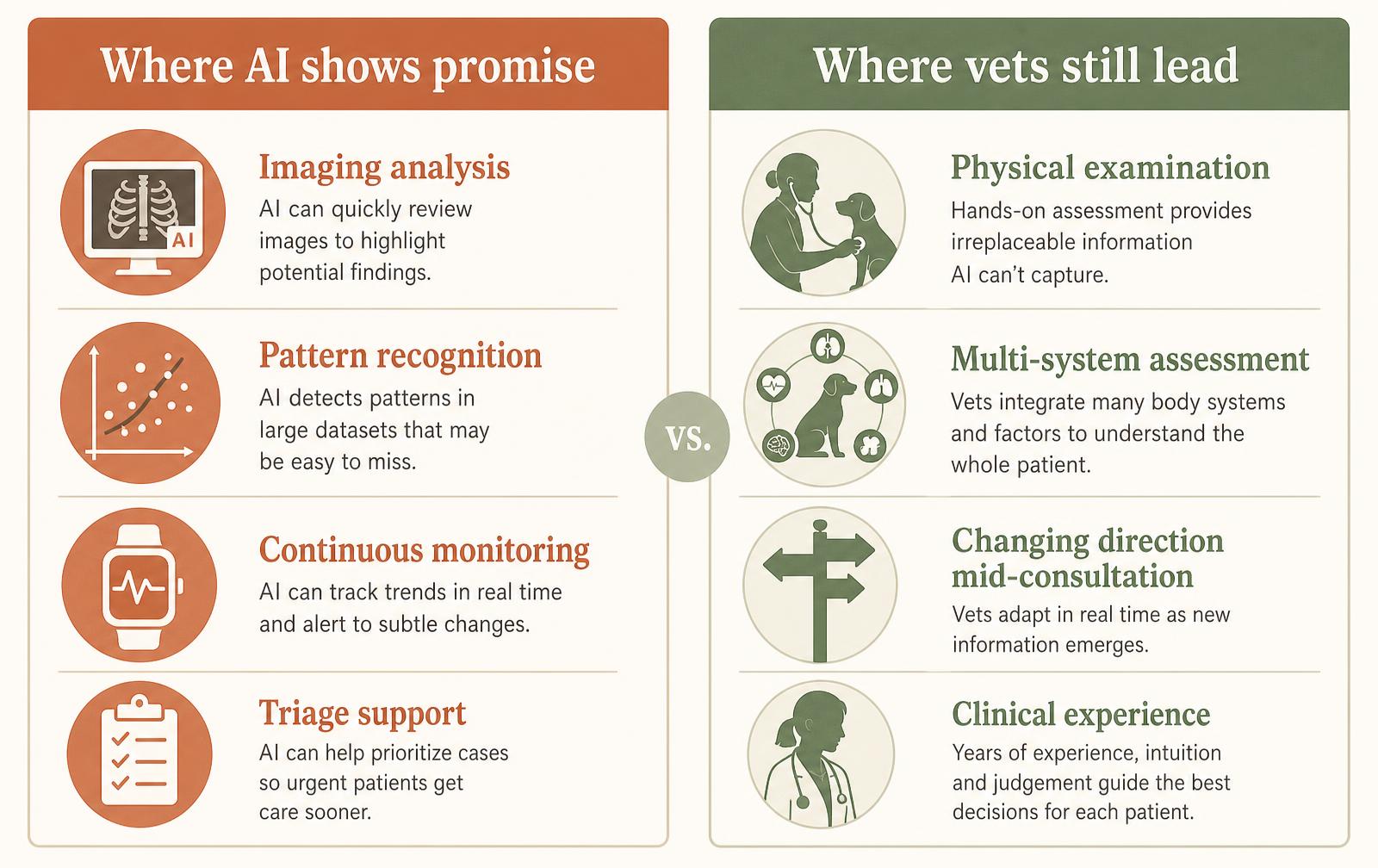
Earlier detection. Wearable devices can potentially monitor activity, heart rate and other measures continuously, identifying deviations before an owner would notice something has changed. Veterinary AI researchers see this as one of the most important opportunities for earlier intervention — particularly for chronic conditions like heart disease and arthritis where gradual change is easy to miss day to day.
Imaging support. AI can provide an additional layer of analysis for X-rays and ultrasound, potentially drawing attention to findings a clinician should look at more closely. The final interpretation remains clinical, but the software acts as an additional check.
Monitoring chronic disease. Instead of assessing an animal during a brief appointment every few months, connected devices could provide longitudinal information about activity, sleep and movement. A trend across six months can tell a very different story from a single measurement taken in a consulting room where a dog is understandably nervous.
Triage. This may be one of the most important applications for pet owners. AI doesn't necessarily need to know exactly what's wrong to be useful. Recognising whether something can probably wait, or whether a pet needs professional attention now, is a meaningful and achievable goal — though systems still require proper validation before owners should depend on them for safety-critical decisions.
Where AI still struggles
There is something a veterinary AI system cannot currently replicate: the animal standing in front of the vet.
A veterinarian can feel an abdomen, inspect gums, assess hydration, manipulate a painful joint, listen to breathing, observe how an animal enters the room and register dozens of small contextual signals. They can also change direction mid-consultation. An appointment that begins with an owner worried about arthritis might end with the vet investigating a neurological problem. AI systems generally work best when the problem has already been narrowed sufficiently for them to analyse a particular type of information. Veterinary medicine rarely begins that neatly.
This matters especially for animals that are good at hiding how they feel — cats in particular.
What about AI chatbots?
Large language models introduce a different proposition. Instead of analysing a heart recording or X-ray, they analyse language — which makes them potentially very useful for pet owners, because so much of healthcare involves information rather than diagnosis.
What does this term in my vet's report mean? What symptoms should I keep track of? What questions should I ask at tomorrow's appointment? These are fundamentally different questions from "what disease does my dog have?" and the distinction matters enormously. Language models can produce convincing answers even when those answers are wrong, and the Frontiers review described veterinary LLM applications as promising but still at an early stage, requiring rigorous validation before routine clinical use.
A separate project published in August 2026 is investigating ways of scoring AI-generated veterinary answers for both strength of evidence and potential harm of unsupported claims — which tells you something important about where the field stands. Making an answer sound authoritative is relatively easy. Ensuring every important claim is safe and properly supported is considerably harder.
Try this today
Before your next vet appointment, spend five minutes writing down three things you've noticed about your pet's behaviour, movement or appetite that seem different from a month ago. Not a vague sense that something seems off, but specific observations: when did you first notice it, how often does it happen, has it changed. That's the kind of systematic observation that AI tools are increasingly designed to support, and it's also what makes a vet appointment more useful — arriving with something concrete rather than a general worry. Your Companion can help you organise those observations if you're not sure what's worth noting.
What Companion is and isn't for
Burrow's Companion is an AI pet-health assistant designed specifically for the space before and between veterinary appointments. It's there to help you think through what you're seeing, understand what it might mean, and prepare better questions for your vet. It won't diagnose, and when something genuinely needs a vet, it will say so plainly.
This is the honest and appropriate use of consumer AI in pet health right now. Not as a replacement for veterinary expertise — but as a way of helping owners use that expertise better when they reach it.
If your pet is seriously unwell, in pain, having difficulty breathing, experiencing a seizure or showing signs of an emergency, contact a veterinary professional directly.
The bottom line
AI is getting surprisingly good at individual veterinary tasks. It can analyse images, listen to heart sounds and identify patterns in health data. But the stethoscope study is a reminder of what the technology is not yet: a reliable substitute for an experienced clinician, particularly when it's been trained on the wrong species' data.
The most plausible near-term future isn't AI versus veterinarians. It's veterinarians using AI — and pet owners using it too, not to diagnose their animals, but to observe them more carefully, understand what they find, and know when to call.
This is general information and not veterinary advice. AI-generated pet-health information should not be used as a substitute for diagnosis, treatment or emergency veterinary care. If your pet is seriously unwell, contact a vet promptly.
Common questions
Frequently asked.
Keep reading
Further reading.
Want plain-English notes on pet health and the technology changing it? Join The Once-Over, our weekly note from Hazel.