Behaviour · Small Pet · 22 Jul 2026
How to Tame a New Hamster (and Teach It to Be Held)
By Burrow · 22 Jul 2026
TL;DR
- Taming is trust-building, and it can't be hurried. Expect it to take a few weeks, going at the hamster's pace.
- Leave a new hamster alone for the first week. Let it settle, unhandled, so its new home feels safe.
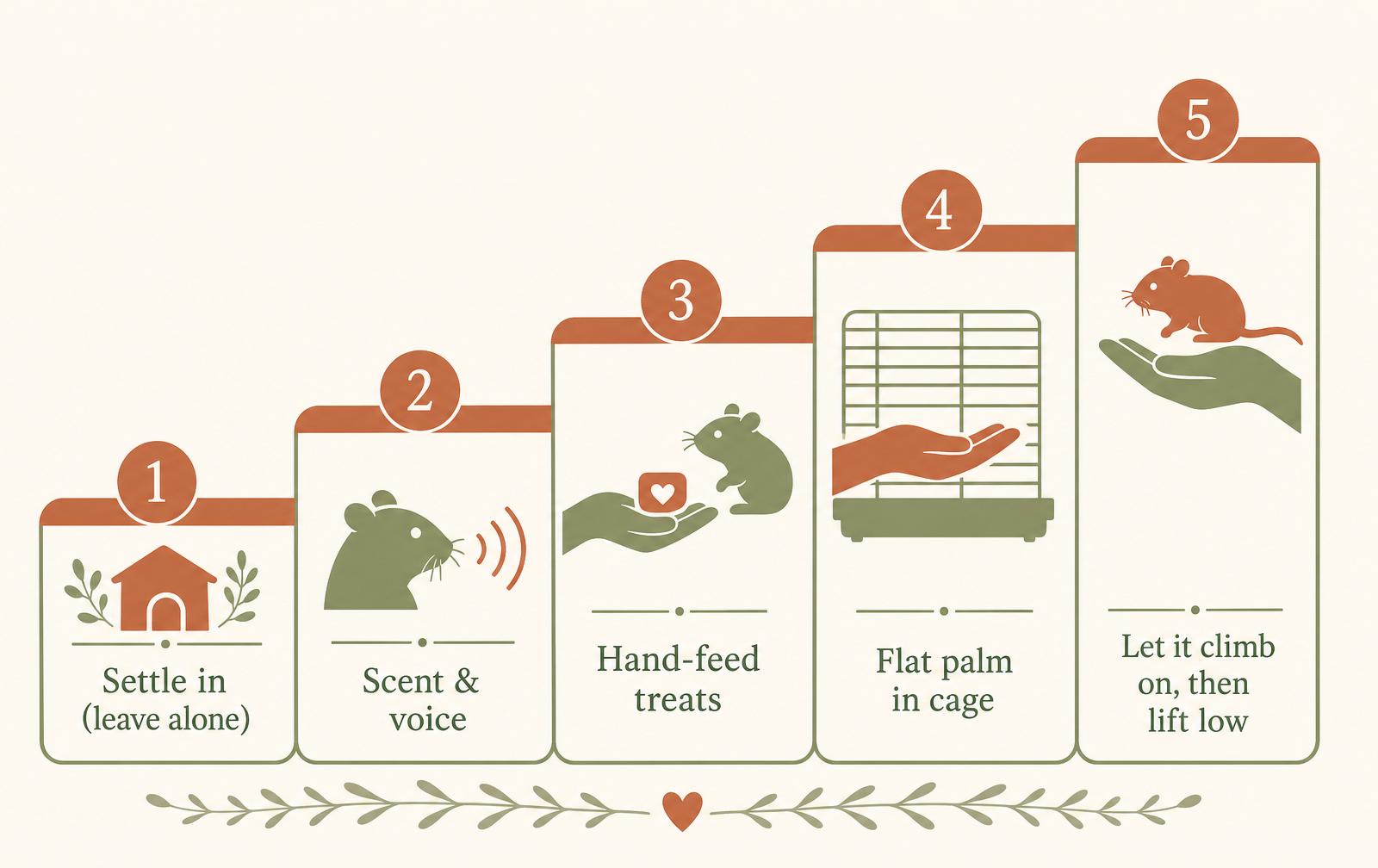
- Work up in stages: scent and voice, then hand-feeding through the bars, then a flat open palm in the cage, then letting it climb on, and only then lifting.
- Never grab from above or wake a sleeping hamster. Both frighten a prey animal and are common causes of bites.
- Always handle low over a soft surface. A startled hamster can leap without warning, and falls injure them.
- Go backwards a step if it gets nervous. Patience always wins; force never does.
You can't rush a prey animal into trusting you. But you can earn it, one small step at a time, and it's genuinely worth doing well.
A new hamster arriving home is not a pet ready to be picked up and cuddled. It's a small, nervous prey animal that has just been uprooted into a strange place, and to its instincts, a large hand descending from above is indistinguishable from a bird of prey. Rush the process, and you'll frighten it, get bitten, and set your progress back by days. Take it slowly, and most hamsters will, over a few weeks, come to trust you and even enjoy your company.
Taming is really just trust-building, done at the hamster's pace rather than yours. Here's how to do it properly, one stage at a time.

First, understand what you're working with
Everything about taming makes sense once you remember one thing: a hamster is prey. In the wild, almost everything larger than it wants to eat it, so its instincts are tuned to treat sudden movement, looming shapes, and being seized from above as mortal threats.
That's why the natural human instinct — to reach in, scoop the hamster up, and hold it close — is exactly wrong. To the hamster, a hand coming down from the sky and closing around it is a predator strike. It doesn't know you mean well. It only knows it's been caught. Taming works by patiently teaching the hamster, through repetition, that your hand means safety and good things rather than danger. You can't argue a hamster out of its instincts, but you can gradually overwrite them with better associations. For what a settled, well-set-up hamster's daily life actually looks like, see our Hamster Care guide.
Stage one: leave it completely alone
The hardest stage, especially for an excited child, is doing nothing at all.
When a new hamster comes home, give it roughly the first week left largely alone to settle in. Let it explore its enclosure, find its food and water, build a nest, and learn that this new place is safe. Keep the room calm and quiet, don't reach in beyond what's needed to top up food and water, and resist the urge to handle it. This week of apparent inaction is the foundation everything else is built on. A hamster that feels secure in its home is a hamster ready to start trusting you; one that's been grabbed on day one has already learned that hands mean fear.
Stage two: become familiar
Once it's settled, begin simply making yourself a normal, unthreatening presence.
Spend time near the enclosure, especially in the evening when the hamster is naturally awake, and talk to it quietly so it learns your voice. Let it get used to your scent: some people rest a hand gently in the enclosure without reaching for the hamster, letting it approach and investigate on its own terms. The goal here isn't contact, it's familiarity. You want the hamster to stop treating your presence as an event, and start treating it as ordinary.
Stage three: hand-feeding
This is where trust starts to build in earnest, through the most reliable currency there is: food.
Begin by offering a favourite treat through the bars, or held just inside the enclosure, letting the hamster come and take it. Once it's confidently doing that, progress to placing the treat on your flat, open palm resting inside the enclosure, so the hamster has to step towards your hand to reach it. Keep your hand still and flat, fingers open, never curled as if to grab. Let the hamster set the pace: some will climb straight on, others will take the treat and dash off for days before they're brave enough to linger. Both are fine. Every calm, positive visit to your hand is teaching the lesson you want.
Stage four: letting it climb on
Once your hamster happily takes food from your open palm, the natural next step is letting it climb onto your hand of its own accord.
Rest your flat hand in the enclosure, perhaps with a treat, and let the hamster step onto it. Don't move, don't close your hand, and don't try to lift — just let it sit, explore, and step off again when it wants. Do this repeatedly over several sessions until being on your hand is completely unremarkable to the hamster. You're teaching it that your hand is simply another safe surface, one that happens to come with snacks. The moment the hamster is choosing to climb on and stay, rather than being placed, you've done the hard part.
Stage five: lifting and holding
Only now, once your hamster is comfortable sitting on your open hand, should you begin to lift.
Do it gently and low. Cup the hamster loosely in both hands rather than gripping it, and keep it low over a soft surface — your lap, a bed, or close above the enclosure — so that if it's startled and jumps (and hamsters can leap suddenly and without warning), it has nowhere dangerous to fall. Falls are a genuine cause of injury in hamsters, so this matters. Keep the first holds very short, a few seconds, and build up gradually. Sit down while you do it, stay calm and quiet, and put the hamster back before it becomes anxious rather than after. Ending each session while the hamster is still relaxed is how you make the next one easier.
The rules that keep it on track
A few principles run through every stage, and getting these wrong is what sets people back.
Never wake a sleeping hamster to handle it. This is one of the commonest causes of bites, and understandably so: imagine being seized from a deep sleep by a giant. Because hamsters are nocturnal, always work with them in the evening when they've woken naturally.
Never grab from above. Always let the hamster come to your hand, or scoop from the side and below — never descend on it from overhead.
Go at the hamster's pace, not a schedule. Some hamsters tame in a fortnight, others take a couple of months, and a few never become keen on being held, which is simply their character. If a stage is going badly, drop back to the previous one and stay there longer. Progress isn't linear, and patience always beats pressure.
Keep sessions short and positive. Little and often works far better than long, forced handling. Always end on a good note.
Wash your hands first. If your hands smell of food, a hamster may nip simply because it mistakes a finger for a snack. A quick wash removes the temptation. And a nip, if it happens, is information, not naughtiness — it usually means the hamster is frightened, so ease off and go back a step.
This lines up with the handling advice from welfare organisations like the RSPCA and Blue Cross, both of which emphasise letting hamsters come to you rather than reaching in from above.
What if my hamster bites?
Bites almost always mean fear — being startled, woken, grabbed, or handled too much too soon — or occasionally that a finger smelled of food. They rarely mean a "bad" hamster.
If your hamster bites, resist any urge to react sharply or punish it, which only confirms that hands are dangerous. Instead, calmly ease back, give it space, and return to an earlier, gentler stage of taming for a while. Wash your hands before handling to rule out the food-smell mistake, and make sure you're not disturbing the hamster during its sleep. Almost always, a biting hamster is one that's been pushed a little too fast, and slowing right down resolves it.
The bottom line
Taming a hamster is an exercise in patience, and the patience is the whole method. Leave a new hamster alone to settle for its first week, then build trust in gentle stages: your voice and scent, then treats from your hand, then an open palm it can step onto, and only then lifting it, low and cupped, over something soft. Never grab from above, never wake it to handle it, and always go back a step rather than pushing through nervousness. Do that, and most hamsters will come to trust you — and being trusted by a creature to whom you are, by every instinct, a predator, is a quietly lovely thing to earn.
This is general guidance on handling and behaviour. If your hamster is unusually aggressive, withdrawn, or seems unwell as well as nervous, it's worth speaking to a small-animal vet, since pain or illness can affect temperament.
Common questions
Frequently asked.
Keep reading
Further reading.
Want plain-English notes on pet health and the things that affect it? Join The Once-Over, our weekly note from Hazel.