Explainer · Dog & Cat & Small Pet · 16 Jul 2026
Is Pet Insurance Worth It? An Honest UK Guide
By Burrow · 16 Jul 2026
TL;DR
- The real question isn't 'is it worth it' in the abstract — it's whether you could absorb a sudden bill of several thousand pounds without insurance.
- If you could, self-insuring by saving is legitimate. If you couldn't, insurance is doing its actual job: protecting you from a financial shock.
- If you insure, lifetime cover is almost always the type worth having. The cheaper types fail you exactly when chronic illness strikes.
- Insure young and healthy. Pre-existing conditions are almost never covered, so waiting until something's wrong defeats the purpose.
- Read the excess, co-payment and annual limit before the monthly price. That's where the value really lives, and where policies are quietly designed to disappoint.
Almost everyone who tells you the answer is selling you the policy. Here's the version from someone who isn't.
Pet insurance has quietly become one of the biggest recurring costs of owning an animal, and one of the hardest to think clearly about — because nearly everything written on it is published by an insurer, a comparison site, or an affiliate earning a cut of whatever you buy. This is the version with nothing to sell. It won't tell you yes or no, because the honest answer depends on you. It will give you the framework to decide well.

The one question that settles it
Strip away the noise and pet insurance answers a single question: what would happen if your pet needed a sudden £5,000 of treatment tomorrow?
That figure isn't scaremongering. A single orthopaedic surgery can run to several thousand pounds, and a swallowed foreign body, a serious accident, or a chronic illness like diabetes can match or exceed it. The average claim in the UK now sits well into the hundreds of pounds, total payouts recently hit a record £1.2 billion in a year, and vet costs are climbing at around 8% annually.
So ask yourself honestly: if that bill landed tomorrow, could you pay it from savings without real hardship? If the answer is yes, then you have a genuine choice, and self-insuring — quietly setting aside what you'd have paid in premiums — is a perfectly rational option. If the answer is no, then insurance is not a luxury or a con. It's doing exactly what insurance is for: turning a rare, unaffordable shock into a predictable monthly cost you can manage.
Everything else is detail. But the detail is where people lose money, so it's worth getting right.
The trap that catches everyone: policy type
If you take one practical thing from this piece, make it this. The most important decision you make is not the price or the provider. It's the type of policy — and it's where most people are quietly caught out.
There are broadly four kinds, and they are not variations on a theme. They are fundamentally different products.
| Policy type | What it does | The catch |
|---|---|---|
| Lifetime | Covers ongoing conditions year after year, with the limit resetting annually, as long as you keep renewing | Most expensive up front, and the only one that reliably protects against chronic illness |
| Maximum benefit | Pays up to a fixed sum per condition, with no time limit, until that sum runs out | Once the money for a condition is used up, that condition is excluded for good |
| Time-limited | Covers a condition for a fixed period, usually 12 months | After the period ends, that condition is excluded forever |
| Accident-only | Covers injuries from accidents, not illness | Illness is the bulk of what pets actually claim for, so this leaves a large gap |
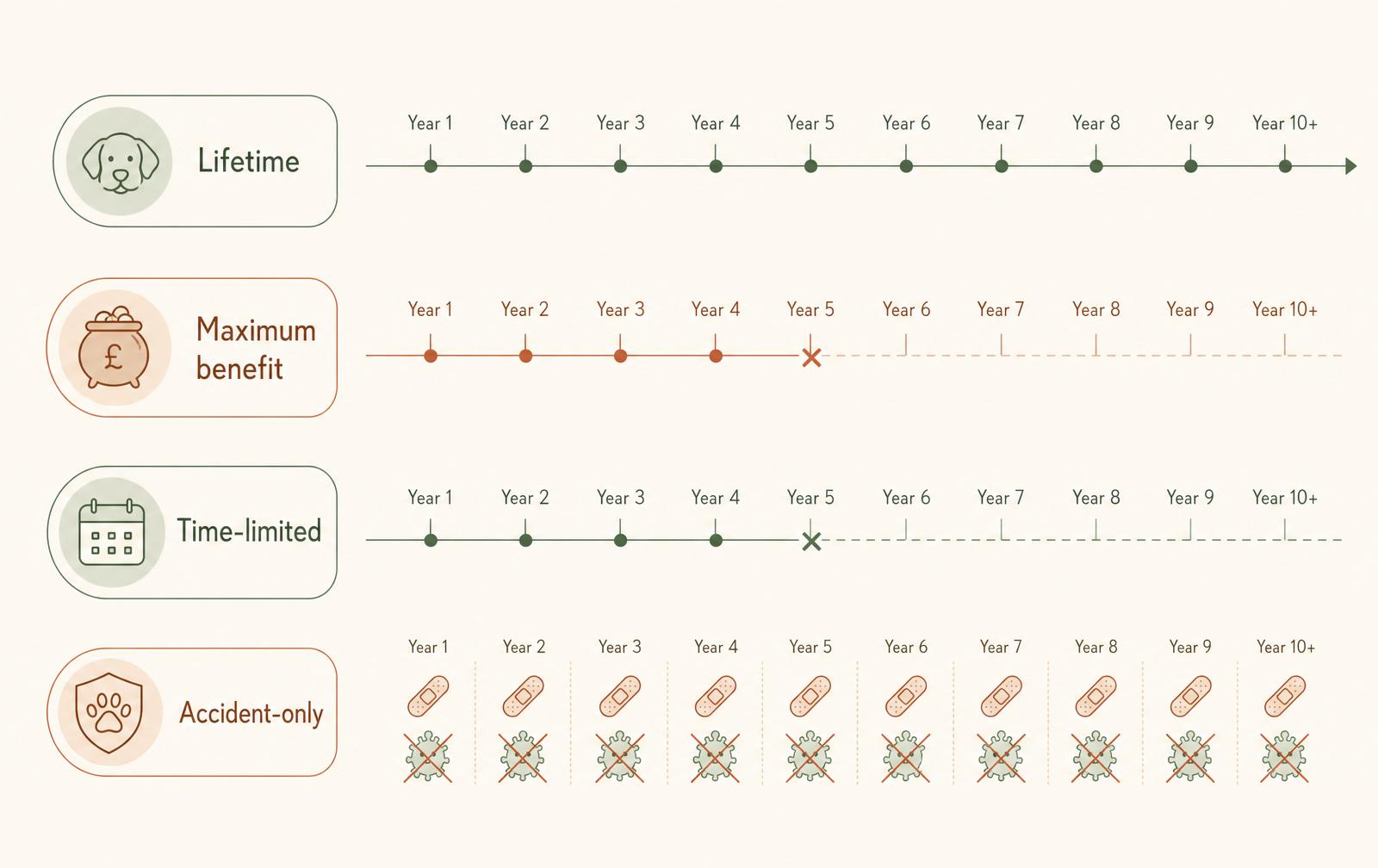
The problem is that the cheaper policies look like a bargain right up until your pet develops something chronic — arthritis, allergies, a heart condition — which is precisely when you most need cover to continue. A time-limited policy will pay for the first twelve months of arthritis and then exclude it for the rest of your dog's life, leaving you paying for the very thing you insured against.
This is why, if you insure at all, lifetime cover is almost always the type worth having. It costs more each month, often 30 to 70% more than time-limited cover, but it's the only kind that does what most people assume all pet insurance does.
Insure young, or don't bother
There's a reason insurers ask so little for a puppy or kitten and so much for an older pet. Premiums rise steeply with age, and, crucially, pre-existing conditions are almost never covered.
A pre-existing condition is any illness or injury your pet had before the policy began, or in some cases before a symptom-free waiting period. Once something is on your pet's record, no new policy will cover it. So the owner who waits until their dog is limping to take out insurance finds that the very thing prompting them to buy is the one thing excluded.
The practical rule follows plainly: if you're going to insure, do it while your pet is young and healthy, before there's anything to exclude. Insuring a middle-aged pet with a history is far less useful and far more expensive, and insuring after a diagnosis is often pointless for that condition.
The costs people don't read until it's too late
The monthly premium is the number everyone compares, and the least useful one to lead with. Three other figures determine whether a policy is actually good value.
The excess is what you pay towards each claim. A higher excess lowers your premium, which can be a sensible trade for a healthy pet, but check whether it's charged per condition per year or per visit. Per-visit excesses can quietly cost a fortune on an ongoing condition.
The co-payment is the trap worth naming loudly. Many policies add a percentage co-payment, often 10 to 25%, once your pet reaches a certain age, typically between five and eight. From then on you pay that share of every bill on top of the excess, exactly when your pet is getting older and claiming more. A policy can look cheap at four and become punishing at nine.
The annual limit is the ceiling on what you can claim in a year. A limit that looks generous can be swallowed by a single serious event, so for higher-risk pets a higher limit is usually worth the extra premium.
Read those three before the price. A cheap premium attached to a low limit, a per-visit excess and an age-triggered co-payment is not a bargain. It's a policy designed to look affordable and pay out little.
A quick word on smaller pets
Rabbits, and some other small animals, can be insured, and vet bills for them are real. But premiums relative to the typical cost of treatment mean many owners find a dedicated savings pot makes more sense than a policy. It's the same underlying question — could you cover a sudden bill — applied to a smaller scale. Worth a think rather than an automatic yes or no.
Before you commit
A short checklist worth running before you sign anything:
- Is it lifetime cover, or one of the cheaper types that will exclude a condition later?
- Does it have a co-payment, and at what age does it start?
- Is the excess per condition per year, or per visit?
- What's the annual limit, and would it survive one serious event?
- Are there waiting periods before you can claim?
- Is the insurer on the Financial Conduct Authority register? Every legitimate UK insurer is, and it's free to check.
The bottom line
Pet insurance isn't a scam and it isn't a must. It's a tool for one specific job: protecting you from a bill you couldn't otherwise absorb. If you could comfortably cover several thousand pounds tomorrow, saving instead is a fair choice. If you couldn't, insurance earns its place — but only if you buy the right kind.
Insure young, choose lifetime, and read the excess, co-payment and limit before the price. Do that, and you'll have made the decision on your terms, rather than the terms of whoever's selling.
This is general information to help you weigh up the decision, not personalised financial advice. Burrow isn't a financial adviser. For advice on your own circumstances, consider a regulated source, and always read a policy's full terms before buying.
Common questions
Frequently asked.
Keep reading
Further reading.
Want plain-English notes on pet health and the things that affect it? Join The Once-Over, our weekly note from Hazel.